Frontiers in Clinical Drug Research - Alzheimer Disorders is a book series concerned with Alzheimer's disease AD, a disease that causes dementia, or loss of brain function. This disease affects parts of the brain that affect memory, thought, and languag
- English
- ePUB (mobile friendly)
- Available on iOS & Android
eBook - ePub
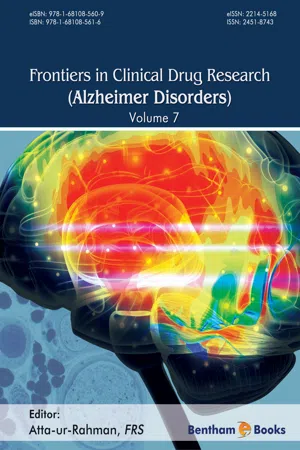
Frontiers in Clinical Drug Research - Alzheimer Disorders: Volume 7
About this book
Trusted by 375,005 students
Access to over 1.5 million titles for a fair monthly price.
Study more efficiently using our study tools.
Information
Topic
Physical SciencesSubtopic
Clinical ChemistryRecent Advances in Alzheimer's Drug Discovery Research
Xin-An Liu1, 6, *, Brati Das2, Youjun Chen3, Zuxin Chen4, Yosef Avchalumov1, Xu Tian5, Sathyanarayanan V. Puthanveettil1, *
1 Department of Neuroscience, The Scripps Research Institute, Jupiter, FL33458, USA
2 Department of Neuroscience, UConn Health, 263 Farmington Avenue, Farmington, CT 06030-3401, USA
3 Department of Neurology, School of Medicine, University of North Carolina at Chapel Hill, NC 27599, USA
4 Department of Neuroscience, Icahn School of Medicine at Mount Sinai, One Gustave L. Levy Place, New York, NY 10029-6574, USA
5 Department of Environmental Sciences and Engineering, School of Public Health, University of North Carolina at Chapel Hill, NC 27599, USA
6 Department of Neuroscience, Icahn School of Medicine at Mount Sinai, One Gustave L. Levy Place, NewYork, NY 10029-6574, USA
Abstract
Alzheimer’s disease (AD) is the most common cause of age-related dementia, a deleterious neurodegenerative disorder that impairs memory, where neuropathological changes develop gradually over years to affect cognitive functions. AD is one of the most important health-care problems with over 20 million people suffering worldwide and has become a critical issue to human health, especially in aging societies. Current treatments do not prevent, stop, or delay disease progression, despite the considerable advances in knowledge of the pathogenesis of AD and in medicinal chemistry over the past quarter of a century. The neuropathologic hallmarks of AD are extracellular senile plaques of aggregated β-amyloid and intracellular neurofibrillary tangles, mainly containing the hyperphosphorylated microtubule-associated protein tau. Additional changes that may also occur in the brains of AD patients include age-related brain atrophy, synaptic pathology, and neuron loss, which contribute to cognitive impairment. So far, only four cholinesterase inhibitors and memantine have been marketed as the therapeutic strategies for Alzheimer’s disease. Despite advancements in prevention strategies, potential targets, effective biomarkers, clinical development methods, and the evaluation of potential treatments in clinical trials. This chapter summarizes our best understanding of the etiology, animal models
currently under study, pharmacotherapeutic targets, and molecular pathways that curtail the progression of AD. This knowledge will help to strategize the development and clinical use of any new drugs for AD therapy in future.
Keywords: Alzheimer’s Disease, Drug Development, Pharmacotherapeutic Targets, Transgenic Models.
* Corresponding authors, Xin-An Liu: Department of Neuroscience, Icahn School of Medicine at Mount Sinai, One Gustave L. Levy Place, NewYork, NY 10029-6574, USA; Tel: 5615427758; E-mail: [email protected]; Sathyanarayanan V. Puthanveettil: Department of Neuroscience, The Scripps Research Institute, Jupiter, FL 33458, USA; Tel: 5612282243; Fax: 5612282249; E-mail: [email protected]
INTRODUCTION
The Prevalence of Alzheimer’s Disease from Epidemiological Studies and Public Health Impact
Alzheimer's disease is a fatal, progressive, degenerative brain disease that slowly destroys memory and thinking skills, often starting 5, 10 or even 20 years before symptoms appear. It is also the most common form of dementia worldwide and the top cause for disabilities in later life. According to 2017 Alzheimer’s Statistics, nearly 44 million people have Alzheimer’s or a related dementia around the world and an estimated 5.5 million Americans of all ages have Alzheimer's disease, in another words, one in 10 people age 65 and older (10 percent) has Alzheimer's dementia (Latest Facts & Figures Report from Alzheimer's Association). Alzheimer is most common in Western Europe and least prevalent in Sub-Saharan Africa (Alzheimer’s Disease International).
Of the 5.5 million Americans with Alzheimer's in 2017, an estimated 5.3 million are age 65 and older and approximately 200,000 individuals are under age 65 and have younger-onset Alzheimer's (early onset Alzheimer's) (Data from 2017 Alzheimer’s Disease facts and figures at alz.org). Further, AD is the sixth-leading cause of death in the United States and the fifth-leading cause of death among those aged 65 and older. Alzheimer’s care has become an overwhelming burden for society and families as the global cost of Alzheimer’s and dementia is estimated to be $605 billion, which is equivalent to 1% of the entire world’s gross domestic product. According to the data from Alzheimer’s Association, people with Alzheimer’s disease are hospitalized three times more often than people without Alzheimer’s, the caregivers have estimated $236 billion in additional health care costs of their own in 2016. These numbers will escalate rapidly in coming years. By 2030, it is estimated that there will be 74.7 million people with dementia, and the cost of caring these individuals could rise to some US$2 trillion [1]. By 2050, the number of people age 65 and older with Alzheimer's disease may nearly triple, barring the development of medical breakthroughs to prevent or cure the disease.
The etiology of Alzheimer disease, which is multi-faceted, other than older age and genetic susceptibility, remains unclear. In the past decade, large strides have been made towards a better understanding of the pathogenesis of AD for possible interventions to delay the course of disease. While AD is rare in young individuals, especially below age 60 years, mutations in known early-onset genes are reported to contribute to ~50% of early-onset cases [2]. Incidence of AD increases with age in all populations [3, 4] with annual incidence in US increasing from ~1% at ages 65-70 years, to 6–8% by age 85 years and up [5, 6]. Although aging is the primary risk factor for AD, there are many other risk factors that may affect the progression of AD. 1) Researches have shown that adults with Type 2 diabetes mellitus (T2D) have a higher risk of later developing Alzheimer's and neurodegeneration compared with healthy individuals [7] and T2D is associated with a progressive cognitive decline [8]. Some work has suggested that brain insulin resistance may be an early and common AD marker [9] a...
Table of contents
- Welcome
- Table of Contents
- Title
- BENTHAM SCIENCE PUBLISHERS LTD.
- PREFACE
- List of Contributors
- Deep Brain Stimulation in the Treatment of Alzheimer's disease
- ASS234: A New and Promising Anti-Alzheimer Agent
- Recent Advances in Alzheimer's Drug Discovery Research
- Alzheimer’s Disease and Proteasome: The Therapeutic Development and Management
- Alzheimer´s Disease: Fundamental Concepts, Novel Findings and Therapeutics Outcomes Coming from the Ca2+/cAMP Signalling Interaction
- Alzheimer's Disease: An Approach for Non-Pharmacological Therapies
- Past and Present Drug Development for Alzheimer's Disease
Frequently asked questions
Yes, you can cancel anytime from the Subscription tab in your account settings on the Perlego website. Your subscription will stay active until the end of your current billing period. Learn how to cancel your subscription
No, books cannot be downloaded as external files, such as PDFs, for use outside of Perlego. However, you can download books within the Perlego app for offline reading on mobile or tablet. Learn how to download books offline
Perlego offers two plans: Essential and Complete
- Essential is ideal for learners and professionals who enjoy exploring a wide range of subjects. Access the Essential Library with 800,000+ trusted titles and best-sellers across business, personal growth, and the humanities. Includes unlimited reading time and Standard Read Aloud voice.
- Complete: Perfect for advanced learners and researchers needing full, unrestricted access. Unlock 1.5M+ books across hundreds of subjects, including academic and specialized titles. The Complete Plan also includes advanced features like Premium Read Aloud and Research Assistant.
We are an online textbook subscription service, where you can get access to an entire online library for less than the price of a single book per month. With over 1.5 million books across 990+ topics, we’ve got you covered! Learn about our mission
Look out for the read-aloud symbol on your next book to see if you can listen to it. The read-aloud tool reads text aloud for you, highlighting the text as it is being read. You can pause it, speed it up and slow it down. Learn more about Read Aloud
Yes! You can use the Perlego app on both iOS and Android devices to read anytime, anywhere — even offline. Perfect for commutes or when you’re on the go.
Please note we cannot support devices running on iOS 13 and Android 7 or earlier. Learn more about using the app
Please note we cannot support devices running on iOS 13 and Android 7 or earlier. Learn more about using the app
Yes, you can access Frontiers in Clinical Drug Research - Alzheimer Disorders: Volume 7 by Atta-ur-Rahman in PDF and/or ePUB format, as well as other popular books in Physical Sciences & Clinical Chemistry. We have over 1.5 million books available in our catalogue for you to explore.