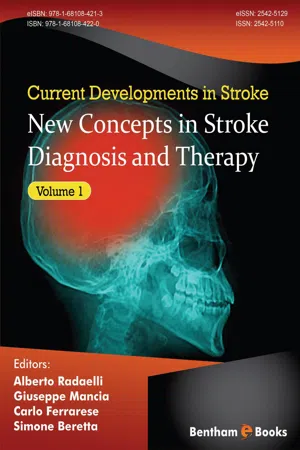
This volume presents a summary of recent research and debates on old and new aspects in stroke medicine. The volume covers topics such as causative factors of stroke such as hypertension, the immune system, genetic factors and the neurovegetative system, to the role of new imaging techniques in improving diagnosis and treatment, from preventive therapy and recanalization to the important and intriguing effects of neuroprotection, neuroregeneration and post stroke rehabilitation. Readers will be able to understand perspectives from stroke medicine researchers about the relationship between the nervous system and other physiological systems in the body and their role in the onset and treatment of stroke. The volume is intended as a resource for neurologists and medical professionals involved in other specialties such as cardiology, internal medicine, rehabilitation and physiology.
eBook - ePub
New Concepts in Stroke Diagnosis and Therapy
- English
- ePUB (mobile friendly)
- Available on iOS & Android
eBook - ePub
New Concepts in Stroke Diagnosis and Therapy
About this book
Information
Preface 1
Stroke prevention, diagnosis and therapy are all evolving fields that give us the idea of how in progress is the clinical job and the scientific work. Stroke in particular deserves a special mention as it is perceived both by patients and by physicians and it is one of the most feared and invalidating condition.
In this regard, every single step able to improve prevention, accelerate diagnosis and therapy is welcome and need to be rapidly shared with all the scientific community.
On the one hand, despite the stabilization of stroke events in civilized countries other emerging countries contribute to new events so keeping a high prevalence of stroke worldwide. In this regard, stroke prevention still represents one of the missing opportunities and the recognition and treatment of old and new risk factors are mandatory. On the other hand, imaging and therefore diagnosis and therapeutic opportunities are now available to treat faster than ever ischemic events in order to reduce overall cerebral damage and therefore disability. These new possibilities nevertheless should not remain restricted to few golden clinical and scientific realities but be rapidly shared and diffused to the emerging countries where the prevalence of stroke is growing.
This book aims to be an aid to the diffusion and discussion of what is new in the field and what are some of the new directions of prevention, diagnosis and therapy. At least, eighty five per cent of strokes are of ischemic origin and are therefore the results of a missed prevention in vascular atherosclerosis and thrombosis. This has always been a “cardiology” field. It is evident that a tighter cooperation between cardiologists and neurologists is needed in order to share expertise and to create more powerful tools to improve prevention, diagnosis and therapy of vascular events that involve in a similar dramatic way both the heart and the brain.
Dr. Alberto Radaelli
Director of the Division of Cardiac Rehabilitation,
San Gerardo Hospital,
Monza,
Italy
Director of the Division of Cardiac Rehabilitation,
San Gerardo Hospital,
Monza,
Italy
Preface 2
Only few decades ago stroke was considered a devastating condition with high mortality, high disability, without adequate prevention strategies, any tool to perform accurate diagnosis and consequently without any effective treatment available.
Scientific and technological advances in the last few years have dramatically changed the scenario: epidemiologic, genetic, imaging, biological and therapeutic advances have made it possible to effectively prevent strokes, to perform accurate differential diagnosis of stroke type and of location of vessel occlusion and new treatments for acute phase have recently demonstrated dramatic results.
In the context of this new scenario, new concepts for stroke diagnosis and therapy emerged, and this book specifically addresses this point.
Major experts and opinion leaders in respective fields extensively review and discuss new advances in the knowledge of the role of stroke risk factor for their prevention; new technological tools to perform in vivo imaging of cerebral collateral circulation and ischemic penumbra are widely described and their relevance for more accurate diagnosis and prognosis is discussed.
Diagnostic challenges in rare aethiologies of stroke are described in detail and new studies on recanalization and neuroprotection strategies are reported, with analysis of their impact on stroke health organization.
Finally, the hemorrhagic risk associated to older and new anticoagulants is discussed and new studies on stroke recovery are presented.
The reader of this new book may obtain a state-of-the-art knowledge of stroke diagnosis and treatment options to address the challenges of this severe, but now treatable disease.
Dr. Carlo Ferrarese,
Professor of Neurology. Director of the Department of Neurology,
San Gerardo Hospital,
University of Milano Bicocca,
Monza,
Italy
Professor of Neurology. Director of the Department of Neurology,
San Gerardo Hospital,
University of Milano Bicocca,
Monza,
Italy
List of Contributors
| Antonio Coca | Hypertension and Vascular Risk Unit. Department of Internal Medicine, Institute of Medicine and Dermatology, Hospital Clinic (IDIBAPS), University of Barcelona, Barcelona, Spain |
| Alberto Radaelli | Division of Cardiac Rehabilitation, San Gerardo Hospital, Monza, Italy |
| Alessandro Versace | Laboratory of Experimental Stroke Research, School of Medicine, University of Milano Bicocca, Monza, Italy |
| Anna Bersano | Cerebrovascular Unit, IRCCS Foundation Neurological Institute “C. Besta”, Via Celoria 11, Milan 20133, Italy |
| Antonio Vincenti | Electrophysiology Unit, Multimedica IRCCS Sesto San Giovanni, Milan, Italy |
| Barbara Casolla | NESMOS (Neuroscience Mental Healt and Sensory Organs) Department, School of Medicine and Psychology, Sapienza University, Rome, Italy |
| Carlo Ferrarese | Department of Neurology, Director of the Department of Neurology, San Gerardo Hospital, University of Milano Bicocca, Monza, Italy |
| Carole Frindel | Université de Lyon, CREATIS, CNRS UMR5220, Inserm U1206, INSA-Lyon, Université Claude Bernard Lyon 1, France |
| Cristina Sierra | Hypertension and Vascular Risk Unit. Department of Internal Medicine, Institute of Medicine and Dermatology, Hospital Clinic (IDIBAPS), University of Barcelona, Barcelona, Spain, |
| David Carone | Laboratory of Experimental Stroke Researc, School of Medicine, University of Milano-Bicocca, Monza, Italy Milan Center for Neuroscience (NeuroMi), Milan, Italy |
| David Rousseau | Université de Lyon, CREATIS, CNRS UMR5220, Inserm U1206, INSA-Lyon, Université Claude Bernard Lyon 1, France |
| Elio Clemente Agostoni | Department of Neuroscience, Neurology and Stroke Unit of the ASST: “Grande Ospedale Metropolitano Niguarda”, Milan, Italy |
| Elisa Cuccione | Laboratory of Experimental Stroke Research, School of Medicine, University of Milano Bicocca, Monza, Italy |
| Fausto De Angeli | Laboratory of Experimental Stroke Research, School of Medicine, University of Milano Bicocca, Monza, Italy |
| Francesco Orzi | NESMOS (Neuroscience Mental Health and Sensory Organs) Department, School of Medicine and Psichology, Sapienza University, Rome, Italy |
| Francesca Maria Salmeri | Department of Biomedical, Dental Sciences and Morphological and Functional Images, University of Messina, Messina, Italy |
| Giuseppe Mancia | University of Milano-Bicocca and IRCCS Istituto Auxologico Italiano, Milan, Italy |
| Gianvito Martino | Institute of Experimental Neurology, Division of Neuroscience, San Raffaele Scientific Institute, Via Olgettina 58, 20132 Milan, Italy |
| Giada Padovano | Laboratory of Experimental Stroke Research, School of Medicine, University of Milano Bicocca, Monza, Italy |
| Gianluca Luigi Russo | Institute of Experimental Neurology, Division of Neuroscience, San Raffaele Scientific Institute, Via Olgettina 58, 20132 Milan, Italy |
| Giuliano Sette | NESMOS (Neuroscience Mental Healt and Sensory Organs) Department, School of Medicine and Psichology, Sapienza University, Rome, Italy |
| Giulia Soraci | University of “La Cattolica Sacro Cuore”, Rome, Italy |
| Leandro Provinciali | Department of Experimental and Clinical Medicine, Neurological Section, Marche Polytechnic University, Ancona, Italy |
| Leslie Wenning | Department of Physiology, Pharmacology and Neuros... |
Table of contents
- Welcome
- Table of Contents
- Title
- BENTHAM SCIENCE PUBLISHERS LTD.
- Foreword
- Preface 1
- List of Contributors
- Stroke and Hypertension
- Autonomic Nervous System Dysfunction and Risk of Stroke
- Stroke and the Immune System: Therapeutic Targeting of Toll-Like Receptors
- Intracerebral Bleeding and Oral Anticoagulant Therapies: Clinical Relevance and Management
- Cerebral Collateral Circulation in Acute Ischemic Stroke: Translational Evidence for Outcome Prediction and Modulation Strategies
- Life in the Penumbra with the BRODERICK PROBE®
- On the Influence of Normalization Strategies for Perfusion MRI in Acute Stroke
- Genetic Causes of Ischemic Stroke
- Diagnostic Challenges: Cryptogenic Ischemic Stroke
- Emerging Concepts for Neuroprotection
- Pharmacological and Endovascular Recanalization Therapy
- Neuroregeneration after Stroke
- Post-Stroke Rehabilitation
Trusted by 375,005 students
Access to over 1.5 million titles for a fair monthly price.
Study more efficiently using our study tools.
Frequently asked questions
Yes, you can cancel anytime from the Subscription tab in your account settings on the Perlego website. Your subscription will stay active until the end of your current billing period. Learn how to cancel your subscription
No, books cannot be downloaded as external files, such as PDFs, for use outside of Perlego. However, you can download books within the Perlego app for offline reading on mobile or tablet. Learn how to download books offline
Perlego offers two plans: Essential and Complete
- Essential is ideal for learners and professionals who enjoy exploring a wide range of subjects. Access the Essential Library with 800,000+ trusted titles and best-sellers across business, personal growth, and the humanities. Includes unlimited reading time and Standard Read Aloud voice.
- Complete: Perfect for advanced learners and researchers needing full, unrestricted access. Unlock 1.5M+ books across hundreds of subjects, including academic and specialized titles. The Complete Plan also includes advanced features like Premium Read Aloud and Research Assistant.
We are an online textbook subscription service, where you can get access to an entire online library for less than the price of a single book per month. With over 1.5 million books across 990+ topics, we’ve got you covered! Learn about our mission
Look out for the read-aloud symbol on your next book to see if you can listen to it. The read-aloud tool reads text aloud for you, highlighting the text as it is being read. You can pause it, speed it up and slow it down. Learn more about Read Aloud
Yes! You can use the Perlego app on both iOS and Android devices to read anytime, anywhere — even offline. Perfect for commutes or when you’re on the go.
Please note we cannot support devices running on iOS 13 and Android 7 or earlier. Learn more about using the app
Please note we cannot support devices running on iOS 13 and Android 7 or earlier. Learn more about using the app
Yes, you can access New Concepts in Stroke Diagnosis and Therapy by Alberto Radaelli,Giuseppe Mancia,Carlo Ferrarese, Alberto Radaelli, Giuseppe Mancia, Carlo Ferrarese in PDF and/or ePUB format, as well as other popular books in Medicine & Neurology. We have over 1.5 million books available in our catalogue for you to explore.