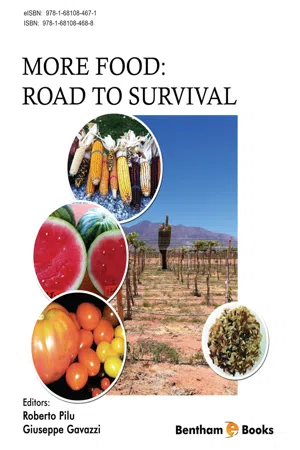
More Food: Road to Survival is a comprehensive analysis of agricultural improvements which can be achieved through scientific methods. This reference book gives information about strategies for increasing plant productivity, comparisons of agricultural models, the role of epigenetic events on crop production, yield enhancing physiological events (photosynthesis, germination, seedling emergence, seed properties, etc.), tools enabling efficient exploration of genetic variability, domestication of new species, the detection or induction of drought resistance and apomixes and plant breeding enhancement (through molecularly assisted breeding, genetic engineering, genome editing and next generation sequencing).
The book concludes with a case study for the improvement of small grain cereals. Readers will gain an understanding of the biotechnological tools and concepts central to sustainable agriculture
More Food: Road to Survival is, therefore, an ideal reference for agriculture students and researchers as well as professionals involved sustainability studies.
- English
- ePUB (mobile friendly)
- Available on iOS & Android
eBook - ePub
More Food: Road to Survival
About this book
Information
Genetic Strategies to Improve Resistance to Biotic Stresses in Plants
Stefano Sangiorgio1, Mario Motto2, *
1 Department of Agricultural and Environmental Sciences – Production, Landscapes, Agroenergy, Università degli Studi di Milano, Milano, Italy
2 Fondazione Istituto Tecnico Superiore per le nuove Tecnologie della Vita, Bergamo, Italy
Abstract
The long-term target of improving crops resistance to biotic stresses is a familiar goal for breeders. Plants ought to constantly protect themselves versus aggressions from a wide spectrum of organisms that include viruses, bacteria, oomycetes, fungi, insects and other herbivores, and weeds. In this chapter attention will be given to depict a picture on the genetic and molecular mechanisms that plants have promoted to recognize and react to invasion by numerous parasites (pathogens and pests). These topics include non-host resistance, constitutive barriers, and race-specific resistance. The chapter also examines current progresses in clarifying the structure and molecular devices developed by plants to neutralize pathogen and pest aggressions. Moreover, it takes a look with aspects experienced in breeding for resistance to relevant biotic stress factors. Major considerations in breeding for resistance to pathogens, insect pests, and weeds, traditional sources of resistance or other possible strategies, such as mutation breeding, genetic manipulations, and molecular strategies to develop crops more resistant to parasites are also explored.
Keywords: Defense mechanisms, Genetic basis of resistance, Pathogenesis related proteins, Signal transduction network, Transgenic plants.
* Corresponding author Mario Motto: Fondazione Istituto Tecnico Superiore per le nuove Tecnologie della Vita, Bergamo, Italy; Tel: +39 0350789106; Fax: +39 0350789107; E-mail: [email protected]
INTRODUCTION
Biotic stresses, the damage caused by plant pathogen, insect, and weed pests, have a negative impact on productivity of our crops by reducing yield and quality [1]. It is estimated that 35% of crop production, on a global scale, is annually lost to pre-harvest biotic stresses, with an additional 6 to 20% of losses due to post-harvest events [2]. A survey of the potential and actual yield injuries attributable to biotic constraints in important crop plants is shown in Table 1. This information indicate that there is remarkable deficit between potential and realized crop productions.
Table 1 Survey of deficit between potential and realized crop yields due to fungal and bacterial pathogens, viruses, animal pests, and weeds including the efficacy of the used pest control activities in various crops (e.g. maize, wheat, rice, barley, potatoes, soybean, sugar beet, and cotton). Modified from Oerke and Dehne [3].
| Pests and pathogens | |||||
|---|---|---|---|---|---|
| Fungi and bacteria | Viruses | Animal pests | Weeds | Total | |
| Loss potential(%)a | 14.9 | 3.1 | 17.6 | 31.8 | 67.4 |
| Actual losses (%)a | 9.9 | 2.7 | 10.1 | 9.4 | 32.0 |
| Efficacy(%)b | 33.8 | 12.9 | 42.4 | 70.6 | 52.5 |
Plant protection has a cardinal function in assuring crop yield performances against plant pathogens, animal pests, and weeds. This relationship is illustrated by a 15–20-fold annual increase in the volume of chemicals (pesticides) employed on a global scale [3]. However, plants are able to counteract parasite damages by several genetically inherited mechanisms, acting at the morphological, physiological, biochemical, cellular, and molecular levels. Therefore, the introduction of genetic resistance or tolerance into plants to the plethora of biotic stresses that severely damage our crops, is an important goal for scientists. Besides, this strategy has showed up relevant consequences for both growers and the seed and agrochemical industrial sectors [4]. Notably, genetically resistant or tolerant crops able to neutralize pest attacks have various benefits over the employment of pesticides or additional procedures to manage biotic stresses. These advantages are reflected by the following arguments: i) economic savings of the costs of pesticide treatments, ii) seed of resistant varieties generally costs to growers no more that the susceptible varieties, iii) although the resistance does not fully protect the crop, partial resistance may conduct to a sizeable decrease in the amount of pesticides needed to provide a tolerable control. Evidence suggests that these benefits depend on simple genetic stability, insignificant expenses after varieties are produced, and a remarkable effectiveness. The principal drawback of genetic resistance in plants to neutralize biotic stress factors is due to the issue that selection pressure is focused on parasite populations: the development of individuals with inherited mechanisms to breakdown plant resistance are favored within these populations. Thereby, it is obvious that this occurrence is restricting the temporal length of resistance performance in crops.
Typically, microbial organisms causing diseases are referred as pathogens, and herbivorous insects, mammals, and birds are termed pests. In this chapter we take a close look at the importance of genetic, biochemical, and molecular processes by which plants protect themselves from diseases and damages caused by plant
pathogens, insects, and weed pests. Additionally, breeding strategies devoted to the development of tolerant or resistant plants are also highlighted.
PLANT PATHOGENS
The many organisms that cause infectious diseases and damages in plants include fungi, oomycetes, bacteria, viruses, and nematodes. A comprehensive description of individual diseases and the methods used in their control is outside the objectives of this chapter. A number of books and reviews have been written in this field to which the reader is addressed for a more detailed illustration [5]. For the sake of brevity, specific pathogens or the diseases and damages they cause are herein mentioned without further explanation.
The main findings emerging from those publications that may worth noting indicate that:
- Several pathogens are specialized to growth on a specific plant species and cannot strike and produce disease in other plants. Others can devastate numerous, frequently unrelated, plant species. To exploit a distinct species as nutriment, a pathogen must be competent to defeat the species defense systems. Nearly all plant species are resistant to the majority of pathogens.
- Pathogens can enter into plants through several routes, such as direct penetra-tion via intact surfaces, entry via natural opening (e.g. stomata), or via oppor-tunist entry represented by existing wounds or cracks on the plant surface.
- After the pathogens have entered into the plant, three major colonization tactics are used by these organisms to take advantage of the host plant as a nutritional substrate for their growth and development. Essentially, either these organisms parasitize the vital plant to pick up nourishments (biotrophic lifestyle) or they destroy the plant tissues that are infected and use up nutrients from the non-longer alive tissues (necrotrophic lifestyle). Hemibiotrophs embrace both lifestyles, shifting from a biotrophic stage at the starting of the infection to a necrotrophic lifestyle as pathogenesis advances.
- Pathogenesis describes the series of phases concerning host and pathogen interaction (e.g. infection, colonization and plant pathogen reproduction) to the progress of the whole syndrome.
- Recent evidence indicates that fungal pathogen employed sex pheromone receptors for perceiving chemotropically host plant signals in an intricate environment medium like the soil [6].
- A pathogen race that induces disease is named virulent. Its favorable outcome may depend from different elements that include: i) very quick and elevated rate of reproduction throughout the central growing season for plants; ii) high performance dispersal system and long-standing survival ability; (iii) great effectiveness to induce genetic variability during haploid phase and successive sexual reproduction.
- Pathogens give raise to a variety of symptoms on infected plants. These symptoms are, from time to time, peculiar for a specific pathogen, permitting it to be detected by visible symptoms, although distinct pathogens can generate analogous effects. Symptoms of the diseases caused by the pathogens on plants result from various factors such as: disruption of respiratio...
Table of contents
- Welcome
- Table of Contents
- Title Page
- BENTHAM SCIENCE PUBLISHERS LTD.
- FOREWORD
- PREFACE
- List of Contributors
- The Yield in the Context of Industrial Versus Sustainable Agriculture
- Increasing Plant Breeding Efficiency through Evolutionary-Participatory Programs
- Genetic Tools for Crop Improvement: Past, Present, and Future
- Role of Epigenetics in Crop Improvement
- Enhancing Photosynthesis: Different Strategies to Improve the Process at the Basis of Life on Earth
- Seed Size: an Important Yield Component
- Genetic Variability as a Means to Improve Seedling Emergence and Early Developmental Phases in Crop Plants
- Natural Genetic Diversity and Crop Improvement
- Domestication of New Species
- Breeding for Drought Stress Resistance in Plants
- Genetic Strategies to Improve Resistance to Biotic Stresses in Plants
- Harnessing Apomixis to Improve Crops
- Molecular-Assisted Breeding
- Genetic Engineering for Crop Yield
- Plant Breeding and Next Generation Sequencing (NGS)
- Genome Editing in Crop Species
- Progress in Small Grain Cereals: A Case Study
Trusted by 375,005 students
Access to over 1.5 million titles for a fair monthly price.
Study more efficiently using our study tools.
Frequently asked questions
Yes, you can cancel anytime from the Subscription tab in your account settings on the Perlego website. Your subscription will stay active until the end of your current billing period. Learn how to cancel your subscription
No, books cannot be downloaded as external files, such as PDFs, for use outside of Perlego. However, you can download books within the Perlego app for offline reading on mobile or tablet. Learn how to download books offline
Perlego offers two plans: Essential and Complete
- Essential is ideal for learners and professionals who enjoy exploring a wide range of subjects. Access the Essential Library with 800,000+ trusted titles and best-sellers across business, personal growth, and the humanities. Includes unlimited reading time and Standard Read Aloud voice.
- Complete: Perfect for advanced learners and researchers needing full, unrestricted access. Unlock 1.5M+ books across hundreds of subjects, including academic and specialized titles. The Complete Plan also includes advanced features like Premium Read Aloud and Research Assistant.
We are an online textbook subscription service, where you can get access to an entire online library for less than the price of a single book per month. With over 1.5 million books across 990+ topics, we’ve got you covered! Learn about our mission
Look out for the read-aloud symbol on your next book to see if you can listen to it. The read-aloud tool reads text aloud for you, highlighting the text as it is being read. You can pause it, speed it up and slow it down. Learn more about Read Aloud
Yes! You can use the Perlego app on both iOS and Android devices to read anytime, anywhere — even offline. Perfect for commutes or when you’re on the go.
Please note we cannot support devices running on iOS 13 and Android 7 or earlier. Learn more about using the app
Please note we cannot support devices running on iOS 13 and Android 7 or earlier. Learn more about using the app
Yes, you can access More Food: Road to Survival by Roberto Pilu,Giuseppe Gavazzi, Roberto Pilu, Giuseppe Gavazzi in PDF and/or ePUB format, as well as other popular books in Technology & Engineering & Sustainable Agriculture. We have over 1.5 million books available in our catalogue for you to explore.