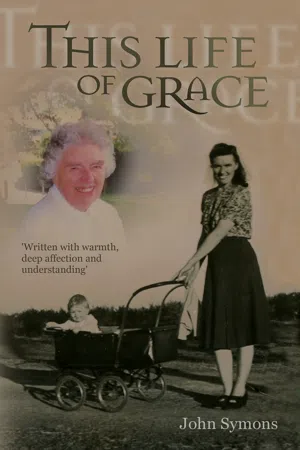
This Life of Grace is a biography and a history. It tells the story of Grace Jarrold, the youngest of eight children, who lived for almost ninety years in the village of Plympton in Devon. It also tells the story of the village over the last century, beginning with the Great War of 1914-1918, school life at that time as revealed in original documents, the building of 'homes fit for heroes' in the 1920s, and the General Strike of 1926. It describes the dwindling of the old 'upstairs-downstairs' life, the approach of the Second World War and the Blitz of Plymouth. After the tranquil period of fifteen years that followed the War, things changed at great speed. The influence of farming declined, leading to the closure of Plympton Market in 2002. The village grew to ten times its size at the time of Grace's birth and it was absorbed into the City of Plymouth. All the events are recorded as they affected local people.Grace is at the heart of the story, much of it told in her words, related remarkably to the author in frank conversations as she relived her life when it was drawing to its close, during almost three years in a hospital bed. The life of her husband, Major William John Symons, of the Indian Army, is told by the same author in Stranger on the Shore, published in 2009.In a pre-publication review, Peter Smith of Crane Books, writes, 'I liked This Life of Grace even more than Stranger, which I had found engrossing and very moving. This Life of Grace is written with such warmth and deep affection and understanding, bringing the characters vividly to life. Grace was a person of dignity and humility, an unusual combination, to which I felt a sense of eloquence, wit and humour should be added. She was very much a Grace.'
eBook - ePub
This Life Of Grace
About this book
Trusted by 375,005 students
Access to over 1.5 million titles for a fair monthly price.
Study more efficiently using our study tools.
Information
1
‘When you and I were seventeen’
IT WAS THERE from the beginning.
No one could tell how the story would end and no one would have wanted it to end as it did, but what was there from the beginning made the end possible and gave it its meaning.

Mum was born in October 1909 into a large, united family. Descended from generations of farm labourers and gamekeepers, her parents and many of her uncles and aunts had gone ‘into service’ as butlers and valets, cooks and maids during the sixty-three years of Queen Victoria’s reign.
Not long after King George V came to the throne in 1910, Mum’s family moved from Cornwall to Plymouth in south Devon. For a while, as an alternative to domestic service, her parents ran a sweet-shop, but they could not make it pay. Perhaps it was as a toddler, in the sweetshop, that Mum gained her life-long taste for liquorice and chocolate.
Two years later the family moved from the city to the village of Plympton St Mary, where Mum’s father once more earned his living as a butler.
‘The first thing I remember was being in the back lane of our row of houses, a bit lonely as all the other children had gone in a horse-and-wagon on the chapel outing to the seaside at Wembury,’ Mum told me.
‘My next memory was of one breakfast-time, jumping up when Mother was making my cocoa, knocking a kettle of water over my shoulders. All the family rushed around frantically trying to help poor Mother. The district nurse came and did my wound. I lay in a cot in the kitchen, being spoiled once more. Mother slept on a mattress on the floor by my cot for a few nights.’
Mum always looked at her parents through rose-tinted spectacles. ‘I can’t help doing it,’ she told me. But her memories contain nuggets that run counter to the way she wished to see things. The stories that she passed on reveal that she had a formidable power of recall and was an honest witness. Her memories have always proved to be accurate when it has been possible to check them.
Mum started school on the thirty-first of August 1914, one day short of four weeks after the First World War broke out, and two months before her fifth birthday.
‘Starting school was a shock to me, being the youngest of eight and a bit spoiled by the others. My sister Hilda was ten years older than me and had already left school. She took me to the baby school, called Bridge School in those days, at the foot of Station Hill. She told me to run home, and told Mother that she hadn’t been able to catch me. The next day Mother took me, and, very tearfully clutching a packet of chocolate drops, I was left with Mrs Bettes and Miss Blight…
‘Our house in Moorland View was lovely. A few weeks later at Christmas, it was filled with holly and ivy, and we just had stockings filled with simple presents, and oranges, apples, and nuts. We had a lovely Christmas dinner and Christmas pudding (set alight with brandy), with ten of us around the table. Two doors away lived my friend, Edie Law, and we always had a good Christmas, with our dolls and toys…
‘We had baths on Saturdays in a tin bath in front of the kitchen fire; there was no bathroom there. After the bath we had sweets.’
Sixty years later, out of the blue, Edie Law visited Mum.
‘Yesterday was a strange day. I answered the doorbell. A lady and a gentleman stood there, and the lady said, “Can you tell us where to find 14 Moorland View where I used to live?” I gave a shout, “Edie Law!” and she said, “Grace Jarrold!” We had not met for sixty years. She was my playmate. They came in and had cups of tea and coconut buns (I didn’t have anything else). They stayed two and a half hours and we talked the hind leg off a donkey, about all the games that we played and of the people we knew. They live in Bristol. Edie’s husband was tickled pink at our meeting. It was very funny after all those years.’
Another of Mum’s friends in Moorland View was Edie Paul. At school Edie was a lively pupil. Like her brother Bill, Edie had the bluest eyes that Mum ever saw. Once, the teacher tried to get her to concentrate, saying ‘Edith Paul, put on your thinking-cap.’ Edie replied, ‘I can’t, Miss; I’ve only got my ’shanter’.
During Mum’s first years at school her two eldest brothers were in the Army, serving in France.
‘I remember Mother crying when Harry and Jack went to war. When they came back from the front on leave their uniforms were filthy from the mud of the trenches and full of fleas. Mother used matches to get the fleas to jump out of the serge; the cloth was so thick and that was the only way to get rid of them.’
After the United States entered the Great War two Americans were billeted with her family for several months in late 1917 and 1918. Mum was frightened of them because they used to play boisterously with her, throwing her up into the air and catching her. ‘Yanks’, as she often called them, rather fondly, always amused her by their ‘exuberance’, a favourite word of hers.
Food was short. According to the log-book kept by the headmaster of the senior school, called Geasons, his staff and pupils used to grow an annual crop of potatoes during the War and for a good few years after it, partly for food and partly to teach the children how to work a vegetable garden. The area under cultivation at the school in 1917 was seven and three quarter roods, a plot that amounts to almost two acres. In the spring of that year Geasons’ staff and pupils planted a hundredweight of seed potatoes.
A series of small events and treats marked the passing of each term. In the late spring and summer months the parish church of St Mary, and the Wesleyan and Congregationalist chapels in Ridgeway, as the high street was called, used to organise teas and outings for the children of the village. On those days the schools would be closed.
Not far from the school stood Hillside House where General and Mrs Birdwood lived for many years. They offered Geasons great support. In early summer each year they gave a tea party for the children in their large garden, with its forest of shrubs and rhododendrons. The wisteria would be in full bloom, covering the south front of the house.
Mr Baple, the energetic new headmaster, recorded in his log-book on the morning of Empire Day, the 24th of May 1917, that ‘Suitable lessons were given and General Birdwood gave a brief address to the children on “The Empire and the Flag”.’ In the words of the writer of a recent textbook,* ‘The British Empire… stretches over the whole globe… The sun never sets or rises over the British dominions… It would be perfectly possible to put round the earth a girdle of telegraphic wire, the ends of which should rest only upon land that belongs to the British Empire.’ Another recent popular history for children told ‘Our Empire Story’.†
The pride felt in our country’s history and achievements was combined with humour and a sense of proportion. On the same day that General Birdwood gave the pupils his talk on the Empire, Mr Baple noted in his log that there was ‘a small attendance of children in the afternoon, a circus being in Plympton’.
The following year on St George’s Day, the twenty-third of April, there were lessons ‘suitable to the day’. A collection in the school raised £1 0s 3d, for the RSPCA’s fund for horses wounded in the War.
Plympton St Mary was a loyal, quiet village. It was home to three or four thousand people, including those living in the neighbouring smaller villages of Plympton St Maurice and Colebrook and in the outlying hamlets. There was a spirit of patriotism in the village and school, and of long-suffering, stoical humanity and realism, with modest pleasures and no luxuries.
The village was typical of thousands across the country. That the people of our country were once so gentle and patient, so hardy and decent, so reasonable and free, facing together so many hardships, can hardly be believed by anyone born after 1950, but so it was.
Even those on the fringes of society in Mum’s childhood seemed to share in this powerful ideal as much as anyone else.
Tramps were sometimes seen passing through Plympton on the main road between Exeter and Plymouth. Without irony, they were known as ‘gentlemen of the road’. One of them regularly called on Mum’s family. Her mother would give him tea, some food to take on his way and a pair of boots saved up for his visit. Sitting at the kitchen table, he used to tell Mum and her mother of his adventures on his long walk between John o’Groats and Land’s End. Even when she was elderly, perhaps partly as a result of this friendship, which lasted for many years, Mum used to carry some loose change with her in her mackintosh pocket in case she met a tramp ‘in need of a cup of tea’.
Old-fashioned gipsy caravans sometimes visited the village. Once in a while they made an encampment in the field beside the Tory Brook, between St Mary’s church and the livestock market. Fascinated by the sight, the village children watched them cooking on their camp-fires and putting their children to bed under the stars. When one of the gipsies died, he was sent on his way by a large congregation at a funeral service in St Mary’s.
In the autumn of 1918 as the Great War was coming to its end, an influenza epidemic (known as ‘Spanish ’flu’) began to rage in the country. In Plympton only sixty per cent of the children were able to attend school on some days. At the end of October and in early November Mr Baple closed the school completely for a fortnight. One boy, Robert Parsons, died. The pupils brought in their pennies for a wreath; £1 6s 11d was collected. Later they made a contribution to the costs of his funeral.
The following summer, in mid-July, the school held a special celebration to mark the return of peace. Mum won a prize in the sports which took place in Geasons field. The next day, according to Mr Baple’s notes, ‘the cake remaining from the festivities was distributed among the children’. Mum’s family had a photograph taken of them all gathered together in their back-garden.
‘At the King’s express desire’, the midsummer holiday was extended from four to five weeks that year. The country, including the children, could begin to breathe more easily for a while.
That summer Mum’s brother, Walter, three years her senior, won a scholarship to Corporation Grammar School at North Road in Plymouth.* He was a clever boy, and the first in the family to go to a grammar school. The family had just enough money to pay for the uniform and books that he needed. Mum’s father was working as the butler at Newnham House, a mile outside the village. He earned 23 shillings a week (£1 15p). Apart from Wally, Mum’s brothers and sisters were by now in work.
In September Wally took up his scholarship. Mum moved up the hill from Bridge School to Geasons. There were about three hundred children at the school, 135 of them boys and 154 girls.
Mum’s family bought her new clothes for the move to the senior school: a warm winter coat, a hat and gloves, and leather lace-up boots. Winters were usually severe and long, and Mum always suffered from chilblains.
‘I remember going up to the Big School. I really loved it when I got used to it, especially when I got older, although I went up the hill from the baby school shaking in my shoes on the first day.’
At the end of October the pupils subscribed £1 2s 10d for a portrait of Nurse Edith Cavell. The matron of a hospital in Brussels at the start of the War, Nurse Cavell had become a popular heroine. She had risked her life by helping two hundred British and Allied soldiers to escape to The Netherlands after the German army occupied Belgium in 1914. She was executed by the Germans in 1915. Her picture was placed in the school’s main assembly room.
On the eleventh of November 1919, the first national commemoration of the anniversary of the Armistice, Mr Baple wrote in his diary: ‘An Assembly was held in the Schoolroom, in accordance with the King’s desire. Silence at 11am for a few minutes; then an address on the subject of the day – the Armistice, its results, the League of Nations, etc. School closed in the afternoon’.
At the end of the winter, in early 1920, Bridge and Geasons Schools were in...
Table of contents
- Cover
- Halftitle
- Title
- Copyright
- Dedication
- Citation
- Contents
- Prologue
- PART ONE
- PART TWO
- PART THREE
- Epilogue … the means of grace and the hope of glory …
Frequently asked questions
Yes, you can cancel anytime from the Subscription tab in your account settings on the Perlego website. Your subscription will stay active until the end of your current billing period. Learn how to cancel your subscription
No, books cannot be downloaded as external files, such as PDFs, for use outside of Perlego. However, you can download books within the Perlego app for offline reading on mobile or tablet. Learn how to download books offline
Perlego offers two plans: Essential and Complete
- Essential is ideal for learners and professionals who enjoy exploring a wide range of subjects. Access the Essential Library with 800,000+ trusted titles and best-sellers across business, personal growth, and the humanities. Includes unlimited reading time and Standard Read Aloud voice.
- Complete: Perfect for advanced learners and researchers needing full, unrestricted access. Unlock 1.5M+ books across hundreds of subjects, including academic and specialized titles. The Complete Plan also includes advanced features like Premium Read Aloud and Research Assistant.
We are an online textbook subscription service, where you can get access to an entire online library for less than the price of a single book per month. With over 1.5 million books across 990+ topics, we’ve got you covered! Learn about our mission
Look out for the read-aloud symbol on your next book to see if you can listen to it. The read-aloud tool reads text aloud for you, highlighting the text as it is being read. You can pause it, speed it up and slow it down. Learn more about Read Aloud
Yes! You can use the Perlego app on both iOS and Android devices to read anytime, anywhere — even offline. Perfect for commutes or when you’re on the go.
Please note we cannot support devices running on iOS 13 and Android 7 or earlier. Learn more about using the app
Please note we cannot support devices running on iOS 13 and Android 7 or earlier. Learn more about using the app
Yes, you can access This Life Of Grace by John Symons in PDF and/or ePUB format, as well as other popular books in Sozialwissenschaften & Sozialwissenschaftliche Biographien. We have over 1.5 million books available in our catalogue for you to explore.