![]()
CHAPTER 1. Sun and Shadow
Thirty years ago, Marseilles lay burning in the sun, one day.
A blazing sun upon a fierce August day was no greater rarity in southern France then, than at any other time, before or since. Everything in Marseilles, and about Marseilles, had stared at the fervid sky, and been stared at in return, until a staring habit had become universal there. Strangers were stared out of countenance by staring white houses, staring white walls, staring white streets, staring tracts of arid road, staring hills from which verdure was burnt away. The only things to be seen not fixedly staring and glaring were the vines drooping under their load of grapes. These did occasionally wink a little, as the hot air barely moved their faint leaves.
There was no wind to make a ripple on the foul water within the harbour, or on the beautiful sea without. The line of demarcation between the two colours, black and blue, showed the point which the pure sea would not pass; but it lay as quiet as the abominable pool, with which it never mixed. Boats without awnings were too hot to touch; ships blistered at their moorings; the stones of the quays had not cooled, night or day, for months. Hindoos, Russians, Chinese, Spaniards, Portuguese, Englishmen, Frenchmen, Genoese, Neapolitans, Venetians, Greeks, Turks, descendants from all the builders of Babel, come to trade at Marseilles, sought the shade alike — taking refuge in any hiding-place from a sea too intensely blue to be looked at, and a sky of purple, set with one great flaming jewel of fire.
The universal stare made the eyes ache. Towards the distant line of Italian coast, indeed, it was a little relieved by light clouds of mist, slowly rising from the evaporation of the sea, but it softened nowhere else. Far away the staring roads, deep in dust, stared from the hill-side, stared from the hollow, stared from the interminable plain. Far away the dusty vines overhanging wayside cottages, and the monotonous wayside avenues of parched trees without shade, drooped beneath the stare of earth and sky. So did the horses with drowsy bells, in long files of carts, creeping slowly towards the interior; so did their recumbent drivers, when they were awake, which rarely happened; so did the exhausted labourers in the fields. Everything that lived or grew, was oppressed by the glare; except the lizard, passing swiftly over rough stone walls, and the cicala, chirping his dry hot chirp, like a rattle. The very dust was scorched brown, and something quivered in the atmosphere as if the air itself were panting.
Blinds, shutters, curtains, awnings, were all closed and drawn to keep out the stare. Grant it but a chink or keyhole, and it shot in like a white-hot arrow. The churches were the freest from it. To come out of the twilight of pillars and arches — dreamily dotted with winking lamps, dreamily peopled with ugly old shadows piously dozing, spitting, and begging — was to plunge into a fiery river, and swim for life to the nearest strip of shade. So, with people lounging and lying wherever shade was, with but little hum of tongues or barking of dogs, with occasional jangling of discordant church bells and rattling of vicious drums, Marseilles, a fact to be strongly smelt and tasted, lay broiling in the sun one day.
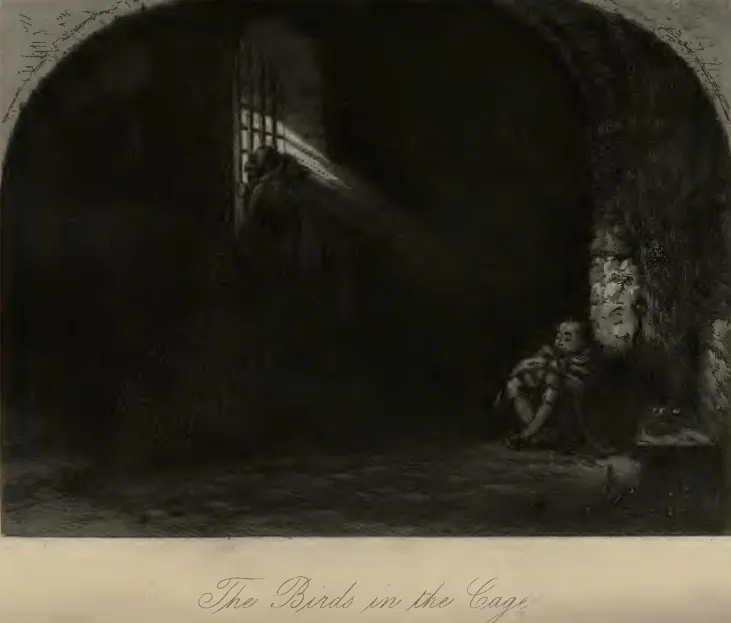
In Marseilles that day there was a villainous prison. In one of its chambers, so repulsive a place that even the obtrusive stare blinked at it, and left it to such refuse of reflected light as it could find for itself, were two men. Besides the two men, a notched and disfigured bench, immovable from the wall, with a draught-board rudely hacked upon it with a knife, a set of draughts, made of old buttons and soup bones, a set of dominoes, two mats, and two or three wine bottles. That was all the chamber held, exclusive of rats and other unseen vermin, in addition to the seen vermin, the two men.
It received such light as it got through a grating of iron bars fashioned like a pretty large window, by means of which it could be always inspected from the gloomy staircase on which the grating gave. There was a broad strong ledge of stone to this grating where the bottom of it was let into the masonry, three or four feet above the ground. Upon it, one of the two men lolled, half sitting and half lying, with his knees drawn up, and his feet and shoulders planted against the opposite sides of the aperture. The bars were wide enough apart to admit of his thrusting his arm through to the elbow; and so he held on negligently, for his greater ease.
A prison taint was on everything there. The imprisoned air, the imprisoned light, the imprisoned damps, the imprisoned men, were all deteriorated by confinement. As the captive men were faded and haggard, so the iron was rusty, the stone was slimy, the wood was rotten, the air was faint, the light was dim. Like a well, like a vault, like a tomb, the prison had no knowledge of the brightness outside, and would have kept its polluted atmosphere intact in one of the spice islands of the Indian ocean.
The man who lay on the ledge of the grating was even chilled. He jerked his great cloak more heavily upon him by an impatient movement of one shoulder, and growled, ‘To the devil with this Brigand of a Sun that never shines in here!’
He was waiting to be fed, looking sideways through the bars that he might see the further down the stairs, with much of the expression of a wild beast in similar expectation. But his eyes, too close together, were not so nobly set in his head as those of the king of beasts are in his, and they were sharp rather than bright — pointed weapons with little surface to betray them. They had no depth or change; they glittered, and they opened and shut. So far, and waiving their use to himself, a clockmaker could have made a better pair. He had a hook nose, handsome after its kind, but too high between the eyes by probably just as much as his eyes were too near to one another. For the rest, he was large and tall in frame, had thin lips, where his thick moustache showed them at all, and a quantity of dry hair, of no definable colour, in its shaggy state, but shot with red. The hand with which he held the grating (seamed all over the back with ugly scratches newly healed), was unusually small and plump; would have been unusually white but for the prison grime.
The other man was lying on the stone floor, covered with a coarse brown coat.
‘Get up, pig!’ growled the first. ‘Don’t sleep when I am hungry.’
‘It’s all one, master,’ said the pig, in a submissive manner, and not without cheerfulness; ‘I can wake when I will, I can sleep when I will. It’s all the same.’
As he said it, he rose, shook himself, scratched himself, tied his brown coat loosely round his neck by the sleeves (he had previously used it as a coverlet), and sat down upon the pavement yawning, with his back against the wall opposite to the grating.
‘Say what the hour is,’ grumbled the first man.
‘The mid-day bells will ring — in forty minutes.’ When he made the little pause, he had looked round the prison-room, as if for certain information.
‘You are a clock. How is it that you always know?’
‘How can I say? I always know what the hour is, and where I am. I was brought in here at night, and out of a boat, but I know where I am. See here! Marseilles harbour;’ on his knees on the pavement, mapping it all out with a swarthy forefinger; ‘Toulon (where the galleys are), Spain over there, Algiers over there. Creeping away to the left here, Nice. Round by the Cornice to Genoa. Genoa Mole and Harbour. Quarantine Ground. City there; terrace gardens blushing with the bella donna. Here, Porto Fino. Stand out for Leghorn. Out again for Civita Vecchia, so away to — hey! there’s no room for Naples;’ he had got to the wall by this time; ‘but it’s all one; it’s in there!’
He remained on his knees, looking up at his fellow-prisoner with a lively look for a prison. A sunburnt, quick, lithe, little man, though rather thickset. Earrings in his brown ears, white teeth lighting up his grotesque brown face, intensely black hair clustering about his brown throat, a ragged red shirt open at his brown breast. Loose, seaman-like trousers, decent shoes, a long red cap, a red sash round his waist, and a knife in it.
‘Judge if I come back from Naples as I went! See here, my master! Civita Vecchia, Leghorn, Porto Fino, Genoa, Cornice, Off Nice (which is in there), Marseilles, you and me. The apartment of the jailer and his keys is where I put this thumb; and here at my wrist they keep the national razor in its case — the guillotine locked up.’
The other man spat suddenly on the pavement, and gurgled in his throat.
Some lock below gurgled in its throat immediately afterwards, and then a door crashed. Slow steps began ascending the stairs; the prattle of a sweet little voice mingled with the noise they made; and the prison-keeper appeared carrying his daughter, three or four years old, and a basket.
‘How goes the world this forenoon, gentlemen? My little one, you see, going round with me to have a peep at her father’s birds. Fie, then! Look at the birds, my pretty, look at the birds.’
He looked sharply at the birds himself, as he held the child up at the grate, especially at the little bird, whose activity he seemed to mistrust. ‘I have brought your bread, Signor John Baptist,’ said he (they all spoke in French, but the little man was an Italian); ‘and if I might recommend you not to game—’
‘You don’t recommend the master!’ said John Baptist, showing his teeth as he smiled.
‘Oh! but the master wins,’ returned the jailer, with a passing look of no particular liking at the other man, ‘and you lose. It’s quite another thing. You get husky bread and sour drink by it; and he gets sausage of Lyons, veal in savoury jelly, white bread, strachino cheese, and good wine by it. Look at the birds, my pretty!’
‘Poor birds!’ said the child.
The fair little face, touched with divine compassion, as it peeped shrinkingly through the grate, was like an angel’s in the prison. John Baptist rose and moved towards it, as if it had a good attraction for him. The other bird remained as before, except for an impatient glance at the basket.
‘Stay!’ said the jailer, putting his little daughter on the outer ledge of the grate, ‘she shall feed the birds. This big loaf is for Signor John Baptist. We must break it to get it through into the cage. So, there’s a tame bird to kiss the little hand! This sausage in a vine leaf is for Monsieur Rigaud. Again — this veal in savoury jelly is for Monsieur Rigaud. Again — these three white little loaves are for Monsieur Rigaud. Again, this cheese — again, this wine — again, this tobacco — all for Monsieur Rigaud. Lucky bird!’
The child put all these things between the bars into the soft, Smooth, well-shaped hand, with evident dread — more than once drawing back her own and looking at the man with her fair brow roughened into an expression half of fright and half of anger. Whereas she had put the lump of coarse bread into the swart, scaled, knotted hands of John Baptist (who had scarcely as much nail on his eight fingers and two thumbs as would have made out one for Monsieur Rigaud), with ready confidence; and, when he kissed her hand, had herself passed it caressingly over his face. Monsieur Rigaud, indifferent to this distinction, propitiated the father by laughing and nodding at the daughter as often as she gave him anything; and, so soon as he had all his viands about him in convenient nooks of the ledge on which he rested, began to eat with an appetite.
When Monsieur Rigaud laughed, a change took place in his face, that was more remarkable than prepossessing. His moustache went up under his nose, and his nose came down over his moustache, in a very sinister and cruel manner.
‘There!’ said the jailer, turning his basket upside down to beat the crumbs out, ‘I have expended all the money I received; here is the note of it, and that’s a thing accomplished. Monsieur Rigaud, as I expected yesterday, the President will look for the pleasure of your society at an hour after mid-day, to-day.’
‘To try me, eh?’ said Rigaud, pausing, knife in hand and morsel in mouth.
‘You have said it. To try you.’
‘There is no news for me?’ asked John Baptist, who had begun, contentedly, to munch his bread.
The jailer shrugged his shoulders.
‘Lady of mine! Am I to lie here all my life, my father?’
‘What do I know!’ cried the jailer, turning upon him with southern quickness, and gesticulating with both his hands and all his fingers, as if he were threatening to tear him to pieces. ‘My friend, how is it possible for me to tell how long you are to lie here? What do I know, John Baptist Cavalletto? Death of my life! There are prisoners here sometimes, who are not in such a devil ...