![]()
CHAPTER I: THE CONTRAST
Look here upon this picture, and on this,
The counterfeit presentment of two brothers.
HAMLET
The latter part of the fifteenth century prepared a train of future events that ended by raising France to that state of formidable power which has ever since been from time to time the principal object of jealousy to the other European nations. Before that period she had to struggle for her very existence with the English already possessed of her fairest provinces while the utmost exertions of her King, and the gallantry of her people, could scarcely protect the remainder from a foreign yoke. Nor was this her sole danger. The princes who possessed the grand fiefs of the crown, and, in particular, the Dukes of Burgundy and Bretagne, had come to wear their feudal bonds so lightly that they had no scruple in lifting the standard against their liege and sovereign lord, the King of France, on the slightest pretence. When at peace, they reigned as absolute princes in their own provinces; and the House of Burgundy, possessed of the district so called, together with the fairest and richest part of Flanders, was itself so wealthy, and so powerful, as to yield nothing to the crown, either in splendour or in strength.
In imitation of the grand feudatories, each inferior vassal of the crown assumed as much independence as his distance from the sovereign power, the extent of his fief, or the strength of his chateau enabled him to maintain; and these petty tyrants, no longer amenable to the exercise of the law, perpetrated with impunity the wildest excesses of fantastic oppression and cruelty. In Auvergne alone, a report was made of more than three hundred of these independent nobles, to whom incest, murder, and rapine were the most ordinary and familiar actions.
Besides these evils, another, springing out of the long continued wars betwixt the French and English, added no small misery to this distracted kingdom. Numerous bodies of soldiers, collected into bands, under officers chosen by themselves, from among the bravest and most successful adventurers, had been formed in various parts of France out of the refuse of all other countries. These hireling combatants sold their swords for a time to the best bidder; and, when such service was not to be had, they made war on their own account, seizing castles and towers, which they used as the places of their retreat, making prisoners, and ransoming them, exacting tribute from the open villages and the country around them — and acquiring, by every species of rapine, the appropriate epithets of Tondeurs and Ecorcheurs, that is, Clippers and Flayers.
In the midst of the horrors and miseries arising from so distracted a state of public affairs, reckless and profuse expense distinguished the courts of the lesser nobles, as well as of the superior princes; and their dependents, in imitation, expended in rude but magnificent display the wealth which they extorted from the people. A tone of romantic and chivalrous gallantry (which, however, was often disgraced by unbounded license) characterized the intercourse between the sexes; and the language of knight errantry was yet used, and its observances followed, though the pure spirit of honourable love and benevolent enterprise which it inculcates had ceased to qualify and atone for its extravagances. The jousts and tournaments, the entertainments and revels, which each petty court displayed, invited to France every wandering adventurer; and it was seldom that, when arrived there, he failed to employ his rash courage, and headlong spirit of enterprise, in actions for which his happier native country afforded no free stage.
At this period, and as if to save this fair realm from the various woes with which it was menaced, the tottering throne was ascended by Louis XI, whose character, evil as it was in itself, met, combated, and in a great degree neutralized the mischiefs of the time — as poisons of opposing qualities are said, in ancient books of medicine, to have the power of counteracting each other.
Brave enough for every useful and political purpose, Louis had not a spark of that romantic valour, or of the pride generally associated with it, which fought on for the point of honour, when the point of utility had been long gained. Calm, crafty, and profoundly attentive to his own interest, he made every sacrifice, both of pride and passion, which could interfere with it. He was careful in disguising his real sentiments and purposes from all who approached him, and frequently used the expressions, “that the king knew not how to reign, who knew not how to dissemble; and that, for himself, if he thought his very cap knew his secrets, he would throw it into the fire.” No man of his own, or of any other time, better understood how to avail himself of the frailties of others, and when to avoid giving any advantage by the untimely indulgence of his own.
He was by nature vindictive and cruel, even to the extent of finding pleasure in the frequent executions which he commanded. But, as no touch of mercy ever induced him to spare, when he could with safety condemn, so no sentiment of vengeance ever stimulated him to a premature violence. He seldom sprang on his prey till it was fairly within his grasp, and till all hope of rescue was vain; and his movements were so studiously disguised, that his success was generally what first announced to the world the object he had been manoeuvring to attain.
In like manner, the avarice of Louis gave way to apparent profusion, when it was necessary to bribe the favourite or minister of a rival prince for averting any impending attack, or to break up any alliance confederated against him. He was fond of license and pleasure; but neither beauty nor the chase, though both were ruling passions, ever withdrew him from the most regular attendance to public business and the affairs of his kingdom. His knowledge of mankind was profound, and he had sought it in the private walks of life, in which he often personally mingled; and, though naturally proud and haughty, he hesitated not, with an inattention to the arbitrary divisions of society which was then thought something portentously unnatural, to raise from the lowest rank men whom he employed on the most important duties, and knew so well how to choose them, that he was rarely disappointed in their qualities. Yet there were contradictions in the character of this artful and able monarch; for human nature is rarely uniform. Himself the most false and insincere of mankind, some of the greatest errors of his life arose from too rash a confidence in the honour and integrity of others. When these errors took place, they seem to have arisen from an over refined system of policy, which induced Louis to assume the appearance of undoubting confidence in those whom it was his object to overreach; for, in his general conduct, he was as jealous and suspicious as any tyrant who ever breathed.
Two other points may be noticed to complete the sketch of this formidable character, by which he rose among the rude, chivalrous sovereigns of the period to the rank of a keeper among wild beasts, who, by superior wisdom and policy, by distribution of food, and some discipline by blows, comes finally to predominate over those who, if unsubjected by his arts, would by main strength have torn him to pieces.
The first of these attributes was Louis’s excessive superstition, a plague with which Heaven often afflicts those who refuse to listen to the dictates of religion. The remorse arising from his evil actions Louis never endeavoured to appease by any relaxation in his Machiavellian stratagems [on account of the alleged political immorality of Machiavelli, an illustrious Italian of the sixteenth century, this expression has come to mean “destitute of political morality; habitually using duplicity and bad faith.” Cent. Dict.], but laboured in vain to soothe and silence that painful feeling by superstitious observances, severe penance, and profuse gifts to the ecclesiastics. The second property, with which the first is sometimes found strangely united, was a disposition to low pleasures and obscure debauchery. The wisest, or at least the most crafty sovereign of his time, he was fond of low life, and, being himself a man of wit, enjoyed the jests and repartees of social conversation more than could have been expected from other points of his character. He even mingled in the comic adventures of obscure intrigue, with a freedom little consistent with the habitual and guarded jealousy of his character, and he was so fond of this species of humble gallantry, that he caused a number of its gay and licentious anecdotes to be enrolled in a collection well known to book collectors, in whose eyes (and the work is unfit for any other) the right edition is very precious.
[This editio princeps, which, when in good preservation, is much sought after by connoisseurs, is entitled Les Cent Nouvelles Nouvelles, contenant Cent Histoires Nouveaux, qui sont moult plaisans a raconter en toutes bonnes compagnies par maniere de joyeuxete. Paris, Antoine Verard. Sans date d’annee d’impression; en folio gotique. See De Bure. S]
By means of this monarch’s powerful and prudent, though most unamiable character, it pleased Heaven, who works by the tempest as well as by the soft, small rain, to restore to the great French nation the benefits of civil government, which, at the time of his accession, they had nearly lost.
Ere he succeeded to the crown, Louis had given evidence of his vices rather than of his talents. His first wife, Margaret of Scotland, was “done to death by slanderous tongues” in her husband’s court, where, but for the encouragement of Louis himself, not a word would have been breathed against that amiable and injured princess. He had been an ungrateful and a rebellious son, at one time conspiring to seize his father’s person, and at another levying open war against him. For the first offence, he was banished to his appanage of Dauphine, which he governed with much sagacity; for the second he was driven into absolute exile, and forced to throw himself on the mercy, and almost on the charity, of the Duke of Burgundy and his son; where he enjoyed hospitality, afterwards indifferently requited, until the death of his father in 1461.
In the very outset of his reign, Louis was almost overpowered by a league formed against him by the great vassals of France, with the Duke of Burgundy, or rather his son, the Count de Charalois, at its head. They levied a powerful army, blockaded Paris, fought a battle of doubtful issue under its very walls, and placed the French monarchy on the brink of actual destruction. It usually happens in such cases, that the more sagacious general of the two gains the real fruit, though perhaps not the martial fame, of the disputed field. Louis, who had shown great personal bravery during the battle of Montl’hery, was able, by his prudence, to avail himself of its undecided character, as if it had been a victory on his side. He temporized until the enemy had broken up their leaguer, and showed so much dexterity in sowing jealousies among those great powers, that their alliance “for the public weal,” as they termed it, but in reality for the overthrow of all but the external appearance of the French monarchy, dissolved itself, and was never again renewed in a manner so formidable. From this period, Louis, relieved of all danger from England by the Civil Wars of York and Lancaster, was engaged for several years, like an unfeeling but able physician, in curing the wounds of the body politic, or rather in stopping, now by gentle remedies, now by the use of fire and steel, the progress of those mortal gangrenes with which it was then infected. The brigandage of the Free Companies [troops that acknowledged no authority except that of their leaders, and who hired themselves out at will], and the unpunished oppression of the nobility, he laboured to lessen, since he could not actually stop them; and, by dint of unrelaxed attention, he gradually gained some addition to his own regal authority, or effected some diminution of those by whom it was counterbalanced.
Still the King of France was surrounded by doubt and danger. The members of the league “for the public weal,” though not in unison, were in existence, and, like a scotched snake [see Macbeth. III, ii, 13, “We have scotch’d the snake, not kill’d it.”], might reunite and become dangerous again. But a worse danger was the increasing power of the Duke of Burgundy, then one of the greatest princes of Europe, and little diminished in rank by the very slight dependence of his duchy upon the crown of France.
Charles, surnamed the Bold, or rather, the Audacious, for his courage was allied to rashness and frenzy, then wore the ducal coronet of Burgundy, which he burned to convert into a royal and independent regal crown. The character of this Duke was in every respect the direct contrast to that of Louis XI.
The latter was calm, deliberate, and crafty, never prosecuting a desperate enterprise, and never abandoning one likely to be successful, however distant the prospect. The genius of the Duke was entirely different. He rushed on danger because he loved it, and on difficulties because he despised them. As Louis never sacrificed his interest to his passion, so Charles, on the other hand, never sacrificed his passion, or even his humour, to any other consideration. Notwithstanding the near relationship that existed between them, and the support which the Duke and his father had afforded to Louis in his exile when Dauphin, there was mutual contempt and hatred betwixt them. The Duke of Burgundy despised the cautious policy of the King, and imputed to the faintness of his courage that he sought by leagues, purchases, and other indirect means those advantages which, in his place, the Duke would have snatched with an armed hand. He likewise hated the King, not only for the ingratitude he had manifested for former kindnesses, and for personal injuries and imputations which the ambassadors of Louis had cast upon him, when his father was yet alive, but also, and especially, because of the support which he afforded in secret to the discontented citizens of Ghent, Liege, and other great towns in Flanders. These turbulent cities, jealous of their privileges, and proud of their wealth, were frequently in a state of insurrection against their liege lords, the Dukes of Burgundy, and never failed to find underhand countenance at the court of Louis, who embraced every opportunity of fomenting disturbance within the dominions of his overgrown vassal.
The contempt and hatred of the Duke were retaliated by Louis with equal energy, though he used a thicker veil to conceal his sentiments. It was impossible for a man of his profound sagacity not to despise the stubborn obstinacy which never resigned its purpose, however fatal perseverance might prove, and the headlong impetuosity which commenced its career without allowing a moment’s consideration for the obstacles to be encountered. Yet the King hated Charles even more than he contemned him, and his scorn and hatred were the more intense, that they were mingled with fear; for he know that the onset of the mad bull, to whom he likened the Duke of Burgundy, must ever be formidable, though the animal makes it with shut eyes. It was not alone the wealth of the Burgundian provinces, the discipline of the warlike inhabitants, and the mass of their crowded population, which the King dreaded, for the personal qualities of their leader had also much in them that was dangerous. The very soul of bravery, which he pushed to the verge of rashness, and beyond it — profuse in expenditure — splendid in his court, his person, and his retinue, in all which he displayed the hereditary magnificence of the house of Burgundy, Charles the Bold drew into his service almost all the fiery spirits of the age whose tempers were congenial; and Louis saw too clearly what might be attempted and executed by such a train of resolute adventurers, following a leader of a character as ungovernable as their own.
There was yet another circumstance which increased the animosity of Louis towards his overgrown vassal; he owed him favours which he never meant to repay, and was under the frequent necessity of temporizing with him, and even of enduring bursts of petulant insolence, injurious to the regal dignity, without being able to treat him otherwise than as his “fair cousin of Burgundy.”
It was about the year 1468, when their feuds were at the highest, though a dubious and hollow truce, as frequently happened, existed for the time betwixt them, that the present narrative opens. The person first introduced on the stage will be found indeed to be of a rank and condition, the illustration of whose character scarcely called for a dissertation on the relative position of two great princes; but the passions of the great, their quarrels, and their reconciliations involve the fortunes of all who approach them; and it will be found, on proceeding farther in our story, that this preliminary chapter is necessary for comprehending the history of the individual whose adventures we are about to relate.
![]()
CHAPTER II: THE WANDERER
Why then the world’s mine oyster, which I with sword will open.
ANCIENT PISTOL
It was upon a delicious summer morning, before the sun had assumed its scorching power, and while the dews yet cooled and perfumed the air, that a youth, coming from the northeastward approached the ford of a small river, or rather a large brook, tributary to the Cher, near to the royal Castle of Plessis les Tours, whose dark and multiplied battlements rose in the background over the extensive forest with which they were surrounded. These woodlands comprised a noble chase, or royal park, fenced by an enclosure, termed, in the Latin of the middle ages, Plexitium, which gives the name of Plessis to so many villages in France. The castle and village of which we particularly speak, was called Plessis les Tours, to distinguish it from others, and was built about two miles to the southward of the fair town of that name, the capital of ancient Touraine, whose rich plain has been termed the Garden of France.
On the bank of the above mentioned brook, opposite to that which the traveller was approaching, two men, who appeared in deep conversation, seemed, from time to time, to watch his motions; for, as their station was much more elevated, they could remark him at considerable distance.
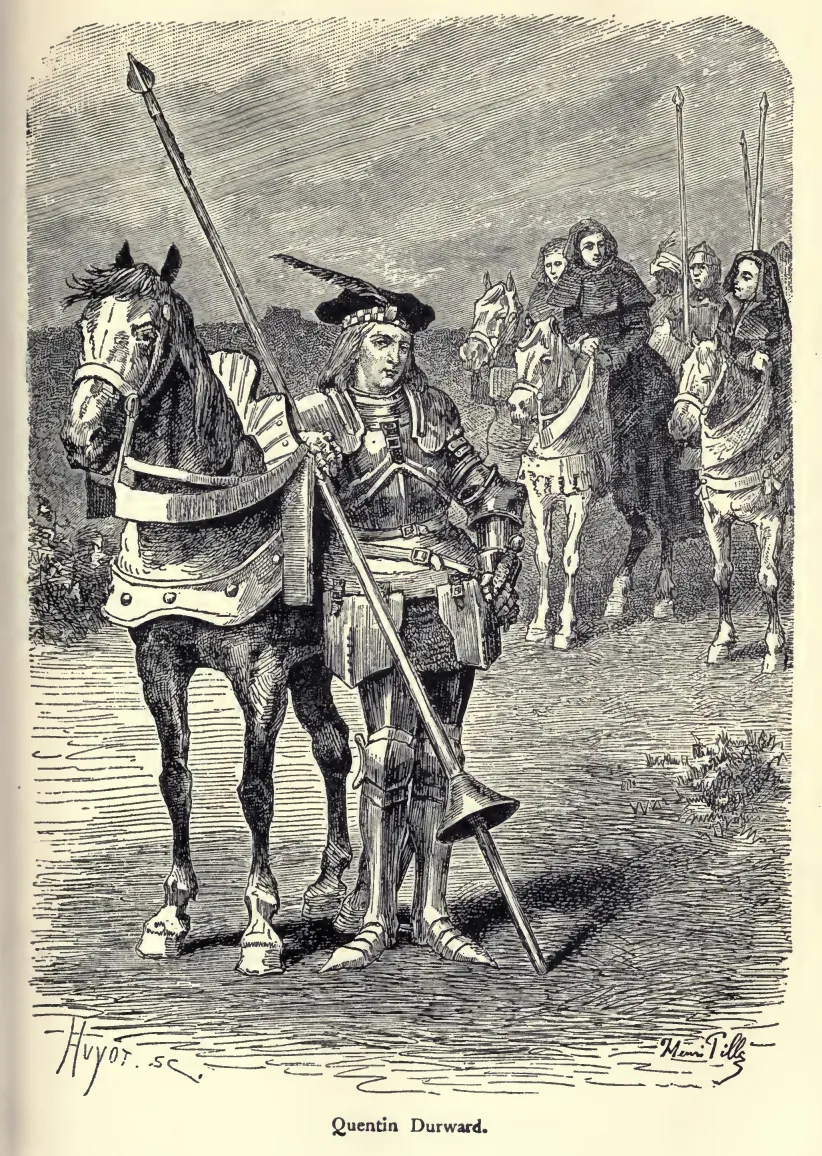
The age of the young traveller might be about nineteen, or betwixt that and twenty; and his face and person, which were very prepossessing, did not, however, belong to the country in which he was now a sojourner. His short gray cloak and hose were rather of Flemish than of French fashion, while the smart blue bonnet, with a single sprig of holly and an eagle’s feather, was already recognized as the Scottish head gear. His dress was very neat, and arranged with the precision ...