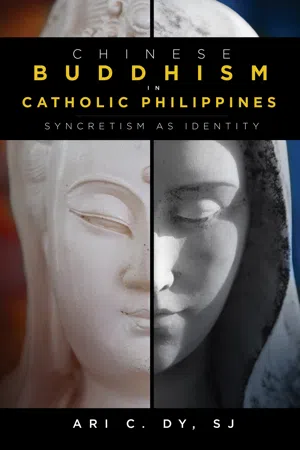
Drawing on his personal experience of growing up exposed to the rituals of Chinese Buddhism, and yet embracing Catholicism and being ordained a Jesuit priest, Fr. Ari Dy ventures to examine Chinese Buddhism in the Philippines, analyzing its adaptation to the Philippines and its contribution to conceptions of Chinese identity.
CHAPTER ONE Being Chinese in the Philippines A Preliminary Discussion of History and Culture
Before I present the history of Chinese Buddhism in the Philippines, it is important to establish some contexts by briefly presenting the history of the Chinese in the Philippines and providing an initial consideration of Chinese religion and identity. As I will shortly demonstrate, there are many layers to these ideas, and these must be kept in mind as the book progresses.
Brief history of the Chinese in the Philippines
Long before the Spanish colonization of the Philippine islands (16th to 19th centuries), the Chinese had been trading with the native peoples of what became known as the Philippines. Chinese sources from the Song Dynasty (960–1279) make reference to parts of the northern island of Luzon.1 Trade relations go back to the 9th century (Ang-See 2005, 20). Chinese sources from the 14th century record seasonal trade relations, and two Philippine kingdoms are recorded as paying tribute to the Ming court (1368–1644) (Wilson 2004, 42–43). Though unsuccessful, there was also an early Ming attempt by the Chinese explorer Zheng He to include the northern Philippines in the Ming Empire (Wang G.W. 1992, 96).
There was, therefore, a free flow of people and goods for several centuries before Spanish colonization. It was only during the more than three centuries of colonial rule, when the Spanish central government took possession of the islands, that identities began to be highlighted.
Andrew Wilson (2004) wrote his doctoral dissertation on the ambition of the Philippine-Chinese merchant elite as a force in the formation of Chinese political identity in the late 19th and early 20th centuries. While his focus was on the strategies employed by Chinese economic elites in the Philippines to preserve their position in the country, especially during the revolutionary chaos at the turn of the 20th century, the context he establishes is helpful for our consideration of Chinese identity in the Philippines. Following Wickberg (1965, 1997), Wilson describes the history of relations between the Philippines and China, highlighting the experiences of the Chinese in the Philippines and Spanish attitudes and policies toward them. In order to better understand the role of Chinese Buddhism in the formation of Chinese identity in the Philippines in the 20th century, I want to first lay down the history of that identity in the Philippine context.2
In the late 16th century, Chinese trade with Southeast Asia became lucrative due to the interest of European colonists in oriental goods. Chinese merchants seized this opportunity and braved the hardships of traveling through the South China Sea, establishing Manila as a major trading post for the Chinese. Before Spanish arrival in Manila, the Chinese there numbered only a few hundred, but this number grew to 20,000 by 1603 and ironically, the Chinese in Manila vastly outnumbered the Spanish (Wickberg 1965, 6; Wilson 2004, 35).
In exchange for Mexican silver, the Spanish bought Chinese goods such as silk, porcelain, and tea through Chinese middlemen in Manila. Unlike the Portuguese and the Dutch who had their own trading posts on Chinese soil,3 the Spanish traded with China by way of Manila, and the volume of this trade proved to be immensely significant for both the Spanish and Chinese economies of the time. The Chinese traders in Manila were crucial to these commercial exchanges. There were always Chinese who were happy to travel frequently between Manila and the southern Chinese coast (Guangdong
and Fujian
, but mostly the latter), but there were also those who decided to settle in Manila.
In time, not only traders but also skilled Chinese laborers arrived in Manila, welcomed by the Spanish for their skills and the continuation of trade with China. The relationship between the Spanish and the Chinese, however, was never harmonious. While there was always a mutually beneficial economic relationship, Spain was a conquering colonizer after all and had reason to doubt the attitudes of the Chinese toward them, the native Filipinos,4 and the Chinese empire. Mutual misunderstandings caused by false assumptions led to periodic outbreaks of violence, including the Chinese massacres of 1603 and 1639, each of which claimed more than 20,000 Chinese lives.5
The Manchu Qing dynasty (1644–1912) that succeeded the Ming did not seem to value trade with Southeast Asia as much as the Ming.6 The new dynasty was severely distrustful of foreigners, segregating them in enclaves in Canton (present-day Guangzhou), and forbidding Chinese emigration (Wilson 1998, 73). Sino-Spanish trade in Manila declined for some time, until the mid-19th century when European commercial and military might have forced China to engage with European powers again. Concurrently, Spanish in the Philippines also wanted to increase trade with China.
Trade in the region beyond the Sino-Spanish link also had an impact on migration to the Philippines. Fujian, being a mountainous region, traded more with Southeast Asia than with the rest of China. The South Fujianese coastal cities of Quanzhou
, Jinjiang
, and Xiamen
were bustling ports of maritime trade from the 16th century onward,7 and these economic links were accompanied by migration to Taiwan, Japan, the Philippines, and other parts of Southeast Asia (Chu 2012, 27–30). By the late 19th century, British rule in Hong Kong opened up another port and a triangular link was established through direct steamship services between Xiamen, Hong Kong, and Manila (Chu 2012, 27–30, 33). The flow of people and goods in the region gave the Chinese sojourners ample opportunities to survive in diverse circumstances.
For most of the Spanish period, in order to control the Chinese in the Philippines, the Spanish policy toward them consisted of three elements: taxation, segregation, and conversion (Wilson 2004, 39).
The Spanish colonial administration was always understaffed and relied heavily on the local elite, giving them administrative roles in exchange for benefits. It was a system that was familiar to the Chinese, who accepted the authority of the Chinese elite that collected various taxes and imposed social order on behalf of the Spanish powers.
To control the mobility of the Chinese, they were required to live in enclaves called Parian and there were limits imposed on their movements. Only the Chinese who accepted baptism were allowed to reside outside the enclave, for fear that the unbaptized would “pollute” the natives with their pagan ideas and hinder the development of Catholicism. By segregating the Chinese, trade was also localized (Wilson 2004, 41).
Finally, converting the Chinese to the Catholic faith was seen as a way to simultaneously gain new Christians who were loyal to Spain. A good Catholic was necessarily a good subject (Wickberg 1965, 15). Furthermore, the Church saw the conversion of the Chinese as a springboard for winning China for the faith,8 a vision that never materialized but nevertheless motivated the Church’s friendly attitude toward the Chinese.
Throughout the Spanish period spanning more than three centuries, the Chinese retained a distinct ethnic identity. Spanish policies treated them as a distinct class of persons, different from the native Filipinos, and different from the mestizos, the offspring of Chinese who had married local women. The latter, because they had become Catholic and married native women, were trusted more and were given great mobility and better terms of taxation. The Spanish encouraged this form of assimilation as it was a way to benefit from Chinese skills without the threat of possibly misplaced loyalties.9 In the late 17th and 18th centuries, the Chinese mestizo class flourished and far outnumbered the Chinese (Chu 2010). By the end of the 19th century, the Chinese mestizo population had reached a quarter of a million (Wickberg 1964, 79).
Meanwhile, the Chinese population in the Philippines ebbed and flowed according to the dynamics of Spanish and Qing dynasty policies. There was a crucial turning point in the middle of the 18th century when the British invaded Manila and the Chinese (but not the Chinese mestizos), hoping for more favorable economic conditions under the British, supported the unsuccessful British invasion (Wilson 2004, 49; Purcell 1965, 526–527). The result was a Spanish backlash on the Chinese. Short of executing all the Philippine-Chinese, those who collaborated with the British were instead expelled (Wickberg 1964, 86). The Chinese community in the Philippines would again increase in number only from the late 19th century (Ibid., 90), when treaty ports in the region facilitated trade from Manila to Hong Kong and Xiamen, and from Xiamen, to Taiwan and Japan (Chu 2012, 32–36).
At that time, the Chinese elite in Manila began to assert themselves as a political entity by lobbying the Qing court for a consulate in Manila, arguing that the Qing had jurisdiction over the Chinese overseas. However, this was done out of expedience and ambition rather than allegiance to the Qing.10 In fact, the overseas Chinese in the Philippines and elsewhere supported the revolutionary forces of Dr. Sun Yat-sen and celebrated the success of the revolution in 1912.
The assertion of Chinese merchant elite leadership over the Chinese community began in the Spanish period and continued into the American and Independence periods. The leadership position in the Chinese community evolved from Gobernadorcillo (little Governor) to Consul-General to President of the Chinese Chamber of Commerce. But through it all, the business elite claimed to represent the interests of the Chinese community (Wickberg 1997, 169; Wilson 2004, 84, 119, 173).
Throughout the colonial era, the Chinese had a strong sense of being the Other in the Philippines. Their confinement to the Parian created physical as well as psychological experiences of being set apart from the local population. Unless one intermarried, one was always seen as a chino, a non-native who could return to China at any time and who might take advantage of the native population. The mutual suspicion among the Spanish, the Filipinos, and the Chinese resulted in the expulsions and massacres of the Chinese that marred the Spanish period, and the restrictive policies toward the Chinese of successive Philippine governments in the mid-20th century (Wickberg 1997, 168; Tong 2010, 207). Since the granting of mass naturalization in 1974 (Ang-See 1997, 29–30), the ethnic Chinese have increasingly ventured beyond the commercial sphere, and integrated much more with Philippine society, but tensions remain as economic success made the Chinese the target of kidnapping syndicates in the 1990s.11
When the reform era took hold in China in the 1980s, there was a new wave of Chinese emigration to the Philippines that continues to this day, and distinguishing these new immigrants from the Chinese Filipinos who have been in the country for several generations can be quite challenging.
In the 20th century, whether they had been in the Philippines for years, or had just arrived to start a new life in the country, how did they retain their Chinese identity? Now that they ceased to live in strictly bound ethnic enclaves, what social structures linked them to their cultural identity? What factors helped them experience Chineseness in the Philippine context?
Chinese community organizations, especially those organized based on surnames or hometowns in China, could provide material aid and a link to their native place. Chinese schools and newspapers provided a platform for the Chinese language and culture to be preserved, and for pride in Chinese history and civilization to be nurtured. Chambers of commerce could grant them access to business networks. These experiences all contributed to reinforce Chinese identity, an identity that was already conditioned by the historical Otherness that had been the experience of the Chinese in the country. To use Benedict Anderson’s (1991) term, the overseas Chinese could “imagine” themselves as a community even as the Philippine concept of nationhood was also being formed.
Anderson was analyzing the birth of modern nationalism, linking language, print technology, capitalism, and the colonial tools of census, map, and museum, to people’s consciousness of belonging to a nation. This process would take several decades to develop in the Philippines. Filipino intellectuals studying in Europe nurtured the idea of the inhabitants of the Philippine islands constituting one nation (Schumacher 1997). This nation was born when Filipino nationalists declared independence in 1898, only to be colonized again by America. In the decades following the Second World War, the country began the long and difficult task of nation building, which many people still consider to be a work in progress.
Meanwhile, the overseas Chinese sought to preserve their ethnic identity, “imagining” themselves as a Chinese “nation” living in a foreign country. Community institutions like Chinese schools, newspapers, village and kinship associations, hospitals and fire brigades, and the overall experience of Chinese enclaves like Chinatowns all indicated an orientation toward China as one’s nation of origin.
Antonio Tan (1988), along with others like Teresita Ang-See (1990, 1997, 2004), have observed that the identity of the Philippine-Chinese has changed with the birth of younger generations of Chinese who have no attachment to China and see the Philippines as their own country. Their forebears, the first two generations to live in the Philippines, continued to follow political developments in China and took sides between the Communists and the Nationalists, especially when the latter established itself as a separate government in Taiwan. However, for the third generation of Chinese in the Philippines, such loyalties were alien. They were proud of being Chinese, but their sense of nation and nationalism was clearly ...
Table of contents
Cover
Half Title
Title page
Copyright
Content
List of Figures and Tables
Note about Chinese Romanization
Acknowledgments
Introduction
Chapter One Being Chinese in the Philippines: A Preliminary Discussion of History and Culture
Chapter Two Chinese Buddhism in the Philippines
Chapter Three Buddhism as a Chinese Religion
Chapter Four Scriptures and Devotions: The Religious Dimensions of Chinese Buddhism in the Philippines
Chapter Five Planting Good Roots, Creating Affinities, and Practicing Compassion: Sociocultural Dimensions
Chapter Six Chinese Buddhist Culture and Chinese Identity
Conclusion
Sources Cited and Bibliography
Trusted by 375,005 students
Access to over 1.5 million titles for a fair monthly price.
Study more efficiently using our study tools.
Frequently asked questions
Yes, you can cancel anytime from the Subscription tab in your account settings on the Perlego website. Your subscription will stay active until the end of your current billing period. Learn how to cancel your subscription
No, books cannot be downloaded as external files, such as PDFs, for use outside of Perlego. However, you can download books within the Perlego app for offline reading on mobile or tablet. Learn how to download books offline
Perlego offers two plans: Essential and Complete
Essential is ideal for learners and professionals who enjoy exploring a wide range of subjects. Access the Essential Library with 800,000+ trusted titles and best-sellers across business, personal growth, and the humanities. Includes unlimited reading time and Standard Read Aloud voice.
Complete: Perfect for advanced learners and researchers needing full, unrestricted access. Unlock 1.5M+ books across hundreds of subjects, including academic and specialized titles. The Complete Plan also includes advanced features like Premium Read Aloud and Research Assistant.
Both plans are available with monthly, semester, or annual billing cycles.
We are an online textbook subscription service, where you can get access to an entire online library for less than the price of a single book per month. With over 1.5 million books across 990+ topics, we’ve got you covered! Learn about our mission
Look out for the read-aloud symbol on your next book to see if you can listen to it. The read-aloud tool reads text aloud for you, highlighting the text as it is being read. You can pause it, speed it up and slow it down. Learn more about Read Aloud
Yes! You can use the Perlego app on both iOS and Android devices to read anytime, anywhere — even offline. Perfect for commutes or when you’re on the go. Please note we cannot support devices running on iOS 13 and Android 7 or earlier. Learn more about using the app
Yes, you can access Chinese Buddhism in Catholic Philippines by Ari C. Dy in PDF and/or ePUB format, as well as other popular books in Theology & Religion & Buddhism. We have over 1.5 million books available in our catalogue for you to explore.