Andrei Tarkovsky died in a Paris hospital in 1986, aged just 54. An internationally acclaimed icon of the film industry, the legacy Tarkovsky left for his fans included Andrei Rublev, Stalker, Nostalgia and a host of other brilliant works. In the Soviet Union, however, Tarkovsky was a persona non grata. Longing to be accepted in his homeland, Tarkovsky distanced himself from all forms of political and social engagement, yet endured one fiasco after another in his relations with the Soviet regime. The Soviet authorities regarded the law-abiding, ideologically moderate Tarkovsky as an outsider and a nuisance, due to his impenetrable personal nature.
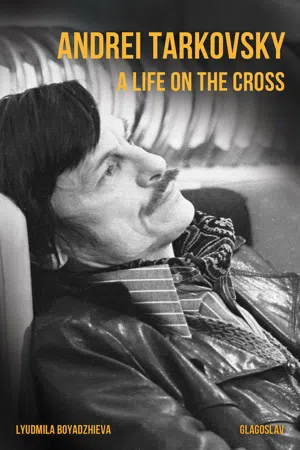
The documentary novel A Life on the Cross provides a unique insight into the life of Andrey Tarkovsky, the infamous film director and a man whose life was by no means free of unedifying behaviour and errors of judgement. Lyudmila Boyadzhieva sets out to reveal his innate talent, and explain why the cost of such talent can sometimes be life itself.
- 3 pages
- English
- ePUB (mobile friendly)
- Available on iOS & Android
eBook - ePub
About this book
Information
PART I. A feeling of immortality
“All his life an artist feeds on his childhood and his own memories, the sense of immortality, his keen reflexes and simple happiness.”
Andrei Tarkovsky
Chapter 1.
CHILDHOOD
The brighter one’s childhood memories, the greater one’s creative potential.
Andrei Tarkovsky
1.
Andrei Tarkovsky was fortunate with his ancestry. He was fortunate if one looks at the seven-and-a-half films which he managed to bring into the treasury of world cinema, and if we overlook the painful road he was forced to walk. In his genes lay a powerful gift and the elements of a contradictory, complex personality, which predetermined the director’s difficult path through life.
Andrei Tarkovsky’s father, the famous poet Arseny Alexandrovich Tarkovsky, was born in 1907 in a provincial town in the Kherson Governorate to the family of a clerk at the Elisavetgrad Public Bank. However, the volatile blood of the rulers of Dagestan, who were the root of Tarkovsky’s ancestry, showed itself — the fate of its representatives was not easy.
The roots of the Tarkovsky family, according to one version, go back to the “Tarkovsky holdings”, as this area, covering almost the whole of Dagestan was called, and only after 1867 was its name changed to the Temir-Khan-Shura district. Shamsudin, the last prince of the Tarkovsky holdings, is considered to be the founder of the Tarkovsky bloodline. The features of the powerful prince can be guessed in the rugged handsomeness and stern character of Arseny Alexandrovich and his son Andrei.
Alexander Karlovich, Andrei Tarkovsky’s grandfather, was endowed with an uneasy and restless soul. Apart from his work at the bank, he wrote poems, stories and translated Dante, Giacomo Leopardi, Victor Hugo for his own pleasure. Furthermore, in the 1880s, he took part in a Narodnaya Volya circle, which brought him under police surveillance. He was arrested, imprisoned three times in Voronezh, Elisavetgrad, Odessa and Moscow and exiled for five years to Eastern Siberia. In exile, he took up journalism, working with newspapers in Irkutsk. Alexander Karlovich’s first wife died young, leaving behind a young daughter. His second wife, Maria Danilovna, bore her husband two sons, Valery and Arseny. As he was undependable for political reasons, Alexander Karlovich’s children were mostly brought up by the family of a relative, the actor and playwright Ivan Karpovich Tobilevich, who was one of the founders of the Ukrainian theater and known in the history of drama under the name Karpenko-Kary.
The family was immersed in literature and theater. Poems and plays, written by lovers of the stage, were performed among friends. At the beginning of the 20th century, drama circles, societies, university and high school student troupes quickly multiplied, encompassing what we might call today the entire youth subculture. Almost everyone wrote poetry: in girls’ albums, in local magazines and newspapers; they published collections at their own expense or timidly kept their secret writings in a desk drawer. And most importantly, they read the poems in mellifluous voices at literary evenings, which were held regularly and ended with stormy debates or dancing.
Arseny, writing in secret and only for the eyes of a girl he loved, found great success among his young peers due to his outlook, which everyone compared to the anti-hero Pechorin in Lermontov’s A Hero of Our Time, and his mysterious, romantic nature. As a young man, he was handsome with a fiery Caucasian beauty, and this alone could evoke sighs and note-passing from the fair sex. And when he recited poetry, it led to walks in the dusk or gardens that had frozen over, kisses, vows, as in the sort of sweet stories that Kuprin, Bunin and Chekhov often wrote.
In the intellectual Tobilevich home, thoroughly in tune with the cultural and artistic trends of the time, one could hear a piano or singing to guitar accompaniment, recitals of poetry or performances of theatrical sketches. How similar was the cherry plush of the Tobilevich living room, the porcelain stove, the cream-colored curtains over the windows to the home of the Turbins, the childhood home of Mikhail Bulgakov. This was an atmosphere in which people were brought up with Romantic bravery, an unshakable sense of duty and a thirst for artistic expression.
While still quite young, Arseny Tarkovsky, together with his father and brother, participated in the literary evenings of some of the capital’s celebrities: Igor Severyanin, Konstantin Balmont and Fyodor Sologub. Later the young man came to Moscow to immerse himself in an atmosphere of poetry. It is difficult to imagine that somewhere beside him, in a banquet hall packed with attentive listeners in rows of chairs, shone the short-sighted eyes of a young Marina Tsvetaeva. Perhaps Arseny saw how, with trepidation, she presented Konstantin Balmont with a white peony after one of his recitals, blushing with embarrassment. Perhaps Arseny heard the first recitals of this budding poetess, who, at her own expense, had already published the collection Evening Album? Much later, in pre-war Moscow, having returned from the West, Marina Tsvetaeva fell under the spell of this handsome man, no longer young, and even wrote him passionate poems. A year later Arseny, learning of her tragic death in August 1941, wrote an epitaph in verse for the martyred Marina.
The Ukrainian civil war ended with the victory of the Soviet authorities. Arseny’s older brother Valery was killed in battle against the ataman Grigoriev in May 1919. People were terrified by the Soviets’ seizure of power and hoped that it would not last long. Arseny and his friends, mad for poetry and constitutional monarchy, published an acrostic in a newspaper in which the first letters depicted the head of the Soviet government, Vladimir Lenin in an unflattering light. The young men were arrested and taken to Nikolaev, which in those years was the administrative center of the oblast. Arseny Tarkovsky managed to escape from the train on the way. This son of an intellectual family became a starving beggar, wandering across Ukraine and the Crimean Peninsula. He was forced to try his hand at several professions, working as an apprentice to a shoemaker and in fisheries. He turned out to be a jack of all trades, which proved useful in his later life.
In 1923, Arseny Alexandrovich came to Moscow and called on an aunt, his father’s sister. Two years later, he enrolled in the Higher Literary Courses, which had been organized in place of the Literary Institute, closed after the death of Valery Bryusov. After he had observed the students for a while, Arseny noticed a beautiful young woman with a tuft of fair hair on the back of her neck, as if her hair were so heavy that it made her hold her chin up with pride.
“She’s the one!” the young poet decided after Maria Vishnyakova’s speech in a student auditorium, where she talked passionately and in an inspired tone about the poetry of Blok.
They would soon take long walks along the Moscow lanes, dance to an orchestra in Gorky Park, read poems ceaselessly to each other and kiss in the intoxicating scent of blooming linden trees.
“I started to write poetry already when I was in nappies!” Arseny boasted, a smile in his dark eyes. “Our house was a place for high arts, we organized various events and poetic evenings. I don’t even remember any more when I made my debut. I just remember that I had to stand on top of a stool. Only later did I grow tall. As a boy I was quite small.”
“At least in my ancestry we are very tough and principled. I don’t forgive insults.” Maria looked into his loving eyes. She knew that she wasn’t the only one dreaming of the handsome young man with the dark looks, but she thought, “Other women’s husbands cheat on them, but I’m a special girl!” and said to him, “Remember, Arseny, you are meant for me for life.”
“Don’t worry, you can rely on me,” he said. “If I have fallen in love with you now, it is for life.” He embraced Maria, but she pulled away and ran ahead of him, a gauze scarf fluttering in her hand. She hid behind an old maple, pressing her back to its trunk. Arseny caught up with her, kissed her gently on her snub nose, took her in his strong arms. “You won’t get away now. I respect people with principles.” He buried his face in her warm hair, which smelled of wild strawberry soap. “You are the only one for me. This scent… No one can have a scent like this!” (Under the spell of love, the country’s only brand of soap at the time was transformed into a rare perfume.)
“And what do you like most about me?” he asked.
Maria furrowed her brow playfully and answered, “That you know how to make shoes. I’ll never be barefoot.”
Maria’s parents liked him and in 1928 the young couple were married.
The next year, Tarkovsky was granted, in recognition of his excellent studies, a monthly stipend from the state publishing house’s foundation for beginning authors. This small sum of money came as a great help to the young married couple. Tarkovsky’s first publications — the quatrain “Svecha” (The Candle) and the poem “Khleb” (Bread) date from his studies in the Courses of Higher Literature. But then the poet’s career stalled. He had to wait a long time to issue a collection of his own poems — several decades, in fact.
In the following year, the Higher Literature Courses closed under scandal, the suicide of one of the female students. Tarkovsky was hired by the newspaper Gudok, the very one where Bulgakov, Olesha and Ilf and Petrov moonlighted. Tarkovsky reviewed court cases and wrote satires in verse and fairy tales under various pseudonyms. The most popular “author” of Arseny’s satires was the rustic character Taras Podkova.
In 1931, Tarkovsky worked as a senior instructor and consultant for an arts program on Soviet radio.
“They took me, dear Maruska, they took me!” he said to his wife as he got home. “Now we’ll make the big money. I’ll write plays for broadcast over the radio.”
“Oh, for radio! You’re my hero. That sounds like a promising and progressive career. But the important thing is not to lose your ideological bearings and don’t say anything… Well, you know,” Maria broke off and looked around furtively, lest someone might have heard the word “anti-Soviet” almost tumbling from her lips. She was making soup from bad fish, part of their rations, on a kerosene stove. “Don’t worry, I’m a smart man, I’ve had some schooling. They’ve already given me a commission for the radio. The play will be called Steklo (Glass). It tells of heroic glassmakers.” Arseny scooped up a bit of broth, blew on the spoon and tasted it. “It’s like in a restaurant! It’s even better that the potatoes are frozen, so they melt in the mouth.”
To get acquainted with glassmakers and learn something of the process by which they worked with molten glass, Tarkovsky went to visit a glassworks. The play was produced in a very short time, recorded by the noted actor Osip Abdulov and broadcast by All-Union Radio.
Almost all the inhabitants of the communal apartment gathered around the radio receiver in the kitchen, neatly seated in rows, as if at a theater. After the play finished, the author was congratulated by his neighbors. Maria set the table, welcoming them with her own vinaigrette salad recipe. They read poems, sang and drank to their life becoming completely wonderful as soon as possible.
“Life will be wonderful! You’ll become a writer for the stage, and we’ll have a son,” whispered Maria one night into the shaven but always stubbly cheek of her husband. “Your hair is so coarse, like bristles.”
“Huh, what?” his eyes shown in the darkness, he sat up and embraced her in astonishment. “What are you saying, Maruska?! You’re expecting a baby boy? That’s fantastic!”
“Or a little girl…”
“No, as you promised, first a boy and then later a girl.”
The next evening Arseny came home in a somber mood. He sat down and pushed his dinner plate away. “I don’t deserve this food. Marusya, your husband is without a job. Oh, what a thrashing the director gave me just now! My ears were burning.”
“They didn’t like the play?” his wife asked, horrified.
“Worse than that, they called me…” Arseny coughed, “They called me a ‘mystic’.”
“A mystic? How awful!” Maria collapsed on a stool. “Arsyusha, that’s bad, very dangerous even. Where did they find it, this mysticism?”
“Oh, the devil tempted me! I’m just a lover of the pen, I wanted to give life to a play, putting it in the voice of the founder of Russian glassmaking, Mikhail Lomonosov.”
“That was a great writing strategy. You showed a link between the generations, a connection with tradition.”
“And I told ...
Table of contents
- Cover
- Halftitle
- Title
- Copyright
- Table of Contents
- Acknowledgement
- A dance of the flesh and symphony of the spirit
- Part I. A feeling of immortality
- Part II. Making films is a moral activity
- Part III. “From confession to sacrifice”
- Appendix A. Afterword: “I don’t believe in death”
- To Readers
- Glagoslav Publications Catalogue
Trusted by 375,005 students
Access to over 1.5 million titles for a fair monthly price.
Study more efficiently using our study tools.
Frequently asked questions
Yes, you can cancel anytime from the Subscription tab in your account settings on the Perlego website. Your subscription will stay active until the end of your current billing period. Learn how to cancel your subscription
No, books cannot be downloaded as external files, such as PDFs, for use outside of Perlego. However, you can download books within the Perlego app for offline reading on mobile or tablet. Learn how to download books offline
Perlego offers two plans: Essential and Complete
- Essential is ideal for learners and professionals who enjoy exploring a wide range of subjects. Access the Essential Library with 800,000+ trusted titles and best-sellers across business, personal growth, and the humanities. Includes unlimited reading time and Standard Read Aloud voice.
- Complete: Perfect for advanced learners and researchers needing full, unrestricted access. Unlock 1.5M+ books across hundreds of subjects, including academic and specialized titles. The Complete Plan also includes advanced features like Premium Read Aloud and Research Assistant.
We are an online textbook subscription service, where you can get access to an entire online library for less than the price of a single book per month. With over 1.5 million books across 990+ topics, we’ve got you covered! Learn about our mission
Look out for the read-aloud symbol on your next book to see if you can listen to it. The read-aloud tool reads text aloud for you, highlighting the text as it is being read. You can pause it, speed it up and slow it down. Learn more about Read Aloud
Yes! You can use the Perlego app on both iOS and Android devices to read anytime, anywhere — even offline. Perfect for commutes or when you’re on the go.
Please note we cannot support devices running on iOS 13 and Android 7 or earlier. Learn more about using the app
Please note we cannot support devices running on iOS 13 and Android 7 or earlier. Learn more about using the app
Yes, you can access Andrei Tarkovsky by Lyudmila Boyadzhieva in PDF and/or ePUB format, as well as other popular books in Scienze sociali & Biografie nell'ambito delle scienze sociali. We have over 1.5 million books available in our catalogue for you to explore.