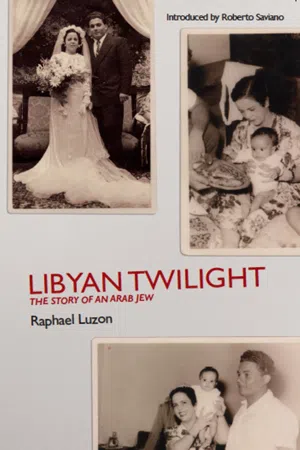
Libyan Twilight is a short memoir that discusses the forgotten Jewish community of Libya. As a child growing up in Benghazi, Raphael Luzon experienced the pogrom that followed the 1967 Six Day War between Israel and Egypt, Syria and Jordan. The Libyan Jews were forced to abandon their homeland and seek refuge overseas as a result. The narrative jumps between the present and past, starting in 2012 where Raphael finds himself in a jail cell in post-revolution Libya amidst political chaos. He rewinds 45 years to a time when Libya was his home, just before the Muslim community ousted the 'Arab Jews'. They spoke in a Libyan dialect of Arabic and had been rooted in North Africa since the destruction of the first temple in Jerusalem in 586BC right up until 1967. Left with no choice, the Libyan Jews were forced to flee Benghazi and find settlement elsewhere, leaving a rich culture behind in Saharan sands. Luzon tells the story with an air of dignity rather than resentment. He opens the lid on a box of memories that reflect on the repercussions he and his community experienced over the last 50 years. As a memoir of exile, Libyan Twilight bursts with nostalgia and gives voice to a forgotten tragedy. Shackled to his Libyan heritage, Luzon relives his life in Italy, Israel and London through a series of charming anecdotes. Sentiments aside, Libyan Twilight is about a man's quest for justice. On a self-assigned mission, Luzon strives for closure on the deaths of his family in Tripoli during the pogrom. Nobody was convicted, nor were they granted a funeral. Luzon's honorary pursuit for redemption places revenge aside, as he sets out to achieve a trial, a conviction and a funeral for the lost Libyan Jews.
- English
- ePUB (mobile friendly)
- Available on iOS & Android
eBook - ePub
About this book
Information
Chapter One
Benghazi, 18 July 2012
I had long since lost track of time. They’d taken everything from me, even my watch. The Saharan heat permeated through window cracks, further oppressing the cell’s silence, only to be interrupted by a barking dog in the distance. I was all alone with my thoughts and the whimpering of prisoners being tortured and interrogated elsewhere. The thought of death was surprisingly calming; my only worries were about my wife, daughter and two sisters.
The cell was empty, with decaying graffiti-filled walls, and the stench of urine and mould permeating the room. The only item in there was a tattered brown leather armchair that stood in the corner. I was finding it hard to sit for long, so I’d pace continually to remain sane. I’d fall asleep for only a couple of minutes at a time, awakened by memories of places and half-forgotten faces. How painful it was that the only thing keeping me awake was feeling guilty about my family! The thoughts dried up in my throat as I squeezed my eyes shut in fear and apprehension. This time I had gone too far in my desperate optimism. My faith in fellowship, coexistence, forgiveness and the triumph of good over evil was rolling away.
Why was I in a Benghazi prison in the scorching Libyan summer? I questioned myself, leaning my forehead against the clammy wall, with the constant urge to cry, but remaining tearless. How well I knew the people and their propensity for violence. It takes a lone leaf to break away off a branch and hit the ground; everything can change from love to hate, from prayers to curses and from life to death. I had seen everything and forgotten nothing in Libya, the land where I was born.
Chapter Two
Benghazi, 4 May 1967
The sweet scent of aftershave clashed with the grimy smell of Shafik’s barber’s shop. He used to stand behind the barber’s chair, cutting and trimming, or playing backgammon with customers. The whole city was familiar with this short, stubby man with his sleek hair and perfectly groomed moustache. He was a cheeky character, whose lively black eyes had a harshness, reflecting a merciless gleam at times.
It was a warm spring afternoon. A soft breeze swayed the palm trees to the rhythm of the sea. As my hair was too long, my mother yelled at me to go to Shafik’s. She walked me to the door, her gaze following me until I turned the corner.
I was on Shafik’s barber’s chair while he was busy trimming the white beard of an elderly customer. His assistant Ahmed was engrossed in the newspaper. Standing behind me, Salvatore, an Italian immigrant from Sicily, produced a white cloth and tied it behind my neck. He then commenced cutting off big chunks of hair. There was an unusual silence in the shop. I could only hear the sound of scissors. It soothed me, along with the touch of Salvatore’s hands and the aroma oozing out of the bottles beneath the mirror. I almost fell asleep in the hands of barber but the reflection in the mirror stopped me, making me think about how I’d turned adolescent.
Suddenly, Salvatore leaned very close to my ear and whispered, ‘You will see, kid, soon they’ll strangle all you Jews.’ I froze, not comprehending what he meant. I caught Salvatore’s evil look of satisfaction in the mirror. He continued cutting as if nothing had happened.
The old man next to me paid and ruefully left the shop. I sensed a compassionate look. Salvatore had finished and, as usual, Shafik strolled over to make sure the hair cut was done perfectly – more of a habit than attention to detail. Brushing off the last strands of hair with precise gestures, Salvatore said in a gentle tone, ‘You Jews, it seems your days are numbered’. His glance suggested that I shouldn’t worry. I knew that being a Jew in Libya meant being resented by some. Ahmed’s voice, from behind his paper, immediately triggered my sense of fear.
‘Leave the boy alone...’
Shafik loosened the cloth around my neck and shook it free in dramatic fashion, strewing my shorn hair on the floor. I looked at them for a few seconds as if they had something to reveal me.
‘Well?’ Shafik said. I handed over the dinars to him and swiftly left the shop. I started running, faster and faster, until I reached my front door, out of breath.
‘What happened, son?’ my mother asked as soon as she opened the door. I simply embraced her, as I had nothing to say.
Chapter Three
Benghazi, 4 June 1967
Zaineb, so slow yet so efficient. Your gestures were so careful and considered. So intricate, like a panther stalking its prey. We sometimes watched you in fascination. In the late afternoon you returned to your shack, leaving our house spotless, a sanctuary without a trace of dust or grime. While working, you sang quietly. Alone in a room, you sang fearlessly. Your songs were essentially Libyan blues, much like the songs of American slaves, who sang the stories of suffering. Your black skin glowed like all those from the Fezzan region.
You lived in the shanty town on the outskirts of Benghazi, an area in dire condition. My mother gave you old dresses, some food and money before you left the house. We didn’t know much about you, as you never wanted to tell us anything. No emotions were present on your face, and your eyes never gave away anything. You always looked at us with such love and affection. You were a good nanny, even though you enjoyed scaring us for fun. We would jump with fright, but your generous smile spread across your face and your hands embraced us with love.
You have protected me from my father’s temper. Also, you were the only one who made my sister Betty eat until she cleared her plate. Betty used to obey you.
That particular night, our house was as immaculate as ever. Once again you surprised us with the magic of your care. You were ready to leave after placing the brooms and mops back in the cupboard. You walked up to me, knelt down and embraced me for a long time. Next was my sister Betty, before giving a kiss to little Rita. You went into the study to say goodbye to my father, squeezing his hand. You’d never done this before. Finally, you approached my mother and hugged her tightly. It seemed as if you wouldn’t let her go. I was standing in front of you watching your tears stream down your cheeks onto your shoulders.
My mother freed herself from Nanny’s embrace. ‘What’s wrong, Zaineb?’ she asked worriedly. You lowered your gaze, unable to reply as you left the house, forgetting to close the door.
The next day, none of the servants who cleaned the homes of Jewish families returned to work. None except you, Zaineb. You worked as usual, then wept and left for your shack, to your life, without saying a word.
Lailat al-maal Kippur. Yom Kippur Eve. A night of expiation before the Day of Atonement. In the Jewish quarter, Rabbi Madar and the teacher Rifali, who was also the kosher butcher of the community, walked from house to house. The Jewish families would wait patiently. Even the young children were awake, screaming with excitement. The chickens that my father had chosen carefully from the market felt their doom drawing closer, clucking nervously.
In front of the big synagogue, Sla al-Kabira, the voices of Jews in prayer rose in the air. Rabbi Labi would take a chicken by its neck for the ritual, Dawar Al-Ras, spinning it around my mother’s head several times. Betty closed her eyes in fear when it was spun above her head, followed by Rita’s. The Rabbi then tightened his grip around the chicken’s neck and circled it over my father and me. The women ululated in the deafening zgaret, like a flock of birds.
‘Tizkùleshanimrabbòt, Akbaldaiiar!’ May you live for many years, we’d wish each other at the end of the ritual.
Rifali performed the Shechita, the kosher butchering. My mother begins the haccianifuacciaarish, purification of the chickens. The excitement rises, our sins drowned, and remorse is to follow. The whole city was looking forward to a silent and bright morning as sunrise drew closer.
Chapter Four
Benghazi, 5 June 1967
My footsteps echoed in the silence of the city’s great cathedral as I passed the building and the confession rooms, brushing against the hallway walls that led to the middle school, Giovanni XXIII. The Franciscan fathers and the Italian consulate of Benghazi waited, as it was end-of-year exams.
Although I was well prepared, I felt anxious, as if my memory would miraculously be erased. We pupils were always smartly dressed on important occasions, sitting up straight. Both Jews and gentiles, we had our sweaty palms clasped as we waited. Eventually, the envelopes containing our exam papers were opened.
An hour later, the doors of the hall opened and Father Anselmo, pale, sweat-drenched and breathless, entered. He and I shared a similar passion: radio. Sometimes he would give me a lift home in his car and we’d chat about our common interest. I smiled as he entered the room, almost forgetting the exam papers in front of me.
However, soon the room was filled with the clamorous voices, loud explosions, car horns and violent cries from outside. The smile on my face instantly disappeared as I caught Father Anselmo’s anxious eyes. Everyone sensed danger, particularly the Jewish children.
The priests took us all into an office and asked us to stay silent. On the wall facing us was a large wooden cross. Father Anselmo explained that a war had broken out between Israel and the Arab countries. Demonstrations had broken out in the streets, and all Jews in Libya were at risk. His words worried me more than the tumultuous noises from outside, as I sensed we were potential victims of violence for something we played no part in.
Father Anselmo started contacting our parents. Soon, some parents arrived at school to collect their children and left without a word. The phone lines were unreliable, so it was hard to contact many families, including ours. We were isolated. Some of the priests started walking some of the children home. Betty and I waited our turn, sitting with our heads low, hands in our laps. Sharing a glance with one another, we made an immediate decision. We stood up with our hands tightly gripped and quietly left the school. We ran down the cathedral’s stone path, which led us to the road.
Chapter Five
We met Khammus near the Shamash Synagogue. Everyone called Khammus ‘Al Fartas’, meaning ‘receding hairline’. He was walking close to the wall with his head down and his short legs moving swiftly. His three young children followed him. He didn’t resemble a Jew, with his muscular body, Turkish-style moustache over his thick lips, and gnarled strong hands. Betty and I stopped Khammus. His eyes were fixed on us, waiting for our voices, but our panicked expression was enough to explain the situation.
‘If somebody stops us, don’t say a word,’ he instructed us. ‘And if they approach you, speak only in Arabic dialect, and give your names as “Ali” and “Khadija”. Now follow me.’
He continued walking close to the wall. We stopped at the nun’s school to pick up Rita, our younger sister. She was waiting for us behind the gate, holding a nun’s hand. We continued walking as a group. Sweaty, breathless men were running in all directions, their hands brandishing iron rods, while they cursed the Jews and Israel. Loudspeakers on top of cars were blaring out the news of Arab victory and the surrender of the Jews, announcing that Arab armies were only a few kilometres away from Tel Aviv.
We crossed Cagni Square, now known as ‘Maydan al-Shajra’. A Jew, Bedussa, owned a huge textile showroom here, the biggest of its kind in Benghazi. The showroom had two entrances and, when shut, we’d see a huge neon sign written in Arabic and Italian: ‘Bedussa’. It was said that the Bedussa family were protected by the Auagir tribe, one of the most influential in Cyrenaica. Whether this was true or not, it was of no use to the Bedussa family in the midst of the violence. We witnessed a mob swarming into the showroom and setting it ablaze.
‘Don’t be frightened, children,’ Khammus murmured. ‘Don’t run, walk slowly, as you are doing now.’ He appeared calm, giving us courage and proving he was a strong man. However, it was clear that he was worried. Small mobs merged into larger mobs, shouting for the destruction of Israel. People were running in all directions. What had Nasser to do with anything? What had Israel to do with anything?
We realised that we were nearing home, but a Muslim stopped us saying, ‘Where are you running to, Jews?’ His evil grin frightened us.
‘We’re not running,’ Khammus answered. ‘We’re going home.’
Again...
Table of contents
- Cover
- About the Author
- Title page
- Coyright page
- Dedication Page
- Acknowledgements
- Introduction
- Chapter One
- Chapter Two
- Chapter Three
- Chapter Four
- Chapter Five
- Chapter Six
- Chapter Seven
- Chapter Eight
- Chapter Nine
- Chapter Ten
- My Father
- My Mother
- Chapter Eleven
- Chapter Twelve
- Chapter Thirteen
- Chapter Fourteen
- Chapter Fifteen
- Fiammetta
- Chapter Sixteen
- Chapter Seventeen
- Hana
- Chapter Eighteen
- Chapter Nineteen
- Chapter Twenty
- Ahmed Rahal
- Chapter Twenty-One
- Chapter Twenty-Two
- Chapter Twenty-Three
- Chapter Twenty-Four
- Chapter Twenty-Five
- Chapter Twenty-Six
- Chapter Twenty-Seven
- Majdouline
- Epilogue
- Back Cover
Trusted by 375,005 students
Access to over 1.5 million titles for a fair monthly price.
Study more efficiently using our study tools.
Frequently asked questions
Yes, you can cancel anytime from the Subscription tab in your account settings on the Perlego website. Your subscription will stay active until the end of your current billing period. Learn how to cancel your subscription
No, books cannot be downloaded as external files, such as PDFs, for use outside of Perlego. However, you can download books within the Perlego app for offline reading on mobile or tablet. Learn how to download books offline
Perlego offers two plans: Essential and Complete
- Essential is ideal for learners and professionals who enjoy exploring a wide range of subjects. Access the Essential Library with 800,000+ trusted titles and best-sellers across business, personal growth, and the humanities. Includes unlimited reading time and Standard Read Aloud voice.
- Complete: Perfect for advanced learners and researchers needing full, unrestricted access. Unlock 1.5M+ books across hundreds of subjects, including academic and specialized titles. The Complete Plan also includes advanced features like Premium Read Aloud and Research Assistant.
We are an online textbook subscription service, where you can get access to an entire online library for less than the price of a single book per month. With over 1.5 million books across 990+ topics, we’ve got you covered! Learn about our mission
Look out for the read-aloud symbol on your next book to see if you can listen to it. The read-aloud tool reads text aloud for you, highlighting the text as it is being read. You can pause it, speed it up and slow it down. Learn more about Read Aloud
Yes! You can use the Perlego app on both iOS and Android devices to read anytime, anywhere — even offline. Perfect for commutes or when you’re on the go.
Please note we cannot support devices running on iOS 13 and Android 7 or earlier. Learn more about using the app
Please note we cannot support devices running on iOS 13 and Android 7 or earlier. Learn more about using the app
Yes, you can access Libyan Twilight by Raphael Luzon, Gaia Luzon in PDF and/or ePUB format, as well as other popular books in Social Sciences & Historical Biographies. We have over 1.5 million books available in our catalogue for you to explore.