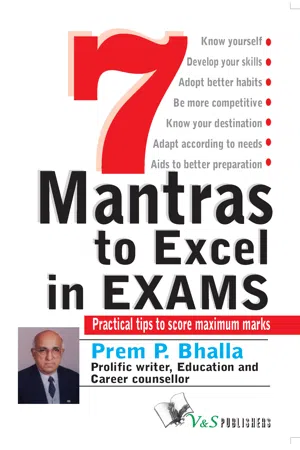
Exams play a major role in the lives of not just during acadenic pursuits,but later in the career too. Although youngsters are taught a variety of subjects to equip them for life in general, no school teaches them how to excel in exams. Most learn only through trial and error. Others remain clueless about how to excel in exams throughout their lives. But this crucial information can ensure that even those with average IQ excel in exams. This book contains simple and practical tips and guidelines on how to tap your full potential and give off your best during exams. An invaluable guide for all students and adults due to appear in exams. As well as for parents who wish to ensure their children do well and secure maximum marks. The book offers simple guidelines on:*Improving memory*Maximising Concentration*Adopting effective study habits and techniques*Developing proper reading, listening, language and communication skills*Doing well in different kinds of exams*Understanding what the examiner wants *Overcoming exam anxiety and tension #v&spublishers
- English
- ePUB (mobile friendly)
- Available on iOS & Android
eBook - ePub
About this book
Information
Topic
Personal DevelopmentSubtopic
Self ImprovementMANTRA 1
“Know Your Destination”

Why are you preparing and appearing for exams? What is your goal? Unfortunately, most students are unable to answer these simple questions. They fail to explain why they are studying in school or college. Those who answer explain they are doing so to obtain a certificate, degree or diploma. And why do they need these? To them, these are symbols of being educated and through these they hope to follow a reasonable vocation and achieve a respectable position in society.
But the real purpose of going to school and college is not to obtain certificates and degrees, but to get educated. The word education is derived from the Latin educe, which means to bring forth from within. Education is the process of preparing a person to use personal capabilities buried deep within. When one knows the purpose of education, and appears for exams that are a part of the process, the person becomes aware of his destination.
At every level of study there will be exams. Written exams, exams in practical work, viva voce, group discussions, interviews, health check-ups and a variety of other tests. Each of these is planned for a particular purpose. To prove your profciency, you will need to understand the purpose of the exams and qualify in them. Let’s proceed step by step to know our destination.
Mantra 1 : Step 1
Do We Need Exams?
Exam is an informal abbreviation of the word examination. An examination is a formal test of knowledge or ability in a subject or skill. It can also be a test of the qualifications or progress of a person.
An exam is nothing new to any educated person. As soon as one enters a school, and learns the first few alphabets, a test soon follows. The teacher wants to ascertain whether the student has learnt what was taught. New lessons are taught as the student progresses. More difficult tests follow. The word test is soon replaced by the word examination. With frequent use, the word has simply been abbreviated to exam.
Exams Begin Early
Even before a child joins school, s/he is not spared from being tested. The mother and father of the infant take pride in making the baby sit, crawl, stand up and take its first unsteady steps. They also take pride in the child’s smile and laughter, just as they are happy when the child says “Ma” or “Pa” for the first few times. The child’s abilities are freely tested before friends and relatives and it is a matter of pride and happiness for the parents when the child responds.
When children grow up and advance to higher classes, the number of subjects taught increases and so does the frequency and number of exams. There are the quarterlies, the mid-year and the final exams. That is when children question the very concept of exams. Who devised exams? Do we really need them? Is it not enough to impart the necessary knowledge and leave the rest to the person concerned? That may appear to be a reasonable way of looking at the problem, but in a civilised society it is not practical.
The Need for Exams
Let’s take a look at some interesting newspapers headlines:
- Over 120,000 to appear for the preliminary PCS exam in Uttaranchal.
- 26,000 students apply for 120 seats in Management College.
- Over 100,000 students sit for Common Admission Test (CAT).
Uttaranchal is a small state with only 13 districts. How many youth can possibly be recruited in the Public Civil Service to administer these districts? With 120,000 aspirants, can there be any other way to shortlist the best candidates than through an exam?
The Management College has 120 seats for various courses. Can it ever accommodate 26,000 aspirants? The Common Admission Test was introduced to ensure that the most capable youngsters were admitted into prestigious institutions that provide the future administration of the country’s commerce and industry.
With a large population, and ever increasing aspirants for the top positions, exams of various kinds are the only option to select the best candidates. Exams are indeed a need and not a curse, as many make them out to be.
Survival of the Fittest
Charles Darwin suggested that there is a natural process of selection in every field all the time. In the race for selection, it is the fittest that survive. We see that happening everywhere, everyday. In every sphere of life, people compete with each other to provide better products and services. This in turn means a better life for the common man. Exams play an important role in the process of selection of the best people.
Wherever there is competition, there is bound to be some tension. Doing away with exams is not a solution to end such tension. Competition is a part of life and cannot be eliminated. To counteract the tension linked with it, the solution lies in developing the correct attitude towards exams and in understanding how to be more competitive. If one can tackle exams positively, it is a definitee step towards becoming more competitive in life.
A Hurdle or Stepping-stone?
Many youth consider exams as a conspiracy to place hurdles in their path! To them every exam is a hurdle. These hurdles have been so placed that at every step some trip over them. Only a lucky few reach the finishing line. Or so such youngsters feel. This is not a positive attitude towards exams.
We need to view exams not as hurdles in life, but as stepping-stones to greater progress. Hurdles are placed at the same level. Even the finishing line is at the same level. In real life, those who succeed do not remain at the same level. They rise just as one climbs a staircase step by step. Therefore, we should perceive exams as stepping-stones to rise higher, just as we do in a staircase, slowly moving towards the top.
Look at how one makes progress in school, from kindergarten to the first, then to the second and onwards, up to the tenth and twelfth classes. Each student moves upwards as in a staircase. At the level of completing school there are many options. Each person selects an option in harmony with his skills and abilities.
Some steps are easy to climb. Others are not. It is the fittest that rise the fastest. So we should always remember that exams are not hurdles, but stepping-stones to success.
Life is an Exam
Although our immediate interest are the formal exams we encounter in everyday academic and professional life, let us not overlook that in due course everyone reali...
Table of contents
- Cover
- Title Page
- Copyright
- Dedication
- Contents
- Preface
- MANTRA 1: “Know Your Destination”
- MANTRA 2: “Know Yourself”
- MANTRA 3: “Adopt Better Habits
- MANTRA 4: Develop Your Skills”
- MANTRA 5: “Adapt According to Need”
- MANTRA 6: “Become More Competitive”
- MANTRA 7: Give Off Your Best”
Trusted by 375,005 students
Access to over 1.5 million titles for a fair monthly price.
Study more efficiently using our study tools.
Frequently asked questions
Yes, you can cancel anytime from the Subscription tab in your account settings on the Perlego website. Your subscription will stay active until the end of your current billing period. Learn how to cancel your subscription
No, books cannot be downloaded as external files, such as PDFs, for use outside of Perlego. However, you can download books within the Perlego app for offline reading on mobile or tablet. Learn how to download books offline
Perlego offers two plans: Essential and Complete
- Essential is ideal for learners and professionals who enjoy exploring a wide range of subjects. Access the Essential Library with 800,000+ trusted titles and best-sellers across business, personal growth, and the humanities. Includes unlimited reading time and Standard Read Aloud voice.
- Complete: Perfect for advanced learners and researchers needing full, unrestricted access. Unlock 1.5M+ books across hundreds of subjects, including academic and specialized titles. The Complete Plan also includes advanced features like Premium Read Aloud and Research Assistant.
We are an online textbook subscription service, where you can get access to an entire online library for less than the price of a single book per month. With over 1.5 million books across 990+ topics, we’ve got you covered! Learn about our mission
Look out for the read-aloud symbol on your next book to see if you can listen to it. The read-aloud tool reads text aloud for you, highlighting the text as it is being read. You can pause it, speed it up and slow it down. Learn more about Read Aloud
Yes! You can use the Perlego app on both iOS and Android devices to read anytime, anywhere — even offline. Perfect for commutes or when you’re on the go.
Please note we cannot support devices running on iOS 13 and Android 7 or earlier. Learn more about using the app
Please note we cannot support devices running on iOS 13 and Android 7 or earlier. Learn more about using the app
Yes, you can access 7 Mantra To Excel In Exams by Prem P.Bhalla in PDF and/or ePUB format, as well as other popular books in Personal Development & Self Improvement. We have over 1.5 million books available in our catalogue for you to explore.