Today English has almost become indispensable in India and abroad, as it is considered to be a standard, international language of communication across the globe. Hence, learning this language has become a necessity, irrespective of one's age, sex, colour or race.
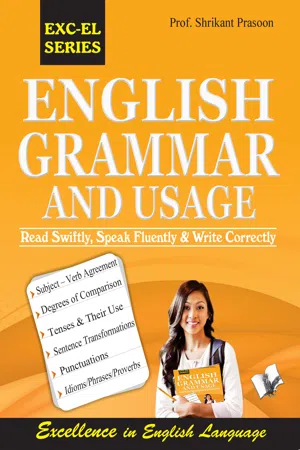
English Grammar And Usage is an altogether different and unique book for understanding and learning the language easily and quickly by writing and speaking innumerable readymade sentences given in the book on each topic of Grammar, without actually studying English Grammar in detail and without the help of one's own mother tongue.
There are different types of Sentence Structures available in the book in the easiest possible forms that make it very user-friendly and interesting for readers of all age groups, especially the student section, who wish to know the language correctly and thoroughly.
The book is a result of insistent and practical research of around18 years by the author, when he was in the Solomon Public School accompanied by a number of teachers at various levels, and compiled together as one comprehensive book. Read on to find more…
#v&spublishers
eBook - ePub
English Grammar And Usage
Read swiftly, speak fluently and write correctly
- English
- ePUB (mobile friendly)
- Available on iOS & Android
eBook - ePub
About this book
Information
Chopter 1
Parts of Speech -An Introduction
Words are divided into different kinds or classes, called parts of speech, according to their use; that - is, according to the work they do in a sentence. The parts of speech are eight in number:
| 1. Noun | 2. Adjective | 3. Pronoun | 4. Verb |
| 5. Adverb | 6. Preposition | 7. Conjunction | 8. Interjection |
A noun is a word used as a name of a person, place or thing as:
Akbar was a great king. Kolkata is also called the ’ City of Joy’ .
The rose smells sweet. The sun shines brightly.
His courage won him honour.
Note: All the words in italics are Nouns.
An adjective is a word used to add something to the meaning of a noun; as,
He is a brave boy.
There are twenty boys in this class.
Note: The words in italics are Adjectives.
A pronoun is a word used instead of a noun; as,
John is absent, because he is ill.
The books are where you left them.
Note: The words in italics are Pronouns.
A verb is a word used to say something about some person, place or thing; as,
The girl wrote a letter to her cousin.
Kolkata is a highly populated city.
Iron and copper are useful metals.
Note: The words in italics are Verbs.
Is and are, also called helping verbs.
An adverb is a word used to add something to the meaning of a verb, an adjective or another adverb; as,
Note: The words in italics are called Adverbs.
He worked the sum quickly. (Here, it is adding to the meaning of a verb)
This flower is very beautiful. (Here, it is adding to the meaning of an adjective)
She pronounced the word quite correctly. (Here, it is adding to the meaning of an adverb)
A preposition is a word used with a noun or a pronoun to show how the person or thing denoted by the noun or pronoun stands in relation to something else as,
There is a cow in the garden.
The girl is fond of music.
A fair little girl sat under a tree.
Note: In, of and under are called Prepositions.
A conjunction is a word used to join words or sentences together to form a single sentence; as,
Rama and Hari are cousins.
Two and two make four.
I ran fast but missed the train.
Note: All the words in italics are Conjunctions.
An interjection is a word which expresses some sudden feeling; as,
Hurrah! We have won the game.
Alas! She is dead.
Note: The words, Hurrah and Alas are called Interjections.
As words are divided into different classes according to the work they do in sentences, it is clear that we cannot say to which parts of speech a word belongs to unless we see it used in a sentence. They arrived soon after. (Adverb)
They arrived after us. (Preposition)
They arrived after we had left. (Conjunction)
From the above examples, we see that the same word can be used in different parts of speech.

1. Name the parts of speech of each italicised word in the following sentences, giving in each case your reason for the classification:
1. Still waters run deep.
2. He still lives in that house.
3. After the storm comes the calm.
4. The after effects of the drug are bad.
5. It weighs about a pound.
6. He told us all about the battle.
7. He was only a yard off me.
8. Suddenly, one of the wheels came off.
9. Mohammedans fast in the month of Ramzan.
10. He kept the fast for a week.
11. He is on the committee.
12. Let us move on.
13. Sit down an...
Table of contents
- Cover Page
- Title Page
- Copyright Page
- Publisher’s Note
- Contents
- Part-I
- Chapter 1 What are Phrases and Clauses?
Trusted by 375,005 students
Access to over 1.5 million titles for a fair monthly price.
Study more efficiently using our study tools.
Frequently asked questions
Yes, you can cancel anytime from the Subscription tab in your account settings on the Perlego website. Your subscription will stay active until the end of your current billing period. Learn how to cancel your subscription
No, books cannot be downloaded as external files, such as PDFs, for use outside of Perlego. However, you can download books within the Perlego app for offline reading on mobile or tablet. Learn how to download books offline
Perlego offers two plans: Essential and Complete
- Essential is ideal for learners and professionals who enjoy exploring a wide range of subjects. Access the Essential Library with 800,000+ trusted titles and best-sellers across business, personal growth, and the humanities. Includes unlimited reading time and Standard Read Aloud voice.
- Complete: Perfect for advanced learners and researchers needing full, unrestricted access. Unlock 1.5M+ books across hundreds of subjects, including academic and specialized titles. The Complete Plan also includes advanced features like Premium Read Aloud and Research Assistant.
We are an online textbook subscription service, where you can get access to an entire online library for less than the price of a single book per month. With over 1.5 million books across 990+ topics, we’ve got you covered! Learn about our mission
Look out for the read-aloud symbol on your next book to see if you can listen to it. The read-aloud tool reads text aloud for you, highlighting the text as it is being read. You can pause it, speed it up and slow it down. Learn more about Read Aloud
Yes! You can use the Perlego app on both iOS and Android devices to read anytime, anywhere — even offline. Perfect for commutes or when you’re on the go.
Please note we cannot support devices running on iOS 13 and Android 7 or earlier. Learn more about using the app
Please note we cannot support devices running on iOS 13 and Android 7 or earlier. Learn more about using the app
Yes, you can access English Grammar And Usage by Prof. Shrikant Prasoon in PDF and/or ePUB format, as well as other popular books in Languages & Linguistics & Communication Studies. We have over 1.5 million books available in our catalogue for you to explore.