The hectic life in Paris was too much for Van Gogh to bear, and he was showing signs of mental stress induced by the strain of city life. The crowds, the intense social life, but also the booze got to him - absinthe in the afternoon, wine at dinner, free beer at the cafe-concerts and every hour in the evening his favorite cognac. When, in February 1888, he arrived in Arles, a city in Provence in southern France, he noticed he had almost become an alcoholic.
In Arles, the artist thought he had found the light of the South and slowly recovered. Even though he had never been in Japan, the landscape reminded him of Japan.
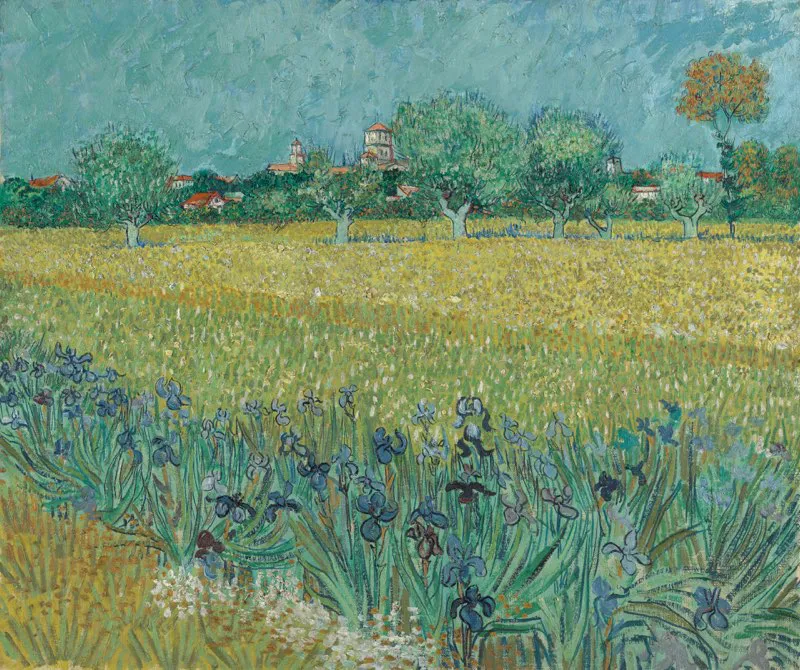
Light and above all color fascinated him, something his work clearly shows. He realized he could never imitate the sunny nature of the south with the somber, Hague School earth colors, so increased the intensity of the cheerful Impressionist colors he had got to know in Paris.
Vincent van Gogh, Field with Irises near Arles, oil on canvas, Arles, 1888 © Van Gogh Museum Amsterdam (Vincent van Gogh Foundation)
In Arles he would occasionally use pastel colors, but much more frequently he used intense reds, bright yellows, blues and greens, sometimes straight from the tube. In Arles he created an astonishing number of drawings and paintings, including his greatest landscapes and portraits.
Van Gogh was very conscious of the relationship between color and emotion and exploited this masterfully. It is especially his use of color that makes him stand out as an artist. Even nowadays, the pictures are remarkable for their wealth of colors. Imagine, that they used to be much stronger at the time of conception! Van Gogh knew they would fade, and incorporated this knowledge in his paintings.
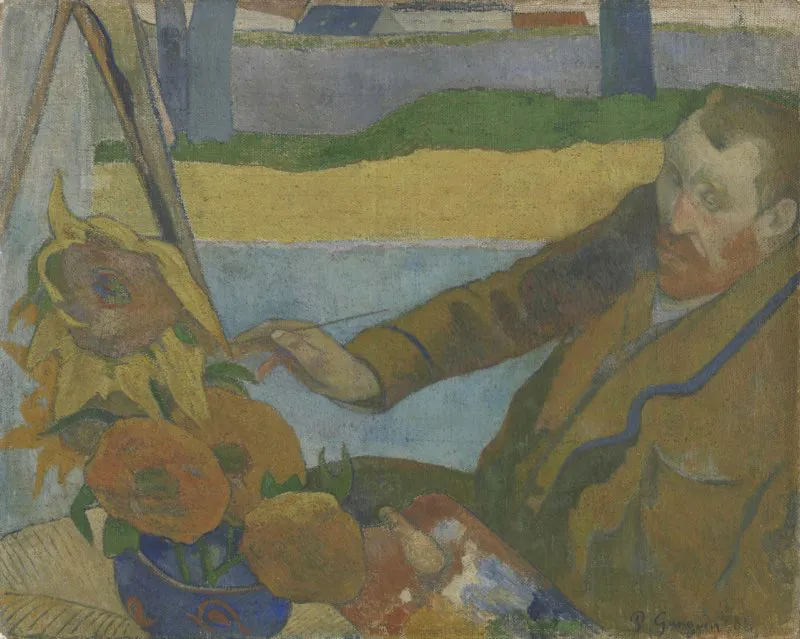
Paul Gauguin, Vincent van Gogh Painting Sunflowers, Arles, 1888 © Van Gogh Museum Amsterdam (Vincent van Gogh Foundation)
His art really matured in the south, creating nature based on instinct, without pretensions or logic, just the way he felt it. He did not try to imitate reality, but recreated what he saw, involving his imagination. In this process colors became symbols. Red and green, for instance, were used to convey human passions. A face could very well be green and orange if he thought those colors matched his feelings. He felt that all of reality was symbolic. He wrote the following to his friend and fellow artist Emile Bernard:
“I couldn't care all that much about the veracity of colors as long as they satisfy the yearning for infinity."
It was in Arles that he produced the most beloved paintings of his entire oeuvre: The Sun Flowers, The Arlésienne, The Bedroom, fascinating self-portraits and the magnificent fields of La Crau.
His paintings of wheat fields are true symphonies in gold. These are all masterpieces that are rightly considered the climax of his career. Van Gogh had found his style and was going full speed ahead artistically. After eight years, he was at the height of his powers, expressing the true essence and character of the subjects he had observed.
Van Gogh considered himself a painter of figures and portraits, even though he seems at his best as a landscape painter, capturing both nature's beauty in dazzling colors and his most inner emotions. He worked on portraits as often as he got the opportunity:
"I sometimes think myself [portraits] are more serious and better than the rest of my work."
Works from the Arles period rank as the highest when it comes to being appreciated. However, at the time they were not understood nor appreciated. His art, with its distorted and exaggerated shapes, forms and harsh colors, has been perceived as the work of a madman. Van Gogh was extremely sensitive to visual stimuli. "C'est un fou", is what people said.
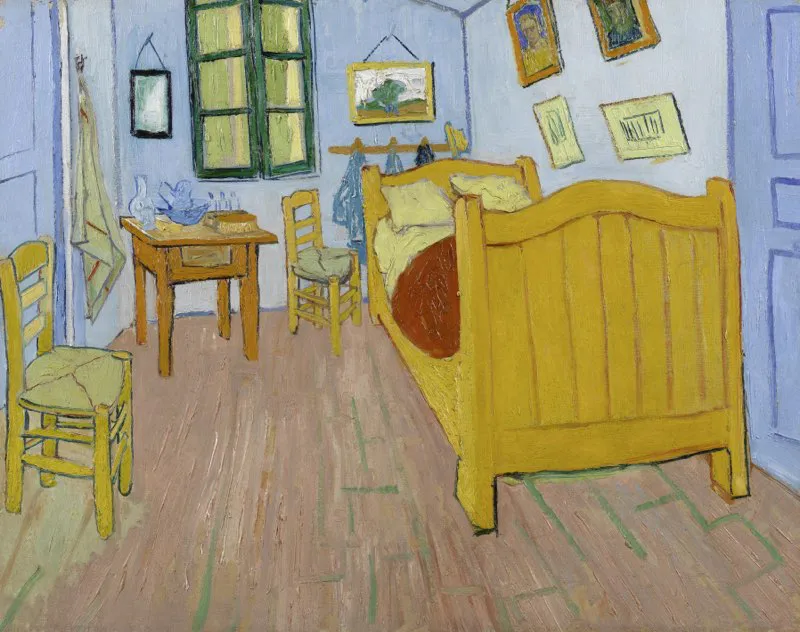
Vincent van Gogh, The Bedroom, oil on canvas, Arles, October 1888 © Van Gogh Museum Amsterdam (Vincent van Gogh Foundation)
ABOUT THE PICTURE: Van Gogh's bedroom in the Yellow House in Arles. Van Gogh dreamed of founding an artist's colony in his Yellow House in which kindred spirits could work and live together. Exhausted after a week working like a madman outside in the fields, he stayed inside hiding from a violent mistral (a fierce, cold wind coming from the north) and started work on the depiction of his own bedroom:
"This time it's simply my bedroom, but the colour has to do the job here, and through its being simplified by giving a grander style to things, to be suggestive here of rest or of sleep in general. In short, looking at the painting should rest the mind, or rather, the imagination. The walls are of a pale violet. The floor is of red tiles. The bedstead and the chairs are fresh butter yellow. The sheet and the pillows very bright lemon green. The bedspread scarlet red. The window green. The dressing table orange, the basin blue. The doors lilac. And that's all - nothing in this bedroom, with its shutters closed. The solidity of the furniture should also now express unshakeable repose. Portraits on the wall, and a mirror and a hand-towel and some clothes. The frame - as there's no white in the painting - will be white. This to take my revenge for the enforced rest that I was obliged to take. I'll work on it again all day tomorrow, but you can see how simple the idea is. The shadows and cast shadows are removed; it's colored in flat, plain tints like Japanese prints." [Letter 705, Arles, 16 October 1888]
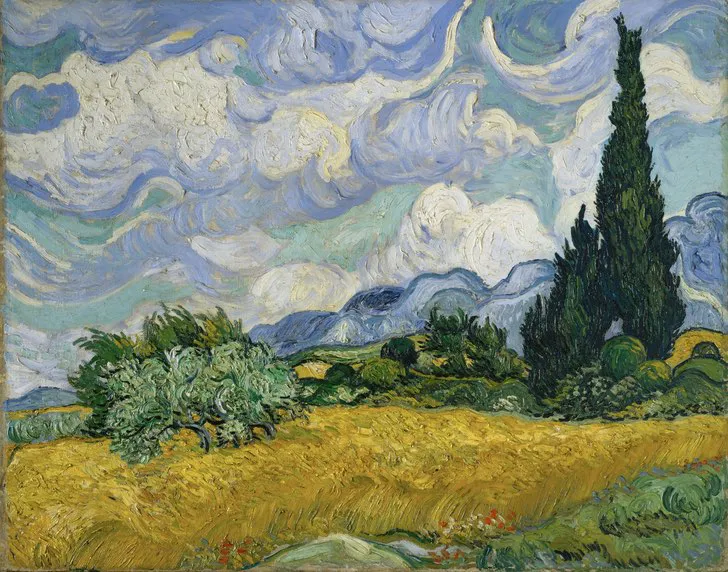
Vincent van Gogh, Wheat Field with Cypresses, oil on canvas, Arles, 1889 © Van Gogh Museum Amsterdam (Vincent van Gogh Foundation)
The way Van Gogh painted deserves some close attention. He painted quickly and intuitively, something which is clear when observing the paint surface, which is so lively! Some paintings look like they've been done in a fury. Turbulent emotions, frozen in paint..! His brushwork shows a rich variety.
Stand as close as possible to the pictures as you possibly can in order to follow his frantic brushstrokes: stripes, dots, commas, waves and many more variations. Because you can follow his movements you get the feeling of being part of the creative process. You are swept away by the paintings' dynamic, which almost jumps out at you. Big, fat blobs of paint, brush strokes filled with energy. What a sense of colour! You will be mesmerized by the curls and circular movements of the skies, or attracted by the piercing, probing eyes in the self-portraits.
It doesn't matter whether things are anatomically correct. For Van Gogh it was all about being truthful. You can feel the passion of an artist who gives his all without holding back. The works have been painted with so much speed and intensity that they come closest to the definition of art I adhere to: ‘art as stilled or captured emotion’. It is not for nothing that these paintings are regarded as the best he ever made.
Van Gogh loved exploring his surroundings on foot, working “laden like a porcupine with sticks, easel, canvas”. He would go out with his painting gear during the mistral and would paint a landscape in a single session! He always had a strong physique, painting in the wheat fields during the hottest part of the day without any problems. And you can almost feel the warmth of the sun when looking at the bright yellow ball in the clear blue sky.
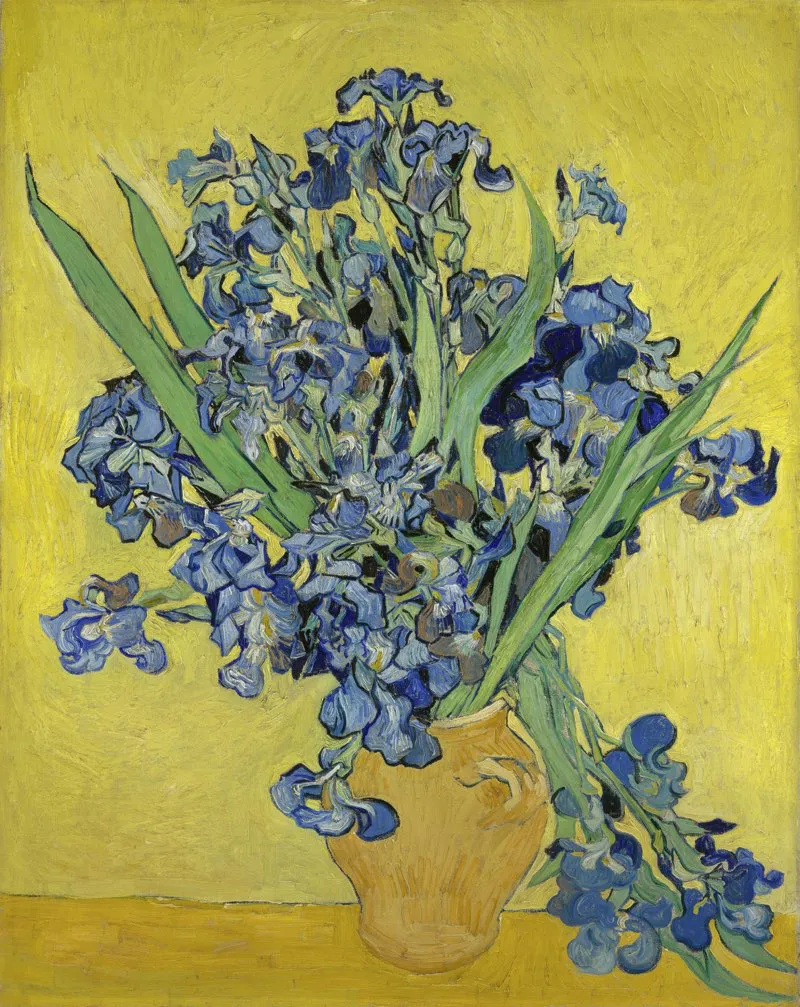
Vincent van Gogh, Irises, oil on canvas, Arles 1890 © Van Gogh Museum Amsterdam (Vinc...