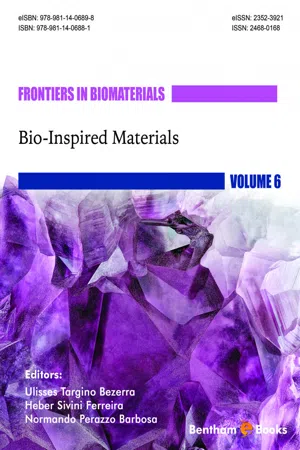
Nature has provided opportunities for scientists to observe patterns in biomaterials which can be imitated when designing construction materials. Materials designed with natural elements can be robust and environment friendly at the same time. Advances in our understanding of biology and materials science coupled with the extensive observation of nature have stimulated the search for better accommodation/compression of materials and the higher organization/reduction of mechanical stress in man-made structures. Bio-Inspired Materials is a collection of topics that explore frontiers in 3 sections of bio-inspired design: (i) bionics design, (ii) bio-inspired construction, and (iii) bio-materials. Chapters in each section address the most recent advances in our knowledge about the desired and expected relationship between humans and nature and its use in bio-inspired buildings. Readers will also be introduced to new concepts relevant to bionics, biomimicry, and biomimetics. Section (i) presents research concepts based on information gained from the direct observation of nature and its applications for human living. Section (ii) is devoted to 'artificial construction' of the Earth. This section addresses issues on geopolymers, materials that resemble the structure of soils and natural rocks; procedures that reduce damage caused by earthquakes in natural construction, the development of products from vegetable resins and construction principles using bamboo. The last section takes a look into the future towards the improvement of human living conditions. Bio-Inspired Materials offers readers - having a background in architecture, civil engineering and systems biology - a new perspective about sustainable building which is a key part of addressing the environmental concerns of current times.
eBook - ePub
Bio-Inspired Materials
- English
- ePUB (mobile friendly)
- Available on iOS & Android
eBook - ePub
About this book
Information
Topic
ArchitectureSubtopic
Architecture GeneralCurrent Developments and Future Needs for Natural Earth Construction: A State-of-the-Art Review
Ana Cecilia Vieira Nóbrega1, Normando Perazzo Barbosa2*
1 Department of Civil Engineering, Federal University of Pernambuco, Recife-PE, Brazil
2 Department of Civil Engineering, Federal University of Pernambuco, João Pessoa-PB, Brazil
Abstract
A more sustainable and conscientious world desires to go back in time to use environmentally friendly construction materials, earthen materials. However, the simplicity of such materials has not yet been properly addressed in either academic or field research; at the same time natural earth construction is far from mature. In this scenario, we summarize the development of natural earth construction during the last few years. Recent publications including a number of books and journals on natural building are reviewed, while emphasizing the impacts of field research. Controversies and gaps in understanding are identified, and we discuss the advances of these modern ideas through the years. Topics include a review of natural earth building; materials selection; property evaluation; academic and field studies; and a state-of-the-art review on current developments (Adobe, Compressed earth blocks, Cob, Rammed earth, Earthbag construction, Earth floors, and Earth wall finishes). Recent developments in standards for earthen building materials are also reviewed. This chapter concludes with perspectives and future needs in natural earth construction, those which may have significant impacts on the advancing field.
Keywords: Earth construction, sustainable building, stabilized earth, compressed earth block, rammed earth, natural building material.
* Corresponding author Normando Perazzo Barbosa: Department of Civil Engineering, Federal University of Pernambuco, Recife-PE, Brazil; Tel: 5583981467225; E-mail: [email protected]
1. INTRODUCTION
No material is more bio-inspiring and simpler than the earth. For thousands of years, humanity has had very little understanding concerning earthen material properties. As a consequence, the stigmas associated with earthen materials have generally included: failures in durability [1], low resistance strength [1], high shrinkage or cracking [1], and low mechanical strength [2] among others.
However, this view has been changing with time. Currently, for example in the Southwest United States and other arid regions, Adobe and rammed earth constructions are resurfacing [3]. Globally, 40 percent of the world's population is housed in earthen shelters [3].
Today we understand that simplicity in earthen constructions need not be related to failures in academic or field research. Yet even though research has increased together with technical knowledge, the field is undoubtedly not completely established.
The objective here is not to define earthen techniques or demonstrate applications; or much less teach construction techniques or give tips for a successful installation; our goal is to provide a state-of-the-art review, a kind of timeline based on remaining controversies or gaps in understanding, on innovations and how to preserve the past conservatory ideas, on how the standards have matured or not, and on perspectives and future needs regarding earth building.
We hope that this review has a significant impact towards advancing the field.
2. AN OVERVIEW OF NATURAL EARTH BUILDING
Earthen buildings remember primordial humanity. Through time, with the advent of concrete and other building materials in certain places and conditions, earthen buildings have often been forgotten. Over time, their advantages, such as sustainability, green-thinking and a more conscientious relationship with the planet, have again redirected attention to earth construction, especially in developed countries.
However, earth construction is not viewed equally around the world. In most developing countries, an earth based building is used to minimize housing problems, as in for example stabilized earth construction, which is discussed in reference [4]. Earth construction remains associated with health problems, since empty living spaces often house Barber bugs, an insect responsible for transmission of Chagas' disease. When located in tropical climates with poor and precarious populations, this problem is accentuated.
In developed countries on the other hand, key-words such as technological advancement, industrialization, healthy indoor environments, energy efficiency, long-life, durability, low maintenance, improved acoustics, improved seismic stability and fire barriers are now associated with modern earth building [5]. A complete overview of modern earth building in developed countries can be seen in a study referenced as [5].
There have been discussions in the literature about using stabilized or unstabilized earth construction for contemporary urban housing [6]. In the case of construction to alleviate urban housing crises, Zami and Lee [6] suggest adopting an appropriate stabilized earth construction such as: rammed earth or compressed stabilized earth blocks, stabilized Adobe or other contemporary stabilized earth construction techniques.
3. SOIL - MATERIALS SELECTION FOR EARTH CONSTRUCTION
An excellent review on sourcing, extraction, and classification of natural soils (also called natural earth or naturally occurring clay, as well as defining construction soils is readily available [7].
Soil composition is essential to the properties of earth construction [8]. We know that to correct construction soils (addition of ...
Table of contents
- Welcome
- Table of Contents
- Title
- BENTHAM SCIENCE PUBLISHERS LTD.
- PREFACE
- List of Contributors
- Bio-Pulse Oscillations Driven Design of Kinetic Structures
- Truss Material Reduction Provided by the Golden Ratio
- Complexity and Adaptability in Nature and Society
- Without Inner Walls: A Concept of the Café’s House
- Similarity Between Particle Packing in Concrete and in Nature
- Current Developments and Future Needs for Natural Earth Construction: A State-of-the-Art Review
- Bio-inspired Design with Bamboo
- Frontiers in Bio-Inspired Mineralization: Addressing Mimesis of Four-Dimensional, Hierarchical, and Nonclassical Growth Characteristics of Biominerals
- Sustainable and Safe Construction Biomaterials: Biocements and Biogrouts
- Interaction Between Natural Fibres and Synthetic Polymers
Trusted by 375,005 students
Access to over 1.5 million titles for a fair monthly price.
Study more efficiently using our study tools.
Frequently asked questions
Yes, you can cancel anytime from the Subscription tab in your account settings on the Perlego website. Your subscription will stay active until the end of your current billing period. Learn how to cancel your subscription
No, books cannot be downloaded as external files, such as PDFs, for use outside of Perlego. However, you can download books within the Perlego app for offline reading on mobile or tablet. Learn how to download books offline
Perlego offers two plans: Essential and Complete
- Essential is ideal for learners and professionals who enjoy exploring a wide range of subjects. Access the Essential Library with 800,000+ trusted titles and best-sellers across business, personal growth, and the humanities. Includes unlimited reading time and Standard Read Aloud voice.
- Complete: Perfect for advanced learners and researchers needing full, unrestricted access. Unlock 1.5M+ books across hundreds of subjects, including academic and specialized titles. The Complete Plan also includes advanced features like Premium Read Aloud and Research Assistant.
We are an online textbook subscription service, where you can get access to an entire online library for less than the price of a single book per month. With over 1.5 million books across 990+ topics, we’ve got you covered! Learn about our mission
Look out for the read-aloud symbol on your next book to see if you can listen to it. The read-aloud tool reads text aloud for you, highlighting the text as it is being read. You can pause it, speed it up and slow it down. Learn more about Read Aloud
Yes! You can use the Perlego app on both iOS and Android devices to read anytime, anywhere — even offline. Perfect for commutes or when you’re on the go.
Please note we cannot support devices running on iOS 13 and Android 7 or earlier. Learn more about using the app
Please note we cannot support devices running on iOS 13 and Android 7 or earlier. Learn more about using the app
Yes, you can access Bio-Inspired Materials by Ulisses Targino Bezerra,Heber Sivini Ferreira,Normando Perazzo Barbosa, Ulisses Targino Bezerra, Heber Sivini Ferreira, Normando Perazzo Barbosa in PDF and/or ePUB format, as well as other popular books in Architecture & Architecture General. We have over 1.5 million books available in our catalogue for you to explore.