Walking bass is an essential element in blues and jazz music. The walking bass hitting a new note on every beat of each bar is a moving force in this kind of music. However, as a solo pianist it can be tricky to get the left hand going while playing melody, harmony or even a solo in the right hand. This book will walk you through some of the common walking bass lines starting with easy blues patterns and progressing to more advanced jazz lines. It will guide you with some simple rules to make your own bass lines and it will bend the rules to make more interesting lines as well. Audio files are available at www.jesperkaae.com
- English
- ePUB (mobile friendly)
- Available on iOS & Android
eBook - ePub
About this book
Information
Subtopic
Jazz MusicEn
Introduction
Walking bass is an essential element in blues and jazz music. The walking bass characterized by a new note on every beat in the bar is a moving force that pushes the music forward and creates richness to the arrangement. In a jazz band the accompaniment of the pianist is often sparse, because of the richness of the bass.
But as a solo pianist you can create some of the same richness by playing a walking bass yourself. Many solo pianists stop developing their left hand after learning a basic octave bass and it may be challenging to play new notes on every beat in the bar in the left hand and at the same time play the melody and harmony or even improvise a solo in the right hand. But the effort will pay off as rich sounding blues and jazz melodies and as a bonus you can fire the other band members.
The arrangements in this book have a progression going from easy to intermediate and going from blues towards jazz and ends with a brief introduction to other genres. We will look at some simple but effective rules for making great walking bass lines and we will bend the rules again to create even more interesting lines.
Audio files for all examples in this book are available at www.jesperkaae.com
To
Chord based walking bass
When playing chords on the piano each chord can have different inversions. A triad can be played in root position or in two different inversions. Extended chords have even more inversions.
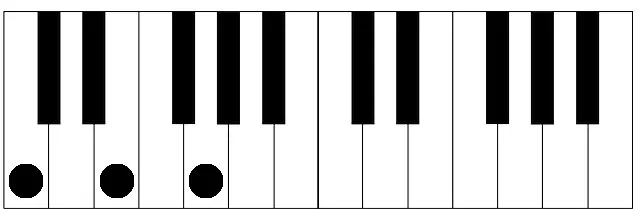
Root position
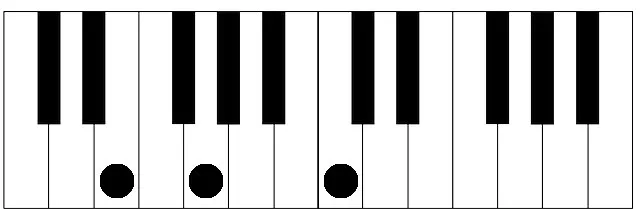
First inversion
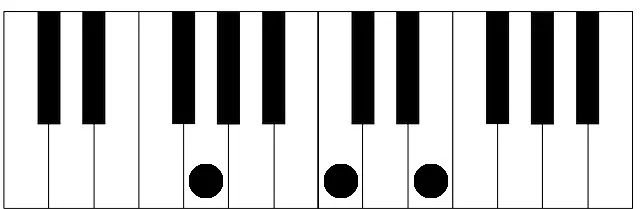
Second inversion
In order to define any chord played by the right hand on the piano we use the left hand to establish and to emphasize the chord. Often you don’t play the root note in the right hand when playing blues and jazz. Therefore the root note is the most important note to play in the left hand, and you do not necessarily have the same freedom in choosing inversions even though other notes can be used as well.
Ex. 2a
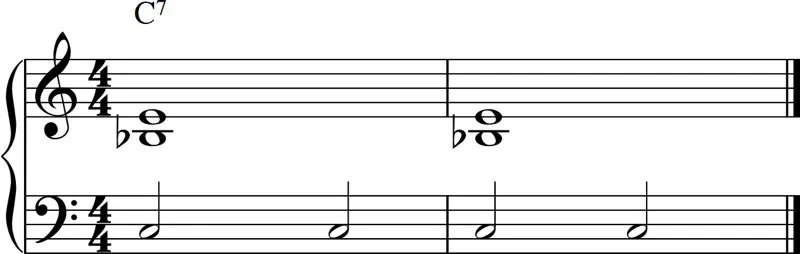
However, there isn’t much walking in playing the root note only. If we include one more note we can create an alternating bass.
Ex. 2b
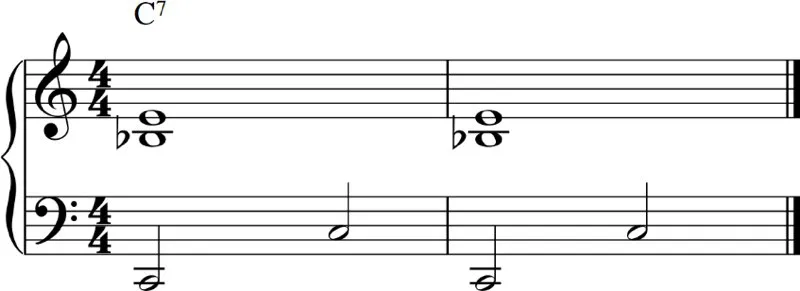
By alternating between the root and the octave the bass starts moving but it’s more jumping up and down than actually walking. That doesn’t mean that note repetitions and octaves can’t be used in walking bass lines as we shall see later but we still need some other notes to make the bass walk.
The most common note to alternate between in the bass is the fifth. Alternating bass is often used in country, folk, and bluegrass music but is very common in blues and jazz as well. What is also referred to as a two beat bass is here sometimes seen in combination with a four beat walking bass.
Ex. 2c
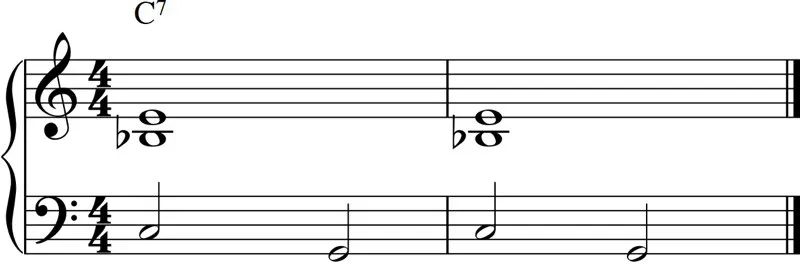
Still the bass doesn’t really walk. Maybe waddling is a better word, even though two beat bass lines have a really nice feel to them. Later on we will have a look at some ways to improve the two beat bass by adding ornamentation.
Now let’s walk. We start with a walking bass based entirely on chord notes. In a blues in C the chords would be C, F and G with a minor seventh added to all the chords. Chords are made by st...
Table of contents
- Copyright
- 1. Introduction
- 2. Chord based walking bass
- 3. Scale based walking bass
- 4. Approach notes
- 5. The 3 rules of thumb
- 6. The 2-5-1 progression
- 7. Ornamentation
- 8. Endings
- 9. Other intervals
- 10. Bebob scales
- 11. Standards
- 12. What you can’t do
- 13. Other genres
- Also By
Trusted by 375,005 students
Access to over 1.5 million titles for a fair monthly price.
Study more efficiently using our study tools.
Frequently asked questions
Yes, you can cancel anytime from the Subscription tab in your account settings on the Perlego website. Your subscription will stay active until the end of your current billing period. Learn how to cancel your subscription
No, books cannot be downloaded as external files, such as PDFs, for use outside of Perlego. However, you can download books within the Perlego app for offline reading on mobile or tablet. Learn how to download books offline
Perlego offers two plans: Essential and Complete
- Essential is ideal for learners and professionals who enjoy exploring a wide range of subjects. Access the Essential Library with 800,000+ trusted titles and best-sellers across business, personal growth, and the humanities. Includes unlimited reading time and Standard Read Aloud voice.
- Complete: Perfect for advanced learners and researchers needing full, unrestricted access. Unlock 1.5M+ books across hundreds of subjects, including academic and specialized titles. The Complete Plan also includes advanced features like Premium Read Aloud and Research Assistant.
We are an online textbook subscription service, where you can get access to an entire online library for less than the price of a single book per month. With over 1.5 million books across 990+ topics, we’ve got you covered! Learn about our mission
Look out for the read-aloud symbol on your next book to see if you can listen to it. The read-aloud tool reads text aloud for you, highlighting the text as it is being read. You can pause it, speed it up and slow it down. Learn more about Read Aloud
Yes! You can use the Perlego app on both iOS and Android devices to read anytime, anywhere — even offline. Perfect for commutes or when you’re on the go.
Please note we cannot support devices running on iOS 13 and Android 7 or earlier. Learn more about using the app
Please note we cannot support devices running on iOS 13 and Android 7 or earlier. Learn more about using the app
Yes, you can access Piano Walking Bass by Jesper Kaae in PDF and/or ePUB format, as well as other popular books in Media & Performing Arts & Jazz Music. We have over 1.5 million books available in our catalogue for you to explore.