As an indie author, you’re looking for more readers. What do we talk about when it comes to marketing and driving sales for our books? Find your readers, reach your readers, go where your readers are. And who goes to libraries? The most avid of readers.
Your keenest readers are likely to be already in the library.
Does it surprise you to know that Americans, for example, go to the library more often than they go to the movies (1.35 billion visits to the library compared to 1.24 billion movie theater admissions). 1
According to Pew Research Center, 46 percent of adults ages eighteen and older report visiting a public library or bookmobile in the previous year.2 And our largest demographic cohort, Millennials, are more likely to have done so than any other generation, using the library not just to borrow, but for discovery.
So if you’re looking to reach readers who are mobile and digital, libraries are the best place.
Up to 60 percent of millennials will check a book out of the library and go buy it after, in print or in digital. If you’re looking to grow readership, libraries are where readers are.
Alexis Petric-Black, Overdrive
Petric-Black, in conversation with ALLi at Digital Book World 2019, says when a library buys your book, it’s like they’re paying you to market your book.
Libraries are not going to allow you to retire early, but they will allow you to get money to get income and advertise your book for free. When you think of every single library and they all have a new in this week, new in this month, a librarian pick, you know whenever it comes out, you will be on the front page of a library's website.
Amy Collins, New Shelves Books
Research by BookNet Canada and reported in 2019 by Porter Anderson in Publishing Perspectives3 suggests that library patrons buy three times as many books as compared to book buyers who do not visit libraries.
BookNet’s research, while specific to Canada, also highlights that the public library is the fourth most popular way readers in general discover new books, especially ebooks and digital audio.
Librarians Love Books — and Authors
Most librarians love or are at least sympathetic to authors. Some are even authors themselves. It’s hard to think of another sector where staff think authors are the bee’s knees.
That makes librarians significant influencers in the book ecosystem. Even if a library only has one copy of your book, word of mouth and reviews from a librarian cannot be underestimated.
How Many Libraries Are There?
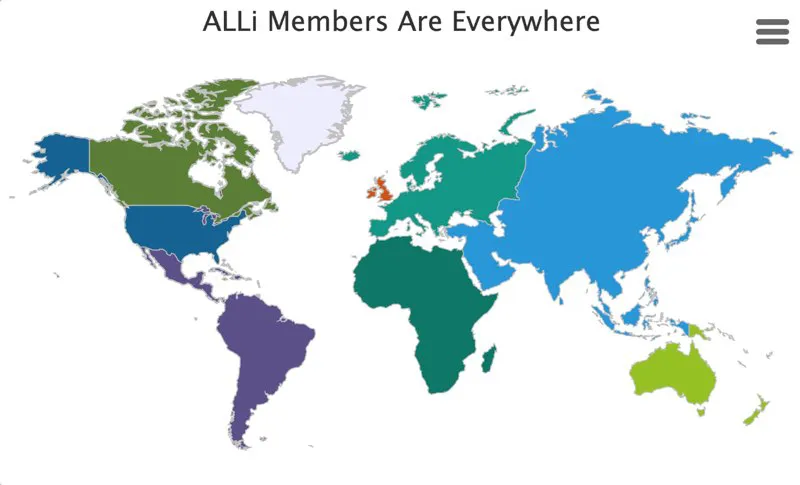
Just as you can find ALLi (Alliance of Independent Authors) members on all continents, libraries of all kinds are to be found everywhere.
There are 2.5 million4 national, academic, public, community, school and corporate libraries worldwide and they’re an important cultural touchstone for readers and writers alike.
- The US has more than 98001 public libraries.
- Canada has over 3300.
- In South and Central America, examples include Mexico, with 7160 public libraries, Colombia with 1609, Argentina with 1545, and Brazil with 6545.
- On the African continent, South Africa has 1800 public libraries, Morocco has 600, Ghana 257 and Ethiopia 249.
- In the EU, Ireland has 348, Italy 7000, France 3410, Poland 8290, Germany 8195, Switzerland 2000, Belgium 641.
- The UK, at the time of this writing on the brink of Brexit, there are 4100 public libraries.
- China, Russia, India, and Ukraine boast the most public libraries, with 51,311, 46,000; 29,800; and 18,323 respectively. Iran has 3950, Thailand 2116 and the Philippines 1224.
- And finally, at the right-hand side of our map, we have Australia with 1429 public libraries and New Zealand with 296. 5
How Do Libraries Know About My Book?
As ever, when you want somebody to order your book there are two things you have to consider: distribution and marketing. You need ways for libraries to learn that your book exists, and you need ways to make your books available to library buyer who is interested.
Having good metadata — that’s BISAC code, categories, and keywords—of your book is vital to your book’s discovery in the library system, as in bookstores.
Book distributors send a metadata feed to its distribution partners (See Chapter 3 Getting Paid: How Libraries Buy Books). A store or library can search for your book and see its metadata. This ensures it appear in relevant searches, but this in itself probably won’t be enough to sell your book to a library.
Libraries, like other retailers, can’t order a book that they don’t already know about. So marketing and promotion activities are as important with libraries as they are anywhere else that you wish to sell your book, or let people know it exists.