In rehabilitation medicine, the therapeutic application of vibration energy in specific clinical treatments and in sport rehabilitation is being affirmed by a growing number of medical professionals. Clinical applications of mechanical vibrations exist in a variety of forms: mechanical vibrations, ultrasound therapy, extracorporeal shock waves therapy and Extremely Low Frequency (ELF) magnetic field therapy, for example. Each mode of therapy has a specific mechanism of action, dose and indication. However, the enormous potential of vibrations as therapy (understood as ESWT, mechanical vibration, ultrasounds, ELF) have yet to be explored in depth in both the experimental and in the clinical setting. The Mechanical Vibration: Therapeutic Effects and Applications is a monograph that presents basic information about vibrational therapy and its clinical applications. Readers will find information about the mathematical, physical and biomolecular models that make the foundation of vibrational therapy, applied mechanical vibrations in different form (whole body, ultrasound and extracorporeal shock waves) as well as an update on vibrational therapy in general.
This monograph is a useful resource for medical professionals and researchers seeking information about the basics of vibrational therapy.
- English
- ePUB (mobile friendly)
- Available on iOS & Android
eBook - ePub
The Mechanical Vibration: Therapeutic Effects and Applications
About this book
Information
The Applied Mechanical Vibration as Ultrasound Energy
Rosa Grazia Bellomo1, *, Simona Maria Carmignano2, Raoul Saggini3
1 Physical and Rehabilitation Medicine, Department of Medical Oral and Biotechnological Sciences, “Gabriele d’Annunzio” University, Chieti-Pescara, Italy
2 School of Specialty in Physical and Rehabilitation Medicine, “Gabriele d’Annunzio” University, Chieti-Pescara, Italy
3 Physical and Rehabilitation Medicine, Department of Medical Oral and Biotechnological Sciences, Director of the School of Specialty in Physical and Rehabilitation Medicine, “Gabriele d’Annunzio” University, Chieti-Pescara, Italy; National Coordinator of Schools of Specialty in Physical and Rehabilitation Medicine
Abstract
Ultrasound is a form of mechanical energy transmitted through and into biological tissues as an acoustic pressure wave at frequencies higher than that of the upper limit of human hearing, and it is used widely in medicine as a therapeutic, operative, and diagnostic tool.
Therapeutic US has a frequency range of 0.75-3 MHz, with most machines set at a frequency of 1 or 3 MHz.
Ultrasound can produce many effects other than just the potential heating effect, acting as a mechanotransduction, a complex biological process that involves the spatial and temporal orchestration of numerous cell types, hundreds if not thousands of genes, and the intricate organization of the extracellular matrix. The intensity or power density of the ultrasound can be adjusted depending on the desired effect and the target tissue.
Keywords: Aesthetic applications, Cavitation, Dosimetry, Non-thermal effects, Phonophoresis, Reparative and Regenerative medicine, Thermal effects, Ultrasound.
* Corresponding authors Rosa Grazia Bellomo: Physical and Rehabilitation Medicine, Department of Medical Oral and Biotechnological Sciences, “Gabriele d’Annunzio” University, Chieti-Pescara, Italy; Tel: 03908713555306; Fax: 03909713553224; E-mail: [email protected]
INTRODUCTION
Methods to generate and detect ultrasound (US) first became available in the United States in the 19th century; however, the first large-scale application of US was for navigation of submarines during World War II. In the SONAR, a short
pulse of US is sent from a submarine through the water, and a detector picks up the echo of the signal. Sound waves are sent out, they returned to the sender “ping” qualities.
In the 1920s it was also observed that extremely high-pressure waves were damaging to living tissues. As early as the 1930s, low intensities of therapeutic US were used for the first time in physical medicine to treat soft tissue conditions with mild heating. Today therapeutic US is a commonly used modality in therapy clinics, applied for its deep heating ability. However, therapeutic forms of US that are available in the twenty-first century are capable of many more applications than providing just deep heating.
PHYSICAL CHARACTERISTICS OF US
Sound is a vibration that propagates as a mechanical wave from a source to a receiver (for example, the ear), through a medium such as air or water. US consists of a mechanical vibration very similar to sound wave, its frequency is greater than 20 kilohertz (20,000 hertz), which represents the threshold of human hearing [1]. The wave specific feature is that the particles of the medium oscillate around a position of equilibrium, this generates movements of the collision between a particle and the other generating a series of similar reactions. A desk ornament, sometimes called Newton’s cradle (Fig. 1), illustrates some principles of this type of energy transfer. It consists of a frame with five metal balls suspended through wires from a horizontal bar so that they touch each other at rest. If one lifts and releases the first ball, the mobile will set in motion. When the first ball swings back into place it bumps into the next ball, which in turn bumps into the one after it. In this way, the energy is transferred from ball to ball. Because the last ball is unopposed, it swings out into space; however, when it drops back into line, a new cycle is set in motion [2].
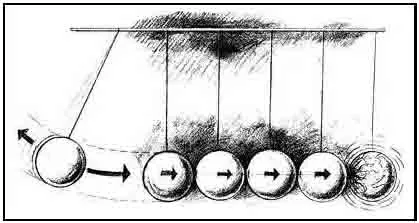
Newton’s cradle. From: http://www.bookvip.net/shock-wave-physics.html.
Waves can travel through media as longitudinal, transverse, and standing waves. When the particles of a medium are compressed and decompressed in the direction that a wave travels, it is termed as longitudinal wave. When particle movement is at right angles to the direction of travel, it is termed as shear or transverse wave (Fig. 2) [3, 4]. Shear waves propagate or start more readily in solids, and longitudinal waves in liquids and gases.
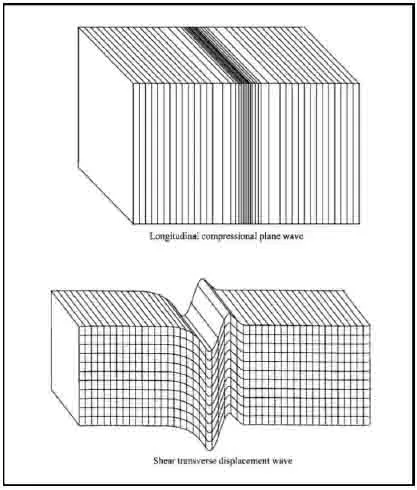
Two examples of acoustic pulses, travelling from left to right. The media on either side of the wave pulse is in the equilibrium position: that the right of the pulse has not yet been disturbed, and that on the left has returned to equilibrium after the oscillations associated with the pulse have damped down. The depicted waves are the longitudinal (compressional) plane wave and the shear (transverse displacement) plane wave. Modified From: Timothy G. Leighton “What is ultrasound?” Progress in Biophysics and Molecular Biology 93 (2007) 3–83.
US can also be defined by the following physical parameters that characterize the wave:
- Frequency: It is defined as the number of cycles per second (Hz They are defined ultrasound because the frequency is greater than that perceived by the human ear (15-20,000 Hz). The frequencies used in therapy typically range between 1.0-3.0 MHz [5]. Generally, therapeutic US has a frequency between 0.7-3.3 MHz, to maximize energy absorption at a depth of 2 to 5 cm of soft tissue.
- Wavelength: is the distance covered by the wave in an ultrasonic period that is the time (usually measured in seconds) that it takes for one cycle. The period is the reciprocal of frequency:
where f is the frequency, T is the period;
- Velocity: it represents the velocity of wave propagation in 'unit of time of the period. It varies depending on the quality of the medium in which they propagate. For example, in a saline solution, the velocity of US is approximately 1500 m/sec compared with approximately 350 m/sec in air (sound waves can travel more rapidly in a more dense medium (from: http://joemanu. free.fr/taratata/) The velocity of US in most tissues is thought to be similar to that in saline. The mathematical representation of the relationship is
where v is the velocity, f is the frequency and λ is the wavelength;
- Amplitude: is the distance to from one peak to other one; it is relative to the amount of energy transported;
- Intensity: the intensity registered on a US unit during the delivery of US indicates the intensity delivered during each pulse (W/cm2), that is the amount of energy flowing in the time unit through a surface of unit area, perpendicular to the direction of wave propagation:
where P is the ultrasonic power, A is the surface area of transducer. The intensity can range over time if it employs continuous wave or pulsed wave. In particular, the presence of a pulsed field brings a temporal variation, and define a duty cycle, as the ratio between the pulse duration US (in time units) and the length of the period, calculated as a percentage [6, 7] (Fig. 3).
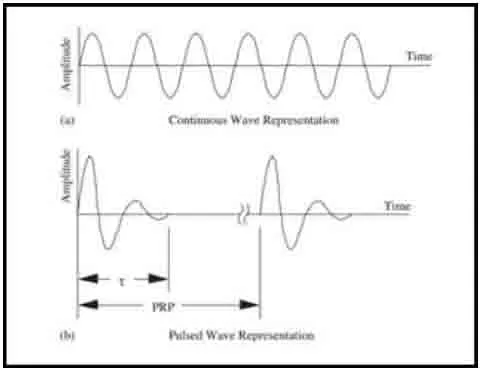
Schematic representations of continuous wave and pulsed wave US waveforms: (a) continuous wave representation and (b) pulsed wave representation. From: O’Brien WD Jr. US-biophysics mec...
Table of contents
- Welcome
- Table of Contents
- Title Page
- BENTHAM SCIENCE PUBLISHERS LTD.
- FOREWORD
- PREFACE
- ACKNOWLEDGEMENTS
- ABOUT THE EDITOR
- List of Contributors
- The Study of Vibrations: Mathematical Modelling and Classifications
- The Applied Mechanical Vibration as Whole-body and Focal Vibration
- The Applied Mechanical Vibration as Ultrasound Energy
- The Applied Mechanical Vibration as Extracorporeal Shock Wave
- The Electromagnetic Vibration: Physical Principles and Biomolecular Effects
- APPENDIX: Update on Therapeutic Applications of Vibrations
Trusted by 375,005 students
Access to over 1.5 million titles for a fair monthly price.
Study more efficiently using our study tools.
Frequently asked questions
Yes, you can cancel anytime from the Subscription tab in your account settings on the Perlego website. Your subscription will stay active until the end of your current billing period. Learn how to cancel your subscription
No, books cannot be downloaded as external files, such as PDFs, for use outside of Perlego. However, you can download books within the Perlego app for offline reading on mobile or tablet. Learn how to download books offline
Perlego offers two plans: Essential and Complete
- Essential is ideal for learners and professionals who enjoy exploring a wide range of subjects. Access the Essential Library with 800,000+ trusted titles and best-sellers across business, personal growth, and the humanities. Includes unlimited reading time and Standard Read Aloud voice.
- Complete: Perfect for advanced learners and researchers needing full, unrestricted access. Unlock 1.5M+ books across hundreds of subjects, including academic and specialized titles. The Complete Plan also includes advanced features like Premium Read Aloud and Research Assistant.
We are an online textbook subscription service, where you can get access to an entire online library for less than the price of a single book per month. With over 1.5 million books across 990+ topics, we’ve got you covered! Learn about our mission
Look out for the read-aloud symbol on your next book to see if you can listen to it. The read-aloud tool reads text aloud for you, highlighting the text as it is being read. You can pause it, speed it up and slow it down. Learn more about Read Aloud
Yes! You can use the Perlego app on both iOS and Android devices to read anytime, anywhere — even offline. Perfect for commutes or when you’re on the go.
Please note we cannot support devices running on iOS 13 and Android 7 or earlier. Learn more about using the app
Please note we cannot support devices running on iOS 13 and Android 7 or earlier. Learn more about using the app
Yes, you can access The Mechanical Vibration: Therapeutic Effects and Applications by Raoul Saggini in PDF and/or ePUB format, as well as other popular books in Medicine & Physiotherapy, Physical Medicine & Rehabilitation. We have over 1.5 million books available in our catalogue for you to explore.