eBook - ePub
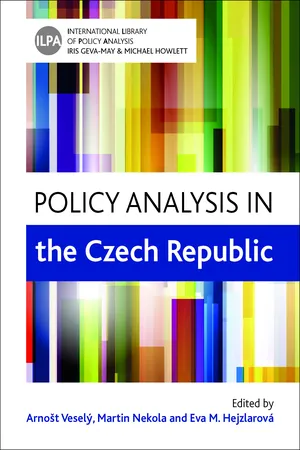
Policy Analysis in the Czech Republic
- 352 pages
- English
- ePUB (mobile friendly)
- Available on iOS & Android
eBook - ePub
Policy Analysis in the Czech Republic
About this book
Policy Analysis in the Czech Republic is a vital addition to the International Library of Policy Analysis series. It is not only the first comprehensive overview of the historical development and current state of policy analysis in the Czech Republic, but also in the post-communist Central and Eastern European region. As such, it provides a unique picture of policy analysis that in many respects profoundly differs from 'Western' policy analysis textbooks. Written by leading experts in the field – including practitioners – it outlines the historical development of policy analysis, identifies its role in academic education and research, and examines its varying styles and methods. This unique book offers indispensable reading for researchers, policy makers and students.
Information
ONE
Policy analysis in the Czech Republic: the state of the art
Introduction
Although there is no clear equivalent for policy analysis in the Czech language, production and use of policy-relevant information has a long tradition there. Located in the geographic centre of Europe, the country's culture has been influenced by different traditions. It still has some traces of the Austro-Hungarian epoch (1867-18), independent Czechoslovakia (1918-38), the German Protectorate (1939-45), the short intermezzo of post-war democratic Czechoslovakia (1945-48) and the totalitarian experience under Soviet influence (1948-89), though with periods of relative liberalisation (the second half of the 1960s). These are mixed with the post-communist transformation after the fall of socialism in 1989. The year 1989 indeed started the construction of a new social order from a strange mixture of components of various origins (Sztompka, 1996, p 120). While the theory related to the practice of policy analysis has been strongly influenced by an extensive import of ideas from the USA, the UK, Germany and other countries, the result of blending quite different traditions has led in many respects to the idiosyncratic nature of Czech policy analysis.
This book provides the first comprehensive review of the historical development and current state of the art of policy analysis in the Czech Republic. It discusses what is unique about it and what it shares with other countries. The aim of this introductory chapter is to provide the reader with the basic concepts used throughout the book (policy, policy analysis, public policy and so on), describe the structure of the book as well as the key research topics and questions that are dealt with. First, the problems with translating 'policy analysis' and 'public policy' are discussed and the practical and theoretical consequences of this are noted. Second, four different possible meanings of policy analysis in the Czech discourse are discerned: (1) policy analysis as policy studies; (2) policy analysis as institutionalised methodological practice; (3) policy analysis as any type of policy advising based upon relevant knowledge; (4) policy analysis as policy work. Third, we describe the structure of the book and provide a brief outline of the individual chapters, basic core themes and questions covered in the book.
Doing policy analysis without policy: intricacies of language and their consequences
Before delving into a description of the development of policy analysis in the Czech Republic, it seems only appropriate to define what is actually meant by this term. There are virtually hundreds of different definitions of policy analysis, and even more definitions of the concept of 'policy' (for example Birkland, 2001; Hill, 2009). These are, however, not very informative for our purposes. This is because the Czech language, similar to most other languages, does not have a clear equivalent for the concept of 'policy'. While the English language has three connected but distinct terms related to different aspects of the policy-making process (politics, polity and policy), the Czech language has only one concept: politika. This concept might denote (Fiala and Schubert, 2000): (a) the process of making politics/policy in which different interests and approaches clash and become more or less successful by means of conflict or consensus (that is politics), (b) the institutional and normative aspect of politics/policy - the existing or demanded specific political order and the overall design and orientation of the society (that is polity), (c) the content of the policy-making process - laws and regulations, programmes and so on that may have a direct impact on citizens (that is, policy).
In everyday discourse, the Czech word politika seems to be associated more with politics than policy or polity. If you say that you are analysing politika, for instance, most people would probably think that you are studying disputes among politicians, struggles of political parties to get into power and suchlike. True, politika as policy is also present in public discourse. For instance, it is not uncommon to hear that 'his/her politika went wrong', 'we need a new employment politika' and so on. In these cases,politika clearly denotes policy, and when translated into English, it is also translated in this way.
These linguistic intricacies have very direct consequences. It is, for instance, not very useful to translate policy analysis into Czech as 'analýza politiky' (analysis of politika). It would be too vague and could mean analysis of policy, politics or polity. For this reason, when Czech authors want to make it clear that they are writing about policy analysis in the Anglo-Saxon usage, they simply use policy analysis untranslated, or choose a longer expression. The first Czech policy analysis textbook (Veselý and Nekola, 2007), for instance, solved this problem by entitling the book Metody analýzy a tvorby politik (literally Methods of policy analysis and design). Adding these two words – methods and design – suggests to potential readers that the book is more about how to make and design politika (on the basis of analysis) than about how to analyse political parties, struggles for power and so on. The plural of 'policies', then, suggests not only that there are numerous public policies (in contrast to one politika) but also the prospective orientation; while numerous policies might be suggested for the future, the singular would imply the past (analysis of what already happened).
Non-existence of the concept of 'policy' has implications for other terms, especially for 'public policy' and 'policy-making process'. The term public policy is translated as veřejná politika, the term policy-making process usually as proces tvorby politiky. Although the concept of 'policy' in these phrases is translated into the otherwise multiple-meaning word politika, these expressions now seem to be rather well established, and the meaning of politika as 'policy' is generally assumed.1 One of the reasons is that public policy was institutionalised as early as in 1993, when the department of Public and Social Policy in the Faculty of Social Sciences at Charles University in Prague was established. Consequently, there have been masters' programmes in public and social policy for more than 20 years (and also PhD programmes for about 18 years). There are now more than 500 graduates in 'Public and Social Policy'. The concept of public policy (veřejná politika) is part of official documents (such as accreditation), research grants and so on.2
Veřejná politika (public policy) currently has at least two different meanings in the Czech language (Potůček, 2005). First, it denotes a social practice - that is, the processes of policy making that actually take place in real life (for example, the ways a law or a strategy emerges and is subsequently implemented). Although arguably public policy as a social practice has a long tradition in the Czech lands (see Chapters Two and Three), it started to be described as public policy only very recently. Second, veřejná politika denotes the academic discipline that studies policy-making processes. Thus, in the former meaning of the term, public policy is an object of inquiry (what is studied), while in the latter meaning public policy is the subject of inquiry (the discipline that studies this object).
Of course, this may, and does, cause different misunderstandings because other disciplines usually use two different terms to denote themselves and their objects of study, respectively. For example, sociology is concerned with the study of society and demographics with the development of population structure. However, as for public policy, we might say, without being tautological, that 'public policy is concerned with public policy'. This is farther complicated by the paradoxical situation of the Czech Republic, where understanding of public policy as a discipline in fact preceded understanding of public policy as a social practice. When public policy was established as an academic discipline in the Czech Republic, it was quite difficult to explain what theobject of inquiry of this discipline would be. Only gradually did the concrete meanings of public policy start to be clarified, and with that, along with the intensive inflow of translation and usage of English-language scholarly texts and political documents by Czech scholars and practitioners, veřejná politika slowly began to be used in public discourse to denote the actual social practice, too.
Four meanings of policy analysis
The mere fact that in the Czech language there is no equivalent for policy does not mean, of course, that policy analysis does not exist in the Czech Republic. On the contrary, as is argued throughout the book, many things that are associated with policy analysis (such as providing advice to politicians on the basis of systematic, in-depth analysis of social problems and proposals for their possible solution) have a long tradition in the Czech lands. In our experience, in the current Czech discourse at least four different meanings of policy analysis might be encountered:
1. policy analysis as policy studies: policy analysis as the description and explanation of policy-making processes;
2. policy analysis as institutionalised methodological practice: policy analysis as a systematic approach, usually based upon a 'step-by-step' methodology and a set of techniques which help to provide useful advice to the client, especially policy makers; it can have either a traditional or an interpretive account;
3. policy analysis as any type of policy advising based upon relevant knowledge: policy analysis as any systematic cognitive activity that seeks to improve the policy-making process by providing relevant knowledge and information;
4. policy analysis as policy work: policy analysis as any activity that seeks to positively influence the policy-making process.
The first possible meaning of policy analysis can be well demonstrated by the first Czech book with policy analysis in the title. It was written jointly by the Czech political scientist Petr Fiala and the well-known German scholar Klaus Schubert. The book is entitled Moderní analýza politiky. Uvedení do teorií a metody policy analysis (literally Modern analysis of policy: introduction to theories and methods of policy analysis). While acknowledging that policy analysis includes both 'knowledge of policy' and 'knowledge in policy', the authors clearly focus upon the former. They understand policy analysis as one of the sub-disciplines of political science, and describe different theories and approaches to the study of the policy-making process (such as the policy cycle, policy networks, policy arenas). The book is strongly influenced by the political science background of the authors and the German tradition of policy analysis (focusing upon policy-making theories). In their understanding policy analysis is similar to what is in Anglo-Saxon countries often labelled as 'policy studies' or 'policy process research'.
The second possible meaning of policy analysis can also be well demonstrated using the example of another book, in this case the previously mentioned first policy analysis textbook edited by Veselý and Nekola (2007). This textbook was strongly influenced by the 'step-by-step policy analysis' books by Dunn (2003), Bardach (2000), Patton and Sawicki (1993), Weimer and Vining (2005) and others. The authors follow what is sometimes in the European context referred to as the 'American style' of policy analysis. They understand policy analysis as a practical activity with the aim to produce knowledge and methodology for use in real policy making (that is, knowledge for policy). The book consists of two parts. While the first part introduces the foundations of policy analysis, the second part, consisting of eight chapters (such as problem definition, setting goals and evaluation criteria, identification of possible solutions), describes various methods and techniques that can be used in producing knowledge relevant for the policy-making process (such as problem tree analysis, stakeholder analysis, cost-benefit analysis). As in other countries, the positivist paradigm of rational step-by-step policy analysis was criticised and in response several Czech scholars argued for, and started to practise, more interpretive policy analysis. Policy analysis as an institutionalised methodological practice thus nowadays can have either the form of a 'step-by-step' approach based upon predominantly rational techniques (hereafter referred to as 'traditional policy analysis'), or the form of interpretive policy analysis based upon the assumption that the social world can be interpreted in many different ways (henceforth 'interpretive policy analysis').
Both the first and second perspectives on policy analysis, as policy studies and as institutionalised methodological practice (either traditional or interpretive), have clear foreign origins. While the first is inspired by the German tradition, the second draws heavily upon the Anglo-Saxon (especially American) or European (French, Dutch) traditions of policy analysis, respectively. Both approaches are nowadays to a certain degree institutionalised in instruction and research (the first approach mainly at Masaryk University in Brno, the second particularly at Charles University in Prague).3 We can thus assume that a not insignificant number of people in both academia and practice are now familiar with either the German or American/European tradition of policy analysis, and have some idea what policy analysis means in an international context.
Nevertheless, there is no doubt that in general only a minority of practitioners is familiar with either of the two meanings as previously discussed. Many of them simply do what could be labelled as policy analysis without actually knowing that their activities could be labelled as 'policy analysis'. If we restricted this book only to work done solely under the rubric of policy analysis, we would miss the bulk of work that closely adheres to the principles and ideas of policy analysis as it is practised and defined abroad. Therefore we can say that policy analysis in the Czech Republic can also have a third meaning: as any type of policy advising based upon relevant knowledge.
In this respect, it might be helpful the review the basic ideas which constitute policy analysis elsewhere. There are many competing definitions of policy analysis. Patton and Sawicki (1993, p 24) define policy analysis as 'a systematic evaluation of the technical and economic feasibility and political viability of alternative policies (or plans or programmes), strategies for implementation, and the consequences of policy adoption'. According to Weimer and Vining (2005, p 24) policy analysis denotes 'client-oriented advice relevant to public decisions and informed by social values'. Dunn (2003, pp 1-2) offers the following description:
Policy analysis is a problem-solving discipline that draws on theories, methods, and substantive findings of the behavioural and social sciences, social professions, and social and political philosophy ... policy analysis is a process of multidisciplinary inquiry that creates, critically assesses, and communicates information that is useful for understanding and improving policies.'
While these and similar definitions stress different aspects of policy analysis, they overlap on several points. First, policy analysis deals with real-life problems and problem situations. Second, it attempts to produce relevant knowledge about these problems, based upon sound methodology and the best available evidence (though taking into account practical limitations, such as time constraints). Third, it strives to provide useful and relevant advice (based upon this knowledge) to clients, usually decision makers. As argued ...
Table of contents
- Coverpage
- Title page
- Copyright
- Contents
- List of tables, figures and boxes
- Notes on contributors
- Acknowledgements
- Editors’ introduction to the series
- 1 Policy analysis in the Czech Republic: the state of the art
- Part One: The styles and methods of public policy analysis in the Czech Republic
- Part Two: Policy analysis by governments
- Part Three: Internal policy advisory councils, consultants, and public opinion
- Part Four: Parties and interest group-based policy analysis
- Part Five: Academic and advocacy-based policy analysis
Trusted by 375,005 students
Access to over 1.5 million titles for a fair monthly price.
Study more efficiently using our study tools.
Frequently asked questions
Yes, you can cancel anytime from the Subscription tab in your account settings on the Perlego website. Your subscription will stay active until the end of your current billing period. Learn how to cancel your subscription
No, books cannot be downloaded as external files, such as PDFs, for use outside of Perlego. However, you can download books within the Perlego app for offline reading on mobile or tablet. Learn how to download books offline
Perlego offers two plans: Essential and Complete
- Essential is ideal for learners and professionals who enjoy exploring a wide range of subjects. Access the Essential Library with 800,000+ trusted titles and best-sellers across business, personal growth, and the humanities. Includes unlimited reading time and Standard Read Aloud voice.
- Complete: Perfect for advanced learners and researchers needing full, unrestricted access. Unlock 1.5M+ books across hundreds of subjects, including academic and specialized titles. The Complete Plan also includes advanced features like Premium Read Aloud and Research Assistant.
We are an online textbook subscription service, where you can get access to an entire online library for less than the price of a single book per month. With over 1.5 million books across 990+ topics, we’ve got you covered! Learn about our mission
Look out for the read-aloud symbol on your next book to see if you can listen to it. The read-aloud tool reads text aloud for you, highlighting the text as it is being read. You can pause it, speed it up and slow it down. Learn more about Read Aloud
Yes! You can use the Perlego app on both iOS and Android devices to read anytime, anywhere — even offline. Perfect for commutes or when you’re on the go.
Please note we cannot support devices running on iOS 13 and Android 7 or earlier. Learn more about using the app
Please note we cannot support devices running on iOS 13 and Android 7 or earlier. Learn more about using the app
Yes, you can access Policy Analysis in the Czech Republic by Veselý, Arnošt, Nekola, Martin, Veselý, Arnošt,Nekola, Martin,Arnošt Veselý,Martin Nekola,Eva M. Hejzlarová in PDF and/or ePUB format, as well as other popular books in Politics & International Relations & Political Process. We have over 1.5 million books available in our catalogue for you to explore.