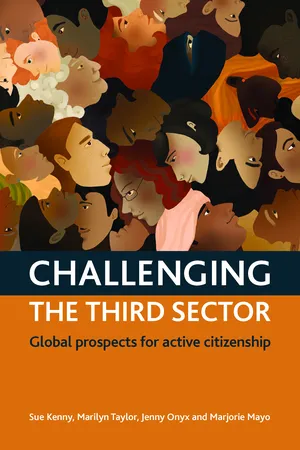
eBook - ePub
Challenging The Third Sector
Global Prospects For Active Citizenship
- 256 pages
- English
- ePUB (mobile friendly)
- Available on iOS & Android
eBook - ePub
Challenging The Third Sector
Global Prospects For Active Citizenship
About this book
This is the first book to explore the different relationships between active citizenship and civil society, particularly the third sector within civil society. In what ways can the third sector nurture active citizenship? How have the third sector and active citizenship been constructed and reconstructed both locally and internationally, over recent years? To what extent have new kinds of social connectedness, changing forms of political engagement and increasingly complex social and environmental problems influenced civil society action? Written by experts in the field, this important book draws on a range of theory and empirical studies to explore these questions in different socio-political contexts and will be a useful resource for academics and students as well as practitioners.
Information
Exploring concepts and contexts
TWO
Active citizenship
Introduction
To understand the contemporary idea of active citizenship we need to note the intellectual shift that was taking place in the social sciences during the 1980s, which focused attention on the importance of human agency in social change. At one level this shift was reflected in the growing interest in new social movements (Melucci, 1989; Touraine, 1988). At another level it found expression in new approaches to welfare. Giddens, for example, writing in Britain, argued for a ‘positive welfare’ approach (Giddens, 1994, p 152), which would recognise the role of self development and the importance of reflexive engagement with life chances and social security systems. This approach can be understood as setting the scene for self determination. However, it also provides a policy platform for ‘self responsibilisation’, requiring individuals to rely on their own resources and take individual responsibility for their own livelihoods. Indeed, Fuller et al (2008, p 157) argue that the emphasis on the self responsible, active citizen emerged in explicit contrast to the earlier needs-/rights-based notion of citizenship. Arguments for self responsibilisation and self help are easily crafted to accord with the principles of neoliberalism – a recurring theme throughout this book.
The refocusing of thinking about the role of human agency in social change has not been limited to Western societies. In other parts of the world, the failure of anti-poverty strategies organised around top-down structural economic adjustment policies led to a rethink of aid policies by international agencies (Chambers, 1983; Bhatnagar and Williams, 1992; Eade and Williams, 1995; World Bank, 2013). By the late 1990s many international development programmes were being reworked, emphasising new programmes for capacity building to ‘empower’ local people to develop and act upon their own policies to improve their lives.
Citizenship in theory
While we can trace the intellectual interest in human agency to the 1980s, the specific theoretical construction of human agents as active citizens has mainly come about through the field of citizenship studies. Much contemporary discussion and debate in citizenship studies has been informed by the writings of T. H. Marshall (1992) in the immediate post World War II years. For Marshall, citizenship denoted membership of a political community, with members entitled to equal rights and participation. He identified different dimensions of citizenship, which, he argued, became institutionalised in Britain in three stages, with a gradual extension of citizen rights from civil rights, to political rights, and then to social rights (Marshall, 1992, p 8). Thus, the eighteenth century saw the establishment of civil rights, including the right to freedom of speech and access to the legal system and justice. In the nineteenth century political rights, such as the right to participate in the political process, were developed (and extended in the twentieth century when women gained the right to vote). In the twentieth century social rights were established, such as the right to welfare and social security in times of sickness and unemployment, culminating in the development of the post war welfare state. The development of these three kinds of rights, which were to apply equally to all members of society irrespective of social differences, provided a means of mitigating the inequalities of social class.
Marshall’s concept of citizenship has been subject to considerable analysis and critique and some have called for a post Marshallian concept (Evers and Guillemard, 2013). Nevertheless, the following six aspects of Marshall’s treatment of citizenship are particularly important for the arguments in this book. These are: the need to distinguish between formal and substantive rights; the evolution assumption; the emphasis on individual rights; the stated-bounded framing of citizenship; the framing of the citizen as a passive recipient of rights; and ethnocentricity.
The first aspect for review is Marshall’s focus on citizenship as consisting of legal rights (Roy, 2005). Legal definitions and approaches to citizenship can be exclusionary. For example, those defined as non-citizens, such as asylum seekers and migrants sans papiers can be, and typically are, treated in discriminatory ways. But critics also argue that the Marshallian formulation failed to understand the importance of distinguishing between formal/legal equality and substantive equality, the latter required for the practical exercising of rights (Delanty, 2000). While they are equal members of a society under the law, many citizens do not have equal substantive membership of society and therefore equal access to rights, because of the structural disadvantages associated with their identity or circumstances, such as those based on gender, ethnicity and class. This has led to a questioning of the assumption that citizens can enjoy rights independent of context or identity. Feminists, for example, have criticised a failure to understand the ways in which women have been either excluded from citizenship entitlements or incorporated on the basis of their services in a patriarchal society (Dietz, 1987; Lister, 1997).
The second aspect for review is Marshall’s focus on an evolutionary framework of citizen rights (Turner, 1992). This linear evolutionary perspective ignores the often disjointed and contradictory nature of change and development. History shows that rights can be claimed and won only to be subsequently clawed back. Third, it could be argued that Marshall’s evolutionary view has paved the way for liberal interpretations of citizenship that are organised solely around individual rights and interests, as we discuss later in this chapter. However, Marshall himself defined citizenship in broader terms (Marshall, 1992, p 18), which incorporated the duty or obligation of civic participation. This understanding of citizenship has been taken up in the civic republican tradition, which is concerned with public political life and civic virtue. In this tradition, citizenship provides a common bond, a process through which individuals from diverse groups can practise civility. A major way of developing and sustaining citizenship today, in this view, is through associational life and, in particular, through involvement in third sector organisations (Turner, 2001; Warren, 2001).
The fourth aspect under review is the state-bounded framing of citizenship and its corollary, the idea that citizenship involves membership of a set political community. The conventional historical reference point in citizenship studies is the Treaty of Westphalia in 1648, this being the origin of the modern nation state. Citizenship relations have thus been primarily conceptualised as interactions between the state and the individual. However, people are now also beginning to think about and act out their social obligations as global citizens (Schattle, 2008, pp 3–4). Yet global citizenship is deemed to be problematic because there are no legal entities that have clear global authority to identify and fulfil rights and set out obligations in the same way as a nation state (a potential exception may be the International Court of Justice in The Hague). Turner (2001) argues, in regard to citizen rights within the nation state, that the three traditional routes to legal entitlements – participation in employment, military service and reproduction – have been eroded. However, there are ways of practising obligations and claiming rights other than with reference to legal authorities or through the legal edifice of the nation state. Substantive citizenship rights can be claimed and practised through people participating at different levels of society as local, national and transnational citizens, claiming the right of recognition and practising obligations based on a common humanity. Yaln-Heckman (2011, p 435) further points out how struggles over access to social rights, state resources and inclusion take many different shapes, based on the ‘multiple, political, and economic processes in post-socialist, post-colonial, post-totalitarian states and transnational fields’.
The fifth aspect of Marshall’s approach to citizenship for consideration is the construction of the citizen as a subject who passively receives privileges of citizenship that are bestowed from above (Marshall, 1992, p 28). Critics of this approach argue that the development of citizenship rights is a ruling class strategy for hegemonic control (Mann, 1987). As Turner (1992, pp 38–9) points out, Marshall failed to account for the role of conflict and struggle in the development of citizenship, in effect denying a role for active agents in these developments. A more dynamic approach to citizenship focuses on how people actively engage in society and how citizens are active and reflexive agents (Evers and Guillemard, 2013, p 48). From this perspective it is their engagement that makes people full members of society. In this view, much of the discussion of citizen engagement constructs the citizen agent as a person who is involved with political and social institutions in collective struggles, both to gain new rights and to give substance to existing rights (Lister, 1997, p 5). Active citizens participate in the identification of, and practices relating to, their obligations to both society and other citizens, just as they engage in claiming new rights.
The final challenge to Marshall’s legacy relates to its ethnocentricity, with citizenship conceptualised in terms of unified and homogenous sets of (Western) social arrangements (Giddens, 1982). As such, the Marshallian analysis fails to grasp the context-specific nature of citizenship. Citizenship studies have tended to focus on either the English-speaking world or Western societies, almost completely ignoring questions of citizenship elsewhere in the world. It is only recently that international studies have begun to investigate the wider applicability of this Western-framed notion of citizenship (Gaventa and Tandon, 2010). It does seem that, regardless of whether the term ‘citizenship’, or similar terms, are in common usage, notions of the rights and obligations of members of a society, however limited, do seem to have universal currency. What does change across time and different cultures is the content of rights and obligations and their applicability across gender and social groups.
Further empirical studies are needed to test the applicability of Western concepts of citizenship. However, noting the ethnocentrism embedded in much of the existing research into citizenship, some researchers argue for an approach that not only understands citizenship as a dynamic process, but also analyses the ways in which it takes shape, without reverting to the idea of citizenship as a singular or universal object, principle or desire (Neveu et al, 2011, p 945).
So, what are the implications of these debates for contemporary citizenship studies? First, they draw attention to the problems of conceiving of citizenship as a stable, singular object. Indeed, an important argument for a post Marshallian conception of citizenship rests on the observation that economies, societies, cultures and ways of being citizens in contemporary society are different from those at the time that Marshall was writing (Evers and Guillemard, 2013). Identity and difference have emerged as key issues in the social sciences, adding new dimensions to earlier preoccupations with issues of inequality in relation to social class (Delanty, 2000). The contemporary world has been affected by significant policy shifts, including, as noted earlier, the erosion of traditional means of claiming citizenship entitlements (Turner, 2001) and the changing roles of women (Lister, 1997). A key challenge, therefore, is to grasp the complexities and changing nature of citizenship (Gaventa and Tandon, 2010). Membership of a political community involves more than just simply claiming rights and fulfilling obligations. It involves complex sets of relationships between rights, duties, participation and identity (Delanty, 2000). These sets of relationships are affected by dominant ideologies, changing political configurations and in recent years, the forces of neoliberal globalisation. It is necessary, therefore, to probe configurations of active citizenship and ask how constructions of citizenship and perceptions of rights and obligations differ according to context.
Second, much of the discussion and debate in citizenship studies has been conceptual and theoretical. A wider appreciation is necessary, moving beyond the abstracted constructions of citizenship rights and obligations to empirical studies of substantive forms of citizenship in their varied settings. Indeed, the very idea of active citizenship underscores a substantive approach to the study of citizenship insofar as it takes the view that citizenship is concerned with the concrete practices of active citizens: how individuals and collectivities, as agents, construct their membership as citizens in any particular society; how they are supported and resourced (their rights); and how they contribute as active citizens (their obligations and duties). As well as understanding the contexts of active citizenship and acts of citizenship (Isin and Nielson, 2008, p 2), the study of citizenship also involves discerning the factors that facilitate and hinder acts of citizenship (Jochum et al, 2005; Robins et al, 2008; Brodie et al, 2011), as well as investigating struggles for recognition and redistribution (Isin and Turner, 2007, p 13).
What is needed is an approach that involves investigation of the ways in which people participate as members of society, defining and practising their rights and obligations, within subnational, national and transnational contexts. It is an approach that sees citizenship as an historically evolving concept (Gaventa and Tandon, 2010, p 10; Neveu et al, 2011), expressed through different practices that can be defined and handed down from above but are also constructed through active engagement in society from below. In this book, therefore, we are concerned with the practices and processes of active citizenship in different settings and levels, including at the subnational, national or transnational levels. Our focus is citizenship in its substantive sense. And we use a working definition of (active) citizenship, while at the same time we acknowledge the contested nature and changing meanings, concepts and manifestations of this term. In the remainder of this chapter, we move from theoretical understandings of citizenship to the ways in which it is manifested in policy and practice.
The practices of active citizenship
Two particular aspects of policy and practice are of concern for this book. The first is to understand the different forms that active citizenship takes or that are promoted. The second is to address the tendency to bestow a normative gloss on active citizenship and judge the active citizen to be more virtuous than the ‘passive’ or ‘apathetic’ citizen. Each of these aspects is now explored in turn and we end by illustrating some of the issues raised, through the example of humanitarian aid.
Forms of active citizenship
For the purposes of our analysis here and in following chapters, we can begin by distinguishing between the two broad manifestations of citizenship that seem from our earlier discussion to have universal significance: citizenship as obligation and citizenship as rights. Citizenship studies have often focused on political activism, locating citizenship in historical struggles or describing acts of citizenship as those comprising political rupture and political claims for new rights (Turner, 1992; Isin and Nielson, 2008; Gaventa and Tandon, 2010). But in the policy discourse, it is citizenship as obligation that has featured most prominently in policies and programmes to promote active citizenship.
Active citizenship as obligation
This type of active citizenship involves people as agents identifying and fulfilling what can be considered as obligations to society. Obligations are sometimes linked with an altruistic intent to ‘do good’ without reward, although ‘doing good’ can also have an instrumental purpose, such as volunteering practised for the purpose of improving a curriculum vitae. In this book we use civil commitment as the generic term to describe this form of active citizenship as obligation. However, a further distinction can be made on the basis of whether active citizenship as obligation is focused on the idea of civility or civicness (see Jochum et al, 2005, pp 13–14). While civility and civicness overlap, it is possible to distinguish the idea of civility, comprising manners, attitudes and acts that are manifestations of mutuality, tolerance and selflessness and that can take place in both private and public realms, from civicness, which is more directly associated with involvement in institutional settings and processes (Evers, 2009, p 242).
Active citizenship based on civility is evident in horizontal relations organised around recognition and respect for others, reciprocity and equality in public life. For example it involves ‘treating others as equals on the condition that they extend the same recognition to you’ (Kymlicka, 1998, p 189). Such citizen obligation is based on solidarity with other citizens and driven by a sense of ‘giving back to my community’. Examples of civil commitment include local community groups in OECD countries setting up support groups for refugees and retired people or organising literacy classes for those with low literacy skills. Such groups are sometimes known as public-serving third sector organisations (Lyons, 2001, p 23). People working together to maintain an arts club or community garden in member-serving organisations (Lyons, 2001, p 23) are also expressions of civil commitment. In other parts of the world, the pooling of cooperative resources in a village for the purpose of funding young people’s attendance at school and a support group for widows would be examples of active citizenship based on civil commitment. Active citizenship as civil commitment is discussed in further detail in Chapters Six and Seven.
Civic commitment is a particular form of civility. It is associated with public institutional settings as spaces for dialogue (Evers, 2009, p 242), into which citizens are invited by the state. These may, for example, be government advisory committees or partnership forums, where citizens can advise on policy and planning matters. In such contexts, relations between the state and citizens tend to be vertical in nature.
A more recent addition to conventional ideas of obligation based on principles of mutuality and altruism is the notion of the obligation for active citizens to take individual responsibility for their own wellbeing and direction – the self responsibilisation discussed earlier. The idea of the res...
Table of contents
- Cover
- Title Page
- Copyright
- Contents
- About the authors
- Acknowledgements
- Preface
- One: Introduction
- Part 1: Exploring concepts and contexts
- Part 2: Forms of active citizenship
- Part 3: New forms of active citizenship: emerging forms and challenges
- References
Trusted by 375,005 students
Access to over 1.5 million titles for a fair monthly price.
Study more efficiently using our study tools.
Frequently asked questions
Yes, you can cancel anytime from the Subscription tab in your account settings on the Perlego website. Your subscription will stay active until the end of your current billing period. Learn how to cancel your subscription
No, books cannot be downloaded as external files, such as PDFs, for use outside of Perlego. However, you can download books within the Perlego app for offline reading on mobile or tablet. Learn how to download books offline
Perlego offers two plans: Essential and Complete
- Essential is ideal for learners and professionals who enjoy exploring a wide range of subjects. Access the Essential Library with 800,000+ trusted titles and best-sellers across business, personal growth, and the humanities. Includes unlimited reading time and Standard Read Aloud voice.
- Complete: Perfect for advanced learners and researchers needing full, unrestricted access. Unlock 1.5M+ books across hundreds of subjects, including academic and specialized titles. The Complete Plan also includes advanced features like Premium Read Aloud and Research Assistant.
We are an online textbook subscription service, where you can get access to an entire online library for less than the price of a single book per month. With over 1.5 million books across 990+ topics, we’ve got you covered! Learn about our mission
Look out for the read-aloud symbol on your next book to see if you can listen to it. The read-aloud tool reads text aloud for you, highlighting the text as it is being read. You can pause it, speed it up and slow it down. Learn more about Read Aloud
Yes! You can use the Perlego app on both iOS and Android devices to read anytime, anywhere — even offline. Perfect for commutes or when you’re on the go.
Please note we cannot support devices running on iOS 13 and Android 7 or earlier. Learn more about using the app
Please note we cannot support devices running on iOS 13 and Android 7 or earlier. Learn more about using the app
Yes, you can access Challenging The Third Sector by Kenny, Sue,Taylor, Marilyn,Sue Kenny,Marilyn Taylor,Jenny Onyx,Marjorie Mayo in PDF and/or ePUB format, as well as other popular books in Ciencias sociales & Política social. We have over 1.5 million books available in our catalogue for you to explore.