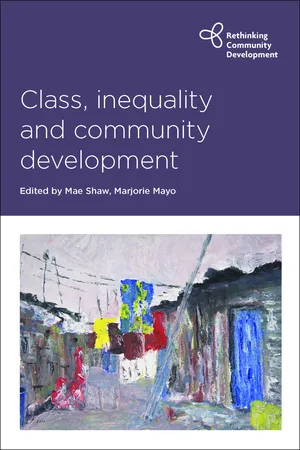
This book, the second title in the Rethinking Community Development series, starts from concern about increasing inequality worldwide and the re-emergence of community development in public policy debates. It argues for the centrality of class analysis and its associated divisions of power to any discussion of the potential benefits of community development. It proposes that, without such an analysis, community development can simply mask the underlying causes of structural inequality. It may even exacerbate divisions between groups competing for dwindling public resources in the context of neoliberal globalisation. Reflecting on their own contexts, a wide range of contributors from across the global north and south explore how an understanding of social class can offer ways forward in the face of increasing social polarisation. The book considers class as a dynamic and contested concept and examines its application in policies and practices past and present. These include local/global and rural/urban alliances, community organising, ecology, gender and education.
- 280 pages
- English
- PDF
- Available on iOS & Android
eBook - PDF
About this book
Information
Table of contents
- CLASS, INEQUALITY AND COMMUNITY DEVELOPMENT
- Table of contents
- Series editors’ preface
- Rethinking Community Development
- Acknowledgements
- Notes on contributors
- Part 1. Contested concepts of class, past and present
- 1. Class, inequality and community development: editorial introduction
- 2. Competing concepts of class: implications and applications for community development
- 3. Community development in the UK: whatever happened to class? A historical analysis
- Part 2. Class, inequality and community development in context
- 4. Working-class communities and ecology: reframing environmental justice around the Ilva steel plant in Taranto (Apulia, Italy)
- 5. Race, class and green jobs in low-income communities in the US: challenges for community development
- 6. Community development practice in India: Interrogating caste and common sense
- 7. The impact of gender, race and class on women’s political participation in post-apartheid South Africa: challenges for community development
- 8. What happens when community organisers move into government? Recent experience in Bolivia
- 9. Community development: (un)fulfilled hopes for social equality in Poland
- 10. Rural–urban alliances for community development through land reform from below
- PART 3
- Part 3. Reconnecting class and inequality through community development
- 11. Reconciling participation and power in international development: a case study
- 12. Transformative education and community development: sharing learning to challenge inequality
- 13. Community development and class in the context of an East Asian productivist welfare regime
- 14. Community organising for social change: the scope for class politics
- Concluding Chapter. Community unionism: looking backwards, looking forwards
- Index
Trusted by 375,005 students
Access to over 1.5 million titles for a fair monthly price.
Study more efficiently using our study tools.
Frequently asked questions
Yes, you can cancel anytime from the Subscription tab in your account settings on the Perlego website. Your subscription will stay active until the end of your current billing period. Learn how to cancel your subscription
No, books cannot be downloaded as external files, such as PDFs, for use outside of Perlego. However, you can download books within the Perlego app for offline reading on mobile or tablet. Learn how to download books offline
Perlego offers two plans: Essential and Complete
- Essential is ideal for learners and professionals who enjoy exploring a wide range of subjects. Access the Essential Library with 800,000+ trusted titles and best-sellers across business, personal growth, and the humanities. Includes unlimited reading time and Standard Read Aloud voice.
- Complete: Perfect for advanced learners and researchers needing full, unrestricted access. Unlock 1.5M+ books across hundreds of subjects, including academic and specialized titles. The Complete Plan also includes advanced features like Premium Read Aloud and Research Assistant.
We are an online textbook subscription service, where you can get access to an entire online library for less than the price of a single book per month. With over 1.5 million books across 990+ topics, we’ve got you covered! Learn about our mission
Look out for the read-aloud symbol on your next book to see if you can listen to it. The read-aloud tool reads text aloud for you, highlighting the text as it is being read. You can pause it, speed it up and slow it down. Learn more about Read Aloud
Yes! You can use the Perlego app on both iOS and Android devices to read anytime, anywhere — even offline. Perfect for commutes or when you’re on the go.
Please note we cannot support devices running on iOS 13 and Android 7 or earlier. Learn more about using the app
Please note we cannot support devices running on iOS 13 and Android 7 or earlier. Learn more about using the app
Yes, you can access Class, Inequality and Community Development by Shaw, Mae,Mayo, Marjorie in PDF and/or ePUB format, as well as other popular books in Social Sciences & Social Work. We have over 1.5 million books available in our catalogue for you to explore.