eBook - ePub
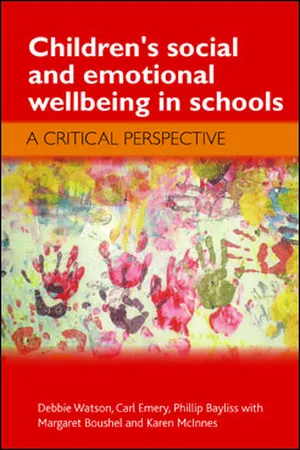
Children's Social and Emotional Wellbeing in Schools
A Critical Perspective
- 288 pages
- English
- ePUB (mobile friendly)
- Available on iOS & Android
eBook - ePub
Children's Social and Emotional Wellbeing in Schools
A Critical Perspective
About this book
This book challenges the concept of wellbeing as applied to children, particularly in a school-based context. Taking a post-structural approach, it suggests that wellbeing should be understood, and experiences revealed, at the level of the subjective child. This runs counter to contemporary accounts that reduce children's wellbeing to objective lists of things that are needed in order to live well. This book will be useful for academics and practitioners working directly with children, and anyone interested in children's wellbeing.
Information
CHAPTER 1
Introduction
Wellbeing as a concept has crept into policy agendas and practice in a range of settings, notably in health care and in regards to work and employment. Increasingly, attention is focused on child wellbeing with reports of increased mental and emotional health needs in children, bullying in schools, and major reports such as the United Nations Children’s Fund report on child wellbeing in rich countries (UNICEF, 2007), which suggested children and young people were less satisfied with their lives, less happy, have a poor quality of life and report a lower subjective wellbeing. Such reports have resulted in the almost uncritical acceptance of the need to improve wellbeing among school-aged children in the UK through the Every Child Matters agenda (DfES, 2004a), National Healthy Schools Standard Promoting Emotional Health and Wellbeing (DFEE, 2005), and the Happy, Safe and Achieving their Potential guidance in Scotland (SE, 2004), with parallel debates occurring elsewhere in the world and led by organisations such as the World Health Organization (WHO, 1999).
Why social and emotional wellbeing?
Although this book explores a range of wellbeing perspectives, the emphasis is on what we have termed ‘social and emotional wellbeing’ (SEWB) in education. SEWB is an umbrella term that encompasses the wide range of concepts, skills, dispositions and attitudes infused within UK education policy and promoted through programmes such as Social and Emotional Aspects of Learning (SEAL), Promoting Alternative Thinking Strategies (PATHS), Second Step, Creating Confident Kids, the UK Resilience Programme, and Getting Connected. The term SEWB includes both programmes focused on positive models emphasising and promoting social and emotional wellbeing, and deficit or negative models that seek to repair or develop responses to socially problematic issues such as depression, anxiety and anti-social behaviour. The National Institute for Clinical Excellence (NICE) stated that SEWB encompasses:
As SEWB has developed across the UK, practice and policy terminology has morphed. Many early programmes were launched under the banner of ‘Emotional Intelligence’ or ‘Emotional Literacy’. By the mid-2000s, this had become Social and Emotional Learning and, in particular, SEAL (the Department for Children, Schools and Families’ schools-based programme). By 2008, the dominant term had become Emotional Health and Wellbeing, and later Emotional Resilience. Alongside this, the phrase ‘teaching happiness’ moved into the public consciousness and still sits there, albeit somewhat stalled.
In an interview with one of the authors in 2011, an expert commentator on SEWB, Neil Humphrey, reflected that SEWB was:
“An umbrella term that’s used to describe a whole range of things that may well be qualitatively different. It’s used in reference to mental health, as a kind of synonym for mental health, but it’s also used to refer to children’s competence, social skills – something that is slightly separate from mental health. It’s also used interchangeably with social and emotional learning, social and emotional literacy, and social and emotional intelligence. It is a fuzzy and intangible concept.”
It is indeed a fuzzy and intangible concept. Current policy and academic literature uses such terms as ‘soft skills’, ‘emotional intelligence’ and ‘emotional resilience’ interchangeably. A fluidity of terminology for educational wellbeing is symptomatic of the challenges and questions we wish to explore in this book. The ever-widening range of terms (emotional intelligence, emotional literacy, emotional health and wellbeing, skills for work and life, emotional resilience, employability skills, social and emotional learning, soft skills, non-academic achievements, social and emotional competency, mental well-being etc) points to the need within education to ‘talk’ a version of SEWB irrespective of the name being applied to it.
The issue of childhood wellbeing in education crosses a wide range of academic disciplines, from psychology and measurement to educational research, health education and promotion, and welfare and counselling literatures. Speaking of the linking of emotional intelligence with knowledge and behavioural constructs, but characteristic of the whole field, Bar-On and Parker’s (2000) Handbook of Emotional Intelligence noted that ‘research progress is perhaps impeded by a lack of consistency in how these constructs are conceptualised and operationalised’ (p 157; for a more detailed critique of ‘Emotional Intelligence’ and the way it has been operationalised, see Watson and Emery, 2010).
In this book we have settled on the term ‘social and emotional wellbeing’ to capture the wide-ranging discourse taking place as well as allowing space to acknowledge the cross-disciplinary and somewhat slippery range of concepts, practices and programmes included in it. The focus of the book is on all children and young people’s SEWB in school contexts. In illuminating this, we sometimes draw on research and experiences with particular groups of children who are deemed to be the most disadvantaged or vulnerable in schools (very young children, those with special educational needs [SEN] or disabilities, or children from minority ethnic groups). However, these examples are offered as exemplars from which the reader can apply the issues, as appropriate, to all children.
‘Social and emotional wellbeing’ in schools
If there is little consensus of what constitutes wellbeing (we use this in a general way here as most literature does not specify SEWB) for children in schools (see eg Coleman, 2009), then there is even less agreement on the place of wellbeing in schools or how wellbeing can be fostered among children (Weare and Gray, 2003, DCSF, 2008b). Given the rise in programmes and measures that aim to address wellbeing in the UK and throughout the world, it is appropriate to question the base premises as, with very few exceptions (Craig, 2007, 2009; Ecclestone and Hayes, 2008, 2009), it remains relatively unchallenged in educational contexts. The challenges that have been posed focused on the question of whether improving the emotional wellbeing of children should be an educational goal in itself, and the implications of allowing the emotional imperative to lead the academic. Ecclestone and Hayes (2009, p 385) illustrated this emotional turn to:
An unchallenged orthodoxy that children and young people want a personally relevant, ‘engaging’ education where adults and peers listen and affirm them. This view presents subject disciplines as reactionary, irrelevant and oppressive. It encourages assumptions that topics and processes can only be engaging if they relate directly to the self and its feelings about life and the world.
Ecclestone and Hayes (2009, p 385) challenged the validity of ‘creating a hollowed-out curriculum as an instrument for “delivering” a plethora of attributes, skills, values and dispositions’ and saw this influence in education as an example of a ‘therapeutic culture’, building on the work of Frank Furedi (2003), which has crept into mainstream schooling, where a discourse ‘of emotional well-being and engagement reveal a pessimistic tone that privileges damage, vulnerability and fragility’ (Ecclestone, 2007, p 464). The work of Ecclestone has been challenged as suggesting that the emotional dimensions of learning and learners are unimportant in school contexts; but she counters this by arguing that it is not wellbeing per se that is out of control in educational policy and practice, but the ‘normalising of therapeutic interventions around self-esteem, emotional intelligence, emotional literacy and emotional well-being’ and the need for ‘resistance to their underlying diminished images of human potential and resilience’ (Ecclestone, 2007, p 467).
Carol Craig has also been an outspoken commentator on the place of wellbeing in schools. She claimed that we have permitted a psychological and mental health perspective to predominate what we understand as wellbeing; and that in doing so we have protected children from experiencing the range of emotions necessary for healthy emotional development. She cited the positive psychologist Martin Seligman as stating that children need to experience negative emotions and low self-esteem in order to be challenged and motivated to succeed and to develop persistence and resilience in the face of failure. She also suggested that there is a good body of evidence to support the fact that an excessive focus on self-esteem in children results in ‘unhealthy materialism and individualism and so undermines, rather than contributes to, wellbeing’ (Crocker and Park, 2004, cited in Craig, 2009, p 6). In agreement with Ecclestone and Hayes, she argued for teachers to return to being good teachers ‘not as surrogate psychologists or mental health workers’ (Craig, 2009, p 16).
While these arguments and challenges are persuasive, what neither Ecclestone’s, Hayes’ nor Craig’s works have addressed are the ways in which wellbeing has and can be conceptualised. It is to this problem of wellbeing as a concept that we turn in order to introduce some key ideas and theories upon which the book will be based.
Wellbeing as a concept – some theoretical tools
While the book is designed to appeal to all audiences concerned with children’s wellbeing in schools, there are a number of theoretical approaches that we have taken that demand some engagement with a critical understanding of wellbeing in epistemological terms. Wellbeing is a concept and it is our intention in this book to deconstruct this concept in order to explore and understand its use. It is for this reason that we now take the reader through a consideration of concepts more generally, as this approach is applied to wellbeing in later chapters. Deconstruction involves following the genealogy of a concept and enabling oneself to (re)think, (re-)prioritise, (re)analyse and to see the components and the roots of the concept anew. Foucault defined genealogy as: ‘the union of erudite knowledge and local memories which allows us to establish a historical knowledge of struggles and to make use of this knowledge tactically today’ (Foucault, 1980a, p 83).
The purpose of philosophy is to create concepts, whereby they ‘are created as a function of problems which are thought to be badly understood or badly posed (pedagogy of the concept)’ (Deleuze and Guattari, 1994, p 17). Concepts have functions, and the way in which a concept is utilised effects how it is determined and experienced. Deleuze wrote that: ‘philosophical theory is itself a practice as much as its objects … it is a practice of concepts, and it must be judged in the light of other practise with which it interferes’ (Deleuze, 1989, p 280). Thus, a concept is defined by its intersections with other concepts, both in its field and in surrounding fields. The intersections of concepts form a ‘plane of immanence’ (May, 1997), which aligns a Deleuzian plane with a Foucauldian discursive practice (Foucault, 1972), where the meaning of the concept (as an effect of its operation) emerges through the unity it articulates among its constituent parts. The consistence of the concept emerges through the bringing together of heterogeneous elements into a whole, where the components are inseparable.
A concept also has a force, which creates effects across a conceptual field as it passes through and by the elements and concepts of that field. A concept, then, is not a representation in any classical sense. Rather, it is a point in a field – or, to use Deleuze’s term, on a ‘plane’ – that is at once logical, political and aesthetic. It is ev...
Table of contents
- Front Cover
- Title Page
- Copyright Page
- Dedication
- Contents
- List of tables and figures
- Acknowledgements
- List of abbreviations
- Biographical notes
- Chapter 1 Introduction
- Part 1 Context
- Part 2 Key issues
- Part 3: New directions
- References
- Notes
Trusted by 375,005 students
Access to over 1.5 million titles for a fair monthly price.
Study more efficiently using our study tools.
Frequently asked questions
Yes, you can cancel anytime from the Subscription tab in your account settings on the Perlego website. Your subscription will stay active until the end of your current billing period. Learn how to cancel your subscription
No, books cannot be downloaded as external files, such as PDFs, for use outside of Perlego. However, you can download books within the Perlego app for offline reading on mobile or tablet. Learn how to download books offline
Perlego offers two plans: Essential and Complete
- Essential is ideal for learners and professionals who enjoy exploring a wide range of subjects. Access the Essential Library with 800,000+ trusted titles and best-sellers across business, personal growth, and the humanities. Includes unlimited reading time and Standard Read Aloud voice.
- Complete: Perfect for advanced learners and researchers needing full, unrestricted access. Unlock 1.5M+ books across hundreds of subjects, including academic and specialized titles. The Complete Plan also includes advanced features like Premium Read Aloud and Research Assistant.
We are an online textbook subscription service, where you can get access to an entire online library for less than the price of a single book per month. With over 1.5 million books across 990+ topics, we’ve got you covered! Learn about our mission
Look out for the read-aloud symbol on your next book to see if you can listen to it. The read-aloud tool reads text aloud for you, highlighting the text as it is being read. You can pause it, speed it up and slow it down. Learn more about Read Aloud
Yes! You can use the Perlego app on both iOS and Android devices to read anytime, anywhere — even offline. Perfect for commutes or when you’re on the go.
Please note we cannot support devices running on iOS 13 and Android 7 or earlier. Learn more about using the app
Please note we cannot support devices running on iOS 13 and Android 7 or earlier. Learn more about using the app
Yes, you can access Children's Social and Emotional Wellbeing in Schools by Watson, Debbie,Emery, Carl,Debbie Watson,Carl Emery,Phillip Bayliss in PDF and/or ePUB format, as well as other popular books in Social Sciences & Children's Studies in Sociology. We have over 1.5 million books available in our catalogue for you to explore.