eBook - ePub
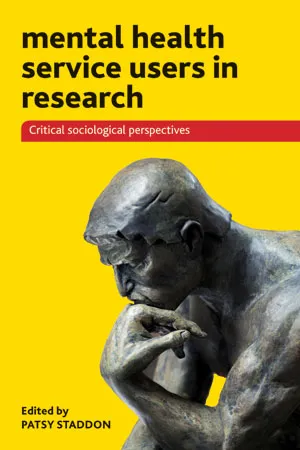
Mental Health Service Users in Research
Critical Sociological Perspectives
- 200 pages
- English
- ePUB (mobile friendly)
- Available on iOS & Android
eBook - ePub
Mental Health Service Users in Research
Critical Sociological Perspectives
About this book
This book aims to show the value but also the difficulties encountered in the application of 'insider knowledge' in service user research. Mental health service users in research considers ways of 'doing research' which bring multiple understandings together effectively, and explains the sociological use of autobiography and its relevance. It examines how our identity shapes the knowledge we produce, and asks why voices which challenge contemporary beliefs about health and the role of treatment are often silenced. An imbalance of power and opportunity for service users, and the stigmatising nature of services, are considered as human rights issues.Most of the contributors to the book are service users/survivors as well as academics. Their fields of expertise include LGB issues, racial tensions, and recovering from the shame and stigma of alcoholism. They stress the importance of research approaches which involve mutualities of respect and understanding within the worlds of researcher, clinician and service user/survivor.
Information
SEVEN
Recognition politics as a human rights perspective on service users’ experiences of involvement in mental health services
Lydia Lewis
Introduction: the policy context
The active participation of the public and service users in shaping public services has been a cornerstone of UK social policy since the 1980s. In the health and social care sector, this ‘user involvement’ has been promoted across all levels of service interaction, from individual service encounters to service management and planning, with influences from both consumerist and democratisation agendas. Within mental health services, organised groups of service users/survivors1 have had an important role. The forums and mechanisms that enable user involvement in these services therefore encompass local and national service user/survivor groups and networks (both independent and service-led) as well as NHS statutory patient and public involvement structures, service user participation in policymaking and implementation groups, and user consultation exercises.
Research across a range of sectors has repeatedly found an implementation deficit for user involvement policies (Bochel et al, 2007). In the context of mental health, evidence suggests that, at all levels, the aims of user involvement are still not fully realised (see, eg, Connor and Wilson, 2006; Carr, 2007), and that there is some cultural change but no structural, decision-making change (Campbell, 2006). Furthermore, recent mental health policy imperatives in the UK towards increased surveillance and control of service users, including the introduction of new mental health legislation that extends the compulsory powers of services into the community, appear to conflict with advancing user involvement. It has therefore been widely argued that meaningful participation for service users cannot be achieved through a bureaucratic, managerialist, consumerist approach that fails to engage with imbalances of power and divergences of interest between users and providers of services (see, eg, Sashidharan, 1997; Stickley, 2006; Carr, 2007; Forbes and Lewis, 2012).
Alongside user involvement, the last UK government2 promulgated a human rights framework for health care (DH, 2007), which promoted the application of the human rights principles of dignity, equality, respect, fairness and autonomy as the value base for service provision, and promoting human rights is central to the current Coalition government’s Mental Health Strategy (HMG and DH, 2011, p 1617). The application of this value base in public-sector services has also been promoted through the Equality and Human Rights Commission. This highlights the question of what the situation with user involvement described earlier means for the achievement of a human rights-based approach within mental health services. Indeed, effective user involvement is central to this approach (DH, 2007; Parker, 2007). Drawing on recognition theories and a qualitative study conducted in one British locality, this chapter explores this question. It aims to illuminate the social and cultural dynamics of user involvement in mental health services and associated human rights concerns, and to outline implications for policy development. Some theoretical background and then an outline of the study are presented first.
Recognition politics as a perspective on human rights
Recognition theories are concerned with cultural or symbolic power and injustice, as analytically distinguished from, but related to, socioeconomic injustice and political representation (Fraser, 1997, 2000, 2007; Lovell, 2007). They are concerned with injustices ‘rooted in patterns of representation, interpretation and communication’ (Fraser, 1997, p 14) and in ‘cultural distinctions institutionalised in the status order’ (Lovell, 2007, p 4). Those in disadvantaged positions, for example, due to poverty (Lister, 2004) or a disabling society (Shakespeare, 2005), may be seen, then, to suffer both socio-economic injustices of deprivation and cultural ones of withheld recognition. Fraser (1997, 2000) identifies three dimensions to these recognition denials: nonrecognition, the rendering of invisibility as a result of dominant cultural forms; misrecognition, being seen as lacking value and as inferior; and disrespect, being maligned or disparaged in everyday interactions or representations. Recognition politics are therefore concerned with affording people value, dignity and respect, with issues of common humanity and personhood, and with the upholding of citizenship status and rights (Fraser, 2000; Lister, 2004, 2007).
Recognition politics are also concerned with exposing and challenging the symbolic operation of power. For Bourdieu (1992, p 170), power operates through the ways in which language and ideology come to construct social belief – the power of‘constituting the given’. He terms the wielding of symbolic power ‘symbolic violence’, a form of domination and oppression that comes from constructing reality in ways that privilege the knowledge and culture of the dominant group, and through practices of social exclusion and inferiorisation that may lead to ‘internalised oppression’. It is resisted through symbolic struggle to assert alternative meanings and values that afford dominated individuals and groups a higher social status and worth.
What is key here, then, is that the importance of recognition is not just socio-political, but also personal, with a strong moral dimension to the issue (Honneth, 1995). Recognition denials can inflict harm and be personally damaging, undermining people’s identities and self-worth; they can be a form of oppression (Taylor, 1992; Honneth, 1995; Lister, 2004; Lovell, 2007).Struggles for social recognition are thus also struggles for self-esteem (feeling valued by one’s social groups and society as a whole), self-respect (a sense of moral and legal personhood and of ‘the possession of universal human rights’) and ‘self-confidence’ (emotional ontological security) (Honneth, 1995, p 119).
In the context of the politics of ‘new social movements’ and of citizenship, recognition has been sought for universal shared humanity and equal moral worth for those who are socially marginalised or subordinated (Honneth, 1995; Fraser, 1999, 2000; Lister, 2007), drawing on human rights principles such as respect and value for persons (Lister, 2004). It has also been sought for cultural identity and experience (Fraser, 2000; Honneth, 2003), as underpinned by human rights principles of autonomy (or self-determination) and dignity (Honneth, 1995; Dean, 2008). Both types of claim – universality and distinctiveness3 – are interdependent with civil, political, social and economic rights. For instance, Fraser (2000) views the actualisation of full societal participation for subordinated groups as predicated upon their cultural revaluation, while Cresswell (2009) asserts that social and political rights are constituted by the assertion of ‘experiential rights’. Similarly, Lister (2004) notes how socially derived respect and esteem are necessary for the full realisation of participation in public affairs, as a political right of citizenship (although she argues that the relationship here is in fact a dialectical one). Many theorists thus discuss cultural recognition, along with imbricated socio-economic ‘redistribution’ and political representation, as essential to the realisation of participatory parity in the public sphere (Honneth, 1995; Fraser, 1997, 2000, 2007; Fraser and Honneth, 2003; Lister, 2004; Lovell, 2007), although the nature and direction of these relationships remain disputed.
This chapter brings a range of recognition theories (see Lovell, 2007), as a perspective on human rights, to bear on the study of user involvement in mental health services. Its focus is on the construction of identity and experience through the discourses, structural organisation and relations of these services and user involvement, and how these relate to participation and equality.
The study
The aim of the study was to explore the outcomes of user involvement policies for the participation of women and men service users within mental health services and for the development of these services. It was conducted in the north-east of Scotland, where various statutory- and voluntary-sector forums for user involvement had been established. The study involved three of these, sampled purposively according to their institutional affiliation and status: a statutory-sector service user group, a voluntary-sector community group (members of which included service practitioners and providers as well as users) and an independent mutual support group. The main purpose of the first group was to disseminate information and to act as a conduit for users’ views, while the second group had a stronger lobbying function, and the third was primarily a support group.
The study was conducted from a feminist critical discourse-analytic perspective (Fairclough, 1992; Lazar, 2005), and so focused on the constitution of power in and through language and other elements of social interaction. It accommodated a twofold conception of discourse: as a way of understanding, or a set of ideas about, a particular phenomenon that works ideologically in conjunction with other elements of social practice (eg the discourse of ‘mental illness’) (Fairclough, 1992); and, since discourses are often associated with particular fields of social action and institutions and combine in particular ways, as ‘knowledges’ and the totality of interactions in a given field (eg ‘psychiatric discourse’) (Fairclough, 2001).
A collaborative, ‘interactive’ and action-oriented feminist methodological approach was adopted (see Lewis, 2007), while multiple, qualitative research methods were employed, including: participant observation at group meetings; interviews and informal interactions with service users (female,n = 9; male,n = 16), practitioners (n = 2) and providers/policymakers (n = 3); and policy analysis.4 This chapter draws mainly upon the participant observation and service user interviews.
User involvement as recognition politics
With the onset of user involvement, service users had become legitimate participants in the planning and development of mental health services in the locality. Motivated by a desire to help themselves and others, and with growing acceptance of their increasing role, their ‘presence’ and ‘voice’ were changing the cultural landscape of these services, and there were personal gains for them, described mainly in terms of mutual support and opportunities for expression. However, the policy initiative simultaneously produced various failures of recognition, which, in turn, worked to structure the social and political field of user involvement in mental health services in the locale. In achieving ‘representation’ for service users, then, user involvement had opened spaces within which recognition politics were played out (Fraser, 2007). In what follows, I discuss these politics in relation to non-recognition and disrespect, first, and then misrecognition and the discourse of mental illness.
Non-recognition and disrespect: being a ‘user’5
An intriguing finding of the study was how the policy discourse of user involvement itself had disempowering and derogatory effects and, as such, was itself contested by those taking part as service users. This was partly due to the ‘involvement’ element of the discourse working to delimit the degree of participation and influence afforded to service users. However, it was also because the discourses and practices of user involvement were centred around people being users of mental health services and categorising people according to their ‘type of mental health problem’ (see Lewis, 2005; Hui and Stickley, 2007). As the following participant notes, this meant that user involvement inevitably had reductionist, homogenising and pathologising effects through positioning people primarily in terms of their relationship to services (Beresford, 2000) and their concomitant ‘mental illness’:
“Even in places like the [named group], people who go along to that, you go along as a service user, and even though it’s not meant, with the best will in the world people see you as a service user, because you wouldn’t be there unless you had a mental illness. So, even though they’re trying to combat that, in a sense, what they’re still seeing first is the mental illness … [as opposed to] the woman or the man or whatever; you know it seems to take centre stage.” (Carol)6
So, as this participant observes, in the context of user involvement, people became occluded from view by their ‘mental illness’ ascription, and within the institutional confines of mental health services, it seemed impossible to eschew or to ideologically de-invest the service user identity (Fairclough, 1992). The discourse and practices of user involvement consequently had their own marginalising and dominating effects through objectification and dividing practices (Foucault, 1982), which differentially marked‘users’ from others in a hierarchical relation (Williams, 1999) and work to ‘split off ’ those seen as mentally ill ‘from the rest of humanity’ (Pilgrim, 2008, p 302). This identity construction resulted not only in status subordination and the undermining of full societal membership for service users (Fraser, 2003), but also in a kind of dehumanisation as people became denied ‘wholeness’ (Cresswell, 2009) and, thus, full humanity. As such,‘service users’ were prevented from participating in the (semi-)public arenas of user involvement as fully fledged partners on the grounds of both inequality of social standing (Fraser, 2003) and unequal endowment with the moral rights of ‘the person’ (Honneth, 1995).
These findings demonstrate how official movements towards valuing people and even attempts at universalist recognition can ‘set in motion a second – stigmatising – recognition dynamic’ (Fraser, 1997, p 25). The preceding participant’s reflections reveal the way in which ‘user group’ politics in health care have often centred upon ‘claims for the realization of personhood, for cultural respect, autonomy and dignity’ (Williams, 1999, p 673).Yet, the very political alignments of service user groups themselves work to simplify and reify group identities (Fraser, 2000), which ‘act back upon their incumbents’ (Taylor, 1998, p 341) and forestall mutual recognition (Crossley, 2004) and parity of participation (Fraser, 2003). In the context of mental health services, these effects are magnified by the stigmatising and all-defining nature of a ‘mental illness’ identity, which it is impossible to positively assert (Hodge, 2005; see also Lister, 2004). Thus, through encouraging segregation and chauvinism, these dividing practices and resulting reification of‘mental illness’ identities not only ‘risk sanctioning violations of human rights’ through constructing people as less than human, but also risk ‘freezing the very antagonisms … [they] purport to mediate’ (Fraser, 2000, p 108).
Some participants reflected on the ideological and political effects of the ‘user’ construct itself. One female respondent, for example, commented, “most genuine people don’t use, they contribute”, thereby indicating the ways in which the discourse constructed ‘users’ as deficient in certain respects (ie as failing to contribute) and therefore how it could work to undermine the value and efforts of individuals, positioning them as of unequal moral worth (Fraser, 1997). Another male interviewee pointed out its implication in constituting relations of dependency, as “a ‘service user’, it implies that you’re addicted to them”. Consequently, as another participant pointed out, “nobody wants to be called a user”, and many participants resisted or refused the construction in favour of ‘more respectable’ alternatives, while the identity issues associated with taking part motivated some people to distance or dissociate themselves from user involvement activities.7
These findings illustrate again how welfare identity categories and official policies aimed at recognition can have unintended consequences, through which they produce their own injustices of recognition. They also illustrate how these identity categories have become a focus for resistance within the organising of many disability, service user and survivor groups, underpinned by demands for respect, autonomy and dignity (Williams, 1999). In the absence of a more fully developed and consensual social rights perspective in respect of welfare provision, the preceding participants were aware of how ‘users’ inevitably became ‘construed as inadequate, blameworthy or undeserving’, and that the construction of dependence was a means through which power was exercised (Hoggett, 2000, p 193) and was corrosive of citizenship rights (Lister, 2007). Moreover, these injustices of recognition could be highly personally damaging and distorting, reflecting back to people a ‘confining … demeaning … and contemptible picture of themselves’ (Taylor, 1992, p 25) and threatening their self-respect and self-esteem (Honneth, 1995).
The discourse and practices of user involvement thus had competin...
Table of contents
- Coverpage
- Titlepage
- Copyright
- Contents
- Notes on contributors
- Preface and acknowledgements
- One: Sociology and survivor research: an introduction
- Two: Mental health service users’ experiences and epistemological fallacy
- Three: Doing good carer-led research: reflecting on ‘Past Caring’ methodology
- Four: Theorising service user involvement from a researcher perspective
- Five: How does who we are shape the knowledge we produce? Doing collaborative research about personality disorders
- Six: Where do service users’ knowledges sit in relation to professional and academic understandings of knowledge?
- Seven: Recognition politics as a human rights perspective on service users’ experiences of involvement in mental health services
- Eight: Theorising a social model of ‘alcoholism’: service users who misbehave
- Nine: “Hard to reach”? Racialised groups and mental health service user involvement
- Ten: Individual narratives and collective knowledge: capturing lesbian, gay and bisexual service user experiences
- Eleven: Alternative futures for service user involvement in research
- Twelve: Brief reflections
- Appendix: Details of the seminar series
Trusted by 375,005 students
Access to over 1.5 million titles for a fair monthly price.
Study more efficiently using our study tools.
Frequently asked questions
Yes, you can cancel anytime from the Subscription tab in your account settings on the Perlego website. Your subscription will stay active until the end of your current billing period. Learn how to cancel your subscription
No, books cannot be downloaded as external files, such as PDFs, for use outside of Perlego. However, you can download books within the Perlego app for offline reading on mobile or tablet. Learn how to download books offline
Perlego offers two plans: Essential and Complete
- Essential is ideal for learners and professionals who enjoy exploring a wide range of subjects. Access the Essential Library with 800,000+ trusted titles and best-sellers across business, personal growth, and the humanities. Includes unlimited reading time and Standard Read Aloud voice.
- Complete: Perfect for advanced learners and researchers needing full, unrestricted access. Unlock 1.5M+ books across hundreds of subjects, including academic and specialized titles. The Complete Plan also includes advanced features like Premium Read Aloud and Research Assistant.
We are an online textbook subscription service, where you can get access to an entire online library for less than the price of a single book per month. With over 1.5 million books across 990+ topics, we’ve got you covered! Learn about our mission
Look out for the read-aloud symbol on your next book to see if you can listen to it. The read-aloud tool reads text aloud for you, highlighting the text as it is being read. You can pause it, speed it up and slow it down. Learn more about Read Aloud
Yes! You can use the Perlego app on both iOS and Android devices to read anytime, anywhere — even offline. Perfect for commutes or when you’re on the go.
Please note we cannot support devices running on iOS 13 and Android 7 or earlier. Learn more about using the app
Please note we cannot support devices running on iOS 13 and Android 7 or earlier. Learn more about using the app
Yes, you can access Mental Health Service Users in Research by Staddon, Patsy,Patsy Staddon in PDF and/or ePUB format, as well as other popular books in Social Sciences & Social Science Research & Methodology. We have over 1.5 million books available in our catalogue for you to explore.