- 88 pages
- English
- ePUB (mobile friendly)
- Available on iOS & Android
eBook - ePub
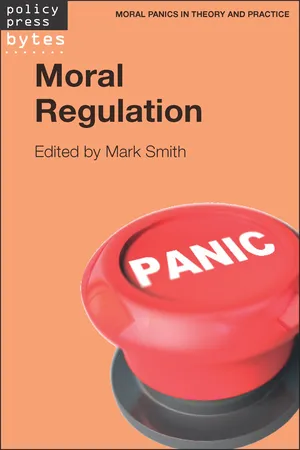
Moral Regulation
About this book
Commentators have long debated 'the moral' in ideas about moral panic, moral regulation and moral discourse. This byte teases out some of the fundamental moral questions that continue to perplex us, about life and death, good and evil, and sex and the body. With an appraisal of the work of one of the chief architects of moral panic ideas, Jock Young, it asks whether these ideas may help or hinder our understanding of these complex issues.
Information
ONE
The moral crusade against paedophilia
Frank Furedi
Introduction
The focus of this essay is the transformation of the threat of paedophilia into a permanent focus of moral outrage. It explores the moral landscape that has turned the child predator into the principal target of moral enterprise. Through a discussion of the concept of a moral crusade it evaluates the impact of society’s obsessive preoccupation with the child predator.
Paedophilia and the threat it represents to children has become a permanent feature of public concern and a regular theme of popular culture. The paedophile personifies evil in 21st-century society; the child predator possesses the stand-alone status of the embodiment of malevolence. But this unique personification of evil is not an isolated figure hovering on the margins of 21st-century society. Jimmy Savile, who died in 2011 and who has not been out of the news during the past two years, was dubbed the most ‘prolific’ paedophile in British history. What is unique about the activities of this alleged celebrity predator is the scale of his operation rather than his behaviour. Allegations against Savile effortlessly acquired the status of a cultural truth, since it is widely believed that, rather than rare, the abuse of children is a very common activity.
According to the cultural script of virtually every western society, child abusers are ubiquitous. This script invites the public to regard all strangers – particularly men – as potential child molesters. The concept of ‘stranger danger’ and the campaigns that promote it have as their explicit objective the educating of children to mistrust adults that they do not know. This narrative of stranger danger helps to turn what ought to be the unthinkable into an omnipresent threat that preys on our imagination. Represented as a universal threat, the peril of paedophilia demands perpetual vigilance. The expectation that adult strangers represent a risk to children has in effect turned concern about paedophilia into a very normal feature of life. That is why physical contact between adults and children has become so intensely scrutinised and policed.
‘I think what is absolutely horrific, frankly, is the extent to which this child abuse has been taking place over the years and across our communities over the years’, stated Theresa May, the UK Secretary of State for Home Affairs, when she outlined the details of the government’s inquiry into sexual abuse in North Wales care homes and into Jimmy Savile’s activities (see Theresa May, quoted by Nigel Morris in the Independent [Morris, 2012]). Her insistence on the all-pervasive character of child abuse resonates with widespread anxiety about the scourge of paedophilia. In official discourse this threat is expressed in a uniquely unrestrained and dramatic manner. Moral entrepreneurs, especially those associated with the child-protection industry, adopt a rhetoric that is classically associated with scaremongering demonologists. They continually use the discourse of big numbers to support the argument that ‘all children are at risk’. England’s Deputy Children’s Commissioner, Sue Berelowitz, demonstrated this when she declared that ‘there isn’t a town, village or hamlet in which children are not being sexually exploited’ (see Berelowitz, quoted by Graeme Wilson, in The Sun [Wilson, 2012]). The moral weight of such claims is rarely contested, since anyone who questions the doctrine of the omnipresence of abuse is likely to be denounced as an appeaser of the child predator.
An ideology of evil
The narrative of paedophilia does not merely encompass the abuse of children. It has become a free-floating idiom of fear that can attach itself to any focus of anxiety. So when the Southern Baptist leader Reverend Jerry Vines declared in June 2002 that Mohammed was a ‘demon possessed paedophile’ and that Allah leads Muslims to terrorism, he was merely harnessing the power of this idiom of fear to promote his apocalyptic vision of the future of the world (Sachs, 2002). It is not just religious fundamentalists who allow their fantasies about paedophiles to intermesh with their wider perceptions of global insecurity. It was announced in 2014 that as far as the British government is concerned, it would like to treat paedophiles in the same way as terrorists. It was reported that Prime Minister David Cameron was determined to close a ‘loophole’ that permits paedophiles to publish and possess ‘manuals’ that offer tips to would-be child predators about how to identify and groom their targets. Cameron indicated that such a new law would authorise the British state to apply the same kind of extraordinary sanctions used to target terrorists who download bomb-making manuals (Hope, 2014).
The adoption of the tactics and strategy of the war against terrorism to the crusade against paedophiles is symptomatic of a world-view that risks losing the capacity to understand the distinction between fantasy and reality. The merging of the threat of the violent terrorist with that of the online predator dramatises the threat of both. Imperceptibly, the terrorist network and the ring of paedophiles become indistinguishable from one another and, through the rhetorical act of joined-up scaremongering, this meshing intensifies the public’s sense of insecurity.
From the standpoint of cultural sociology, what is particularly interesting is the transformation of paedophilia into an idiom of evil, one that serves as a moral resource for competing claims makers to draw on. Since the early 1980s, Britain and many other societies have experienced a succession of highly charged alarmist outbursts over paedophile-related incidents. Such incidents have led to mob violence against individuals wrongly accused of child abuse and to the killing of individuals who were victims of mistaken identity. Even the most improbable claims (such as scaremongering allegations of satanic ritual abuse (SRA)) have been treated as if they were based on hard evidence and facts. More than three decades of recurrent panics about the threat of paedophilia have had the cumulative impact of transforming the periodic outburst of anxiety over specific cases of abuse into a stable outlook through which communities make sense of the uncertainties of daily life.
The normalisation of paedophilia as an existential threat haunting childhood provides a rare example of the mutation of what first emerged as a moral panic in the 1980s into a coherent and enduring ideology of evil. That this ideology exercises influence over society is demonstrated by the fact that childhood and relations between generations have been regularly reorganised to contain the peril of paedophilia. Consequently, relations between generations are now carefully regulated and policed. In every walk of life, an assumption of ‘guilty until proven innocent’ underpins intergenerational relations. The premise that all adults pose a potential risk to children means that the criminal records check is the current index of trust; police checks on millions of adults are deemed essential before they can be trusted to be near, or to work with, children.
Experience indicates that suspicion towards adult motives only begets more mistrust. Numerous informal rules have been introduced to prevent adults from coming into direct physical contact with children. Even nursery workers feel that their action is under constant scrutiny. Adult carers have not been entirely banned from applying sun cream on children. Some still follow their human instinct and do what they believe is in the best interest of a child. But frequently, this practice requires formal parental consent. It is now common practice for nurseries and schools to send out letters to parents to sign to give teachers the right to put sun cream on their child. Some nurseries have sought to get around this problem by asking their employees to use sprays rather than rub sun cream onto children’s bodies. These ‘no touch’ rules are underpinned by an ideology that regards physical contact between adults and children as a precursor to potentially malevolent behaviour (see Piper and Stronach, 2008).
Bans in one domain of adult–child interaction have a nasty habit of leading to bans in another. ‘No-touch’ rules are followed by ‘no picture’ rules that seek to prevent parents and others from taking pictures of children during school plays, concerts and sporting activity. In some playgrounds and parks, there are rules that seek to ban ‘unaccompanied adults’ from entering the site. From this perspective, the idea that an adult watching a child play can be an innocent act of enjoying the sight of youngsters fooling around is simply preposterous; only a pervert, it is suggested, would wish to watch other people’s children playing.
The proliferation of rules governing intergenerational relations is underpinned by an ideology of evil. For moral entrepreneurs, society’s insecurity about paedophilia strengthens the case for their argument that ‘something must be done’. It provides opportunities for moral positioning against the one evil that all of us can agree on. The moral entrepreneur is a rule creator who, explains the sociologist Howard Becker, ‘feels that nothing can be right in the world until rules are made to correct it’. However, since evil is omnipresent, every new rule serves only as a prelude to the next. A moral crusader is a ‘professional discoverer of wrongs to be righted, of situations requiring new rules’ (Becker, 1963, pp 147–8 and 153). Though they are often ‘fervent’ and ‘self-righteous’, they are not motivated by cynicism or opportunism, but by the impulse of helping others (Becker, 1963, p 148). They invariably perceive themselves as the champions of suffering victims. However, despite their intentions, zealous crusades often incite confusion and moral disorientation.
From the standpoint of cultural sociology, the numerous campaigns launched to protect children and to promote an alarmist state of concern about the threat of child predators is usefully captured by the concept of a moral crusade. In his classic study of moral enterprise, Becker concludes that the ‘final outcome of the moral crusade is a police force’ (Becker, 1963, p 156). Threats are represented as not just physical hazards, but a danger to the natural order of things. It was this perception in early modern Europe that gave witch-hunting its mandate and fierce passion. Similarly, the powerful sense of moral repugnance of the practice of ‘self-pollution’ by 18th-century moral entrepreneurs against the dangers of masturbation was inextricably linked to the conviction that this was the most unnatural of acts. Advocates of these causes almost effortlessly make the conceptual jump from unnatural to malevolent and from malevolent to evil.
Contemporary society is not usually comfortable with the moral condemnation of evil. Indeed 21st-century western culture is estranged from a grammar of morality. Consequently, with the notable exception of sexual abuse, threats and dangers are rarely conveyed in an explicit moral form. Moral regulation often possesses an incoherent form and may be promoted indirectly through the language of health, science and risks. Fear appeals frequently appear as a response to non-moral and scientifically affirmed objective imperatives; such appeals directed against smoking are paradigmatic in this respect (see Thompson et al, 2009).
The disassociation of objects of dread and fear from the grammar of morality does not mean that warnings about them have been denuded of the imperative of moralisation. What it signifies is that the contemporary culture of fear makes it difficult to draw on the authority of an uncontested moral code. That is why paedophilia has such a culturally strategic significance. Paedophilia, along with a small number of inter-personal abuses, has a formidable capacity to incite moral outrage. What endows paedophilia with a unique quality to excite alarm and consternation is that it appears to represent the annihilation of childhood. And if the paedophile is the personification of evil, then the child has become a symbol of its moral opposite. Some social scientists believe that a sublimated form of guilt accounts for the intense hostility towards the child molester. Garland (2008, p 17) wrote that ‘the intensity of current fear and loathing of child abusers seems to be connected to unconscious guilt about negligent parenting and widespread ambivalence about the sexualisation of modern culture’.
In the name of the child
The sacralisation of the child is the flip side of the tendency to universalise the threat of paedophilia. The unique moral status of the sacred child is so powerful that it is literally beyond discussion. As Anneke Meyer observes, ‘“the child” becomes a shorthand for sacralisation and moral status; its meaning no longer has to be made explicit’. She concludes that this narrative is ‘so powerful that in fact any opinion can be justified by simply referring to children, and without having to explain why and how children justify it’. The very mention of the word ‘children’ closes down discussion; the discourse on the perils of childhood provides an uncontested validation for claims making and ‘anything can be justified via children as children make the case good and right’ (Meyer, 2007, p 60).
Fear appeals that manipulate our natural anxiety towards children are actively promoted to encourage a disposition towards suspicion and mistrust. Mention the word ‘child’ and people will listen. Raise the moral stakes by claiming that a ‘child is at risk’ and people will not just listen but endorse your demand that ‘something must be done’. Consequently campaigners against poverty understand that they are far more likely to gain sympathy for their cause by focusing attention on what is now called ‘child poverty’. Abstract socioeconomic injustices gain compelling definition through recasting poverty as an affliction confronting a child. Campaigners on Third World issues know that the very mention of ‘child labour’ or the ‘exploitation of children’ or ‘child soldiers’ or ‘starving children’ is far more likely to resonate with a western public than calls for economic assistance. In education a call for ‘child centred’ teaching will gain you a standing ovation. ‘Mention the word children, and the money rolls in’, remarks an acquaintance who works as a fund-raising consultant in the charity sector.
Children serve as a moral resource with which to promote policies and causes. The tendency on the part of moral entrepreneurs to hide behind the child and frame their message through the narrative of child protection is motivated by the recognition that it is a uniquely effective communication strategy. The cause of child protection enjoys formidable cultural support. Indeed the child has emerged as a very rare focus for moral consensus. As I argue elsewhere, in a world of existential disorientation the child serves as the main focus for both emotional and moral investment (Furedi, 2008). The sacralisation of the child means that those who speak ‘in the name of the child’ can benefit from the moral resources associated with children. At a time when society finds it difficult to express itself through the grammar of morality and where there are big disputes about what is right and wrong, the child stands out as a singular exemplar of moral unity. People may argue about whether gay marriage is right or wrong. They may dispute the legitimacy of assisted suicide, the right to abortion or the desirability of sex education. But all sides of the debate are unequivocally for the sacred child. That is also why in the current age paedophilia has emerged as most powerful symbol of evil.
Using children as a moral shield is now widely practised by policy makers and fear entrepreneurs. They understand that most adults find it difficult to raise their doubts about the numerous policies that are promoted through their alleged benefit for the security of children. Civil rights campaigners against identity cards and numerous attempts to expand government surveillance tend to lose their voice when children are brought into the discussion. So there was virtually no criticism raised by the annou...
Table of contents
- Cover
- Title
- Copyright
- Contents
- Contributors
- Series editors’ preface
- Introduction
- 1 The moral crusade against paedophilia
- 2 Animal welfare, morals and faith in the ‘religious slaughter’ debate
- 3 From genuine to sham marriage: moral panic and the ‘authenticity’ of relationships
- 4 Integration, exclusion and the moral ‘othering’ of Roma migrant communities in Britain
- 5 Assisted dying: moral panic or moral issue?
- Afterword: the moral in moral panics
Trusted by 375,005 students
Access to over 1.5 million titles for a fair monthly price.
Study more efficiently using our study tools.
Frequently asked questions
Yes, you can cancel anytime from the Subscription tab in your account settings on the Perlego website. Your subscription will stay active until the end of your current billing period. Learn how to cancel your subscription
No, books cannot be downloaded as external files, such as PDFs, for use outside of Perlego. However, you can download books within the Perlego app for offline reading on mobile or tablet. Learn how to download books offline
Perlego offers two plans: Essential and Complete
- Essential is ideal for learners and professionals who enjoy exploring a wide range of subjects. Access the Essential Library with 800,000+ trusted titles and best-sellers across business, personal growth, and the humanities. Includes unlimited reading time and Standard Read Aloud voice.
- Complete: Perfect for advanced learners and researchers needing full, unrestricted access. Unlock 1.5M+ books across hundreds of subjects, including academic and specialized titles. The Complete Plan also includes advanced features like Premium Read Aloud and Research Assistant.
We are an online textbook subscription service, where you can get access to an entire online library for less than the price of a single book per month. With over 1.5 million books across 990+ topics, we’ve got you covered! Learn about our mission
Look out for the read-aloud symbol on your next book to see if you can listen to it. The read-aloud tool reads text aloud for you, highlighting the text as it is being read. You can pause it, speed it up and slow it down. Learn more about Read Aloud
Yes! You can use the Perlego app on both iOS and Android devices to read anytime, anywhere — even offline. Perfect for commutes or when you’re on the go.
Please note we cannot support devices running on iOS 13 and Android 7 or earlier. Learn more about using the app
Please note we cannot support devices running on iOS 13 and Android 7 or earlier. Learn more about using the app
Yes, you can access Moral Regulation by Smith, Mark,Mark Smith in PDF and/or ePUB format, as well as other popular books in Ciencias sociales & Criminología. We have over 1.5 million books available in our catalogue for you to explore.