eBook - ePub
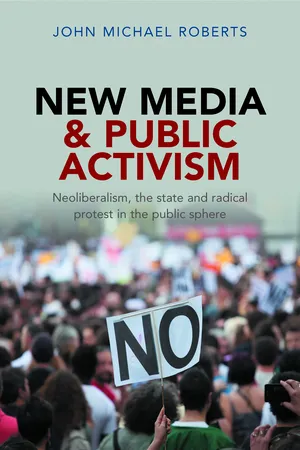
New Media and Public Activism
Neoliberalism, the State and Radical Protest in the Public Sphere
- 240 pages
- English
- ePUB (mobile friendly)
- Available on iOS & Android
eBook - ePub
New Media and Public Activism
Neoliberalism, the State and Radical Protest in the Public Sphere
About this book
The Arab Spring, chat forums, political leaders tweeting, online petitions, and protestors in the Occupy Movement - new media public spheres have without doubt radically altered social and political activism in society. But to what extent is this new activist public sphere stifled by the neoliberal economy and workfare state? Have we in fact become transformed into subjects of online consumption and orderly surveillance, rather than committed social and political campaigners? In this highly topical book, John Michael Roberts employs a political economy perspective to explore the relationship between financial neoliberal capitalism and digital publics. He assesses the extent to which they provide new forms of radical protest in civil society and offers an indispensable guide to understanding the relationship between the state, new media activism and neoliberal practices.
Information
SIX
Zoning public space 1: hybrid surveillance and state power
Introduction
On 28 September 1862 the Workingmen’s Garibaldian Committee organised a sympathy meeting at Hyde Park, London for Giuseppe Garibaldi, leader of the Italian Risorgimento, who was injured and had been captured at Aspromonte during the Second Italian War of Independence. Garibaldi was an immensely popular figure among all sections of British society. Members of the working class applauded Garibaldi’s perceived radicalism, while middle-class supporters considered Garibaldi to be a successful businessperson and a fine example of the virtues of political economy (Finn, 1993, p 205). At the meeting, attended by some 20,000 people, Secularists spoke on behalf of Garibaldi’s republican offensive against Catholic Rome. Soon, scuffles broke out among the police and mainly Irish Catholic sympathisers (Gilley, 1973, pp 704–5; see also Richter, 1981, pp 51–2). The following week around 100,000 people came to Hyde Park to hear once again a number of orators speaking about Garibaldi. More disturbances ensued. The state was itself divided over how to govern this particular public space of activism. A Marlborough Street magistrate who presided over the trial of Garibaldian rioters recommended the outright banning of meetings; a view that was echoed by the Hyde Park superintendent.
Sir Richard Mayne, a commissioner of the Metropolitan Police, agreed that too many gatherings had occurred in the Park since the 1860s but he also realised that to ban them would be counter-productive. Based on their accumulated knowledge gained through surveillance, Mayne decided instead to let the police judge which topics were deemed ‘popular and exciting’ and to issue bans on such topics at their discretion. This was a considerable improvement over previous mechanisms of governing public demonstrations at Hyde Park. Through the Recreation Grounds Act 1859 parks managers could enforce byelaws, although they had no power to impose a fine. The Public Improvement Act 1860 improved the condition by conferring the power of making byelaws to the Bath and Wash Houses Act 1846, which enabled a penalty not exceeding £5 to be imposed on any person breaching a byelaw. Local authorities would often swear in park keepers and labourers as special constables to make sure members of the public followed these rules and regulations. In all these matters, the degree and extent of governance became the prerogative of local authorities themselves (Conway, 1991, pp 203–7).
Crucially, by arguing for the need of proper police surveillance at Hyde Park, Mayne contributed towards new thinking about the accumulation of knowledge of local public spaces by the authorities. Mayne not only recognised that the legal and governance mechanisms of the day were failing to curtail popular demonstrations in London’s public parks, he also tacitly recognised that the distinct place of Hyde Park required more sophisticated mechanisms of governance. Simply banning demonstrations at Hyde Park was no longer a viable option in an age of organised radical groups. Regular police surveillance, along with gaining knowledge about how political agitators used specific public spaces, was now the preferred strategy.
By today’s digital standards, Mayne’s approach to governing demonstrations seems rather quaint and outdated. A network society is said to be powered through ICTs, which in turn means that knowledge and information can be accumulated in ways unimaginable to the Victorians. Digital modes of surveillance, so some argue, demonstrate that the state no longer has to rely on government police tactics. Databases are centres of computation through which various pieces of information about distinct populations can be fed. This includes not just ‘normal’ information about individuals such as their age, occupation and place of residence, but also DNA profile information that travels between databases through digital networks, across natural borders that connect subject profiles together in order to gather information in national jurisdictions (Prainsack and Toom, 2010, p 1125). Surveillance thus operates both transnationally, across borders, and locally, in situated contexts.
However, while much can be learnt about new modes of surveillance from this perspective there is also something amiss. In particular, there lurks an ever-present danger that this viewpoint perpetuates a dualist framework in which the networked nature of contemporary surveillance practices is given precedence over state-led governance and regulation. Yet, this considerably underestimates how new modes of surveillance are integrally related to the ‘normal’ actions of state power and political projects. Certainly, it appears to be the case that surveillance today is markedly different to that of the past. In past years the state seemed to be actively engaged in physically regulating the behaviour of defined groups in public space as well as subjecting them to modes of undercover police investigation. By way of contrast, the authorities in the present day appear to be preoccupied mainly with digital surveillance of specific populations in society. As we will also see in this chapter, however, while it is indeed true to say that police and security organisations currently draw on technologically sophisticated mechanisms to track and monitor political groups, it is equally true to say that they also draw on ‘old-fashioned’ physical means to control and pre-empt the activity of demonstrators in much the same way that Mayne did in the 1860s. Physically zoning public space helps the authorities to gain comprehensive knowledge of the actions of distinct political groups during moments of protest and demonstration. And these procedures are underpinned by state power and the strong arm of law and order.
Contemporary surveillance is therefore comprised of a hybrid mix of physical state regulation and digitally networked forms of accumulating knowledge and information about citizens. In this respect, hybridity is simply a process in which more conventional and older systems of surveillance – the physical zoning of public space, for example – are recombined with newer types of surveillance – the digital coding of discrete populations, for example. By bringing together past and present, old and new types of surveillance, novel forms of control, with their own strategic agendas, are brought to life (Chadwick, 2013, pp 14–15). These very specific forms operate within a wider surveillance system, but they also represent a distinctive response to a particular set of circumstances during a certain period. As such, they contain their own strategies for dealing with real and discursively narrated crises, dilemmas and problems in society that are also fought out in a battle over hegemonic projects. As Chadwick goes on to observe:
Particulate hybridity is the outcome of power struggles and competition for pre-eminence during periods of unusual transition, contingency, and negotiability. Over time, these hybrid practices start to fix and freeze; they become sedimentary, and what was once considered unusual and transitional comes to be seen as part of a new settlement, but that new settlement is never entirely fixed. (Chadwick, 2013, p 15)
To begin to explore this hybrid surveillance at work in public space we first need to discuss new digital control mechanisms in more depth.
Codes, control and public space
City space is now inextricably tied up with new forms of technology. Of particular significance has been the creation of ‘codes’ – strings of numbers and letters that are generated through mathematical algorithms by means of software programs. Information systems track and monitor the movement of codes, differentiate them and assign them a unique identification. Different forms of identification codes can then be generated in a database depending upon whether the focus of attention is people, objects, information, transactions or territories (Dodge and Kitchen, 2005, pp 853–4). Through a database, codes are sorted into different types of knowledge and identification that track people and objects. These place people and objects into a number of profiles and populations, like that of criminality, homelessness or ethnicity. By performing these tasks codes have the power to pre-empt the movement of people and objects (Dodge and Kitchen, 2005, pp 858–9). The coming together of these devices results in new forms of surveillance; the rationalised accumulation of personal data to manage and control social environments. Surveillance techniques thus extract ‘fragments’ of data about ‘virtual’ selves that can be used ‘as the basis of discrimination between one category and another, and to facilitate differential treatment’ (Lyon, 2004, p 138; see also Thrift and French, 2002; Mackenzie and Vurdubakis, 2011).
Importantly, according to Deleuze (1990), these technologies mean that we have moved towards a control society based on how we are coded. This is different to living in a society based on discipline. Whereas discipline ‘enclosed’ and ‘moulded’ people, control is based on ‘modulation’, that is, on continuous change, mobility and variety. For example, education is no longer confined to the physical disciplinary location of the classroom but has become a continuous mode of learning throughout a person’s life cycle (the continuous training and development of ‘skills’, for example). Whereas discipline sought to regulate the behaviour of ‘individuals’ located in ‘mass’ culture, control societies are grounded in regulating populations through codes and ‘dividuals’. Our sense of being an ‘individual’ is now broken down into a multitude of codes which are then recoded in a variety of ways, thereby creating a number of profiles or ‘dividuals’ for each person located in a distinctive population. Elsewhere Deleuze says that this new condition represents a diagram, a cartography that is ‘coextensive with the whole social field’ (Deleuze, 1988, p 34). What Deleuze wants to alert us to is the manner in which codes spread across society as a whole through decentralised networks to manage specific populations of people and groups in society. No longer confined to physical locations, codes override the normal boundaries between different forms of existence. Indeed, they operate by unmaking realities and stable representations and by establishing continual and numerous points of emergence. Codes thus generate ‘supple and transversal’ networks of alliances that map strategic relations between forces beyond that of the state (Deleuze, 1988, pp 35–6).
The idea that control through digital technology now subsists primarily in non-state forms is one that is commonplace among some scholars and thinkers. Sure enough, Deleuze’s arguments are persuasive. Furthermore, this new form of control no longer relies on governing individuals in localities through one central point of command in the guise of a state. More precisely, control operates through codes and databases that anticipate and, indeed, socially construct the behaviour of discrete populations. This is to argue that control operates by pre-empting the activity of formless and shapeless processes that it will eventually try to mould. Control is not so much concerned with the actual subjects as it is with ‘the effects, the patterns of code that are continuously generated by “subjects” as they use their mobile phone, twitter, check their Facebook and MySpace pages, drive their car, do their shopping, or surf the web’ (Savat, 2013, p 48). The internet provides a practical illustration of some of these points.
During the Cold War there had been much speculation in US government and military circles about whether a communication network might be able to survive a nuclear attack. At the RAND Corporation in 1959 an American scientist, Paul Baran, started to think through the implications of this question. His answer was to design a computer network that essentially escaped centralised control. At the forefront of this breakthrough was ‘packet switching’. In this system messages break themselves apart into small fragments and each fragment goes on to find its own way to a destination through different interconnected networks. Arriving at their destination, fragments then reassemble into the message. Even if part of the network is subsequently destroyed there will always be other routes that a message can take to reach its end-point. Revolutionary at the time, this relatively simple idea provided the foundation for what later became the decentralised network formation that comprised the internet (Barney, 2000, pp 67–72). But the internet is also built around Internet Protocols (IP), which are the rules and standards that govern relationships in networks. IPs send packets of information to points across computer networks. If one packet goes missing, then a Transmission Control Protocol (TCP) can request that it is sent again. Hence, TCP is a layer within IP and addresses problems in communication between computers. Protocols are therefore uninterested as to the content of information, preferring instead to manage the formal structure of information (Galloway and Thacker, 2004). Protocols ensure that a number of decentralised, distributed and flat networks comprise the internet.1
According to Galloway (2004), however, a more centralised system is also noticeable on the internet in the shape of Domain Name Systems (DNSs). When a computer wants to send data to another computer it does so through the IP address, which is made up of numbers. In order to render these numbers intelligible to humans, DNSs transform them into an easily identifiable name. The Uniform Resource Locator (URL) or web address is the most common example in this respect. How IP addresses are matched with domain names is dependent on a hierarchy of computers and this implies a degree of centralisation and distributed control in the internet. So, while there are decentralised networks these can only successfully operate through centralisation (Galloway, 2004, p 13). But (de)centralisation is also a type of control in a Deleuzian sense that is qualitatively distinct from disciplinary power associated with the state. Protocols that govern the internet are contained in Request for Comments (RFC) documents. RFCs originated in 1969 and are today published by the internet Engineering Task Force in the US, but there are also other organisations that develop protocols such as the World Wide Web Consortium. In practice, this means that protocols are governed by a technocratic elite of scientists, professional bodies, committees and so on. New modes of control are thus maintained through decentred computer networks and through professional technocratic groups whose expertise lies beyond state power (Galloway and Thacker, 2004).
Another illustration of this Deleuzian pre-emptive control agenda can be found at airports. Amoore (2006) notes that airport personnel have been increasingly engaged in compiling and classifying data on individual passengers. Information is gathered from a variety of sources, including financial transactions and social security information. Advanced computer technology can use mathematical modelling techniques to then map ‘normal’ patterns of human behaviour. One technique at the disposal of American airport authorities and security is that of Automated Targeting Systems (ATS). Amoore (2006) notes that the purpose of ATS is to accumulate passenger data such as address, financial records, past one-way travel and seating preference in order to assign a risk score to individual travellers. Worryingly, scores can then be used to physically detain individual passengers or deny them entry to the US or elsewhere if the passenger in question is deemed a risk. In practice, the authorities are searching for the ‘unknown terrorist’ who has yet to commit a terrorist act. However, because a person identified might never have committed an act of terrorism it is unclear how they might challenge decisions made about them by security forces working at airports. This is especially difficult when a person is not even told why they have been denied entry to a country (Amoore, 2006; see also Marx, 2007, p 380).
Today, then, power and surveillance moves beyond the state and encompasses the whole of society. It is a less visible type of surveillance than in the past. But another question immediately presents itself in this respect. If this new form of control is now pervasive and ubiquitous throughout cities, why do people accept its governing mandate? One answer lies in a discourse of legitimation that often accompanies control societies. While not the only utterance employed to justify a new surveillance agenda, ‘resilience’ has nonetheless become important in demarcating security concerns in cities. Prompted by the belief that we live in a world of uncertainty and non-preventable threats in which risks can now flow through informational networks across the globe, ‘resilience’ highlights the need to take pre-emptive action to offset the worst-case scenarios of these risks. This is to insist that individuals, groups, organisations, cities, regions and so forth take control of their own risk-averse strategies in order to develop the potential to withstand and bounce back from shocks (O’Malley, 2010). Resilience is subsequently an utterance that helps to rationalise this pre-emptive (de)centralised new security agenda.
Stephen Graham’s work is instructive here. He also employs, in part, Deleuze’s ideas on modulation, and this leads him to argue that contemporary cities are today controlled through a number of computerised calculations linked together via global computer networks and databases. Management of distinct populations through these mechanisms of control has become increasingly merged with the surrounding urban fabric of cities (Graham, S., 2010, p 64). Congestion charges and smart highways are two illustrations. Notably, Graham subscribes to the idea that political power has moved beyond its embodiment in a central sovereign force. Power is now spread across a number of networks, primarily those associated with ‘visual-technological popular culture, political economy and state practice’ (Graham, 2012, p 137). More ominously, resilience and security have given rise to ‘battlespaces’ in everyday urban locales. Here, numerous objects become a site of permanent war. Military and civilian boundaries collapse into one another. ‘Unpredictable’ terrorist forces in cities, for example, justify the need for authorities to engage in a constant process of creating pre-emptive risk profiles of populations (Graham, S., 2010, p 31). For Graham, ‘resilience’ is a vital resource employed by authorities to defend and legitimate these practices. Announcing to their citizens that they have built a resilient infrastructure to tackle unpredictable threats becomes a means for authorit...
Table of contents
- Cover
- Title
- Copyright
- Contents
- Acknowledgements
- List of abbreviations
- one Introducing new media and public activism
- two Creative digital capitalism? Exploitation, information and finance
- three Neoliberalism and new public management: the rise of the competent public sphere
- four E-democracy and public deliberation in the competent public sphere
- five Social media and the neoliberal subject
- six Zoning public space 1: hybrid surveillance and state power
- seven Zoning public space 2: gentrification, community publics and CCTV
- eight Global social movements: beyond the competent public sphere?
- nine Conclusion: the Occupy movement, community activism and ‘incompetent’ public spheres
- References
Trusted by 375,005 students
Access to over 1.5 million titles for a fair monthly price.
Study more efficiently using our study tools.
Frequently asked questions
Yes, you can cancel anytime from the Subscription tab in your account settings on the Perlego website. Your subscription will stay active until the end of your current billing period. Learn how to cancel your subscription
No, books cannot be downloaded as external files, such as PDFs, for use outside of Perlego. However, you can download books within the Perlego app for offline reading on mobile or tablet. Learn how to download books offline
Perlego offers two plans: Essential and Complete
- Essential is ideal for learners and professionals who enjoy exploring a wide range of subjects. Access the Essential Library with 800,000+ trusted titles and best-sellers across business, personal growth, and the humanities. Includes unlimited reading time and Standard Read Aloud voice.
- Complete: Perfect for advanced learners and researchers needing full, unrestricted access. Unlock 1.5M+ books across hundreds of subjects, including academic and specialized titles. The Complete Plan also includes advanced features like Premium Read Aloud and Research Assistant.
We are an online textbook subscription service, where you can get access to an entire online library for less than the price of a single book per month. With over 1.5 million books across 990+ topics, we’ve got you covered! Learn about our mission
Look out for the read-aloud symbol on your next book to see if you can listen to it. The read-aloud tool reads text aloud for you, highlighting the text as it is being read. You can pause it, speed it up and slow it down. Learn more about Read Aloud
Yes! You can use the Perlego app on both iOS and Android devices to read anytime, anywhere — even offline. Perfect for commutes or when you’re on the go.
Please note we cannot support devices running on iOS 13 and Android 7 or earlier. Learn more about using the app
Please note we cannot support devices running on iOS 13 and Android 7 or earlier. Learn more about using the app
Yes, you can access New Media and Public Activism by Roberts, John Michael,John Michael Roberts in PDF and/or ePUB format, as well as other popular books in Politics & International Relations & Social Policy. We have over 1.5 million books available in our catalogue for you to explore.