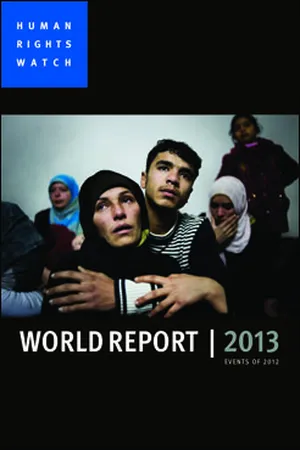
- 680 pages
- English
- ePUB (mobile friendly)
- Available on iOS & Android
eBook - ePub
About this book
CUSTOMERS IN NORTH AMERICA: COPIES ARE AVAILABLE FROM WWW.SEVENSTORIES.COM Human Rights Watch's twenty-third annual World Report summarizes human rights conditions in more than 90 countries and territories worldwide. An invaluable and respected resource for journalists, diplomats, and citizens, the book includes essays that tackle major human rights themes, and country chapters addressing key human rights abuses and the roles –positive or negative – that significant domestic and international figures played during the year. It reflects extensive investigative work by Human Rights Watch staff, often in close partnership with domestic activists.
Information
WORLD REPORT
2013
2013
EUROPE
AND CENTRAL ASIA
Armenia
Armenia’s ruling coalition retained a parliamentary majority following the May 2012 elections amid allegations of abuse of administrative resources, and intimidation of voters, observers, and journalists. Ill-treatment in police custody persists. The government has yet to offer conscientious objectors a genuine civilian alternative to military service and has failed to effectively investigate a troubling number of non-combat deaths in the military.
Politically motivated defamation lawsuits no longer appear to be a problem, but media pluralism is lacking, and some journalists covering the May 6 parliamentary elections suffered violent attacks by onlookers, some of them members of Armenia’s ruling political party. Violence and discrimination based on sexual orientation are serious problems. Bureaucratic restrictions prevent people with terminal illnesses from accessing strong pain medications.
Parliamentary Elections
The Organization for Security and Co-operation in Europe’s (OSCE) monitoring report assessed the May 6 parliamentary elections as competitive and largely peaceful, yet marred by “an unequal playing field” due to misuse of administrative resources, and party representatives and local authorities pressuring voters, interfering in voting, and hindering the work of journalists.
Several violent incidents occurred during the campaign period in Yerevan, including assaults on opposition party Armenian National Congress (ANC) candidate Babken Garoyan and three other ANC members on April 15, and on ANC candidate Karen Tovmasyan on April 17. In both cases, the ANC members were distributing campaign information. Police opened investigations into each case.
Helsinki Association campaign monitor Arman Veziryan filed complaints alleging that Yerevan resident Tigran Manukyan punched him and hindered his work as an observer while Veziryan observed an opposition activist distributing election pamphlets on April 30. Instead of investigating, prosecutors pressured Veziryan to withdraw the complaint and in June charged him with beating Manukyan, although Manukyan never claimed to be a victim. Veziryan was awaiting trial at this writing.
Torture and IllTreatment in Custody
According to local human rights defenders, torture and ill-treatment in police custody persist. Authorities often refuse to investigate ill-treatment allegations or coerce citizens into retracting complaints. The October report of the European Committee for the Prevention of Torture (CPT) on a follow-up visit in December 2011 noted overcrowding, unhygienic conditions, and inadequate medical care in two prison facilities. CPT also noted that it received no new cases of ill-treatment from these facilities in 2012.
The government has not effectively investigated a complaint from seven ANC activists that police beat them in detention in August 2011. The activists’ lawyers also filed a complaint alleging police denied them access to their clients, refused their request for a medical examination for the activists, and detained the lawyers for seven hours, during which a lawyer witnessed police beating one of the activists, Artak Karapetyan. The activists testified about the abuse during trial, but a Yerevan court did not request an investigation.
In July, the court sentenced four of the activists—Karapetyan, Tigran Arakelyan, Sargis Gevorgyan, and David Kiramijyan—to two to six years’ imprisonment for hooliganism and resisting authority. In November, the appeals court upheld their sentences. In August, police dropped charges against the other three for lack of evidence.
In October, the European Court of Human Rights (ECtHR) ruled that Armenia had violated the prohibition against inhuman or degrading treatment in the case of opposition party member Grisha Virabyan when police repeatedly hit him in the testicles with metal objects after detaining him following demonstrations in 2004. The court denounced the authorities’ failure to effectively investigate.
Army Abuses
Local human rights groups reported 44 non-combat army deaths through September. On February 29, conscript Tigran Varyan was killed by a gunshot wound. The government-mandated autopsy revealed that Varyan was subject to violence, but investigators classified his death as suicide. A report by local human rights groups noted the Defense Ministry’s failure to initiate investigations promptly, to account for signs of violence in cases of alleged suicides, and to disclose the circumstances of many deaths.
A January ECtHR ruling found Armenia had violated the right to religious freedom of two Jehovah’s Witnesses by imprisoning them for refusing to perform mandatory military service in 2003.
According to Forum 18, an international religious freedom nongovernmental organization, 32 conscientious objectors were in prison as of September 20 for refusing military and alternative service, believing the alternative service was not independent of the military. In 2012, courts sentenced to prison terms 16 additional Jehovah’s Witnesses for refusal to serve. The sentences were not enforced.
In 2011, authorities proposed amendments to the alternative service law. However, the OSCE and the Council of Europe (CoE) criticized the amendments for not making alternative service truly independent of the military and for making it 12-18 months longer than military service. In its July review of Armenia, the United Nations Human Rights Committee (HRC) urged the government to ensure a real alternative to military service, and release those imprisoned for refusing to perform military service or the existing alternative to it.
Freedom of Expression
Politically motivated defamation lawsuits no longer appear to be a serious problem. However, a June 2012 Parliamentary Assembly of the Council of Europe (PACE) report on media freedom in Europe found Armenian journalists’ capacity to report was “hampered by pressures of self-censorship” and expressed concern about television stations’ use of material from political advertisements in news coverage.
At least two journalists suffered attacks while covering the May elections. In Yerevan, a man punched Elina Chilingaryan as she filmed a bus arriving at a polling station, knocking her camera to the ground. Police brought charges against the assailant for interfering with the professional duties of a journalist. They later dropped the charges, claiming that Chilingaryan was not performing her professional duties at the time of the attack since she was not wearing her press badge. The authorities did not bring separate assault charges.
In Gyumri, four unidentified men approached journalist Karen Alekyan at a polling station, ripped off his press badge, and broke his camera. Alekyan filed a complaint. The investigation was ongoing at this writing.
Palliative Care
Armenia’s complicated and time-consuming prescription and procurement procedures for opioid medications obstruct the delivery of adequate palliative care. UN statistics from 2009-2010 suggest that approximately 7,000 people die annually in Armenia from cancer and HIV/AIDS. However, analysis of strong pain medicine consumption suggests only about 600 patients with moderate to severe pain gained access in 2012 to adequate pain relief during the last stages of their illness.
Sexual Orientation and Gender Identity
In July, the NGO Public Information and Need of Knowledge (PINK) Armenia reported that lesbian, gay, bisexual, and transgender (LGBT) people experience employment discrimination, obstacles accessing healthcare, and physical and psychological abuse in the army, in families, and in public.
On May 8, unidentified people threw a homemade bomb at DIY, a Yerevan bar frequented by LGBT and women’s rights activists. Graffiti identified LGBT people as targets. Deputy Speaker of Parliament Eduard Sharmazanov called the attack “right and justified.” Police arrested two suspects who were released pending trial. Unidentified attackers destroyed bar property and made death threats against its owners in three subsequent May incidents. Police were called during each attack but intervened only once.
On May 21 in Yerevan, a group of people threatened violence and shouted homophobic slogans at participants in a march organized by PINK Armenia and the Women’s Resource Center Armenia to celebrate diversity.
Human Rights Defenders
In April, about 200 people gathered outside the human rights nongovernmental Helsinki Citizens’ Assembly’s (HCA) Vanadzor office, throwing eggs and stones, breaking windows, and threatening staff with further violence if films made by Azerbaijani filmmakers were screened as planned. The group dispersed after HCA leaders agreed to cancel the films. As the crowed assembled HCA staff called the police, who failed to intervene.
In April, a court rejected a lawsuit by Lernapat Mayor Vano Yeghiazaryan against Artur Sakunts, head of HCA Vanadzor. In a 2011 newspaper interview Sakunts accused Yeghiazaryan of embezzlement and abuse of power. The court concluded that Yeghiazaryan, as a public official, “must be more tolerant towards opinions and publications relating to him.”
Key International Actors
In its May European Neighborhood Policy Progress Report, the European Commission urged Armenia to address corruption, media freedom, low public trust in the judiciary, and inadequate investigation of ill-treatment. It commended the government for strengthening laws on gender equality and health care.
European Union foreign ministers’ conclusions on the South Caucasus adopted in February at the Foreign Affairs council in Brussels highlighted the importance of free and fair elections and further judiciary reforms, political pluralism, freedom of and equal access to media, and protection of human rights defenders.
In his July visit to Yerevan, EU President Herman Van Rompuy welcomed Armenian authorities’ efforts to deliver more competitive and transparent parliamentary elections, but cautioned that February 2013 presidential elections should be more democratic.
Following its July review of Armenia’s compliance with the International Covenant on Civil and Political Rights (ICCPR), the HRC highlighted a host of concerns, including lack of comprehensive antidiscrimination legislation, violence against racial and religious minorities and LGBT people, discrimination and violence against women, lack of accountability for torture, and threats and attacks against rights defenders.
In May, the UN Office in Armenia condemned violence and intolerance based on sexual orientation and gender identity. The EU Delegation to Armenia and the CoE’s European Commission against Racism and Intolerance expressed concern over Armenia’s inadequate response to anti-LGBT hate speech and violence.
In a new strategy for Armenia adopted in May, the European Bank for Reconstruction and Development stressed the need for “further steps” such as police and judiciary reform and facilitating media pluralism.
Azerbaijan
Azerbaijan hosted the 2012 Eurovision Song Contest, casting an international spotlight on the government’s deteriorating human rights record. The atmosphere for political activists and independent and pro-opposition journalists grew acutely hostile. Authorities used imprisonment as a tool for political retribution and forcibly dispersed a number of peaceful demonstrations, indiscriminately arresting activists and passersby. Restrictions on freedom of religion and the prosecution of unregistered religious groups continued. The government intensified its urban renewal campaign in the capital Baku, forcibly evicting thousands of families and illegally demolishing homes.
Foreign actors failed to fully realize the potential of their relationships with the government to press it to honor its human rights obligations.
Freedom of Media
In June, the Supreme Court released Bakhtiyar Hajiyev, a social media activist who had been serving a two-year prison sentence for allegedly avoiding mandatory military service. But Azerbaijani journalists continue to face prosecution on bogus charges, harassment, intimidation, and physical attacks. Defamation remained criminalized.
In November 2011, a court sentenced Aydin Janiyev, a Khural newspaper correspondent, to three years in prison on hooliganism charges, apparently in retaliation for his articles criticizing the authorities. Avaz Zeynalli, Khural’s editor, in custody since his October 2011 arrest, was at this writing on trial on dubious extortion charges brought by a member of parliament from the ruling party. Khrural, which regularly published allegations of government corruption, closed in October 2011, when a court ordered that bailiffs seize its property to pay fines imposed in three defamation cases.
In March 2012, police arrested the executive director and editor-in-chief of Khayal TV, a local station, who remained in custody at this writing pending trial on charges of organizing social unrest and abuse of authority. The charges are linked to a video posted on YouTube showing the governor of the northern city of Guba insulting local residents in a speech, which many believe was the catalyst for the March 1 mass protests in the city.
In June, a court convicted Anar Bayramli, a journalist for the Iranian satellite television station Sahar TV, on trumped-up charges of illegal drug possession. In July, the Appeals Court halved his two-year prison sentence.
Hilal Mammadov, the editor-in-chief of Tolishi Sado newspaper who was arrested in June on bogus drug possession charges, remained in custody pending trial. In June, police also detained Mehman Huseynov, a blogger and photographer at the Institute for Reporters’ Freedoms and Safety, a local media monitoring organization, and released him pending investigation on trumped-up charges of hooliganism.
In August, a court sentenced Faramaz Novruzoglu, a freelance journalist, to fourand-a-half years in jail on bogus charges of illegal border crossing and inciting mass disorder, stemming from spring 2011 Facebook postings, written using a pseudonym, calling for riots. Novruzoglu has denied the allegations and claims they are retribution for his investigations into business ties of high-level officials.
In April, police and private security personnel beat unconscious Idrak Abbasov, a journalist who was filming forced evictions and house demolitions. A police investigation was pending at this writing.
In March, unknown persons attempted to blackmail Khadija Ismailova, a Radio Liberty journalist, in retaliation for her investigation into the business holdings of the president’s family and close associates.
In November 2011, Rafig Tagi, a journalist with Sanet weekly, was stabbed on the street near his apartment, and died of the wounds. No one had been charged for the attack at this writing.
In September 2012, the opposition daily Azadlig faced ...
Table of contents
- Cover
- Title
- Copyright
- Dedication
- Human Rights Watch
- Acknowledgments
- Table of Contents
- Foreword
- The Day After by Kenneth Roth
- The Trouble With Tradition When “Values” Trample Over Rightsby Graeme Reid
- Without Rules A Failed Approach to Corporate AccountabilityBy Chris Albin-Lackey
- Lives in the Balance The Human Cost of Environmental NeglectBy Juliane Kippenberg and Jane Cohen
- Photo Essays Photographs from Nigeria, Russia, and Greece
- AFRICA
- AMERICAS
- ASIA
- EUROPE AND CENTRAL ASIA
- MIDDLE EAST AND NORTH AFRICA
- UNITED STATES
- 2012 HUMAN RIGHTS WATCH PUBLICATIONS
Trusted by 375,005 students
Access to over 1.5 million titles for a fair monthly price.
Study more efficiently using our study tools.
Frequently asked questions
Yes, you can cancel anytime from the Subscription tab in your account settings on the Perlego website. Your subscription will stay active until the end of your current billing period. Learn how to cancel your subscription
No, books cannot be downloaded as external files, such as PDFs, for use outside of Perlego. However, you can download books within the Perlego app for offline reading on mobile or tablet. Learn how to download books offline
We are an online textbook subscription service, where you can get access to an entire online library for less than the price of a single book per month. With over 1.5 million books across 990+ topics, we’ve got you covered! Learn about our mission
Look out for the read-aloud symbol on your next book to see if you can listen to it. The read-aloud tool reads text aloud for you, highlighting the text as it is being read. You can pause it, speed it up and slow it down. Learn more about Read Aloud
Yes! You can use the Perlego app on both iOS and Android devices to read anytime, anywhere — even offline. Perfect for commutes or when you’re on the go.
Please note we cannot support devices running on iOS 13 and Android 7 or earlier. Learn more about using the app
Please note we cannot support devices running on iOS 13 and Android 7 or earlier. Learn more about using the app
Yes, you can access World Report 2013 by Human Rights Watch in PDF and/or ePUB format, as well as other popular books in Politics & International Relations & Human Rights. We have over 1.5 million books available in our catalogue for you to explore.