- 272 pages
- English
- ePUB (mobile friendly)
- Available on iOS & Android
eBook - ePub
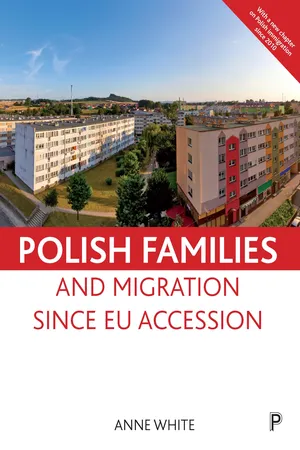
Polish Families and Migration since EU Accession
About this book
Based on 115 interviews with Polish mothers in the UK and Poland, as well as a specially-commissioned opinion poll, this topical book discusses recent Polish migration to the UK. In a vivid account of every stage of the migration process, the book explores why so many Poles have migrated since 2004, why more children migrate with their families and how working-class families in the West of England make decisions about whether to stay. With a fully revised introduction for the paperback edition, it covers many broader themes - including livelihoods and migration cultures in Poland, experiences of integration into UK communities and issues surrounding return to Poland. This book is highly relevant to migration policy across Europe and beyond. It will be of interest to policy-makers and the general public as well as students and scholars. Winner of the BASEES George Blazyca Prize 2011.
Information
APPENDIX 1
The interviewees
Not including key informants, there were 115 interviews and 102 interviewees in total. Seventy-two first interviews (2007-08) and 10 repeat interviews (2009) were conducted in Poland. Thirty first interviews (2006-09) and three repeat interviews (2007, 2009) were conducted in the UK. Interviews in Poland took place in 2007 in Biedruszko, Brodnica (Wielkopolska), Gniezno, Książ Wielkopolski, Tarnowo Podgórne and Witkowo (one interview in each location), as well as Suwałki (3), Ełk (6), Kłodawa (3); in 2008 in Grajewo (33) and Sanok (21); and in 2009 in Grajewo (10). Interviews in England took place in Bath (17 interviews, 2006-09), Bristol (12 interviews, 2006-09), Frome (one interview, 2009) and Trowbridge (three interviews, 2007-09).
UK interviewees were 31 years old on average, Polish interviewees about 37. Twenty-three interviewees were under the age of 30 and 10 were over the age of 45.
The 30 UK interviewees had previously lived in almost every region of Poland. In total, the last Polish places of residence of UK interviewees included seven cities with populations of approximately 100,000 or more, seven towns of 40,000-70,000, eight towns under 40,000 and eight villages.
Most of the interviewees (73) were found by ‘gatekeepers’ – my personal contacts, or contacts of contacts. These gatekeepers were mostly teachers and kindergarten heads, as well as a nurse (the mother of a UK contact). Most of the gatekeepers have been thanked in the ‘Acknowledgements’ at the start of this book, but I have not mentioned by name those interviewees who, without reference to a gatekeeper, helped me directly to find other interviewees (the so-called ‘snowball’ method). In fact only 11 interviewees were contacted by the snowball method. I approached 23 interviewees (five in Poland and 18 in the UK) directly, persuading them to talk to me at English lessons or lunchtime breaks for cleaners at the University of Bath; at Saturday schools/toddler groups in the UK; at hotels in Poland; and through the social networking internet site Nasza Klasa. (In addition, one Nasza Klasa contact in Sanok, ‘Olga’, aged 24, did not want to be interviewed, but replied to questions by email.) I also requested all 13 repeat interviewees by contacting the interviewees directly. I found no interviewees through paper advertisements (which I posted in Polish shops in the UK, displayed at an event at the Saturday School in Bath and distributed to parents at a school in Sanok). I paid for interviews, except for the first few in the pilot survey. (The fee was 50 zl in Poland and £15, rising in 2008 to £20, in England.)
There were 14 key informants in the UK. Most were teachers: English teachers, teaching assistants at schools, a schools liaison officer working with Polish families and a Saturday school headteacher. The other key informants were three cleaning managers, one recruitment agency manager, one community development worker and the Trowbridge representative of the Polish Honorary Consul in Bristol. I also had many informal conversations with teachers at the Saturday School in Bath. In Poland I interviewed/had conversations with local education officers, House of Culture employees and a newspaper editor in Suwałki; a local historian and a hospital administrator in Grajewo; nursery and kindergarten heads in Sanok; travel agency workers in Ełk, Grajewo and Sanok; and job centre heads/employees, librarians, teachers and school secretaries in all four towns.
Some interviewees did not completely match my criteria because of misunderstandings on the part of the gatekeepers. Unfortunately five women turned out to have higher education (Polish Master’s) but in places where this seemed to differentiate them from other respondents (for example, because they had different aspirations, such as non-manual work or private education for their children) I have not used information from the interviews. The five women were: Eliza and Hanna in the UK, Karolina and Irena in north-east Poland and Rozalia in Sanok. In Poland, Marcelina and Julita were not yet mothers (although Julita was heavily pregnant). In the UK, Agnieszka had been childless when she first arrived in the UK, but had her first baby shortly afterwards. I tried to interview only mothers with children under the age of 20 (although some also had older children); Henryka turned out to have only older children, but since her son and his family were living in England this was an interesting interview nonetheless.
APPENDIX 2
The opinion poll
The opinion poll was conducted by telephone among 1,101 residents of Podkarpacie (excluding the city of Rzeszów) in March 2008. Although I wrote the questions, the information was collected by sociologists from the University of Rzeszów working for an independent firm, BD Center Consulting, run by Dr Paweł Walawender.
Questions
1Since 1 May 2004, have whole families begun to migrate from your locality to Western Europe?
2.1‘If one parent in the family works abroad temporarily, it’s better for the children if the father migrates, not the mother, even when the children are teenagers.’
2.2‘Mothers of small children should not leave their children and husbands to work abroad.’
2.3.1‘In my locality you can notice certain problems connected with parental migration: there are more lone-parent and broken families.’
2.3.2‘In my locality you can notice certain problems connected with parental migration: the children left in Poland have psychological and behavioural problems.’
2.3.3‘In my locality you can notice certain problems connected with parental migration: grandparents looking after migrants’ children have too many responsibilities.’
3.1‘It’s better for children under 12 years old to go abroad with both parents, rather than staying in Poland without one parent.’
3.2‘It’s better for teenage children to go abroad with both parents, rather than staying in Poland without one parent.’
3.3‘If one parent has a good job offer, or has already found a good job in Western Europe, it’s worthwhile for the whole family to try emigrating (they can return if it doesn’t work out).’
3.4‘For lone mothers, migration is often a sensible escape route from a difficult financial situation; afterwards, they can bring their children to be with them and start a new life abroad.’
3.5‘In my locality, you can notice a certain social pressure on family members left behind in Poland to go and join the husband or wife who is already working abroad.’
3.6‘It’s frightening to move with children to another country and I find it hard to understand parents who decide to do this.’
4.1Do you agree that it’s easier for families to live in England than in Poland?
4.2Do you agree that English towns are less safe than Polish ones?
4.3Do you agree that young children quickly adapt to life in a new country?
4.4Do you agree that teenagers would quickly adapt to life in England, because they learned English at school?
4.5Do you agree that the school syllabus in England is similar to the Polish syllabus?
5.1Are there any members of your immediate family in England or who have been there over the past year?
5.2What is the sex of that person/those people?
Respondents were also asked about their own age, educational level, financial status, whether they had been in the UK or to other Western countries, whether they had children under the age of 20 and, if so, whether they had lived with those children abroad. A record was kept of where they lived and the places of residence were categorised into four bands by BD Center Consulting: villages, plus three sizes of town (under 9,000, 9,000-50,000 and over 50,000 population). During the analysis, I also identified three sub-regions: the south-east periphery (128 respondents), the west (133) and the north (129). All sub-regions were on the borders of Podkarpacie and not adjacent to one another.
APPENDIX 3
2001 Census data for Bath, Bristol, Frome and Trowbridge urban areas

Source: ONS (2004, Tables KS01, KS06, KS09a, KS11a, KS12a, KS18)
Bibliography
Aboim, S. (2010) ‘Gender cultures and the division of labour in contemporary Europe: a cross-national perspective’, The Sociological Review, vol 58, no 2, pp 171-96.
Ackers, L. (1998) Shifting spaces: Women, citizenship and migration within the European Union, Bristol: The Policy Press.
Ackers, L. (2004) ‘Citizenship, migration and the valuation of care in the European Union’, Journal of Ethnic and Migration Studies, vol 30, no 2, pp 373-96.
admin, ‘Sieroty emigracji’ (http://isanok.pl/index.php?option=com_content&task=view&id=681&Itemid=99999999).
Ager, A. and Strang, A. (2004) Indicators of integration: Final report, London: Home Office.
AKJ, KAI (2007) ‘Powołanie małżeńskie i rodzinne’, Nasz Dziennik, 20 August.
Al-Ali, N. (2002) ‘Loss of status or new opportunities? Gender relations and transnational ties among Bosnian refugees’, in D. Bryceson and U. Vuorela (eds) The transnational family: New European frontiers and global networks, Oxford: Berg, pp 83-102.
Alexander, C., Edwards, R. and Temple, B. (2007) ‘Contesting cultural communities: language, ethnicity and citizenship in Britain’, Journal of Ethnic and Migration Studies, vol 33, no 5, pp 783-800.
Anderson, B., Clark, N. and Parutis, V. (2007) New EU members? Migrant workers’ challenges and opportunities to UK trades unions: A Polish and Lithuanian case study, London: Trades Union Congress.
Anderson, B., Ru...
Table of contents
- Coverpage
- Title page
- Copyright
- Contents
- List of figures and tables
- Acknowledgements
- one: Introduction
- two: Post-communist Poland: social change and migration
- three: Small-town livelihoods
- four: Local migration cultures: compulsion and sacrifice
- five: Local migration cultures: opportunities and ‘pull factors’
- six: Parental migration with and without children
- seven: The emotional impact of migration on communities in Poland
- eight: Integration into British society
- nine: Being Polish in England
- ten: Return to Poland
- eleven: Conclusions
- twelve: Afterword: Polish migration since 2010
- Appendix 1: The interviewees
- Appendix 2: The opinion poll
- Appendix 3: 2001 Census data for Bath, Bristol, Frome and Trowbridge urban areas
- Bibliography
Trusted by 375,005 students
Access to over 1.5 million titles for a fair monthly price.
Study more efficiently using our study tools.
Frequently asked questions
Yes, you can cancel anytime from the Subscription tab in your account settings on the Perlego website. Your subscription will stay active until the end of your current billing period. Learn how to cancel your subscription
No, books cannot be downloaded as external files, such as PDFs, for use outside of Perlego. However, you can download books within the Perlego app for offline reading on mobile or tablet. Learn how to download books offline
We are an online textbook subscription service, where you can get access to an entire online library for less than the price of a single book per month. With over 1.5 million books across 990+ topics, we’ve got you covered! Learn about our mission
Look out for the read-aloud symbol on your next book to see if you can listen to it. The read-aloud tool reads text aloud for you, highlighting the text as it is being read. You can pause it, speed it up and slow it down. Learn more about Read Aloud
Yes! You can use the Perlego app on both iOS and Android devices to read anytime, anywhere — even offline. Perfect for commutes or when you’re on the go.
Please note we cannot support devices running on iOS 13 and Android 7 or earlier. Learn more about using the app
Please note we cannot support devices running on iOS 13 and Android 7 or earlier. Learn more about using the app
Yes, you can access Polish Families and Migration since EU Accession by White, Anne,Anne White in PDF and/or ePUB format, as well as other popular books in Politics & International Relations & Social Policy. We have over 1.5 million books available in our catalogue for you to explore.