The Emotional Politics of Social Work and Child Protection
eBook - ePub

The Emotional Politics of Social Work and Child Protection

  1. 224 pages
  2. English
  3. ePUB (mobile friendly)
  4. Available on iOS & Android
eBook - ePub

The Emotional Politics of Social Work and Child Protection

About this book

For several decades, social work and child protection systems have been subject to accelerating cycles of crisis and reform, with each crisis involving intense media and political scrutiny. In understanding the nature and causes of this cycle, little attention has been paid to the importance of collective emotions.

Using a range of cases from the UK, and also considering cases from the Netherlands, the US and New Zealand, this book introduces the concept of emotional politics. It shows how collective emotions, such as anger, shame, fear and disgust, are central to constructions of risk and blame, and are generated and reflected by official documents, politicians and the media. The book considers strategies for challenging these 'emotional politics', including identifying models for a more politically engaged stance for the social work profession.

Frequently asked questions

Yes, you can cancel anytime from the Subscription tab in your account settings on the Perlego website. Your subscription will stay active until the end of your current billing period. Learn how to cancel your subscription.
No, books cannot be downloaded as external files, such as PDFs, for use outside of Perlego. However, you can download books within the Perlego app for offline reading on mobile or tablet. Learn more here.
Perlego offers two plans: Essential and Complete
  • Essential is ideal for learners and professionals who enjoy exploring a wide range of subjects. Access the Essential Library with 800,000+ trusted titles and best-sellers across business, personal growth, and the humanities. Includes unlimited reading time and Standard Read Aloud voice.
  • Complete: Perfect for advanced learners and researchers needing full, unrestricted access. Unlock 1.4M+ books across hundreds of subjects, including academic and specialized titles. The Complete Plan also includes advanced features like Premium Read Aloud and Research Assistant.
Both plans are available with monthly, semester, or annual billing cycles.
We are an online textbook subscription service, where you can get access to an entire online library for less than the price of a single book per month. With over 1 million books across 1000+ topics, we’ve got you covered! Learn more here.
Look out for the read-aloud symbol on your next book to see if you can listen to it. The read-aloud tool reads text aloud for you, highlighting the text as it is being read. You can pause it, speed it up and slow it down. Learn more here.
Yes! You can use the Perlego app on both iOS or Android devices to read anytime, anywhere — even offline. Perfect for commutes or when you’re on the go.
Please note we cannot support devices running on iOS 13 and Android 7 or earlier. Learn more about using the app.
Yes, you can access The Emotional Politics of Social Work and Child Protection by Warner, Joanne,Joanne Warner in PDF and/or ePUB format, as well as other popular books in Social Sciences & Political Propaganda. We have over one million books available in our catalogue for you to explore.

Information

References
Abbott, D. (2013) ‘Daniel Pelka’s horrendous death: the buck-passing must stop here’, The Guardian, 18 September.
Ahmed, S. (2004) The cultural politics of emotion, New York, NY: Routledge.
Aldridge, M. (1994) Making social work news, London: Routledge.
Allen, G. and Smith, I.D. (2008) Early intervention: Good parents, great kids, better citizens, London: The Centre for Social Justice/The Smith Institute.
Allpress, J.A., Barlow, F.K., Brown, R. and Louise, W.R. (2010) ‘Atoning for colonial injustices: group-based shame and guilt motivate support for reparation’, International Journal of Conflict and Violence, 4(1), 75-88.
Altheide, D.L. (1996) Qualitative media analysis, Thousand Oaks, CA: Sage Publications.
Anderson, B. (2008) ‘The night a grim malaise was hammered home’, The Sunday Telegraph, 16 November.
Angel, J. (2014) Moving beyond the market: A new agenda for public services, London: New Economics Foundation.
Arlott, G. (2014) ‘City councillors put aside party divides at children’s services meeting’, Coventry Telegraph, 10 April.
Armingeon, K. and Guthmann, K. (2014) ‘Democracy in crisis? The declining support for national democracy in European countries, 2007-2011’, European Journal of Political Research, 53, 423-42.
Atkinson, P. and Coffey, A. (1997) ‘Analysing documentary realities’, in D. Silverman (ed) Qualitative research: Theory, method and practice, Thousand Oaks, CA: Sage Publications, 45-62.
Attlee, C. (1920) The social worker, London: Bell & Sons.
Ayre, P. (2001) ‘Child protection and the media: lessons from the last three decades’, British Journal of Social Work, 31, 887-901.
Balls, E. (2008a) ‘Wakefield Express column’, Wakefield Express, 14 November, p 10, www.edballs.co.uk
Balls, E. (2008b) ‘Power of your feeling is clear’, The Sun, 27 November, p 10.
Barbalet, J. (2002) ‘Introduction: why emotions are crucial’, in J. Barbalet (ed) Emotions and sociology, Oxford: Blackwell, 1-9.
Barbalet, J. (2006) ‘Emotions in politics: from the ballot to suicide terrorism’, in S. Clarke, P. Hoggett and S. Thompson (eds) Emotion, politics and society, Basingstoke: Palgrave Macmillan, 31-55.
Beddoe, L. (2013) ‘ ‘Making a moral panic - welfare reform, racism and “feral families” in New Zealand: doing the work of the state?’, Social work research in New Zealand, blogpost: http://socialworkresearchnz.wordpress.com/2013/08/31/making-a-moral-panic-welfare-reform-racism-and-feral-families-in-new-zealand-doing-the-work-of-the-state-3/
Beddoe, L. and Fraser, H. (2012) ‘Social work in Australasia’, in K.H. Lyon, T. Hokenstad, M. Pawar, N. Huegler and N. Hall (eds) Sage handbook of international social work, London: Sage Publications, 421-35.
Berezin, M. (2002) ‘Secure states: towards a political sociology of emotion’, in J. Barbalet (ed) Emotions and sociology, Oxford: Blackwell, 33-52.
Berrick, J.D. (2011) ‘Trends and issues in the U.S. child welfare system’, in N. Gilbert, N. Parton and M. Skivenes (eds) Child protection systems: International trends and orientations, New York, NY: Oxford University Press, 17-35.
Bird, S.E. and Dardenne, R.W. (1997) ‘Myth, chronical and story: exploring the narrative quality of news’, in D. Berkowitz (ed) Social meanings of news, Thousand Oaks, CA: Sage Publications, 333-50.
Blair, L. (2008) ‘Gordon Brown on the psychologist’s couch’, The Daily Telegraph, 17 May.
Blom-Cooper, L. (1985) A child in trust: The report of the panel of inquiry into the circumstances surrounding the death of Jasmine Beckford, London: London Borough of Brent.
Booker, C. (2013) ‘The social worker’s sledgehammer misses the nut yet again’, The Sunday Telegraph, 4 August.
Bradford Safeguarding Children Board (BSCB) (2013) A serious case review: Hamzah Khan – the overview report, Bradford: BSCB.
Brandon, M., Sidebotham, P., Bailey, S., Belderson, P., Hawley, C., Ellis, C. and Megson, M. (2012) New learning from serious case reviews: A two-year report for 2009-2011, DFE-RR226, London: Department for Education.
Briggs, K. (2014) ‘Aboriginal mothers like me still fear that our children could be ta...
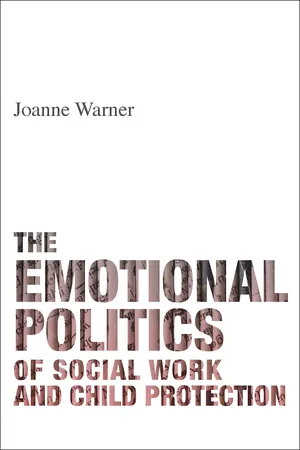
Table of contents

  1. Cover page
  2. Title page
  3. Copyright
  4. Dedication
  5. Contents
  6. Notes on the author
  7. Acknowledgements
  8. one: Introducing emotional politics
  9. two: ‘Heads must roll’? The politics of national anger and the press
  10. three: Hidden in plain sight: poverty and the politics of disgust
  11. four: From crisis to reform: the emotional politics of child rescue and commemoration
  12. five: Risk, respectability and the emotional politics of class
  13. six: The emotionality of official documents: the serious case review as an active text
  14. seven: Comparative perspectives: cultures of difference and convergence
  15. eight: Towards a new emotional politics of social work and child protection
  16. Appendix
  17. References