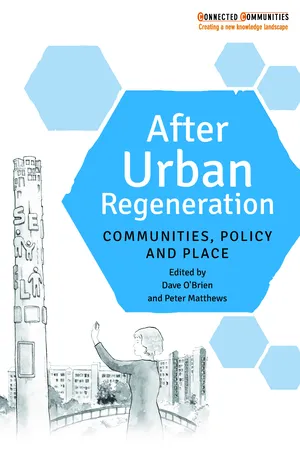
eBook - ePub
After Urban Regeneration
Communities, Policy and Place
- 208 pages
- English
- ePUB (mobile friendly)
- Available on iOS & Android
eBook - ePub
After Urban Regeneration
Communities, Policy and Place
About this book
After Urban Regeneration is a comprehensive study of contemporary trends in urban policy and planning. Leading scholars come together to create a key contribution to the literature on gentrification, with a focus on the history and theory of community in urban policy. Engaging with debates as to how urban policy has changed, and continues to change, following the financial crash of 2008, the book provides an essential antidote to those who claim that culture and society can replicate the role of the state. Based on research from the UK Arts and Humanities Research Council's Connected Communities programme and with a unique set of case studies drawing on artistic and cultural community work, the book will appeal to scholars and students in geography, urban studies, planning, sociology, law and art as well as policy makers and community workers.
Information
After regeneration?
TWO
Urban policy and communities
Stuart Wilks-Heeg
Introduction
In one form or another, all UK governments since 1945 have pursued policies aimed at addressing urban problems. A concern with community has been evident throughout, although the assumptions about how communities would be engaged with, and benefit from, these policies have varied enormously. In the first two decades after the end of the Second World War, communities were regarded as the passive beneficiaries of planned decentralisation to new towns and the replacement of ‘slums’ with modern public housing. Partly due to the backlash against such policies, the late 1960s witnessed the emergence of neighbourhood-based, often experimental, urban policy initiatives designed to address what Home Secretary James Callaghan described as the ‘deadly quagmire of need and apathy’ in some inner-city communities.1 Since then, there have been numerous shifts in the way in which communities are framed by urban policies, with some initiatives framing ‘communities’ as the solution and others promoting them as the problem. As this chapter demonstrates, this shifting approach to community reflects a deeper set of long-run tensions in urban policy, with policy change tending to emerge as a response to previous policy failure.
The chapter is divided into three main sections. The first section provides an overview of urban policy, with an emphasis on understanding the key shifts in policy since the first area-based initiatives (ABIs) were established in the late 1960s. The tendency for urban policy experiments to serve as a barometer of political and ideological change is noted and the consequences for policymaking are highlighted, with particular emphasis on the circular nature of urban policy debate. The second section examines in more detail the turn, or, more accurately, return, to community in urban policy from the early 1990s onwards. It is shown how community involvement, and ultimately community leadership, came to be seen as the solution to previous policy failure. Yet, it is argued, urban policies continued to repeat the mistakes of past initiatives by misrepresenting the causes of neighbourhood decline. The final, short section briefly examines the contemporary urban policy context. For the first time since 1968, there are effectively no ABIs in England and national government policy has shifted from targeted intervention to a philosophy of general ‘facilitation’. In many ways, this abandonment of urban policy experiments is the biggest regeneration experiment to date. The outcome is almost certain to be that the gap between affluent and deprived neighbourhoods continues to grow.
Urban policy and communities
There is a long history of UK governments adopting policies aimed specifically at addressing urban and regional problems. Indeed, it is possible to argue that regional policies were pioneered in the UK during the 1930s, when measures were introduced in response to the rise of mass unemployment in many core industrial areas (Forthergill, 2005). Many authors also highlight the historical significance of post-war planning frameworks in driving the reconstruction of British cities within the context of the broad political consensus associated with the Keynesian welfare state (Thornley, 1991; Atkinson and Moon, 1994). However, it was the late 1960s that served as the key starting point for most accounts of the development of what has become known as ‘urban policy’. It was at this time that the then Labour government launched the first special programmes targeted at a small number of neighbourhoods deemed to be suffering from concentrated urban social problems. Introducing the government’s proposals to the House of Commons on 22 July 1968, Home Secretary James Callaghan explained:
There remain areas of severe social deprivation in a number of our cities and towns—often scattered in relatively small pockets. They require special help to meet their social needs and to bring their physical services to an adequate level. The Government propose to initiate an urban programme to help tackle the social problems of the communities concerned. (Callaghan, 1968)
Callaghan’s framing of the new Urban Programme captures many of the recurrent and defining, although not necessarily constant, features of urban policy. First, urban policies tend to take the form of ABIs operating in a limited number of localities. Second, this spatial targeting has generally been determined on the basis of social need (although sometimes on other criteria) and involves initiatives that operate in addition to mainstream state provision. Third, the social problems that these initiatives are designed to address are assumed to be present in particular localities, or communities, and therefore essentially absent from others.
These long-term continuities in many of the defining characteristics of urban policy should not, however, be taken as an indicator of policy stability. There have been dramatic shifts in the objectives and character of urban policy initiatives over time. Moreover, since the creation of the Urban Programme in 1968, a bewildering array of initiatives that could legitimately be classified as urban policies have come and gone. By the mid-1990s, accounts of urban policy were already replete with an ‘alphabet soup’ of abbreviations: CDPs (Community Development Projects), SRB (Single Regeneration Budget) and UDCs (Urban Development Corporations). After New Labour came to power in 1997, the number of ABIs proliferated dramatically (Rhodes et al, 2005). Indeed, if we cast the net a little wider than the core features of urban policy outlined earlier, it is possible to identify around 200 policy programmes with ‘some relevance to urban policy’ operating during the early 2000s (Imrie and Raco, 2003: 14–16).
Given the sheer number of initiatives involved, this chapter makes no attempt to present a full history of urban policy, not least because numerous detailed accounts already exist (see Atkinson and Moon, 1994; Tallon, 2010). Instead, it will suffice to summarise five key phases through which urban policy passed after 1968, and the dominant features of policy, as well as examples of key policy initiatives, in each of these (developments since 2010 are considered in the final part of the chapter).
In the first phase, from 1968 to 1976, urban policy initiatives arose as a response to the so-called ‘rediscovery of poverty’ in the 1960s and to growing concerns about racial and ethnic tensions in a number of inner-city areas. These programmes were largely premised on what became known as a ‘social pathology’ perspective. Essentially, it was assumed that given the existence of full employment and a ‘cradle to grave’ welfare state, the persistence of poverty and other social problems in some inner-city areas must be the product of the dysfunctional character of the communities concerned. As well as the Urban Programme, initiatives such as the CDPs and the Inner Area Studies reflected this approach. There was a particular focus on policymakers and other ‘experts’, including university researchers, seeking to work with local communities to generate ‘solutions’ to social problems.
There were growing criticisms of the ‘social pathology’ perspective during the 1970s, many of them voiced from key players in the programmes themselves. In response, a brief second phase of urban policy, from 1977 to 1978, saw the focus shift towards efforts to devise strategic policy responses to the impact of structural economic change, particularly deindustrialisation and manufacturing job loss, on inner-city areas. Based on the analysis contained in the Labour government’s (Department of the Environment, 1977), six Inner City Partnerships were created as mechanisms for coordinating local and central government efforts to tackle urban decline. While these programmes were short-lived, the new emphasis on the causes of inner-city problems being primarily economic, rather than social, was to mark a significant change in direction.
Thus, from 1979 to 1990, under Margaret Thatcher’s governments, problems associated with urban decay came to be seen as manifestations of the lack of an enterprise culture in inner-city areas. This third phase of urban policy resulted in programmes designed to ‘lever in’ private sector investment in order to bring about physical regeneration and drive job creation. It was assumed that economic benefits would subsequently ‘trickle down’ to local communities, primarily through improved employment opportunities. This policy shift was underpinned by significant institutional changes. Many urban policy initiatives circumvented local authorities, which the Thatcher governments saw as part of the problem, and, in some cases, involved the establishment of new organisational structures giving business representatives a leading role. The UDCs were the dominant policy initiative of the period. Other key programmes included Enterprise Zones and Derelict Land Grants.
However, under the Major governments of the early to mid-1990s, urban policy again shifted in response to a growing body of criticism. By the early 1990s, evidence was mounting that while the property-led regeneration programmes of the previous decade had brought about the physical transformation of some urban areas, the impact on levels of unemployment and poverty had been negligible. At the same time, the previous proliferation of programmes and the poor coordination of regeneration initiatives was widely held to have created an ineffectual ‘patchwork quilt’ of agencies and initiatives. New policy programmes from 1991 to 1996 sought to address urban social and economic problems in an integrated way, to promote partnership-working between the public, private and voluntary sectors, and to facilitate the involvement of local communities in urban policy. At the same time, there was a move away from allocating funding solely on the basis of social need. In particular, the key initiatives launched during this period – City Challenge and the SRB – were based on a new model of competitive bidding between areas seeking regeneration funding.
A fifth distinctive phase of urban policy, from 1997 to 2010, was marked by Labour’s return to power under Tony Blair in 1997 and the rise of ‘third way’ ideas in shaping the party’s economic and social policies. With respect to urban policy, the ‘New Labour’ approach was underpinned by the objective of tackling ‘social exclusion’ and a renewed emphasis on community-based solutions at the neighbourhood level. The New Deal for Communities (NDC) was the centrepiece of Labour’s urban policy agenda, which also saw a return to targeting policies towards areas with the greatest social need. Meanwhile, other Labour initiatives focused on economic development at a regional scale, through the creation of Regional Development Agencies. There was also a proliferation of regeneration and economic development partnerships, particularly at local authority and sub-regional scales.
Despite the sheer number of urban policy initiatives operating in each of these periods, and the bold claims made about their potential to tackle urban problems, they have never accounted for more than a fraction of public expenditure. As selective and spatially targeted programmes, the budgets for urban policy initiatives are dwarfed by mainstream social policy expenditure. Nonetheless, urban policy has always been a high-profile, and much-studied, area of public policy. A key reason for the disproportionate attention it has received is that urban policy starkly reflects broader political and ideological shifts with respect to pressing questions of social and economic policy. There are a number of good reasons why urban policy operates as such an effective barometer of wider public policy change. First, and foremost, as urban policies operate beyond mainstream programmes, radical shifts in policy are relatively easy to bring about, not least because they rarely require primary legislation. Second, as urban policy initiatives tend to be spatially targeted, they are also amenable to experimental approaches and can be used to trial new approaches before they are rolled out more widely. Third, the relatively low cost and flexible and experimental nature of urban policies makes them highly suitable for new ministers seeking to make their mark politically. Perhaps more so than in any other policy area, urban policy programmes tend to be identified as the ‘pet projects’ of particular secretaries of state, as other contributors to this volume highlight.
The highly politicised nature of urban policy exemplifies, and arguably exaggerates, a number of tensions that are widely observed in public policy more generally. Regular policy shifts take place despite a broad consensus that tackling urban social problems requires a sustained, long-term approach. Moreover, while a great deal has been invested in evaluating urban policies and in schemes to promote policy learning, it is the political and ideological factors identified earlier that serve as the primary drivers of policy change. Finally, urban policies tend to be characterised by failure, or, perhaps more charitably, it tends to be very difficult to find evidence of their success, particularly in the short term (Lawless, 2010).
Of course, there is no reason to assume that urban policy should offer any greater prospect of lasting cross-party consensus, evidence-based policymaking or unambiguously successful policy outcomes than other policy areas. However, when combined with a tendency for each experimental urban policy to be announced as a virtual panacea for urban decline, these shortcomings have created a very particular set of temporal policy dynamics. Despite the vast array of urban policy initiatives, there are, in truth, a limited range of options for spatial targeting. Essentially, policy can attempt to improve the lives of people or improve the look of places, or, under the most ambitious variants, both. Yet, these modestly resourced, experimental programmes always tend to founder in the face of deep-rooted urban problems, prompting policy to switch continually from one of these broad approaches to another. As a result, urban regeneration exhibits a cyclical tendency, whereby ‘wheels have to be reinvented and long-established truths have to be rediscovered’ (Wilks-Heeg, 1996: 1264).
This cycle has had significant consequences for how communities have been defined with respect to urban policy. It is certainly true that community has represented ‘a recurrent theme’ in urban policy since the late 1960s (Tallon, 2010: 140) and that ABIs ‘have always had some measure of community involvement’ (Dargan, 2009: 306). However, the way in which policies have viewed the role of communities has been far from stable. As the preceding summary of the history of urban policy illustrated, communities have been seen variously as the problem that needs fixing, as the passive recipients of ‘trickle-down’ from inward investment, or as the unique possessors of the local knowledge that will help provide the solutions. It is also evident, however, that there was a growing emphasis on community involvement in urban policy from the early 1990s, which reached its peak during the 2000s. Writing with reference to the failings of property-led regeneration in the 1980s, Robinson and Shaw (1991) noted some initial signs of community involvement in urban policy and argued for far stronger emphasis on community as part of a balancing of place-based and people-based regeneration. Reflecting a decade and a half later on their 1991 account, Robinson et al (2005: 14) noted that ‘the change has been substantial – even, perhaps, remarkable’. How, then, did this (re)turn to community come about?
Understanding the (re)turn to community
As noted earlier, the ‘turn to community’ was not new to urban policy as attempts had already been made to embed urban policy initiatives in specific communities through the ABIs of the late 1960s and early 1970s. In this sense, it is more accurate to speak of a ‘return to community’, albeit with some important distinctions to note in the way in which community participation was framed (see later). Equally, community involvement was not unique to urban policy and ne...
Table of contents
- Cover
- Title Page
- Copyright
- Contents
- Notes on contributors
- ONE: Introduction
- Part One After regeneration?
- Part Two Exploring epistemologies
- Part Three New places for communities
- Part Four New spaces for policy
Trusted by 375,005 students
Access to over 1.5 million titles for a fair monthly price.
Study more efficiently using our study tools.
Frequently asked questions
Yes, you can cancel anytime from the Subscription tab in your account settings on the Perlego website. Your subscription will stay active until the end of your current billing period. Learn how to cancel your subscription
No, books cannot be downloaded as external files, such as PDFs, for use outside of Perlego. However, you can download books within the Perlego app for offline reading on mobile or tablet. Learn how to download books offline
Perlego offers two plans: Essential and Complete
- Essential is ideal for learners and professionals who enjoy exploring a wide range of subjects. Access the Essential Library with 800,000+ trusted titles and best-sellers across business, personal growth, and the humanities. Includes unlimited reading time and Standard Read Aloud voice.
- Complete: Perfect for advanced learners and researchers needing full, unrestricted access. Unlock 1.5M+ books across hundreds of subjects, including academic and specialized titles. The Complete Plan also includes advanced features like Premium Read Aloud and Research Assistant.
We are an online textbook subscription service, where you can get access to an entire online library for less than the price of a single book per month. With over 1.5 million books across 990+ topics, we’ve got you covered! Learn about our mission
Look out for the read-aloud symbol on your next book to see if you can listen to it. The read-aloud tool reads text aloud for you, highlighting the text as it is being read. You can pause it, speed it up and slow it down. Learn more about Read Aloud
Yes! You can use the Perlego app on both iOS and Android devices to read anytime, anywhere — even offline. Perfect for commutes or when you’re on the go.
Please note we cannot support devices running on iOS 13 and Android 7 or earlier. Learn more about using the app
Please note we cannot support devices running on iOS 13 and Android 7 or earlier. Learn more about using the app
Yes, you can access After Urban Regeneration by O'Brien, Dave,Matthews, Peter,Dave O'Brien,Peter Matthews in PDF and/or ePUB format, as well as other popular books in Social Sciences & City Planning & Urban Development. We have over 1.5 million books available in our catalogue for you to explore.