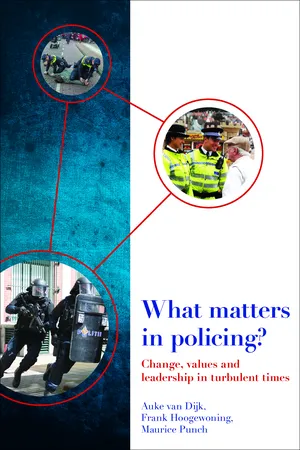
eBook - ePub
What Matters in Policing?
Change, Values and Leadership in Turbulent Times
- 240 pages
- English
- ePUB (mobile friendly)
- Available on iOS & Android
eBook - ePub
What Matters in Policing?
Change, Values and Leadership in Turbulent Times
About this book
Policing is at a turbulent turning point: the pace of change is accelerating with renewed emphasis on crime reduction yet with austerity. This topical book examines what matters in policing, rather than just what works. It compares the implications of restructuring in the UK and The Netherlands, also in the USA, regarding police systems, policing paradigms and research knowledge. The authors, who cover both academia and practice, focus particularly on dilemmas for police leadership relating to strategy, values and operational command. With a foreword by Peter Neyround, University of Cambridge, it argues for developing confident and competent leadership and also provide a comprehensive paradigm to chart policing in the future while retaining trust. It is accessibly written for academics, practitioners, policy makers and students in diverse societies.
Information
References
ACPO (Association of Chief Police Officers) (2009) Guidance on command and control, London: NPIA.
ACPO (2010) Risk principles, London: NPIA.
Adeney, M. and Lloyd, J. (1986) The miners’ strike, London: Routledge and Kegan Paul.
Adlam, R. and Villiers, P. (2003) Police leadership in the 21st century, Winchester: Waterside Press.
Aigner, G. (2011) Leadership beyond good intentions. What it takes to really make a difference, Crow’s Nest: Allen & Unwin.
Alderson, J. (1979) Policing freedom, Plymouth: Macdonald & Evans.
Alison, L. and Crego, J. (eds) (2008) Policing critical incidents, Cullompton: Willan.
Allason, R. (1983) The branch, London: Secker and Warburg.
Allum, F. and Gilmour, S. (eds) (2012) Routledge handbook of transnational organized crime, Abingdon/New York, NY: Routledge.
Anckar, C. (2008) ‘On the applicability of the most similar systems design and the most different systems design in comparative research’, International Journal of Social Research Methodology, vol 11, no 5, pp 389-40.
Andersen, T. (2014) ‘William Evans to be named Boston police commissioner’, Boston Globe, 7 January.
Andreas, P. and Nadelmann, E. (2006) Policing the globe, New York, NY/Oxford: Oxford University Press.
Appelbaum, A. (2012) Iron curtain: The crushing of Eastern Europe 1944-1956, London: Allen Lane.
Argyris, C. and Schön, D. (1974) Theory in practice: Increasing professional effectiveness, San Francisco, CA: Jossey Bass.
Ascoli, D. (1979) The Queen’s peace, London: Hamish Hamilton.
Asher, M. (2008) The regiment: The real story of the SAS, London: Penguin Books.
Bailey, V. (ed) (1981) Policing and punishment in nineteenth century Britain, London: Croom Helm.
Bangma, K. (2014) ‘Sturing versus professionele ruimte’, Symposium veranderingen in het openbaar bestuur, University of Groningen, 25 February.
Banton, M. (1964) The policeman in the community, London: Tavistock.
Barham, D. (2010) ‘Multi-point of direct entry’, Police Review, 20 August.
Barker, A. (2004) Shadows: Inside Northern Ireland’s special branch, Edinburgh/London: Mainstream.
Bayley, D.H. (1994) Police for the future, New York, NY/Oxford: Oxford University Press.
Bayley, D.H. (2006a) Changing the guard: Developing democratic police abroad, New York, NY: Oxford University Press.
Bayley, D.H. (2006b) ‘Police reform: who done it?’, Paper presented at Police Reform from the Bottom Up, Conference, University of California, Berkeley, CA, October.
Bayley, D.H. and Nixon, C. (2010) ‘The changing environment for policing 1985-2008’, New perspectives in policing: Harvard executive session on policing and public safety, Cambridge, MA: Harvard Kennedy School/NIJ.
Bayley, D.H. and Perito, R.M. (2010) The police in war, Boulder, CO/London: Lynne Rienner.
Bayley, D.H. and Shearing, C. (2001) The new structure of policing, Washington, DC: NIJ.
BBC Radio (2009) ‘The reunion: Iranian Embassy siege’, 6 September.
Beevor, A. (2009) D-Day: The battle for Normandy, London: Viking.
Belur, J. (2010) Permission to shoot: Police use of deadly force in democracies, London: Springer.
Bennis, W. (2003) On becoming a leader, New York, NY: Basic Books.
Bennis, W. and Nanus, B. (2003) Leaders: Strategies for taking change, New York, NY: HarperCollins.
Bennis, W., Parich, J. and Lessem, R. (1997) Beyond leadership, New York, NY: Wiley.
Bianchi, H. (1975) ‘Social control and deviance in the Netherlands’, in H. Bianchi, M. Simondi and I. Taylor (eds) Deviance and control in Europe: Papers from the European Group for the Study of Deviance and Social Control, London: Wiley, pp 1-11.
Bichard Report (2004) The Bichard inquiry report, London: House of Commons.
Bittner, E. (1967) ‘The police on skid row: a study of peace-keeping’, American Sociological Review, vol 32, no 5, pp 699-715.
Bittner, E. (1970) The functions of the police in modern society, Chevy Chase, MA: NIMH.
Bittner, E. (1974) ‘Florence Nightingale in pursuit of Willie Sutton: a theory of the police’, in H. Jacob (ed) The potential of reform for criminal justice, Beverly Hills, CA: Sage, pp 17-44.
Blair, I. (2003) ‘Leading towards the future’, Speech at Future of Policing Conference, LSE, London.
Blair, I. (2005) Richard Dimbleby Lecture, BBC, London.
Blair, I. (2009) Policing controversy, London: Profile Books.
Boin, R.A., van der Torre, E.J. and ‘t Hart, P. (2003) Blauwe bazen: Het leiderschap van korpschefs, Zeist: Kerckebosch.
Bootsma, P. (2001) De Molukse acties, Amsterdam: Boom.
Bowling, B. (1999) ‘The rise and fall of New York murder’, British Journal of Criminology, vol 39, no 4, pp 531-54.
Bowling, B. (2006) ‘Quantity and quality in police research: making the case for case studies’, unpublished paper presented at Cambridge Symposium on Research Methods, March.
Bowling, B. (2008) ‘Fair and effective policing methods: towards “good-enough” policing’, Journal of Scandinavian Studies in Criminology and Crime Prevention, vol 8, no 1, pp 17-32.
Bowling, B. and Phillips, C. (2003) ‘Policing ethnic minority communities’, in T. Newburn (ed) Handbook of policing, Cullompton: Willan, pp 528-54.
Bowling, B. and Ross, J. (2006) ‘The Serious Organised Crime Agency: should we be afraid?’, Criminal Law Review , 12, pp 1019-34.
Bowling, B. and Sheptycki, J. (2012) Transnational policing, London: Sage Publications.
Brants, C. (1999) ‘The fine art of regulated tolerance: prostitution in Amsterdam’, Journal of Law and Society, vol 25, no 4, pp 621-6.
Bratton, W. and Knobler, P. (1998) Turnaround: How America’s top cop reversed the crime epidemic, York: Random House.
Brodeur, J.-P. (1981) ‘Legitimizing police deviance’, in C. Shearing (ed) Organizational police deviance, Toronto: Butterworths, pp 127-60.
Brodeur, J.-P. (1983) ‘High and low policing. Remarks about the policing of political activities’, Social Problems, vol 30, no 5, pp 507-20.
Brodeur, J.-P. (2010) The policing web, New York, NY/Oxford: Oxford University Press.
Brogden, M. (2005) ‘H...
Table of contents
- Cover
- Title
- Copyright
- Contents
- Acknowledgements
- Abbreviations
- Foreword: a crisis in public policing
- Preface
- one Policing in perilous times: change and leadership
- two Police systems, perspectives and contested paradigms
- three Sea of troubles: the nature of policing
- four When matters become ‘really real’: commanding operations
- five Leadership and leadership development
- six Towards a comprehensive paradigm
- Appendix
- References
Trusted by 375,005 students
Access to over 1.5 million titles for a fair monthly price.
Study more efficiently using our study tools.
Frequently asked questions
Yes, you can cancel anytime from the Subscription tab in your account settings on the Perlego website. Your subscription will stay active until the end of your current billing period. Learn how to cancel your subscription
No, books cannot be downloaded as external files, such as PDFs, for use outside of Perlego. However, you can download books within the Perlego app for offline reading on mobile or tablet. Learn how to download books offline
Perlego offers two plans: Essential and Complete
- Essential is ideal for learners and professionals who enjoy exploring a wide range of subjects. Access the Essential Library with 800,000+ trusted titles and best-sellers across business, personal growth, and the humanities. Includes unlimited reading time and Standard Read Aloud voice.
- Complete: Perfect for advanced learners and researchers needing full, unrestricted access. Unlock 1.5M+ books across hundreds of subjects, including academic and specialized titles. The Complete Plan also includes advanced features like Premium Read Aloud and Research Assistant.
We are an online textbook subscription service, where you can get access to an entire online library for less than the price of a single book per month. With over 1.5 million books across 990+ topics, we’ve got you covered! Learn about our mission
Look out for the read-aloud symbol on your next book to see if you can listen to it. The read-aloud tool reads text aloud for you, highlighting the text as it is being read. You can pause it, speed it up and slow it down. Learn more about Read Aloud
Yes! You can use the Perlego app on both iOS and Android devices to read anytime, anywhere — even offline. Perfect for commutes or when you’re on the go.
Please note we cannot support devices running on iOS 13 and Android 7 or earlier. Learn more about using the app
Please note we cannot support devices running on iOS 13 and Android 7 or earlier. Learn more about using the app
Yes, you can access What Matters in Policing? by van Dijk, Auke,Hoogewoning, Frank,Auke van Dijk,Frank Hoogewoning,Maurice Punch in PDF and/or ePUB format, as well as other popular books in Scienze sociali & Criminologia. We have over 1.5 million books available in our catalogue for you to explore.