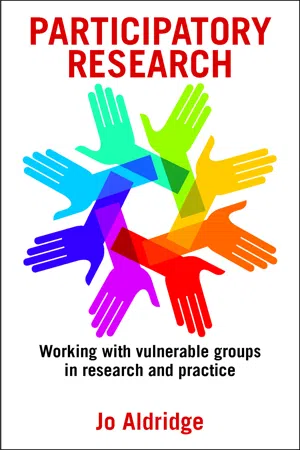
eBook - ePub
Participatory Research
Working with Vulnerable Groups in Research and Practice
- 200 pages
- English
- ePUB (mobile friendly)
- Available on iOS & Android
eBook - ePub
Participatory Research
Working with Vulnerable Groups in Research and Practice
About this book
This book examines the nature of participatory research in the social sciences and its role in increasing participation among vulnerable or marginalised populations. Drawing on engaging in-depth case studies, it examines the ways in which inclusion and collaboration in research can be enhanced among vulnerable participants, such as those with profound learning difficulties, victims of abuse and trauma and multiply vulnerable children and young people, and shows how useful it can be with these groups. The book will be an invaluable resource for students, researchers and academics in many countries who want to put participatory research methods into practice.
Information
References
Abdul-Quader, A.S., Heckathorn, D.D., Sabin, K. and Saidel, T. (2006) ‘Implementation and analysis of respondent-driven sampling: lessons learned from the field’, Journal of Urban Health: Bulletin of the New York Academy of Medicine, vol 83, no 7, pp 12-15.
Alanen, L. and Mayall, B. (eds) (2001) Conceptualising child–adult relationships, London: Routledge.
Alderson, P. (1995) Listening to children: Children, ethics and social research, Barkingside: Barnardo’s.
Aldridge, J. (2006) ‘The experiences of children living with and caring for parents with mental illness’, Child Abuse Review, vol 15, no 2, pp 79-88.
Aldridge, J. (2007) ‘Picture this: the use of participatory photographic research methods with people with learning disabilities’, Disability & Society, vol 22, no 1, pp 1-17.
Aldridge, J. (2010) ‘Consulting with young carers and their families’, in S.R. Redsell, and A. Hastings (eds) Skills for consulting with children, London: Radcliffe Medical Press, pp 87-99.
Aldridge, J. (2012a) ‘The participation of vulnerable children in photographic research’, Visual Studies, vol 27, no 1, pp 48-58.
Aldridge, J. (2012b) ‘Working with vulnerable groups in social research: dilemmas by default and design’, Qualitative Research, pp 1-19.
Aldridge, J. (2013) ‘Identifying the barriers to women’s agency in domestic violence: the tensions between women’s personal experiences and systemic responses’, Social Inclusion, vol 1, no 1, pp 3-12.
Aldridge, J. (forthcoming, 2015) Write It: An anthology of women’s writing on surviving domestic violence, Loughborough: Loughborough University.
Aldridge, J. and Becker, S. (1993) Children who care: Inside the world of young carers, Loughborough: Young Carers Research Group, Loughborough University.
Aldridge, J. and Becker, S. (1994) My child, my carer, Loughborough: Young Carers Research Group, Loughborough University.
Aldridge, J. and Becker, S. (2003) Children who care for parents with mental illness: Perspectives of young carers, parents and professionals, Bristol: Policy Press.
Aldridge, J. and Cross, S. (2008) ‘Young people today: media, policy and youth justice’, Journal of Children and Media, vol 2, no 3, pp 203-18.
Aldridge, J. and Dearden, C. (2013) ‘Disrupted childhoods’, in M. Pickering and E. Keightley (eds) Memory research in cultural studies, Edinburgh: Edinburgh University Press, pp 167-84.
Aldridge, J. and Sharpe, D. (2007) Pictures of young caring, Loughborough: Young Carers Research Group, Loughborough University.
Aldridge, J. and Wates, M. (2004) ‘Young carers and their disabled parents: moving the debate on’, in T. Newman and M. Wates (eds) Disabled parents and their children: Building a better future, Ilford: Barnardo’s.
Allen, M. (2011) Narrative therapy for women experiencing domestic violence: Supporting women’s transitions from abuse to safety, London: Jessica Kingsley Publishers.
Anthony, E.J. (1970) ‘The impact of mental and physical illness on family life’, American Journal of Psychiatry, vol 127, no 2, pp 138-46.
APA (American Psychiatric Association) (2001) Diagnostic and statistical manual of mental disorders (4th edn, revised) (DSM-IV-T), Washington, DC: APA.
Arnot, M. and Reay, D. (2007) ‘A sociology of pedagogic voice: power, inequality and pupil consultation’, Discourse: Studies in the Cultural Politics of Education, vol 28, no 3, pp 311-25.
Aspis, S. (2000) ‘Researching our own history: who is in charge?’, in L. Brigham (ed) Crossing boundaries: Change and continuity in the history of learning disabilities, Kidderminster: BILD Publications, pp 1-6.
Atkinson, D. (1986) ‘Engaging competent others: a study of the support networks of people with a mental handicap’, British Journal of Social Work, vol 16, supplement, pp 83-101.
Atkinson, D. (1997) An auto/biographical approach to learning disability research, Aldershot: Ashgate.
Atkinson, D. and Williams, F. (1990) Know me as I am: An anthology of prose, poetry and art by people with learning difficulties, Sevenoaks: Hodder & Stoughton.
Baldwin, C. (2013) Narrative social work: Theory and application, Bristol: Policy Press.
Bancroft, L. (2002) ‘Why does he do that?’ Inside the minds of angry and controlling men, New York: The Berkley Publishing Group.
Banks, M. (2001) Visual methods in social research, London: Sage.
Banks, M. (1995) Visual research methods, Guildford: University of Surrey (Sru.soc.surrey.ac.uk/SRU11/SRU11.html).
Banyard, K. (2010) The equality illusion: The truth about women and men today, London: Faber & Faber.
Barry, M. (2001) Young people’s views and experiences of growing up, York: Joseph Rowntree Foundation (www.jrf.org.uk/publications/young-peoples-views-and-experiences-growing).
Barton, D. and Papen, U. (2010) The anthropology of writing: Understanding textually-mediated worlds, London: Continuum.
Becker, S. (2000) ‘Young carers’, in M. Davies (ed) The Blackwell encyclopaedia of social work, Oxford: Blackwell, p 378.
Becker, S., Aldridge, J. and Dearden, C. (1998) Young carers and their families, Oxford: Blackwell Science.
Benbasat, I., Goldstein, D.K. and Mead, M. (1987) ‘The case research strategy in studies of information systems’, MIS Quarterly, vol 11, no 3, pp 369-86.
Biggs, S. (1989) Resource-poor farmer participation in research: A synthesis of experiences from nine national agricultural research systems, OFCOR (On-Farm Client-Oriented Research) Comparative Study Paper 3, The Hague: International Service for National Agricultural Research.
Bilsborrow, S. (1992) ‘You grow up fast as well...’ Young carers on Merseyside, Liverpool: Carers National Association, Personal Services Society and Barnardo’s.
Birren, J.E. and Birren, B.A. (1996) ‘Autobiography: exploring the self and encouraging development’, in J. Birren, G. Kenyon, J.E. Ruth, J. Schroots and T. Svensson (eds) Aging and biography, New York: Springer, pp 283-300.
Boddy, J. and Oliver, C. (2010) Research governance in children’s services: The scope for new advice, London: Thomas Coram Research Unit, Department for Education (www.gov.uk/government/uploads/system/uploads/attachment_data/file/182165/DFE-RR072.pdf).
Boddy, J., and Smith, M. (2008) ‘Asking the experts: developing and validating parental diaries to assess children’s minor injuries’, International Journal of Social Research Methodology, vol 11, no 1, pp 63–77.
Bolton, G. (1999) The therapeutic potential of creative writing: Writing myself, London: Jessica Kingsley Publishers.
Bolton, G. (2006) ‘Narrative writing: reflective enquiry into professional practice’, Educational Action Research, vol 14, no 2, pp 203-18.
Bolton, G. (2010) Reflective practice: Writing and professional development (3rd edn), London: Sage.
Bolton, G., Field, V. and Thompson, K. (eds) (2006) Writing works: A resource handbook for therapeutic writing workshops and activities, London: Jessica Kingsley Publishers.
Bolton, G., Field, V. and Thompson, K. (eds) (2011) Writing routes: A resource handbook of therapeutic writing, London: Jessica Kingsley Publishers.
Booth, T. (1996) ‘Sounds of still voices: issues in the use of narrative methods with people who have learning difficulties’, in L. Barton (ed) Disability and society: Emerging issues and insights, Sociology Series, New York: Longman, pp 237-55.
Booth, T. and Booth, W. (2003) ‘In the frame: PhotoVoice and mothers with learning disabilities’, Disability & Society, vol 18, no 4, pp 431-42.
Bourdieu, P. (1996) ‘Understanding’, Theory, Culture & Society, ...
Table of contents
- Cover
- Title Page
- Copyright
- Dedication
- Contents
- About the author
- Acknowledgements
- Introduction
- One: Participation, 'vulnerability' and voice
- Two: Participatory research with children and young people
- Three: Involving people with learning difficulties in participatory research
- Four: Participatory research with victims of abuse and trauma: women victims-survivors of domestic violence
- Five: Participatory research: interpretation, representation and transformation
- Six: Advancing participatory research
- Notes
- References
Trusted by 375,005 students
Access to over 1.5 million titles for a fair monthly price.
Study more efficiently using our study tools.
Frequently asked questions
Yes, you can cancel anytime from the Subscription tab in your account settings on the Perlego website. Your subscription will stay active until the end of your current billing period. Learn how to cancel your subscription
No, books cannot be downloaded as external files, such as PDFs, for use outside of Perlego. However, you can download books within the Perlego app for offline reading on mobile or tablet. Learn how to download books offline
Perlego offers two plans: Essential and Complete
- Essential is ideal for learners and professionals who enjoy exploring a wide range of subjects. Access the Essential Library with 800,000+ trusted titles and best-sellers across business, personal growth, and the humanities. Includes unlimited reading time and Standard Read Aloud voice.
- Complete: Perfect for advanced learners and researchers needing full, unrestricted access. Unlock 1.5M+ books across hundreds of subjects, including academic and specialized titles. The Complete Plan also includes advanced features like Premium Read Aloud and Research Assistant.
We are an online textbook subscription service, where you can get access to an entire online library for less than the price of a single book per month. With over 1.5 million books across 990+ topics, we’ve got you covered! Learn about our mission
Look out for the read-aloud symbol on your next book to see if you can listen to it. The read-aloud tool reads text aloud for you, highlighting the text as it is being read. You can pause it, speed it up and slow it down. Learn more about Read Aloud
Yes! You can use the Perlego app on both iOS and Android devices to read anytime, anywhere — even offline. Perfect for commutes or when you’re on the go.
Please note we cannot support devices running on iOS 13 and Android 7 or earlier. Learn more about using the app
Please note we cannot support devices running on iOS 13 and Android 7 or earlier. Learn more about using the app
Yes, you can access Participatory Research by Aldridge, Jo,Jo Aldridge in PDF and/or ePUB format, as well as other popular books in Social Sciences & Social Science Research & Methodology. We have over 1.5 million books available in our catalogue for you to explore.