eBook - ePub
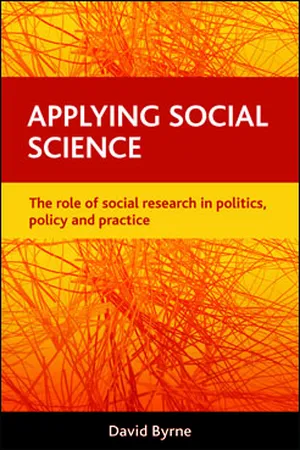
Applying social science
The role of social research in politics, policy and practice
- 240 pages
- English
- ePUB (mobile friendly)
- Available on iOS & Android
eBook - ePub
Applying social science
The role of social research in politics, policy and practice
About this book
In complex contemporary societies social science has become increasingly interwoven into the whole fabric of governance. At the same time there is an increasing recognition that attempts to understand the social world which seek to mimic the linear approaches of the conventional 'hard sciences' are mostly useless given the complex systems character of society in all its aspects. This book draws on a synthesis of critical realism and complexity theory to examine how social science is applied now and how it might be applied in the future in relation to social transformation in a time of crisis. A central argument is that there is no such thing as a 'pure' science of the social and that a recognition of the inevitability of application imposes obligations on social scientists wherever they work which challenge the passivity of most in the face of inequality and injustice.
Information
Bibliography
Abbott, A. (1988) ‘Transcending general linear reality’, Sociological Theory, vol 6, pp 169–86.
Abbott, A. (1998) ‘The causal devolution’, Sociological Methods and Research, vol 27, no 2, pp 148–81.
AcSS Commission (2002) Great expectations, London: Academy of Social Sciences.
Alam, S.H., Meyer, R., Ziervogel, G. and Moss, S. (2007) ‘The impact of HIV/AIDS in the context of socioeconomic stressors: an evidence-driven approach’, Journal of Artificial Societies and Social Simulation, vol 10, no 4, p7.
Alberti, G. (2007) Emergency access: Clinical case for change, London: Department of Health.
Allen, C. (2008) Housing market renewal and social class, London: Routledge.
Archer, M.S. (1995) Realist social theory: The morphogenetic approach, Cambridge: Cambridge University Press.
Arnstein, S.R. (1969) ‘A ladder of citizen participation’, Journal of the American Institute of Planners, vol 35, no 4, pp 216–24.
Audit Commission (2007) The academies programme, HC: 254 2006–2007, London: HMSO.
Bahro, R. (1978) The alternative in Eastern Europe, London: NLB.
Bains Report (1972) The local authorities: Management and structure, London: HMSO.
Balloch, S. and Taylor, M. (2001) Partnership working: Policy and practice, Bristol: The Policy Press.
Bang, H. (2002) ‘Culture governance: a new mechanism for connecting system and lifeworld’, Paper presented at the ECPR joint sessions of workshops, Workshop 6, Turin, Italy, 22–27 March.
Barker, K. (2007) ‘The UK Research Assessment Exercise: the evolution of a national research evaluation system’, Research Evaluation, vol 16, no 1, pp 3–12.
Barnes, D., Wistow, R., Dean, R. and Foster, B. (2006) National child and adolescent mental health service mapping exercise 2005, Durham: School of Applied Social Sciences, Durham University.
Barnes, M., Matka, E. and Sullivan, H. (2003) ‘Evidence, understanding and complexity: evaluation in non-linear systems’, Evaluation, vol 9, no 3, pp 265–84.
Bartholomew Working Party on the Measurement of Unemployment in the UK (1995) ‘The measurement of unemployment in the UK (with discussion)’, Journal of the Royal Statistical Society Series A, vol 158, part 3, pp 363–418.
Bateson, N. (1984) Data construction in social surveys, London: Allen and Unwin.
Beatty, C., Fothergill, S., Gore, T. and Powell, R. (2007) The real level of unemployment 2007, Sheffield: CRESR.
Beveridge, W. (1909) Unemployment: A problem of industry, London: Longmans, Green and Co.
Bhaskar, R. (1979) A realist theory of science, Brighton: Harvester.
Bierce, A. (1911) The devil’s dictionary (www.thedevilsdictionary.com).
Blackman, T. (2006) Placing health, Bristol: The Policy Press.
Blackman, T., Wistow, J. and Byrne, D.S. (2010, forthcoming) Variations between Spearhead areas in progress with tackling health inequalities in England, SDO Project Ref: 08/1716/203.
Blaikie, N. (2007) Approaches to social enquiry, Cambridge: Polity.
Blamey, A. and Mackenzie, M. (2007) ‘Theories of change and realistic evaluation’, Evaluation vol 13, no 4, pp 439–55.
Blanden, J., Gregg, P. and Machin, S. (2005) Intergenerational mobility in Europe and North America, Bristol: Centre for Economic Performance.
Blowers, A. (2002) ‘Political modernization and the environmental question’, Local Government Studies, vol 28 no 2, pp 69–87.
Borgerson, K. (2009) ‘Valuing evidence: bias and the evidence hierarchy of evidence-based medicine’, Perspectives in Biology and Medicine, vol 52, no 2, pp 218–33.
Bosse, T. and Gerritsen, C. (2010) ‘Social simulation and analysis of the dynamics of criminal hot spots’, Journal of Artificial Societies and Social Simulation, vol 13, no 2, pp 5 (http://jasss.soc.surrey.ac.uk/13/2/5.html).
Boyle, R. (2006) Mending hearts and brains: Clinical case for change, London: Department of Health.
Bradley, W.J. and Schaefer, K.C. (1998) The uses and misuses of data and models, London: Sage.
Brady, D. (2004) ‘Why public sociology may fail’, Social Forces, vol 82, no 4, pp 1629–38.
British Academy (2008) Punching our weight: The humanities and social sciences in public policy making, London: British Academy.
Burawoy, M. (2004) ‘Public sociologies: contradictions, dilemmas and possibilities’, Social Forces, vol 82, no 4, pp 1603–18.
Burns, D. (2006) ‘Evaluation in complex governance arenas: the potential of large system action research’ , in B. Williams and I. Imam (eds), Using systems concepts in evaluation, Fairhaven, MA: American Evaluation Association.
Burns, D. (2007) Systematic action research, Bristol: The Policy Press.
Byrne, D.S. (1998) Complexity theory and the social sciences, London: Routledge.
Byrne, D.S. (2000) ‘Newcastle’s going for growth: governance and planning in a postindustrial metropolis’, Northern Economic Review, vol 30, pp 3–16.
Byrne, D.S. (2002) Interpreting quantitative data, London: Sage.
Byrne, D.S. (2005a) ‘Complexity, configuration and cases’, Theory, Culture and Society, vol 22, no 5, pp 95–111.
Byrne, D.S. (2005b) ‘Theory, role of’, Encyclopedia of social measurement, Los Angeles: Elsevier Inc, pp 785–9.
Byrne, D.S. (2009a) ‘Complex realist and configurational approaches to cases: a radical synthesis’, in D.S. Byrne and C. Ragin (eds) Sage handbook of case based methods, London: Sage, pp 101–12.
Byrne, D.S. (2009b) ‘Using Cluster Analysis, Qualitative Comparative Analysis, and NVIVO in relation to the establishment of causal configurations with pre-existing large N data sets: machining hermeneutics’, in D.S. Byrne and C. Ragin (eds) Sage handbook of case based methods, London: Sage, pp 260–8.
Byrne, D.S. (2010) ‘Idleness’ in G. Calder, J. Gass and K. Merrill-Glover (eds) The British welfare state at 60, Cardiff: University of Wales Press.
Byrne, D.S. and Doyle, A. (2005) ‘The visual and the verbal – the interaction of images and discussion in exploring cultural change’, in C. Knowles and P. Sweetman (eds) Using visual methods, London: Routledge.
Byrne, D.S. and Ruane, S. (2007) ‘The case for hospital reconfiguration – not proven: A response to the IPPRs The Future Hospital’, www.nhscampaign.org.uk/uploads///documents/Reconfiguration%20Not%20Proven.pdf
Byrne, D.S., Williamson, W. and Fletcher, B. (1975) The poverty of education, London: Martin Robertson.
Byrne, D.S., Olsen, W. and Duggan, S. (2009) ‘Causality and interpretation in Qualitative policy-related research’, in D.S. Byrne and ...
Table of contents
- Cover
- Title Page
- Copyright
- Contents
- Abbreviations and acronyms
- Introduction
- ONE: The methodological foundations of applied social science
- TWO: Constructing evidence: the development of knowledge which is to be applied
- THREE: Surveying the social world: assembling knowledge as a basis for action
- FOUR: Evaluating: determining the worth of social interventions
- FIVE: Legitimating: the selective use of social science in justifying policy and practice
- SIX: Consulting: the role of social research in relation to new modes of governance
- SEVEN: Modelling: representing the world in order to understand how it works
- EIGHT: Acting
- NINE: The academy and beyond: applied social research in the real world
- TEN: Concluding
- Bibliography
Trusted by 375,005 students
Access to over 1.5 million titles for a fair monthly price.
Study more efficiently using our study tools.
Frequently asked questions
Yes, you can cancel anytime from the Subscription tab in your account settings on the Perlego website. Your subscription will stay active until the end of your current billing period. Learn how to cancel your subscription
No, books cannot be downloaded as external files, such as PDFs, for use outside of Perlego. However, you can download books within the Perlego app for offline reading on mobile or tablet. Learn how to download books offline
Perlego offers two plans: Essential and Complete
- Essential is ideal for learners and professionals who enjoy exploring a wide range of subjects. Access the Essential Library with 800,000+ trusted titles and best-sellers across business, personal growth, and the humanities. Includes unlimited reading time and Standard Read Aloud voice.
- Complete: Perfect for advanced learners and researchers needing full, unrestricted access. Unlock 1.5M+ books across hundreds of subjects, including academic and specialized titles. The Complete Plan also includes advanced features like Premium Read Aloud and Research Assistant.
We are an online textbook subscription service, where you can get access to an entire online library for less than the price of a single book per month. With over 1.5 million books across 990+ topics, we’ve got you covered! Learn about our mission
Look out for the read-aloud symbol on your next book to see if you can listen to it. The read-aloud tool reads text aloud for you, highlighting the text as it is being read. You can pause it, speed it up and slow it down. Learn more about Read Aloud
Yes! You can use the Perlego app on both iOS and Android devices to read anytime, anywhere — even offline. Perfect for commutes or when you’re on the go.
Please note we cannot support devices running on iOS 13 and Android 7 or earlier. Learn more about using the app
Please note we cannot support devices running on iOS 13 and Android 7 or earlier. Learn more about using the app
Yes, you can access Applying social science by David Byrne,Byrne, David in PDF and/or ePUB format, as well as other popular books in Politics & International Relations & Social Policy. We have over 1.5 million books available in our catalogue for you to explore.