The past few years have seen a renewed interest in the subject of social work ethics. In this short form book, part of the Critical and Radical Debates in Social Work series, Sarah Banks argues that this can be seen as reflecting two very different agendas. On the one hand, it is part of a progressive movement which offers a critique of New Public Management (NPM), or managerialist, approaches through emphasising the role of social workers as active moral agents working for social justice. On the other hand, the growth of interest in ethics can be viewed as part of NPM, with codes of ethics a means of regulating and controlling the conduct of professionals and service users. She emphasises the importance of reclaiming professional ethics for social work, and outlines a preliminary framework for a situated ethics of social justice.
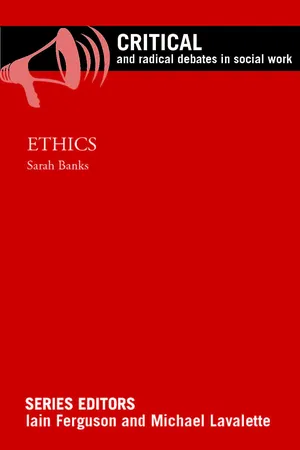
- 76 pages
- English
- ePUB (mobile friendly)
- Available on iOS & Android
eBook - ePub
Ethics
About this book
Information
PART ONE
Lead essay
Reclaiming social work ethics: challenging the new public management1
Sarah Banks
Introduction
In his book Reclaiming social work, Ferguson (2008, p 132) includes a short section entitled ‘Reclaiming the ethical’. He writes in the context of increasing managerialism and marketisation in the field of social work in the late 20th and early 21st century – a period that has witnessed an erosion of practice premised on values of social justice and human dignity. This chapter is a response to Ferguson’s call – made all the more urgent with the new public austerity that prevails in many countries following the financial crisis of 2008. In this climate of welfare reform and public sector restructuring, social workers are increasingly finding themselves expected to monitor and control the behaviour of the growing numbers of people who are poor, sick, disabled and stigmatised.
This article examines the growth of interest in social work ethics in the context of neoliberal policies and, in particular, the growth of managerialism in public service professions. The main characteristics of neoliberal policies are the promotion of free markets and the privatisation of public goods, along with a strengthening of private property rights and weakening of labour rights – resulting in a growing centralisation of wealth and power (Harvey, 2005). Taking the UK as an example, while drawing links with trends across Europe and other countries in the global North, the article traces the development of the ‘new public management’ (NPM) since the 1990s. NPM is characterised as stressing the importance of measurable outputs, targets, competition and cost-effectiveness in the provision of public services. The article considers the extent to which the growth of interest in ethics in social work is part of a progressive movement to offer a critique of NPM through emphasising the role of social workers as active moral agents working for social justice. Alternatively, the growth of interest in ethics can be viewed as part of NPM, with a focus on ethics as being about the regulation of the conduct of professionals and service users. The article concludes by emphasising the importance of reclaiming professional ethics for social work, outlining a preliminary framework for a situated ethics of social justice.
Ethics and radical social work
Ferguson’s (2008) brief section on ‘reclaiming the ethical’ amounts to a call for social workers to resist attacks on the core values of social work. It is, in effect, a call to reassert a value base that has at its heart a profound solidarity with people who are experiencing poverty, indignity, suffering and all forms of oppression. This is one part of what ‘reclaiming the ethical’ means for social work – namely reasserting and arguing for a radical definition of the ethical values of social justice and empathic solidarity with the poor. These are values that have got lost in an everyday social work practice driven by market values of economy, efficiency and a concern with maintaining social order in a period of severe crisis of capitalism. The statement on ethics for direct social work developed by Slovenian social workers and academics involved in the Occupy Ljubljana movement (Flaker, 2012) is a good example of this process of reclaiming social work values (the list includes promoting advocacy for the powerless, active resistance against injustice and refusing to treat people as objects). In this sense, ‘reclaiming the ethical’ is a project concerned with rearticulating a set of progressive values for social work (see also Progressive Social Work Network (Hong Kong), 2011).
There is, however, another very important sense of ‘reclaiming the ethical’ that I also wish to consider in this article. It is about reclaiming the topic of ‘ethics’: reclaiming what we mean by ‘the ethical’. For alongside the growth of managerialism and market-driven social welfare programmes, there has also been a growth of interest in the topic of ethics. Some of the growing concern with ethics has been in response to the erosion of the social work value base and can be seen as part of the resistance described above. However, an equally significant feature of the ‘ethics boom’ has been the development of ethical standards, codes and regulatory systems for controlling and disciplining professionals and the people with whom they work. Here ‘the ethical’ is not about resistance and radical action, but rather about conformity to prevailing social norms and regulations. So what does ‘reclaiming the ethical’ mean in this context? For those theorists and practitioners who identify themselves as radical (in the sense of socialist, feminist, critical or anti-oppressive, for example), it may be more about claiming ethics as part of the radical project, as much as it is about reclaiming the ethical. For ethics as a topic in its own right has tended not to feature strongly in texts on radical social work.
The literature on radical social work of the 1970s and 1980s (for example, Bailey and Brake, 1975; Corrigan and Leonard, 1978; Brake and Bailey, 1980; Galper, 1980; Langen and Lee, 1989) said very little about ethics as a topic. There may be a number of reasons for this, including the fact that interest in professional ethics as an identifiable subject area in social work was only just emerging in the 1970s (Reamer, 1999, p 7). In addition, ethics was not a topic covered explicitly by Marx, or many of the other Marxist theorists upon which the radical social work literature drew. This does not mean that in the writings of Marx himself and in the radical social work literature there is no reference to themes that we might regard as the subject matter of ethics (human needs, relationships, equality, justice), just that these are not labelled as ‘ethical’ themes. These themes arise as part of a political analysis of the nature of society and a political commitment to striving for a better world. They arise in the context of clear value judgements about what is wrong with our current society, what counts as a good society and what people (including social workers) should do to make this better world possible. This kind of radical politics is inclusive of ethics (if we regard ethics as being about people’s conduct and character relating to what is right/wrong, good/bad) but does not separate it out as an identifiable topic in its own right. This does not mean that an ethical perspective is rejected or absent, but rather that the ethics within radical politics is deeply embedded in the political analysis. As Critchley (2007, p 132) comments: ‘Politics is an ethical practice that is driven by a response to situated injustices and wrongs’.
While some theorists have argued that several different and contradictory ethical positions can be found in the writings of Marx and Marxism (Kamenka, 1969; Lukes, 1985), others have argued that it is possible to identify and develop a Marxist ethics from Marx’s writings (Truitt, 2005; Blackledge, 2008). But it is not in the form of a traditional Western ethical theory based on the idea of ethics as pertaining to universal (for all time and places) principles of right and wrong, enacted by abstract individual moral agents making impartial judgements. Indeed, Marx characterised this kind of rationalist, universal ethics as a bourgeois illusion (Marx and Engels, 1848/1969, pp 60, 68) – a morality (or system of ethics) which presents prevailing liberal social norms as universal and impartial (such as rights to private property and privacy), whilst in fact they serve the interests of the ruling class. As Eagleton (2011, pp 158–9) points out, when Marx denounced ‘morality’ this does not mean he did not have a moral (or ethical)2 stance himself. What he was, in fact, denouncing, was ‘moralism’ – which abstracts moral values from their historical contexts and makes moral judgements as if based on universal standards. Underpinning Marx’s writings is an ethical perspective that is situated in a specific time and economic system and takes sides with those who are oppressed and exploited (Truitt, 2005, p 13). According to Blackledge (2008, p 1), Marx offers an alternative ethics that takes as its starting point ‘the collective struggles of workers against their exploitation’. It is this kind of ethical position that is present in the literature on radical social work, even though it is not explicitly labelled as ‘ethics’.
At a time when the ethical is increasingly associated with devising and following codified rules, with conformity to standards and with the individual making ethical judgements based on rational deduction from abstract universal principles, it is particularly important to reclaim a situated ethics, that is about values and commitments of people as social beings engaged in collective struggles for a better world.
What is ethics?
Before proceeding to document the ‘ethics boom’ and the rise of NPM, I will first outline how I understand the term ‘ethics’. In this article I am using ‘ethics’ in a broad sense to refer to a subject area that covers all or some of the following themes:
- Conduct – what actions are regarded as right and wrong (eg promisekeeping and lying)?
- Character – what moral qualities are regarded as good and bad (eg. trustworthiness and deceitfulness; altruism and selfishness)?
- Relationships – what responsibilities attach to people’s relationships with each other, individually and in groups (eg the responsibility of a parent towards a child; the responsibility of a community towards its vulnerable members)?
- The good society – in what kind of society do we want to live (eg a society in which all living beings flourish in harmony with the natural environment; a society in which all human beings are free to enjoy the fruits of their labour)?
This is a deliberately broad description of the subject matter of ethics, which can encompass a range of theoretical approaches to ethics. Particular ethical theories often narrow the sphere of ethics to one or two of these themes – or at least focus on one as the foundation or starting point of ethics. The dominant paradigm in contemporary writings on social work ethics tends to be based on principles of conduct, including principles focusing on the promotion of rights to freedom of choice and action (deontological or Kantian approaches to ethics) and principles focusing on the greatest good of the greatest number of people (consequentialist or utilitarian approaches). However, there is a small but growing interest in ethical theories that focus on the character of the moral agent (virtue ethics) and the caring relationship between people (the ethics of care), both of which entail a vision of what counts as the good society or human flourishing. Radical or Marxist ethics would also start with a focus on the nature of human flourishing – seeing humans as essentially social beings.
‘The ethics boom’
Davis (1999) used the term ‘ethics boom’ in the late 1990s to characterise the rapidly growing interest in the theme of ethics, including professional ethics. The ‘boom’ has continued apace – in social work as much as any other area. Indeed, the number of specialist textbooks on ethics in social work published in Europe and the English-speaking world is very rapidly growing (for example, Rouzel, 1997; Timmer, 1998; Lingås, 1999; Linzer, 1999; Reamer, 1999, 2006a; Beckett and Maynard, 2005; Bowles et al, 2006; Joseph and Fernandes, 2006; Charleton, 2007; Barsky, 2009; Clifford and Burke, 2009; Congress et al, 2009; Dolgoff et al, 2009; Gray and Webb, 2010; Banks, 2012; Banks and Nøhr, 2012). These texts generally cover ethical theories, codes of ethics, practice-related dilemmas and ethical decision-making. Principle-based theories of what counts as right and wrong are often invoked, although increasingly attention is being paid to character and relationship-based ethics (virtue ethics and the ethics of care).
There is also a growth of interest in codes of ethics published by professional associations and regulatory bodies. These usually provide statements about the core purpose of social work, the values and principles upon which it is based and some standards or rules to guide social workers’ conduct. Many countries that did not have codes of ethics for social work developed them in the 1990s and 2000s, and in many instances, but not all, codes are getting longer each time they are revised, as the examples given in Table 1 show. The results of a survey of codes of ethics of professional associations for social work in 2005 (Banks, 2006, pp 74–102) suggest that the longer codes tend to be in the global North, in countries where social work is well established and where codes may be used to discipline social workers for misconduct.3
Codes of ethics tend to be action-focused (outlining ethical principles and rules of conduct), although, of course, they are framed in terms of the professional roles and relationships of social workers. The nature of the good society is not explicitly outlined in most codes of ethics, although a vision of certain features of a good society is implicit in the mission statements often included at the start of codes. Many of the national codes ...
Table of contents
- Cover
- Title
- Copyright
- Contents
- Notes on contributors
- Series editors’ introduction
- Part One: Lead essay
- Part Two: Responses
- Part Three: Concluding remarks
- References
Trusted by 375,005 students
Access to over 1.5 million titles for a fair monthly price.
Study more efficiently using our study tools.
Frequently asked questions
Yes, you can cancel anytime from the Subscription tab in your account settings on the Perlego website. Your subscription will stay active until the end of your current billing period. Learn how to cancel your subscription
No, books cannot be downloaded as external files, such as PDFs, for use outside of Perlego. However, you can download books within the Perlego app for offline reading on mobile or tablet. Learn how to download books offline
Perlego offers two plans: Essential and Complete
- Essential is ideal for learners and professionals who enjoy exploring a wide range of subjects. Access the Essential Library with 800,000+ trusted titles and best-sellers across business, personal growth, and the humanities. Includes unlimited reading time and Standard Read Aloud voice.
- Complete: Perfect for advanced learners and researchers needing full, unrestricted access. Unlock 1.5M+ books across hundreds of subjects, including academic and specialized titles. The Complete Plan also includes advanced features like Premium Read Aloud and Research Assistant.
We are an online textbook subscription service, where you can get access to an entire online library for less than the price of a single book per month. With over 1.5 million books across 990+ topics, we’ve got you covered! Learn about our mission
Look out for the read-aloud symbol on your next book to see if you can listen to it. The read-aloud tool reads text aloud for you, highlighting the text as it is being read. You can pause it, speed it up and slow it down. Learn more about Read Aloud
Yes! You can use the Perlego app on both iOS and Android devices to read anytime, anywhere — even offline. Perfect for commutes or when you’re on the go.
Please note we cannot support devices running on iOS 13 and Android 7 or earlier. Learn more about using the app
Please note we cannot support devices running on iOS 13 and Android 7 or earlier. Learn more about using the app
Yes, you can access Ethics by Banks, Sarah,Sarah Banks in PDF and/or ePUB format, as well as other popular books in Social Sciences & Social Policy. We have over 1.5 million books available in our catalogue for you to explore.