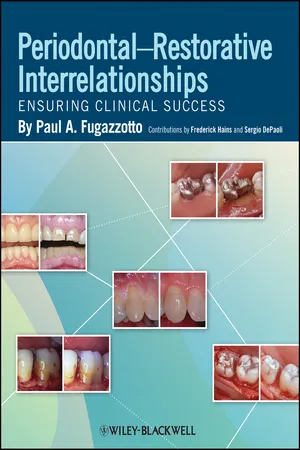
Periodontal-Restorative Interrelationships: Ensuring Clinical Success begins with a careful discussion of treatment planning, comprehensively covering all variables in simple to complex cases. Subsequent chapters focus upon the most commonly encountered clinical challenges, using a systematic, easy-to-follow approach to various treatment methodologies. All chapters are well-illustrated with clinical examples. Firmly grounded in evidence-based research, the book affords clinicians from multiple specialties a practical guide for predictable, successful results. Accessible and logically organized, Periodontal-Restorative Interrelationships is an invaluable reference for all clinicians performing these procedures.
- English
- ePUB (mobile friendly)
- Available on iOS & Android
eBook - ePub
About this book
Even with the option of dental implants, periodontists, restorative dentists, and general dentists alike continue to treat patients' natural teeth on a day-to-day basis. Procedures including crown lengthening surgery, furcation treatment, mucogingival therapy, and tooth restoration are essential treatment regimes requiring multifaceted expertise. Periodontal-Restorative Interrelationships: Ensuring Clinical Success provides guidelines for comprehensive treatment planning, and features step-by-step clinical instruction for periodontal and restorative procedures from beginning to end. As a result, the book fosters better understanding and increased efficiencies between specialties, resulting in shorter treatment times and consistently better therapeutic outcomes.
Information
Chapter 1
Examination and Diagnosis
The periodontal prerequisites for maximization of long-term oral health are well established. Effective home-care efforts, maintainable probing depths (defined as 3 mm or less), no evidence of furcation involvements, and adequate bands of attached keratinized tissue to provide a stable fiber barrier in various clinical scenaria are well-accepted periodontal endpoints of therapy. Combined with appropriate management of carious and endodontic lesions, replacement of missing teeth, control of parafunctional habits, and establishment of a healthy, stable occlusion, such a periodontal milieu will help ensure maximization of patient comfort, function, and aesthetics in both the short and long terms.
It has become popular to speak of paradigm shifts in clinical dentistry. However, these shifts represent nothing more than alterations in the treatment approaches utilized to attain the aforementioned therapeutic goals. In addition, efforts must be made to utilize the least-involved and least-expensive therapies possible for ensuring these treatment outcomes.
Maximizing oral health and ameliorating patient concerns remain essential to ethical practice. When considering the utilization of various treatment approaches, it is important to listen to patient desires, determine patient needs, and ensure that the therapy to be employed is truly in the best interest of the patient. A thorough understanding of the predictability of appropriately performed therapies around natural teeth is crucial to the formulation of an ideal treatment plan for a given patient. This treatment plan is based upon a precise diagnosis of the patient’s condition and recognition of all contributing etiologies. Such a diagnosis takes into consideration the patient’s overall health and the entire dentition, treating each site as both an individual entity and as a component of the masticatory unit.
Establishment of such oral health is dependent upon first carrying out a thorough examination, so as to establish a comprehensive diagnosis of patient etiologies, needs, and required therapies.
Establishing an Appropriate Treatment Plan
A high-quality full series of radiographs must be taken. All full series of radiographs must employ two film/sensor sizes: a #2 film/sensor in posterior regions and a #1 film/sensor in anterior areas. Attempts at utilizing either a #1- or #2-size film/sensor in all areas of the mouth will result in an inability to properly position the film/sensor in the anterior regions, and lead to poorly angulated, nondiagnostic radiographs. Digital radiographs are preferable, due to the ability to manipulate the images and thus gain additional information, and the lesser radiation exposure to the patient. When necessary, three-dimensional images are utilized. Panorex films are not used, since their accuracy is not sufficient for providing useful information for constructing a comprehensive diagnosis.
The components of a thorough clinical examination include periodontal probing depths, assessment of clinical attachment levels, hard- and soft- tissue examination, models, and face-bow records. However, it is important to realize that a thorough examination begins with an open discussion with the individual patient, as a step in determining the patient’s needs and desires. In this way, treatment plans may be formulated that are in the best interest of the patient and represent a greater value for the patient.
Prior to formulating a comprehensive treatment plan, all potential etiologies must be identified and assessed. In addition to systemic factors, these etiologies include, but are not limited to, periodontal disease, parafunction, caries, endodontic lesions, and trauma.
The treating clinician should always formulate an “ideal” treatment plan and present it to every patient. Appropriate and predictable treatment alternatives must be offered to the patient as well, to allow the patient to choose the treatment option to which he or she is best suited physically, financially, and psychologically.
In many situations, initial therapies, such as plaque control instruction, debridement, caries control, and endodontic assessment, must be carried out prior to establishment of the final treatment options.
While it is true that clinicians who fail to incorporate regenerative and implant therapies into their treatment armamentaria are depriving their patients of predictable therapeutic possibilities that afford unique treatment outcomes in a variety of situations, other proven therapies should not be abandoned too quickly.
Teeth that can be predictably restored to health through reasonable means should be maintained, if their retention is advantageous to the final treatment plan. Clinicians who claim to be implantologists, performing only implant therapy while ignoring periodontal and other pathologies, do patients a disservice. Such clinicians include practitioners who either perform inadequate periodontal therapy to predictably halt the disease process, or remove teeth that could be treated through predictable periodontal techniques.
It is inconceivable that any clinician would see only patients who require implant therapy, and demonstrate periodontal, endodontic, restorative, and occlusal health around all remaining teeth that are not to be extracted. Such a clinical outlook is at the expense of ethical, comprehensive care, and must be avoided at all times.
Clinical presentations of different patients may appear similar, despite dramatic differences in etiology and individual patient needs. It is crucial that the conscientious clinician utilize all tools at his or her disposal to differentiate between various clinical entities.
It is also imperative that the periodontal restorative dynamic be understood in its complexity, and managed comprehensively, to maximize treatment endpoints. All periodontal therapies have restorative ramifications. Similarly, all restorative therapies have periodontal ramifications. One of the goals of the conscientious clinician must be to determine the relative influence of each discipline on the treatment considered in a given clinical scenario, and manage all aspects of this interrelationship appropriately.
Most if not all clinicians would agree that reconstructive therapy must be grounded in sound periodontal prosthetic principles. It is important to realize the same is true for a single restoration.
Periodontal procedures cannot be considered without understanding their far-reaching restorative ramifications. All therapies succeed or fail depending upon how periodontal and restorative concerns are managed, both individually and as interdependent entities.
The introduction by Amsterdam and Cohen (1) of the concept of periodontal prosthesis almost 50 years ago helped to define this interrelationship. While complex, state of the art therapies were presented and the results were documented over decades, such execution was not the greatest contribution the concepts of periodontal prosthesis have made to modern clinical practice. Rather, periodontal prosthesis afforded clinicians something even more important. A system was presented by which comprehensive record taking, diagnosis, and treatment planning could be carried out with specific treatment endpoints in mind, resulting in long-term therapeutic success. The advent of implant therapy has done nothing to change this concept. Comprehensive care mandates thorough examination and record taking, a multifactorial diagnosis, and interdisciplinary treatment planning to maximize therapeutic outcomes. C...
Table of contents
- Cover
- Title page
- Copyright page
- Dedication
- Contributors
- Chapter 1 Examination and Diagnosis
- Chapter 2 The Role of Crown-Lengthening Therapy
- Chapter 3 Treating the Periodontally Involved Furcation
- Chapter 4 The Role of Mucogingival Therapy
- Chapter 5 Restoration of the Periodontally Treated Tooth
- Chapter 6 Developing Treatment Algorithms for Restoration or Replacement of the Compromised Tooth
- Index
Trusted by 375,005 students
Access to over 1.5 million titles for a fair monthly price.
Study more efficiently using our study tools.
Frequently asked questions
Yes, you can cancel anytime from the Subscription tab in your account settings on the Perlego website. Your subscription will stay active until the end of your current billing period. Learn how to cancel your subscription
No, books cannot be downloaded as external files, such as PDFs, for use outside of Perlego. However, you can download books within the Perlego app for offline reading on mobile or tablet. Learn how to download books offline
Perlego offers two plans: Essential and Complete
- Essential is ideal for learners and professionals who enjoy exploring a wide range of subjects. Access the Essential Library with 800,000+ trusted titles and best-sellers across business, personal growth, and the humanities. Includes unlimited reading time and Standard Read Aloud voice.
- Complete: Perfect for advanced learners and researchers needing full, unrestricted access. Unlock 1.5M+ books across hundreds of subjects, including academic and specialized titles. The Complete Plan also includes advanced features like Premium Read Aloud and Research Assistant.
We are an online textbook subscription service, where you can get access to an entire online library for less than the price of a single book per month. With over 1.5 million books across 990+ topics, we’ve got you covered! Learn about our mission
Look out for the read-aloud symbol on your next book to see if you can listen to it. The read-aloud tool reads text aloud for you, highlighting the text as it is being read. You can pause it, speed it up and slow it down. Learn more about Read Aloud
Yes! You can use the Perlego app on both iOS and Android devices to read anytime, anywhere — even offline. Perfect for commutes or when you’re on the go.
Please note we cannot support devices running on iOS 13 and Android 7 or earlier. Learn more about using the app
Please note we cannot support devices running on iOS 13 and Android 7 or earlier. Learn more about using the app
Yes, you can access Periodontal-Restorative Interrelationships by Paul A. Fugazzotto in PDF and/or ePUB format, as well as other popular books in Medicine & Dentistry. We have over 1.5 million books available in our catalogue for you to explore.