'Always one to take on big questions, Grosz wants to shift the attention of feminist and other radical social theory to the natural sciences, in order to ask how the biological induces the cultural and, further, how our immersion in time affects the materiality of living beings. Her characteristically lucid and passionate style engages imagination and intellect equally.'
Susan Sheridan, Professor of Women's Studies, Flinders University
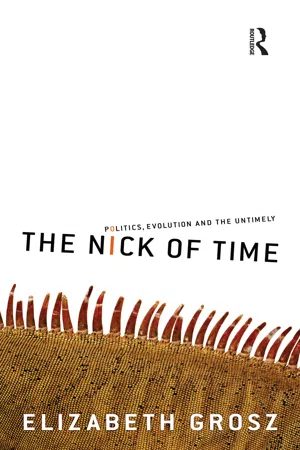
In this pathbreaking new work, Elizabeth Grosz proposes a theory of becoming in place of the prevailing emphasis on being in social, political and biological discourse. Drawing on evolutionary biology, she explores the effect of time on the organization of matter and the development of biological life. She argues that factoring in the relentless forward movement of time throws new light on the ever-growing complication of social life, and also on political struggle.
Grosz juxtaposes the work of Darwin, Nietzsche and Bergson. Each theorises time as an active phenomenon with specific effects, with a profound impact on understandings of the body in relation to time. She shows how their concepts of life, evolution, and becoming are manifest in the work of Deleuze and Irigaray.
Throughout The Nick of Time, Grosz emphasizes the political and cultural imperative to fundamentally rethink time: the more clearly we understand our temporal location as beings straddling the past and the future without the security of a stable and abiding present, the more transformation becomes conceivable.
- 328 pages
- English
- ePUB (mobile friendly)
- Available on iOS & Android
eBook - ePub
About this book
Information
PART I. DARWIN AND EVOLUTION
1
DARWINIAN MATTERS: LIFE, FORCE, AND CHANGE
Darwin’s great novelty, perhaps, was that of inaugurating the thought of individual difference. The leitmotiv of The Origin of Species is: we do not know what individual difference is capable of! We do not know how far it can go, assuming we add to it natural selection.—Gilles Deleuze, Difference and Repetition
Ontology seems to be the forgotten or elided element of contemporary philosophy. The devastating critique of metaphysics that revitalized the natural sciences, helped generate the social sciences, and effectively transformed philosophy during the earliest years of the twentieth century has perhaps succeeded only too well in adjudicating not only the appropriate and inappropriate questions to which knowledge must direct itself, but in dismissing many questions that, it seems, we cannot do without, that we cannot but ask. Some of the most basic questions of ontology—What is matter? What is life? How do they link together? What are their relations of intrication?—need to be readdressed, perhaps not in the same terms in which they were originally considered, but in more contemporary language, which considers the social, historical, and political context in which metaphysics is invariably, if unconsciously, embedded. In the desire to abandon metaphysical presuppositions and to replace the apparently unanswerable questions of ontology with the more modest propositions of epistemology, self-consciously moving from the unknown to the knowable, shifting the ground from what exists to what we know, the inevitable ontological investments of discourses, the presuppositions they must make about the modes, types, and forms of existence they analyze, have remained unexamined, though the production of ontologies continues unabated. In distancing ontology ever further from epistemology, we lose the capacity to provide political critiques of epistemologies, for we lose access to what is outside, to the outside of knowledges, to what they leave out, transform, or cannot know. The more we focus on the production of knowledges, the less we are able to address the real, what is outside, what constitutes the gaps or flaws of existing knowledges.
I examine three interrelated philosophical clusters of concepts that are embedded in these central questions of ontology. First, I explore those ontologies in which matter is imbued with a dynamism or activity, in which nature is construed as force, provocation, activity, or incitement, rather than, as is the current fashion in feminist and cultural studies, where nature is considered an inert passivity onto which life, culture, and the human impose themselves.1 Second, I examine those epistemological frameworks that actively affirm the perspectival orientation of all forms of knowledge, the historical, social, and sexual specificity of ways of seeing the world, ways of understanding the real, which accept that there may be a number of competing and possibly incommensurable epistemic models adequate to the richness of the real. Third, I examine those discourses that imbue time with an existence autonomous from space, from objects and from models that privilege causal or deterministic prediction, which see time in terms of the precedence of the future, time as an active, forward-moving force, a positivity that both coheres and transforms, that makes as much as it unmakes or decays. These three clusters of concepts—those linking matter, time, and (sexual and other forms of) difference—are embedded in their own ontological presuppositions, and between them, they may help us both to refigure and transform the stasis associated with most conceptualizations of ontology and to understand matter and life as dynamic forces, bound in various forms of cohesion, as modalities of difference. This conception of life as the mobilization of maximal difference links these abstract metaphysical questions to the concerns of contemporary politics, that is, to the productive destabilization of present social and cultural arrangements. Rethinking time and matter may help transform how we understand politics and political struggle.
This highly selective discussion of the intrication of life with time and matter begins with the key writings of Charles Darwin, who not only developed the theory of natural selection into a scientific research paradigm of unparalleled fruitfulness and success for nearly a century and a half, but who also produced a philosophical framework whose resonances have still not been properly understood, even today. There has been a great deal of attention devoted to Darwinism, to scientific developments and elaborations within biology and its cognate disciplines since the writings of Darwin himself, and a vast amount of published material has appeared under the rubric of scientific or empirical Darwinism. Darwinism has also had a powerful effect on literature, on cultural and artistic representations, on economic and political discourses. Yet, rather surprisingly, it has not had the same impact on philosophy or, more generally, theory, which has tended to address it only marginally, if at all. Only in recent years has analytic philosophy embraced Darwinian biological models as paradigms of mind,2 and it is even more rare to find philosophers from the Continental tradition invested in exploring the philosophical implications of Darwin’s work.
Instead of examining the scientific development and elaboration of Darwinism through the nineteenth and twentieth centuries—a fascinating project but well beyond the scope of this book3—I concentrate in this and in the next two chapters on Darwin’s own writings on natural and sexual selection, and on elaborating his understanding of evolution as the emergence in time of biological innovation and surprise. It is my claim that although there are acknowledged and well-recognized gaps and points of unclarity in Darwin’s understanding—most notably, his self-avowed ignorance of the mechanisms of inheritance, published in its earliest and most speculative form by Gregor Mendel in 1863, only a few years after the publication of the first edition of Darwin’s Origin of Species (1859/1996)—his account of the development of species, including the descent of man, provides a powerful and fundamentally plausible and suitably complex understanding both of the genesis of (primitive) life from the complexities of matter and of the growing elaboration, adaptation, and specialization of organisms to their stable or changing life conditions. Darwin’s work is of direct relevance to feminist concerns and indeed is a commonly elided assumption of much feminist work, even as it tends to be identified with patriarchal privilege. Darwin develops an account of a real that is an open and generative force of self-organization and growing complexity, a dynamic real that has features of its own which, rather than simply exhibit stasis, a fixed essence or unchanging characteristics, are more readily understood in terms of active vectors of change. Darwin managed to make this dynamism, this imperative to change, the center of his understanding of life itself and the very debt that life owes to the enabling obstacle that is organized matter. This dynamism of life is the condition of not only cultural existence but also cultural resistance. While presenting an ontology of life, Darwin also provokes a concern with the possibilities of becoming, and becoming-other, inherent in culture, which are also the basic concerns of feminist and other political and social activists.
What Is “Origin”?
The question of origins, and of originality, is paradoxically not only the buried center of Darwin’s concept of the evolution of species, it is also one of the critical historical questions directed to Darwin’s own discourse. It is today a truism that Darwin’s Origin of Species (hereafter OS) precisely refuses to deal with the question of the origin of species!4 It is also well recognized that Charles Darwin is not really the originator of the theory of natural selection, of modification with descent, or the struggle for existence, though his name is now singularly associated with a new discipline, or a new approach to an old discipline, bringing a mass of scientific information, a vast repertoire of empirical observations, together to produce an ever more credible and carefully detailed account. One of Darwin’s first critics, Samuel Butler, in Luck or Cunning? (1887), charged Darwin with refusing to acknowledge the origins of the theory of natural selection by refusing to admit his utilization of already existing sources, particularly the work of Georges Buffon, Jean-Baptiste Lamarck, Robert Chambers, and, above all, Erasmus Darwin, Charles’s paternal grandfather. It is one of the quirks of history that many of these ideas were developed in the first instance by the elder Darwin (1731–1802), a prominent doctor, naturalist, inventor of quite sophisticated machines (including various machines of locomotion anticipating the steam engine), as well as a political activist and free thinker (who struggled, among other things, against the institution of slavery and for the humane treatment of the insane, abstaining from both alcohol and Christianity).5 The origins of the theory of the origin of species is itself indeterminate and impossible to pin down precisely.6 However, I am less interested in the genealogy of Charles Darwin’s ideas than in their form and structure, in their philosophical and ontological investments, that is, in understanding how his account of evolution works, what limits and problems it might have, what this account adds to the ways we understand time, matter, and life, and ultimately, how these explain or limit cultural life and provide us with more complex ways of understanding politics and political change.
The question of how to represent or understand the origin of species is intimately bound up with the question of how to understand the identity, or unity, of the object of biological and historical investigation. This is among the most complex and underdiscussed elements of Darwinism, the point where Darwin’s own account uncannily anticipates Derridean différance. What is the minimal unit, the scientific object, of investigation: the individual, the group, the species, or life in its generality? How species develop and undergo modification over the passage of time is closely linked with the criteria of differentiation between one group and another closely allied with it. What differentiates one species from another? How do we tell where one species ends and another begins? How small or large must the differences between them be for us to designate the emergence of new species from already existing ones? These are the questions any science, at its inception, must ask in order to attain scientific status: What, in the clearest terms, is the object of analysis, and how can this object be decomposed into its most elementary parts? In attempting to devise workable (and necessarily anti-essentialist) answers to these questions, Darwin inadvertently introduces a fundamental indeterminacy into the largely Newtonian framework he aspired to transpose into the field of natural history: the impossibility of either exact prediction or even precise calculation or designation, the seeking of tendencies rather than individual causes, of broad principles rather than universal laws. Darwin introduced a new understanding of what science must be to be adequate to the reality of life itself, which has no real units, no agreed upon boundaries or clear-cut objects, and to the reality of time and change that it entails. This differentiated his understanding of natural selection from that of his contemporaries and predecessors: such a science could not take the ready-made or pregiven unity of individuals or classes for granted but had to understand how any provisional unity and cohesion derives from the oscillations and vacillations of difference. The origin can be nothing but a difference!
Darwin provides little discussion and no real explanation of the origin of species. He analyzes only the descent, the genealogy, the historical movement (for we cannot even call it progress) of species, the movement from an earlier to a later form, a movement that presupposes an origin that it cannot explain, which perhaps is not an origin except in retrospect. The question of origins, the emergence of the first forms of life in simple strings of proteins from nonliving chemical mixtures, has recently become a focal point of evolutionary conjecture, even though Darwin did indulge in some brief and undeveloped speculation on this question toward the end of Origin:7
I believe that animals are descended from at most only four or five progenitors, and plants from an equal or lesser number.
Analogy would lead me one step farther, namely, to the belief that all animals and plants are descended from some one prototype. But analogy may be a deceitful guide. Nevertheless all living things have much in common … so that all organisms start from a common origin. (OS 642)
Though Darwin seems to be reluctant to address the highly speculative question of origins, and though he lacked any scientific evidence to aid in these speculations, he does hypothesize that it may be the case that “all the organic beings which have ever lived on this earth may be descended from some one primordial form” (643), but he never goes further than to suggest that this is highly conjectural and, in some sense, ultimately irrelevant. It does not matter for the evolutionary project how life arose, as long as when it did, it conformed to the principles of individual variation and natural selection. Moreover, though we may not understand how or even when this transformation from the inorganic to the organic takes place, we can be assured that it did take place, for our own existence is proof of it. Darwin is extremely careful in Origin to provide arguments only for those claims for which he has amassed scientific evidence, but he does speculate in private correspondence to Hooker about this “moment” of emergence of life from nonlife: “But if (and oh what a big if) we could conceive in some warm little pond with all sorts of ammonia and phosphoric salts, light, heat, electricity and etc., present, that a protein compound was chemically formed, ready to undergo still more complex changes” (quoted in Depew and Weber 1997, 399–400).
This remains a question of enormous interest to contemporary Darwinians, to molecular biology, to ethological simulations, and especially to those working in the arena of artificial life, a-life (the modeling and simulation of life, usually very simplified representations of life, in open-ended computer programs), as well as to philosophy: Out of what raw materials and using what processes did the simplest forms of life emerge? What were the non-organic ingredients of the prebiotic soup out of which elementary life appeared? What is the point of conversion from chemical to biological components? How closely tied are biological life forms to the particular chemistry of those forms of life with which we are familiar? We, and all creatures on earth, are carbon-based life forms. The question contemporary a-life scientists ask is: Is life essentially tied to those accidental, carbon-based life forms we know today? Can there be a silicon-based or, say, a nitrogen-based life form? What, for example, are those open-ended computer programs that exhibit reproductive, regulative, and emergent properties, similar, at least in some respects, to other forms of life? Was the emergence of life highly improbable, a freak occurrence, unlikely to be repeated?8 Or was it, immanent in the inorganic chemistry of the universe, a likely consequence of chemical potential?9 Just what kind of chemical complexity and types of transformations are necessary to precondition or refigure life?
This is in part to ask the philosophical question: At what point and in what form does matter convert itself, through whatever chemical/informational reactions, into life, however simple? At what point is there a transformation from quantitative to qualitative? At what point does material or informational complexity become organic, at what point does matter become complex and coordinated enough to be considered living, and what material constraints exist on the processes of information in “living” systems? Is life materially tied to the biological forms that appear in the past and today? Is there a pattern, a network of information, that is substrate-neutral? Is life a pattern rather than a mode of materiality?10
Instead of a theory of genetic origin, or a theory of descent from original primordial ancestors, paradoxically and without much analysis by other commentators Darwin seems to produce a quite peculiar, and thoroughly postmodern, account of origin. Origin is neither a divinely ordained beginning ex nihilo, a magical creation or gift, nor is it the result of an infinite, unbroken material and historical chain of organisms linked through descent, the two residual theological models, creationism and infinite or eternal existence. Origin is a consequence of human, or rather, scientific taxonomy, a function of language. Origin is a nominal question. What constitutes an origin depends on what we call a species, where we (arbitrarily or with particular purposes in mind) decide to draw the line between one group and another that resembles it, preexists it, or abides in close proximity with it. What we call a species depends on certain affinities and resemblances, as well as on differences and incompatibilities between different groups. A species is an arbitrarily chosen set of similarities that render other differences either marginal or insignificant. Species are a measure, an incalculable, nonnumerical measure, of significant differences. The individuals constituting each species vary immensely from each other. When these variations exhibit some systematicity and resemblance, as well as significant or demarcatable differences between groups, we may be justified in describing the individuals thus associated as a variety; similarly, it is only if the variety has marked any significant differences from other varieties that it has the potential to develop into separate species, genera, or phyla. The origin of species can be understood as the discernable but noncalculable measure of degrees of difference between individuals and groups, a kind of biological pure d...
Table of contents
- Cover
- Title Page
- Copyright Page
- Contents
- Acknowledgments
- Abbreviations
- Introduction: To the Untimely
- Part I. Darwin and Evolution
- Part II. Nietzsche and Overcoming
- Part III. Bergson and Becoming
- Conclusion: The Future
- Notes
- References
- Index
Trusted by 375,005 students
Access to over 1.5 million titles for a fair monthly price.
Study more efficiently using our study tools.
Frequently asked questions
Yes, you can cancel anytime from the Subscription tab in your account settings on the Perlego website. Your subscription will stay active until the end of your current billing period. Learn how to cancel your subscription
No, books cannot be downloaded as external files, such as PDFs, for use outside of Perlego. However, you can download books within the Perlego app for offline reading on mobile or tablet. Learn how to download books offline
Perlego offers two plans: Essential and Complete
- Essential is ideal for learners and professionals who enjoy exploring a wide range of subjects. Access the Essential Library with 800,000+ trusted titles and best-sellers across business, personal growth, and the humanities. Includes unlimited reading time and Standard Read Aloud voice.
- Complete: Perfect for advanced learners and researchers needing full, unrestricted access. Unlock 1.5M+ books across hundreds of subjects, including academic and specialized titles. The Complete Plan also includes advanced features like Premium Read Aloud and Research Assistant.
We are an online textbook subscription service, where you can get access to an entire online library for less than the price of a single book per month. With over 1.5 million books across 990+ topics, we’ve got you covered! Learn about our mission
Look out for the read-aloud symbol on your next book to see if you can listen to it. The read-aloud tool reads text aloud for you, highlighting the text as it is being read. You can pause it, speed it up and slow it down. Learn more about Read Aloud
Yes! You can use the Perlego app on both iOS and Android devices to read anytime, anywhere — even offline. Perfect for commutes or when you’re on the go.
Please note we cannot support devices running on iOS 13 and Android 7 or earlier. Learn more about using the app
Please note we cannot support devices running on iOS 13 and Android 7 or earlier. Learn more about using the app
Yes, you can access The Nick of Time by Elizabeth Grosz in PDF and/or ePUB format, as well as other popular books in Philosophy & Philosophical Metaphysics. We have over 1.5 million books available in our catalogue for you to explore.