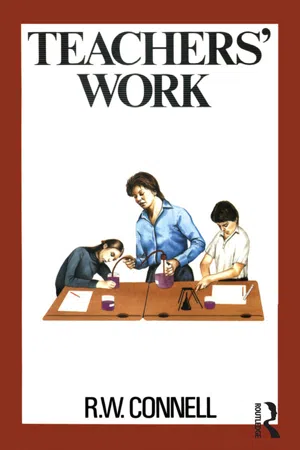
Teachers' Work is a highly readable, penetrating and often amusing account of the reality of teachers working lives, as relevant to the profession and its future as it was when first published in 1985. Based on the classic Australian study of the schools and homes of the wealthy and powerful and of ordinary wage-earners described in Making the Difference, Teachers' Work draws on extended interviews with teachers in elite private schools and mainstream government high schools and with the students and parents who attend and patronise them. As well as providing an absorbing account of the life and work of teachers through vivid portraits of people, classrooms and staffrooms, Teachers' Work illuminates the interaction between personal relationships in the classroom and the social structures of gender and class. In generating new ways of thinking about the character and origins of inequality in education, this book gives teachers themselves cause for reflection, offers student-teachers a picture of the real world of teaching, and provides parents with an insight into daily life behind the classroom door. At a time when the power of 'effective teaching' is being widely recognised and national debate focuses on the condition and prospcts of the teaching profession, Teachers' Work is as insightful and rewarding as ever.
- 228 pages
- English
- ePUB (mobile friendly)
- Available on iOS & Android
eBook - ePub
Teachers' Work
About this book
Information
1
Sheila Goffman and Margaret Blackall
This chapter introduces two teachers in working-class high schools. Both are young and both are teaching in academic areas of the curriculum, but they have already evolved very different teaching styles.
The schools they work in are comprehensive high schools in the state system. One is on the urban fringe, a product of recent expansion-one pupil’s father reminisced about shooting rabbits in the paddock where the school was later built. The other is in an older-established suburb but still well out from the city centre. Both have substantially working-class clienteles. Fathers work as storemen, carpenters, railway shunters and so on; mothers as cleaners, packers, sometimes clerks, and of course houseworkers. There are some families of small business people and public servants, not too many. On the other hand there are few in dire poverty; there are no transients in these areas, and almost everyone lives in a one-family bungalow with a bit of land for a garden. Some families are renting from the Housing Authority, some are buying houses on long time-payment, some bought a block of land and have built their own. There is the ethnic mixture that is usual in the Australian working class nowadays, but not a high migrant population in either neighbourhood. English is much the commonest language at home and virtually the only language spoken in the playground. There is some unemployment among the adults, especially the women, and serious unemployment among young people.
Being a teacher
Sheila Goffman, only two years out from university, is quite possibly the most popular teacher in her school. She is a progressive teacher in the child-centred vein, who is making a raging success of it in an unlikely setting.
It was not done smoothly. She had wanted to be a teacher from early in her own high school years, and the academically-oriented state school she went to launched her easily enough into university. Nor did she have much trouble getting her Bachelor of Arts degree, or her Diploma of Education. She was offered a job immediately by the Education Department, and came straight to Rockwell High. That was where the trouble hit.
The school is not exceptionally rough, but it has problems of control. The kids walked all over her. In retrospect she is critical of her teacher training. It gave her lots of ideas for lessons,
but I was never prepared for the discipline, at all. I think it was unreal.
Facing the classic shock of the idealistic young teacher dumped into her first classroom, she reacted in a classic way. She came down hard on the kids. She called in support from the school hierarchy, and insisted on silence and order. After a few months she got it.
But she soon came to see this as the wrong solution. She had control, all right; but the kids still were not learning anything.
Learning doesn’t necessarily happen in a dead quiet classroom with everyone jumping when you say ‘jump’.’
So she began to put her main effort into building personal relationships with the kids in which they would become involved.
This has led in two directions. On the one hand it has produced lively, informal classes with a great deal of student participation. Most of the kids love it. Sheila has gone far beyond the conventional devices of debates and projects. She has adapted encounter-group techniques, and uses them as ‘self-exploration’ exercises in the classroom. She uses workshops, self-directed group projects, and free-floating discussions in which she is an active participant but not the source of all wisdom. And this energy is by no means confined to the classroom. She is also involved with the school magazine and the drama programme, she supervises debating, organises the school dance, goes on vacation camps with the kids.
On the other hand she has tried to individualise the teaching. Her view of education is based firmly on the idea of individual development. It is nicely summed up in her response to parents’ views that school is for learning the basics. Yes, agrees Sheila, but it is more than that: ‘they’re here to grow up’. She tries to work out the appropriate tasks, but give to the kids the responsibility for doing them. She has a clear notion of the normal pattern of adolescent development, worries about any who depart from it, and tries to act according to the needs of each one. She has no hesitation about intervening in their peer relations for this purpose. For instance she tried to separate Greg Wilkins, a Year 9 boy in our sample, from a friend who she thought was holding him back in ‘immature’ behaviour.
Two things are obvious about this kind of teaching. First, to do it well requires a lot of time and energy. Sheila not only gives herself freely. Her relations with the kids obviously generate energy and stimulate her as a teacher. Still, however much energy there is, it is never enough. She too is bound by the facts of staff-student ratios and the school’s limited and parcelled time. She notes for instance that Greg Wilkins, whom she thinks likely to leave school at Year 10, needs extra attention to solve his problems of shyness and poor written expression; and she cannot give it to him.
Second, this kind of pedagogy demands that the teacher get to know the students well at a personal level. Sheila is a mine of information about the kids’ characters and situations, the different layers in their personality, the ups and downs of their relations with each other, their love lives, their hopes and fears. She is certainly a good practical psychologist, but it is more than that. She has taken the trouble to gather information about these things, in the classroom, in her other activities around the school, and even outside the school. She regularly drives kids home in her car, though she does not live in the district. And they, many of them, respond in kind. They talk to her about things they rarely confide to teachers, for instance sexual and family problems. They join in her programmes with curiosity, enthusiasm and, in the view of some other teachers, rather too much movement and noise.
Margaret Blackall is a language teacher at a school with a reasonably similar clientele, Greenway High. It is her first school and she has been there for six years. Her route into teaching was very similar to Sheila’s: a selective state school, a university BA and DipEd, and straight into a Departmental appointment. And she had the same kind of experience at the jump. Her response was similar to Sheila Goffman’s first response: to survive you have to get on top. But the emotional shading was slightly different:
After you have gone through the first year of teaching, you can organise yourself a bit better. You know what to expect, you care less what the kids think of you. In your first year out, you still treat them as monsters, or as you would treat any other adult. Now I treat kids more as I should treat them. I don’t yell at them any more, or only rarely I suppose. And I like to cultivate a friendly but firm relationship with them, which I find works very well with most kids. A little bit like a big sister, but a strict big sister, who expects things.
Her solution, then, was not the about-face that Sheila did. It was to find balances: in relationships with the kids, a balance between friendliness and firmness; and in her own relationship with the job, a balance between caring and making herself too vulnerable.
The outcome of this search for balance is a teaching style that seems markedly more conventional. Margaret’s classrooms are quiet and orderly; she insists on a degree of decorum that more free-floating staff see as even a shade authoritarian. Another teacher observed about her:
Very prim and proper, a very good teacher, but she expects them to behave as kids did about fifteen years ago. For instance, Jacko, this kid chews gum in class all the time. I think he’s written his exercise book out a couple of times for her!
Margaret herself comments on how taut the classroom should be in relation to another of her classes, a small group studying for the School Certificate:
I’ve been a lot more lenient with them than I should be, because I know them so well. And I feel they’ve taken advantage, work-wise, and think ‘Well she’s a good old stick. She won’t mind if we haven’t done the homework’. And then I get very frustrated.
Her interactions with the kids thus are noticeably more formal and, as the jargon has it, ‘teacher-centred’ than is the case with Sheila Goffman. This corresponds to a somewhat different view of what education is about. She too explains it by means of an interesting contrast with parent’s ideas:
For me, schools are to pass on knowledge, to make people grow intellectually, to civilise them, however you would like to see that process done. I don’t really see them as job finders. I don’t like utilitarian education. Perhaps that’s too idealistic, but I feel that if you have grown as a person, you will find something. We shouldn’t be sort of channelling people into boxes.
So Margaret shares with Sheila a notion of ‘growth’, and a distaste for making the school an agent of the labour market. But for her the notion of growth is much more about the growth of the mind, and teaching is above all the communication of knowledge in the cause of enlightenment.
For this goal she is prepared to work hard and long. She too is a dedicated teacher, who cares a great deal what happens to the kids. Sheila is more intimate with them, but nothing she says is quite as moving as Margaret’s explanation of why she rejects the policy of streaming:
Here at this school, my very first day with the children having the tests, and then next day putting them into groups, and seeing the children sitting around. And straight away they knew which was the best group, which was the worst group. And hearing a little girl say that she hadn’t been picked for any group yet: ‘Oh, I hope I get in this group’, and ‘Oh, that must be the good group because such-and-such is in it’. And then the last group called out, and she was in it. The dejected way, on the second day of the school year, that she went to that class, knowing that it was the dummy class-that was dreadful. And for all the good things that go with streaming, I would never advocate it, because of that.
The trouble is, concern with intellect and knowledge normally implies a policy of streaming, and a notion that the kids’ results on tests simply reflect their ‘ability’. Margaret is too sensitive, and too clear-sighted, to swallow all of that uncritically. But the result is that she has to take the consequences of streaming on board as an emotional problem for herself; just as she had taken on board the School Certificate class’s slackness about homework as if it were her own moral responsibility.
Sources and supports
Sheila Goffman is making a success of child-centred pedagogy in an environment where that would not normally happen. It is a crucial fact that she is not trying to do it alone. Her search for a teaching style in her first year took the turn it did partly because it met up with a reconstruction of her department’s work being undertaken by a new subject head.
Like whole schools, individual departments are from time to time taken in hand by a new head and renovated. John Demetriou came to Rockwell High the year before Sheila. It is his first promotion position, and he has been energetic in introducing new ideas: individualised instruction, breaking down streaming, placing strong emphasis on ‘relevance’ and contemporary issues. He has campaigned for, and with the support of the principal won, funding for a specialised resources centre for his subject.
Sheila’s interest in her students’ development, and her social skills, dovetailed with John Demetriou’s programme. She admires him, remarking that he really believes the kids come first and acts accordingly. The consequence is not only a warm reception for her flow of bright ideas about the curriculum, but also a context of support for her student-centred practices. The English staff as a group decided to throw open their staffroom to the kids to come in and chat, to convey the idea that they think of them as ‘people’ with whom one can have a relationship outside the classroom. Other departments, Sheila notes, think they are ‘crazy’ to give up their privacy-and, no doubt, create unwelcome precedents. The custom in the school is that the kids stop at the door and do not come into staffrooms.
Positive relations with her immediate colleagues, her department head, and more remotely the school principal (who has also supported her schemes) are plainly important in making Sheila the kind of teacher she is. But it is also a question of the kind of person she is. Talkative, confident, cheerful, but also sensitive to emotions and concerned with other people’s responses to her. She is good with people, establishes contact easily. One of her Year 9 students has a talent for cartooning and drew a series of the Rockwell High teachers. He pictured Sheila as a hippie, with fuzzy hair, a big smile, an open mouth-and surrounded by kids.
There is another level to this, for the pattern is not just a matter of an outgoing style. It is also, quite specifically, a type of femininity. In some ways Sheila runs counter to traditional stereotypes of women. She is active, assertive, deeply involved in her career. Yet her personal version of progressive education, which stresses caring, sensitivity, and emotional relationships, can only be understood in the context of her femininity. It expresses something basic about the way she has been constituted as a person, and the way she has constituted herself. And it is an important reason for her difficulty in understanding the rather different patterns of femininity she is meeting among the Rockwell girls.
Margaret Blackall works in a department where the atmosphere is rather cooler, and no doubt this is one reason for her pedagogy having taken a different shape from Sheila’s. But in understanding Margaret’s teaching and her impact on the students at Greenway, we need to give closest attention to her own outlook. She is a more reserved and more self-sufficient person than Sheila, and has also put more effort into thinking out her educational philosophy.
When Margaret suggested, in the passage already quoted, that she put more stress on the importance of knowledge than the parents do, she was not making a rhetorical gesture. This is important to her. It is close to the heart of why she is a teacher, and why she has stayed a teacher despite the trauma of her first year and the emotional battering it has meant since.
I’m here mostly because I love my subject so much. I want to instil a love of knowledge in general, I think. I want people to have the same sort of rewarding experience that I have.
In short, she feels herself to be an intellectual. And she feels intellectual life has a vital, though much under-rated, part to play in society as a whole. This view of knowledge gives a dignity to the teacher’s task which Margaret feels, which informs her interested-but-firm relations with the kids-and which is undermined by teachers like Sheila.
Margaret is also committed to teaching as a career. She comes from a working-class family whose education was limited but all the more valued for that. She was a high flyer at school, and now sees teaching as a life-time career. She is going for her first promotion now; intends to take leave to travel overseas, then come back to the Department and look around for a transfer. She has a professional identity as a teacher, into which her view of the importance of knowledge is integrated.
For professional women there is a classic...
Table of contents
- Cover
- Half Title
- Title Page
- Copyright Page
- Dedication Page
- Contents
- Introduction
- Part One Teachers’ Lives
- Part Two Teachers’ Work
- Part Three Teachers’ Worlds
- Notes
- Bibliography
- Index
Trusted by 375,005 students
Access to over 1.5 million titles for a fair monthly price.
Study more efficiently using our study tools.
Frequently asked questions
Yes, you can cancel anytime from the Subscription tab in your account settings on the Perlego website. Your subscription will stay active until the end of your current billing period. Learn how to cancel your subscription
No, books cannot be downloaded as external files, such as PDFs, for use outside of Perlego. However, you can download books within the Perlego app for offline reading on mobile or tablet. Learn how to download books offline
Perlego offers two plans: Essential and Complete
- Essential is ideal for learners and professionals who enjoy exploring a wide range of subjects. Access the Essential Library with 800,000+ trusted titles and best-sellers across business, personal growth, and the humanities. Includes unlimited reading time and Standard Read Aloud voice.
- Complete: Perfect for advanced learners and researchers needing full, unrestricted access. Unlock 1.5M+ books across hundreds of subjects, including academic and specialized titles. The Complete Plan also includes advanced features like Premium Read Aloud and Research Assistant.
We are an online textbook subscription service, where you can get access to an entire online library for less than the price of a single book per month. With over 1.5 million books across 990+ topics, we’ve got you covered! Learn about our mission
Look out for the read-aloud symbol on your next book to see if you can listen to it. The read-aloud tool reads text aloud for you, highlighting the text as it is being read. You can pause it, speed it up and slow it down. Learn more about Read Aloud
Yes! You can use the Perlego app on both iOS and Android devices to read anytime, anywhere — even offline. Perfect for commutes or when you’re on the go.
Please note we cannot support devices running on iOS 13 and Android 7 or earlier. Learn more about using the app
Please note we cannot support devices running on iOS 13 and Android 7 or earlier. Learn more about using the app
Yes, you can access Teachers' Work by RW Connell in PDF and/or ePUB format, as well as other popular books in Education & Education General. We have over 1.5 million books available in our catalogue for you to explore.