In scope and spread this book deserves to become a standard text for policy-makers, practitioners, those in training and their tutors. I welcome this book for its coverage of typical and a-typical development in young children and its emphasis upon an ethical and principled approach to working with young children and their families.
Professor Sheila Wolfendale, Director of the Doctorate in Educational Psychology programme at the University of East London.
Most young children with additional educational needs are enrolled in their local childcare centre or pre-school. Whether they have delayed or advanced skills, many will need extra support from teachers and child care workers so that they can participate fully in these settings.
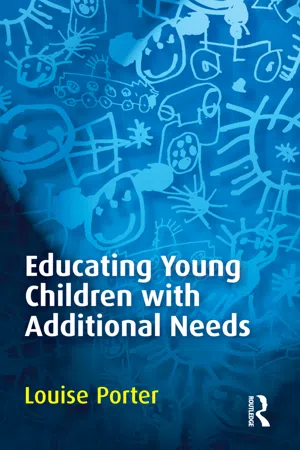
Educating Young Children with Additional Needs is a comprehensive guide to working with these children. It outlines how to recognise when young children have atypical needs, individualise relevant programs for them, and make sure that they can participate socially with other children in the group. It highlights the importance of teachers' and caregivers' responsiveness both to the children and their parents.
Individual chapters explain how to identify and meet the additional needs of children with vision or hearing impairments and those with difficulties acquiring motor, daily living, communication or intellectual skills. The emphasis is on assisting those with mild to moderate difficulties in any of these domains. The particular needs of gifted children are also explored.
Educating Young Children with Additional Needs is a valuable professional reference and student text for child care workers and pre-school teachers.
- 320 pages
- English
- ePUB (mobile friendly)
- Available on iOS & Android
eBook - ePub
Educating Young Children with Additional Needs
About this book
Information
1 FUNDAMENTALS OF EARLY EDUCATION
LOUISE PORTER
KEY POINTS
- Education in the early years has been shown to benefit children with developmental disabilities, those experiencing educationally disadvantaging circumstances, and those with typical development.
- Across the spectrum of development, children have many needs in common, but children with atypical development have additional needs. Society has the obligation to cater for a range of typical and atypical requirements.
- Although the ideal components of early education programs for children with atypical needs have been difficult to identify through research, some core values of early education imply a range of recommended practices.
INTRODUCTION
In the United States, the types of educational services provided to young children with disabilities are specified by legislation (e.g. see Cook et al. 2000); in the United Kingdom (see Long 1996; Roffey 1999) and Australia (see Williams 1996) the legislation is less prescriptive for this population, although a general educational framework governs some practices. Elsewhere, services for these children are dictated only by local policy or are not yet established practice. As for children with advanced development, where services exist at all, these are typically recommended at policy level only, with no legislative backing. Regardless of the presence of a local legal imperative, however, the authors of this book concur with the special education rationale that society has a responsibility to provide all children with an education that meets their needs—however these are manifested—and to support their families through relevant service provision (Guralnick 1997).
This rationale applies equally to children with compromised and with advanced development. The needs of children with disabilities might seem self-evident; while a focus on gifted children might seem unnecessary, as these children are already advantaged in that they can learn more easily than most. Nevertheless, they are still children and still need to be taught how to learn; they cannot excel without support (Braggett 1994). Thus, a special education approach advocates modified provisions for all children with atypical needs.
TERMINOLOGY
Internationally, the early childhood period is considered to span from birth to 8 years of age. However, because of the programming differences between preschool and school settings, this text will focus mainly on children who have not yet entered school.
Remedial programs provided in the early childhood period are often referred to as ‘early intervention’. The adjective ‘early’ in this term implies the provision of supports and resources to children and families as soon as a developmental anomaly is detected, which might be at or even before birth (Bredekamp 1993). ‘Intervention’ can be characterised along a continuum, from typical educational experiences and informal social supports through to the more structured and systematic provision of remedial activities for children with atypical development (Dunst 2000; Simeonsson et al. 1982).
The aim of early intervention is to optimise children’s learning by making use of their strengths and attempting to circumvent their difficulties to improve their daily functioning and wellbeing (Cook et al. 2000). It also aims at supporting families in their role of meeting their child’s needs. It can achieve this at a number of levels: primary prevention comprises detecting a condition before it has any expression in the child’s development, as with screening for PKU, for example (see Appendix I); secondary prevention seeks to prevent identified risk conditions from affecting children’s functioning; while tertiary prevention seeks to restrict the impact of an impairment on development (Guralnick 1997; Meisels 1991).
In Australia, the term intellectual disability is used when children’s cognitive development is significantly delayed or otherwise impaired in comparison with the typical milestones and timetable. In the early childhood years we tend to be cautious about making diagnoses so early in children’s lives, and thus usually employ the term ‘developmental delay’. While justifiably avoiding bestowing diagnoses based on a short history of development, this term can be unfortunate, in that the word ‘delay’ might imply that delayed children will catch up, which is unlikely when the delay is severe.
In the United Kingdom, the terms ‘learning difficulty’ and ‘learning disability’ are used synonymously with intellectual disability or developmental delay. However, elsewhere these same terms are used to refer to difficulties—usually manifested during the school years—with reading, writing, spelling or computation, perhaps the best known being dyslexia. These difficulties are both less severe and more domain-specific than intellectual disability and so, to avoid confusion, the UK terms will not be employed in this text.
In the USA, the term mental retardation is used synonymously with the two terms favoured in Australia. However, as well as the stigma which the US label attracts, it leaves the door open for two misunderstandings, particularly in the lay community. The first misconception arises from the fact that its root word ‘tardy’ implies that ‘retarded’ children are able to achieve normal development—merely later than usual. For children with severe disabilities this is not going to be the case: intellectually, some may never progress beyond dealing with concrete materials, having very limited capacity to reason in the abstract.
The second misconception leads to the opposite misinformation—namely, that children who are ‘retarded’ are unable to learn anything at all. This is clearly not the case.
Having assessed a six year-old’s developmental skills, I subsequently explained at length to her mother that her daughter had an intellectual disability. As I was preparing to leave, the mother declared that she was extremely relieved and, on enquiry, expressed the belief that ‘retarded’ children cannot learn anything and so she had been hoping that her daughter would not be retarded.
Another cluster of terms comprises the triumvirate of impairment, disability and handicap. To simplify the World Health Organization’s classification (see Pope 1992), an impairment is a discrete loss of mental or physical functioning, such as brain damage; a disability refers to the effect of this on the individual, such as the movement difficulties associated with cerebral palsy; while a handicap is the social stigma and environmental restrictions that are often imposed on those with disabilities but which are not usually an inevitable feature of their condition.
At the other end of the spectrum of abilities is the equally numerous group of children with advanced development. In the UK these children are referred to as highly able but elsewhere they are usually known as gifted. The former term, while seeming preferable, has the limitation of focusing only on those children who are currently successful, rather than including children who have the potential for high performances but whose educational circumstances or accompanying disabilities impair the expression of their skills. The term ‘gifted’, however, is unfortunate as it implies getting something for nothing, and ignores the fact that even very bright children have to put in effort in order to succeed.
Notwithstanding the stigma associated with the term, in this text writers will use the term ‘gifted’ to mean children who have the potential to display significantly advanced skills in any developmental domain. This is distinguished from ‘talented’ (or highly able) children who are already expressing that potential in the form of advanced achievements (as a rough guide, those who are achieving around 30% ahead of age). This distinction between giftedness and talent is proposed by Gagné (1991) and described further by Porter (1999).
Finally, to three aspects of language employed in this book. First is the use of what is called ‘people first’ language, in which, rather than referring to children who have disabilities as ‘disabled children’, the contributors refer to them as people who also have some atypical requirements. Second, we use the term additional needs to signal the inclusion of gifted children as well as children with developmental difficulties. Historically, children with disabilities have been referred to as having special needs. Finally, we use the term ‘educators’ to refer both to early childhood teachers and to professional caregivers in child care settings, in the belief that it is not possible to care for children without giving them an education, and equally impossible to educate children in the early years without caring for them.
EFFECTS OF EARLY CARE AND EDUCATION
High-quality centre-based care has been found to benefit children’s cognitive and language development and their confidence and positiveness in interacting with peers, while producing no deterioration in attachment to their parents (Burchinal et al. 1996; Field 1991; Field et al. 1988; Ochiltree 1994; Phillips & Howes 1987; Rubenstein et al. 1981). As well as such immediate benefits, Andersson (1989, 1992) demonstrated that these gains were still present at the ages of 8 and 13 years in children who had attended child care as infants.
As for children with disabilities, such clear findings about the benefits of early intervention are difficult to obtain. This is because programs differ in their content and method of delivery; it can be difficult to determine whether developmental gains were due to maturation or resulted from the program; success could be manifested as the prevention of developmental regression or the avoidance of secondary disabilities—both of which are difficult to measure; and gains could be attained in skills that were not specifically targeted or measured, such as social or emotional qualities or parents’ confidence (Bailey & Wolery 1992; Casto & Mastropieri 1986; Guralnick 1991; Kemp & Carter 1993; Simeonsson et al. 1982). Moreover, the findings on the efficacy of intervention programs with one type of disabling condition might not necessarily hold for other disabilities (Bailey & Wolery 1992).
Timing of intervention is also a factor in outcomes: it has been assumed that children benefit most from early intervention when it is begun as soon as a developmental anomaly is detected. This, however, seems to be true only for educationally disadvantaged children, those with milder disabilities and children with autism; for those with other severe disabilities, earlier is not necessarily better (Casto & Mastropieri 1986; Guralnick 1991)—perhaps because very young children with significant developmental delays might not yet be ready to take advantage of formal instruction.
The general conclusion, despite the research difficulties and issues of timing, is that early intervention is both beneficial and a natural right of children and families (Kemp & Carter 1993). Althoug...
Table of contents
- Cover
- Half Title
- Title Page
- Copyright Page
- Contents
- Figures and tables
- About the contributors
- PART I—FOUNDATIONS OF EARLY YEARS EDUCATION
- PART II—PROGRAMMING FOR ATYPICAL DEVELOPMENTAL NEEDS
- Appendix I—Common causes of atypical development
- Appendix II—Typical developmental milestones
- Appendix II—Indicators of advanced development in young children
- Bibliography
- Index
Trusted by 375,005 students
Access to over 1.5 million titles for a fair monthly price.
Study more efficiently using our study tools.
Frequently asked questions
Yes, you can cancel anytime from the Subscription tab in your account settings on the Perlego website. Your subscription will stay active until the end of your current billing period. Learn how to cancel your subscription
No, books cannot be downloaded as external files, such as PDFs, for use outside of Perlego. However, you can download books within the Perlego app for offline reading on mobile or tablet. Learn how to download books offline
Perlego offers two plans: Essential and Complete
- Essential is ideal for learners and professionals who enjoy exploring a wide range of subjects. Access the Essential Library with 800,000+ trusted titles and best-sellers across business, personal growth, and the humanities. Includes unlimited reading time and Standard Read Aloud voice.
- Complete: Perfect for advanced learners and researchers needing full, unrestricted access. Unlock 1.5M+ books across hundreds of subjects, including academic and specialized titles. The Complete Plan also includes advanced features like Premium Read Aloud and Research Assistant.
We are an online textbook subscription service, where you can get access to an entire online library for less than the price of a single book per month. With over 1.5 million books across 990+ topics, we’ve got you covered! Learn about our mission
Look out for the read-aloud symbol on your next book to see if you can listen to it. The read-aloud tool reads text aloud for you, highlighting the text as it is being read. You can pause it, speed it up and slow it down. Learn more about Read Aloud
Yes! You can use the Perlego app on both iOS and Android devices to read anytime, anywhere — even offline. Perfect for commutes or when you’re on the go.
Please note we cannot support devices running on iOS 13 and Android 7 or earlier. Learn more about using the app
Please note we cannot support devices running on iOS 13 and Android 7 or earlier. Learn more about using the app
Yes, you can access Educating Young Children with Additional Needs by Louise Porter in PDF and/or ePUB format, as well as other popular books in Education & Early Childhood Education. We have over 1.5 million books available in our catalogue for you to explore.