Both the theory and practice of educational administration have undergone major changes in recent years. There is now more theoretical diversity in the field than at any other time, with influences from traditional and post-positivist science, subjectivism, ethics, critical theory and cultural studies. Similarly, social, political and economic factors have brought about new approaches to practice. Schools administration in particular is increasingly being dominated by decentralization and pressures for accountability on curriculum and educational outcomes.
Educational Administration is the first Australian text to offer a comprehensive survey of theory, context and practice. It includes chapters from leading Australian scholars such as Richard Bates, Hedley Beare, Brian Caldwell, Gabriele Lakomski and Fazal Rizvi.
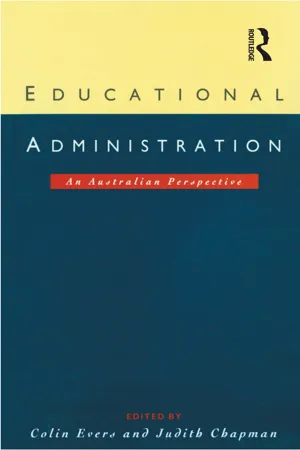
- 376 pages
- English
- ePUB (mobile friendly)
- Available on iOS & Android
eBook - ePub
Educational Administration
About this book
Information
1 Theory in Educational Administration
Gabriele Lakomski and Colin W. Evers
If indicators of a profession’s existence are the availability of university, in-service and Department of Education courses, national and international conferences and the emergence of a journal, then the birth of Australian educational administration as a profession occurred in about 1963. Of course, there were individuals or groups concerned with school administration before this, but as the focus of an identifiable theoretical activity and a set of articulated practices, Australian educational administration is barely thirty years old.
Australian educational administration borrowed its theoretical framework from North America, where professional status was much better established. The prevailing mood of the time was that of the Theory Movement, whose theoreticians are well represented in the texts of Australian educators such as William Walker (1970), who had gained his doctorate from the University of Illinois in the late 1950s.
The best indication of what constituted ‘theory’ in educational administration is found in the Journal of Educational Administration, the first truly international journal in the field, closely followed by the establishment of the North American Educational Administration Quarterly in 1964. The founder of the Journal of Educational Administration, William Walker, more than any other writer in the Australian context, must be credited with making available and personally contributing to the development of the theoretical–philosophical foundations of educational administration. While the practical concerns of educational administration have mostly been well represented in research studies, theoretical concerns have also been a focus of Australian research since the 1960s. Australian educational administration thus has a strong tradition of theory development, which continues to gain international acclaim.
The Theory Movement in Australia
Discussing the first Australian postgraduate course in educational administration, offered by the University of New England in 1959, Walker (1964) described the course as being comparative but also unambiguously theoretical in orientation. The ‘how to do it’ approach was not favoured, and Walker (1964: 21) was most concerned that the new profession was still ‘rich in opinion and folk-lore, but sadly lacking in scientific foundation and fact’. Arguing against those who believed that personal experience in school administration was sufficient training, Walker conceded that ‘the school of hard knocks’ had produced some excellent administrators but insisted ‘that they might well have distinguished themselves much earlier and much more often if they had been able to avoid a long period of trial and error learning. It is doubtful whether we can any longer afford to be as wasteful of our resources in material and personnel as we have been in the past’ (Walker 1964: 12). This assessment shared by the prominent Australian educator William Bassett (1965) and others, clearly indicates the direction Walker believed the new profession of educational administration should take: it should be placed on a sound theoretical platform. It is largely because of Walker’s work that the writers of what has come to be known as the Theory Movement (see Evers and Lakomski 1991: Ch. 3) were introduced to Australian educational administration and in turn shaped its early theoretical orientation. The clearest expression of the nature and function of ‘theory’ in administration is in Walker’s (1965) landmark article, ‘Theory and Practice in Educational Administration’, published in the Journal of Educational Administration. Guided by the Deweyan motto that there is nothing more practical than a good theory, Walker is very clear on the kind of distinction to be drawn in educational administration: the only relevant distinction is that between good theory and bad theory. It is not the commonly advanced dichotomy of theory vs practice or even theory and practice. And even more strongly:
Clearly, there is no question as to whether we should or should not employ theory in our administrative behaviour. Such a question is as meaningless as is the question as to whether we should or should not use motivation in our behaviour. The point is that all of us theorise, but that few of us develop good theory, that is, theory which reveals uniformities in the subject matter of the theory, which enables us to predict precisely in accordance with established criteria and provides guides to action which ‘work’, or more rigidly, as defined by Griffiths after Feigl, ‘a set of assumptions from which can be derived by purely logico-mathematical procedures a larger set of empirical laws’. (Walker 1965: 20)
So the purpose and function of ‘theory’ is that it provides a coherent, systematic basis that can assist the administrator to predict a future state of affairs, and hence to guide action accordingly. In short, administrative theory guides people to better action or decision-making. Administrative action, including decision-making, in this context is considered to be rational or scientific.
This description already makes it clear what (administration) theory is not. Following Griffiths’ (1959: 13–19) definition, adopted by Walker, ‘theory’ is not just a personal matter, nor a mere speculation or dream, nor is it to be equated with a philosophy. The important distinction for us is the third one. What Griffiths means to indicate by this distinction is that a philosophy has to do with (among other things) a well-developed set of values or ‘oughts’. Roughly put, philosophy trades in values or ‘oughts’, whereas ‘theory’ trades in facts or ‘is’s’. The ‘is–ought dichotomy’ was actually the trademark of logical positivism and logical empiricism, the dominant philosophical orientation in the early decades of the twentieth century. Key members of the Theory Movement, such as Daniel Griffiths (1959), Andrew Halpin (1958 1966) and Jack Culbertson et al. (1973), accepted the logical empiricist doctrine of a strict separation of fact from value; and indeed this dichotomy has been best expressed by Herbert Simon (1976: 249–50) in his example from economics:333
... the proposition ‘Alternative A is good’ must be translated into two propositions, one of them ethical, the other factual:
‘Alternative A will lead to maximum profit.’
‘To maximize profit is good.’
The first of these sentences has no ethical content and is a sentence of the practical science of business. The second sentence is an ethical imperative and has no place in any science.
Science cannot tell whether we ought to maximize profit. It can merely tell us under what conditions this maximum profit will occur, and what the consequences of maximization will be.
According to this distinction, values (‘oughts’) have no place in science because they cannot be verified empirically, whereas facts can be by observation and deduction. The underlying belief—in Griffiths’ theory and others—is that administration as a social activity can be studied scientifically; that is, the phenomena of social life are as amenable to scientific scrutiny as the phenomena of physics and biology; the only proviso is not to confuse matters of fact with matters of value. Administration, then, can be a science rather than remain an art based only on personal intuition and experience, or what Simon calls the ‘proverbs’ of administration. The science/art distinction in educational administration has its origins in the logical empiricists’ separation of facts and values. Both dichotomies continue to pervade contemporary theorising in the field, the science/art distinction being the more overt.
For administrative theory to be scientific, according to Griffiths, it has to possess some specific characteristics. Like science generally, it has to be able to describe, explain and predict the phenomena with which it is concerned. Following the formulations of the logical empiricist Herbert Feigl, Griffiths believes that ‘[T]he study of administration can become scientific to the extent that it ascertains its facts by a meticulous scrutiny of administrative behaviour. This must then be followed by causal interpretation of the facts. On the basis of description and interpretation, accurate predictions can be made.’ (Griffiths 1959: 22) Administrative scientific inquiry, like any other scientific enterprise, is guided by the criteria of objectivity, reliability, operational definitions, coherence and comprehensiveness. Of particular importance for the theorists of the Theory Movement was the concept of operational definitions, by which is meant observable measurable procedures that could be carried out in order to identify phenomena to which the relevant concepts refer. Griffiths (1959: 24) expresses the expectations of administrative scientific theory best when he writes that ‘the practice of administration is the application of the theory of administrative researchers. . . and that the hypotheses to be tested must . . . be suggested by practitioners in the field’. Theory, among other things, is thus quite clearly conceived of as a guide to action. This is a point worth emphasising, because for an applied science such as administration it is precisely its capacity to guide action that proves its mettle. It is therefore not surprising that this issue has provided an important focal point for criticism by proponents of alternative, non-scientific conceptions of administration.
In addition to the scientific criteria listed above, a theory’s role is to explain the phenomena under discussion. Having thus described the various criteria a scientific administrative theory must satisfy, Griffiths (1959: 28), following Feigl (1951), defines a theory as ‘a set of assumptions from which can be derived by purely logico-mathematical procedures a larger set of empirical laws’. The definition of administrative theory provided by Griffiths shows three particular philosophical constraints that are characteristic of the Theory Movement:
- ‘Theory’ is a hypothetico-deductive structure in which statements are partitioned into hypotheses and testable consequences, based on core assumptions, and eventually leading to ‘a larger set of empirical laws’.
- Operational definitions are created to provide empirical content for theoretical terms.
- Administrative theory sharply distinguishes facts and values, where the latter are accounted for in terms of variables only.
These three constraints are indicative of the basic empiricist epistemological structure for the justification of theories. But in philosophy and epistemology, this kind of structure for justification is no longer considered sound, and empiricism as an account of science has been replaced by alternative post-positivist conceptions (Churchland 1986: especially Ch. 6; BonJour, 1985).
Systems theory
Seen through the eyes of Walker and Griffiths, the Theory Movement adhered to logical empiricism as its philosophical basis, while its conceptual framework was that of systems theory, which described (educational) organisations as social systems. (For a contemporary, prominent version, see Hoy and Miskel 1991.) Because the next chapter explicitly discusses educational organisations as systems, let us note here only some features. (For an excellent discussion, see Scott in Meyer 1978; Scott 1981; Chs 4 and 5; Harmon and Mayer 1986; Evers and Lakomski 1991: 59–73.) In general terms, systems are commonly described as consisting of interrelated objects, attributes and events (see Litterer 1969: 4) and are usually classified as either closed or open. A closed system is one that focuses primarily on its internal characteristics (for example, a lawnmower or a Weberian type of bureaucracy), while an open (or natural) system is defined in terms of its dependence on its environment—that is, the processes and events external to it (a school is an example). The ‘environment’ of an organisation comprises such elements as economics, politics, culture and technology, as well as other social and inter-organisational features (Scott 1978: 21) considered vital for the system’s continued existence.
Prominent social system theorists such as Getzels, Lipham and Campbell (1968: 52) describe administration ‘structurally . . . as the hierarchy of superordinate–subordinate relationships within a social system. . . Functionally, this hierarchy of relationships is the locus for allocating and integrating roles and facilities in order to achieve the goals of the system’. There are a number of important concepts to note here. Considering a school as a social system, two classes of phenomena can be observed (as in any social system):
- There are institutions with certain roles and expectations that are supposed to fulfil the goals of the system.
- There are also the individuals with different personalities and needs; it is their observed interactions that are called ‘social behaviour’.
‘Institution’, ‘role’ and ‘expectation’ refer to the normative (or nomothetic) dimension of social system activity, while ‘individual’, ‘personality’ and ‘need disposition’ indicate the personal (or idiographic) dimension. The major task is to understand the relationship between these elements in order to explain observed behaviour and predict and control it. Understanding administrative behaviour therefore involves understanding the nature of the individuals who inhabit various roles and react to certain expectations. To re-emphasise this important point: role and individual are not synonymous. And as Harmon and Mayer (1986: 170) note, this separation ‘is an important step of abstraction’. The significance of this is that because roles and role expectations cannot be directly seen, they ‘must be inferred from phenomenological report or from the analysis of other kinds of data’ (Getzels et al. 1968: 61).
Now within the justificatory framework of logical empiricism and Feigl’s definition of theory, the ‘science of managing behaviour’ (as Walker put it) has to proceed by observing actual behaviour and then inferring roles and expectations from these observations. The point to be made here is that all observation is theory-laden, and it is human beings (and not abstract roles) who act. This means that an organisational role is in practice an interpretation of what should be done in a given circumstance (see Evers and Lakomski, 1993), and this interpretation, and thus the role, is shaped by a person’s beliefs, wants and values. If this is so, then the distinction between the nomothetic and idiographic dimensions blurs, and the purported need to explain any relationship between them that was expected to deliver an account of ‘organisational behaviour’ becomes problematic. Organisational behaviour appears to be no more and no less than people’s interpretations of what they should do under given circumstances, and the notion of role will often be too abstract to figure usefully in analyses of system behaviour. Insofar as we continue to talk of administrative roles, we do so by recognising that they are always value-laden. This was the very point made by Thomas B. Greenfield in his now-legendary address to the 1974 International Intervisitation Programme in Bristol, an address that changed the theoretical direction of educational administration. (The core essays of Greenfield’s work are included in his 1993 collection entitled Greenfield on Educational Administration, edited by himself and Peter Ribbins.)
Greenfield's subjectivism
By renouncing the systems theorists’ assumption ‘that organisations are not only real but also distinct from the actions, feelings and purposes of people’, Greenfield (Greenfield and Ribbins 1993: 1) challenges the core of the behavioural science of administration. Basing his argument largely on European (especially Weberian) interpretive social science, he stresses that it is human action and intention that first constitute what we call ‘organisation’. Since ‘organisation’ is just another meaning we create for ourselves to explain what it is that we do in certain situations, according to Greenfield it is untenable to speak of organisations as if they had an objective reality outside of us, as if they were real in the sense that houses and cars are. It is in this sense that Greenfield speaks of organisations as ‘social inventions’. They are ‘invented’ insofar as they are the products of our minds’ activity, and it is in this sense that they are subjective. Hence, the systems theorists’ talk of organisations as if they were houses whose basic structures remain intact while the human tenants come and go, is at best misleading and at worst amounts to reifying social reality. Expressed clearly in his 1974 Bristol presentation, this remains the core epistemological feature of Greenfield’s research program and provides the basis for his alternative subjectivist perspective on educational administration. (For an elegant exposition of his ideas covering Greenfield’s publications to 1982, see Gronn 1983. It can be said that Gronn has been largely responsible for making Greenfield’s work largely accessible to Australian administrators. Gronn, 1994, updates and expands the earlier emphases.)
By rejecting a scientific view of administration, and by drawing expressly on the tradition of European and North American interpretivist social science, Greenfield also rejects the idea that educational administration can be an objective enterprise. In support of his view he draws on some crucial criticisms of empiricist science as developed in Thomas Kuhn’s and Paul Feyerabend’s work. The idea t...
Table of contents
- Cover
- Half Title
- Title Page
- Copyright Page
- Contents
- Figures and tables
- Preface
- Contributors
- Introduction
- 1 Theory in Educational Administration
- 2 Educational Organisations as Systems
- 3 Subjectivity and the Creation of Organisations
- 4 Critical Theory of Educational Administration
- 5 Cultural Theory in Educational Administration
- 6 Ethics in Educational Administration
- 7 Towards Coherence in Administrative Theory
- 8 Cross-national Exchange and Australian Education Policy
- 9 New Patterns for Managing Schools and School Systems
- 10 The Provision of Non-government Schooling in Australia: Retrospect and Prospect
- 11 The Provision of Education and the Allocation of Resources
- 12 The Statutory Framework of Education and Legal Issues of Concern for Administrators
- 13 Management of the Curriculum: Stability vs Change, Evolution vs Destabilisation
- 14 Managing the Reform of Teachers and their Work: Perspectives, Prospects and Paradox
- 15 Parents, the Community and School Governance
- 16 School Leadership: Securing Quality Teaching and Learning
- 17 Quality Assurance and Quality Management in Education Systems
- Bibliography
- Index
Trusted by 375,005 students
Access to over 1.5 million titles for a fair monthly price.
Study more efficiently using our study tools.
Frequently asked questions
Yes, you can cancel anytime from the Subscription tab in your account settings on the Perlego website. Your subscription will stay active until the end of your current billing period. Learn how to cancel your subscription
No, books cannot be downloaded as external files, such as PDFs, for use outside of Perlego. However, you can download books within the Perlego app for offline reading on mobile or tablet. Learn how to download books offline
Perlego offers two plans: Essential and Complete
- Essential is ideal for learners and professionals who enjoy exploring a wide range of subjects. Access the Essential Library with 800,000+ trusted titles and best-sellers across business, personal growth, and the humanities. Includes unlimited reading time and Standard Read Aloud voice.
- Complete: Perfect for advanced learners and researchers needing full, unrestricted access. Unlock 1.5M+ books across hundreds of subjects, including academic and specialized titles. The Complete Plan also includes advanced features like Premium Read Aloud and Research Assistant.
We are an online textbook subscription service, where you can get access to an entire online library for less than the price of a single book per month. With over 1.5 million books across 990+ topics, we’ve got you covered! Learn about our mission
Look out for the read-aloud symbol on your next book to see if you can listen to it. The read-aloud tool reads text aloud for you, highlighting the text as it is being read. You can pause it, speed it up and slow it down. Learn more about Read Aloud
Yes! You can use the Perlego app on both iOS and Android devices to read anytime, anywhere — even offline. Perfect for commutes or when you’re on the go.
Please note we cannot support devices running on iOS 13 and Android 7 or earlier. Learn more about using the app
Please note we cannot support devices running on iOS 13 and Android 7 or earlier. Learn more about using the app
Yes, you can access Educational Administration by Judith Chapman,Colin Evers in PDF and/or ePUB format, as well as other popular books in Education & Education General. We have over 1.5 million books available in our catalogue for you to explore.