- 256 pages
- English
- ePUB (mobile friendly)
- Available on iOS & Android
eBook - ePub
About this book
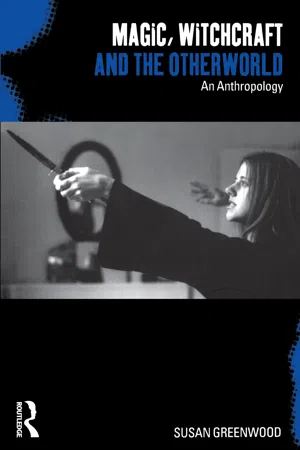
Anthropology's long and complex relationship to magic has been strongly influenced by western science and notions of rationality. This book takes a refreshing new look at modern magic as practised by contemporary Pagans in Britain. It focuses on what Pagans see as the essence of magic - a communication with an otherworldly reality. Examining issues of identity, gender and morality, the author argues that the otherworld forms a central defining characteristic of magical practice. Integrating an experiential ethnographic approach with an analysis of magic, this book asks penetrating questions about the nature of otherworldly knowledge and argues that our scientific frameworks need re-envisioning. It is unique in providing an insider's view of how magic is practised in contemporary western culture.
Information
-1-
Introduction
Anthropology has traditionally been concerned with the translation of cultures usually of non-Western small-scale or developing societies; but this book is an anthropological study of a Western magico-spiritual counter-culture commonly termed Paganism. Paganism is an umbrella term for a number of diverse groups and practices, and ranges from various forms of high magic (sometimes called ceremonial magic or 'Western mysteries'), through witchcraft or wicca, druidry, and the Northern magical traditions of the Scandinavian and Germanic peoples, to chaos magick.1 These disparate groups have varying mythologies and cosmologies; but all share a common uniting belief in communication with an 'otherworld' — a realm of deities, spirits or other beings experienced in an alternative state of consciousness. The otherworld is viewed as part of a holistic totality co-existent with ordinary, everyday reality; it is seen to be a source of sacred power. Contact and communication with the otherworld is usually conducted through special rituals, a process that is seen to bring transformations both to the individual and to the wider cosmos. Connection with the otherworld is thus central to the magical practice and experience of Paganism.
Engaging in magical rituals designed to facilitate contact with the otherworld affects magicians' notions of identity, gender and morality. These areas of magical life illustrate how central the experience of the otherworld is to magical thought; they also show decisive differences not only between different magical philosophies but also between the magical world and mainstream society. Since the Enlightenment, Western cultures have been associated with reason and rationality, which are in turn connected to notions of masculinity (Seidler 1989). Magicians argue that there are multiple ways of viewing the cosmos, and that the rational, objective realm is not the only reality. Magical rituals in contrast provide a space devoted to the forces of'unreason' — whereby everything associated with emotion, intuition, and femininity is valued. It is a striking feature of magical practices that often women or 'the feminine' are central, in contrast to orthodox world religions, where women have largely been marginalized. This is because most contemporary magical ideologies are based on the predominant stereotypical view of gender difference: women are more intuitive, men more rational. Being intuitive is seen to be an essential characteristic of a good magician, who must be in touch with the forces of the otherworld; and women are often thought to have an innate advantage. In some practices, such as witchcraft, women act as initiators of men into magic. In addition, magical energy is often likened to the two poles of a battery, one of which must be negative, the other positive for the current to flow. Sexual stereotyping positions women and men as opposing poles in the energy field. Rituals form a theatrical space apart from the ordinary world, in which the body is seen to be the locus of the forces that are personalized as spirits or deities of the otherworld. For magicians, ritual is a space of resistance to the rationalism of the wider culture Rituals are viewed as a space where a magician gains contact with the otherworld, a special 'place between the worlds', where magical transformations are said to occur.
Magic, to the outsider's eye, is concerned with mystery and beguilement; it is the stuff of enchantment, popularized and synthesized by the films of Disney and synonymous with fantasy and dreams. Real-life magicians take on some of the popular images of magic, and many weave them into magical personas that are associated with an otherworldly power. However, underneath the glitter and glamour of magic there is another more serious process of psychospiritual transformation. Magicians' identities are formed from their relationship with the otherworld, and part of the practice of magic as a spiritual path requires learning how to channel the forces of the cosmos. But before this can happen much magical work involves healing the magician from the effects of living in the ordinary world; and the parallels with shamanism are explicit. It is only when the magician can 'balance the forces' that the work of bringing power through from the otherworld begins.
Morality in magical practices is an important issue. For magicians, good and evil are joined in a dialectical process that creates a greater cosmic unity: there is no absolute separation between good and evil. The 'occult' means that which is kept secret, the esoteric, the mysterious, that beyond the range of ordinary knowledge. In Christian terms, it is often thought of as sinister, and associated with the Devil as an opposing moral force to the goodness of God. The term 'occult' is loose and all-embracing, and can refer to a variety of practices ranging from Spiritualism to alchemy or astrology. It is often used by outsiders in a derogatory way to describe that which is seen to be heretical to orthodox beliefs. In particular, witchcraft has been associated with evil, darkness, illness, misfortune and death. Christianity constructed the image of the witch as an associate of the Devil in an evil partnership that threatens an ordered and good society. In this way, notions of witchcraft may be seen to embody a society's negative values, as in the case of the witches' Sabbath, which is associated with gatherings in the darkness, female sexuality and animal metamorphosis. This is in contrast to the Christian emphasis on light, controlled sexuality or chastity and definite boundaries between animal and human (Ginzburg 1992). Morality in magic is thus effectively shaped by the Christian religion of the mainstream society; and I show how magical practices either incorporate elements of Christianity or rebel against it in an effort to determine an internal sense of morality that is in harmony with natural 'cosmic truths'.
Often anthropological and sociological analyses ot magic tail to take account of magicians' interactions with the otherworld. This is due to the fact that the social sciences have had a problematic relationship with magic, largely as a result of the close association of rationality with a certain view of science. By failing to attach sufficient importance to the otherworld, these analyses miss what Pagans see as the essence of magic: otherworldly experience. By focusing on central issues concerning magical identity, gender, and morality the value of a different perspective that incorporates ideas and experiences of the otherworld becomes clear. This work has implications for the study of the social sciences as a whole, and engages with perennial philosophical and anthropological debates concerning what rationality is and what constitutes a scientifically valid knowledge of reality. This study is part of a growing corpus of work that questions ethnographic epistemologies and the construction of knowledge through cultural interpretation (Favret-Saada 1980; Marcus and Fischer 1986; Stoller and Olkes 1987; Tedlock 1991; Young and Goulet 1994; Cohen and Rapport 1995). However, before discussing these issues in more detail I will introduce the magical subculture in London.
The Magical Subculture in London
'Talking Stick' is an informal discussion forum that is held twice a month when a large group of a hundred or so magicians gather in the upstairs meeting room of a central London pub near the British Museum. Nearby stands the empty Centrepoint building, which occupies a site that, according to magical lore, was cursed by the notorious magician Aleister Crowley. On one occasion when I attended one such meeting the atmosphere in the room was hot and smoky, but also charged with expectation, for the speaker was a well-known personality in the magical scene, and most were interested in what she had to say. Down below the traffic roared; but the outside world seemed very distant on this hot May evening. Recent forum talks had included 'Jung and the Uncanny (Making Coincidences Meaningful)', 'Does Magic Work?', 'Witchcraft and Tradition in The Basque Country', 'Renaissance Magic', and a 'Meet The Groups' session with representatives of different magical groups.
Magical practitioners of all persuasions gathered in small groups, exchanging information and chatting. Most were in their twenties and thirties, white, middleclass and not really out of the ordinary at first glance. On closer inspection pentangles and talismans, in the form of rings or other decorative jewellery, became more apparent. There was also a preponderance of black clothing, especially black leather. Leaflets were circulated: a member of a Pagan group was having an open house and 'workshops, story-telling, a discussion forum, an attunement meditation and short closing ritual' were on offer. Information on magical moots in another area of London, including 'Themes of Midsummer', and 'Sacred Plants and Natural Magic', were also available. For those with an interest in Egyptian magic, a Midsummer Ritual of 'The Rebirth of Amun Ra' was advertised. This was to be led by an archaeologist specializing in Egyptology and his partner, who were also high priest and priestess of a witchcraft coven. 'Together they will provide an opportunity to understand and participate in the voyage of the Sun god, Ra, across the horizon. Using visualisation and magickal technique, we will experience the power of solar transformation.' Various Pagan journals and newspapers, including Psychic News, were on sale from a central table, as were various books relevant to the talk.
How does the newcomer into the occult choose from such a bewildering array of paths to 'spiritual truth'? There are perhaps hundreds of open organizations, ranging from Charlton House Astrology Group through The Fellowship of Isis (created to promote closer communication with the Goddess), Cheiron (a group for elderly, disabled and invalid occultists), the Eagle's Wing Centre for Contemporary Shamanism, Hoblink (a networking group for homosexual/bisexual Pagans), and the Order of Bards Ovates and Druids, to the Theosophical Society and The Vampyre Society. There are experts who will teach various aspects of Kabbalah2 in weekend courses with such titles as Kabbalistic Astrology and 'The Tree of Life'. Alternatively, it is possible to join a 'Wicca Study Group' to discover, amongst other things, the Wiccan Circle and the Elements, The Wheel of the Year, The Goddess and the God, Making Magic and the Meaning of Initiation.
Most of these magicians call themselves Pagans or neo-Pagans,3 and 'Paganism' has become the descriptive term for a mulitiplicity of diverse practices. Some, usually those in the northern traditions, prefer to be called 'Heathen' (Harvey 1996:49); but Paganism has become the descriptive label for this type of magico spiritual practice. However, this is not unproblematic, because Paganism has a rather vague umbrella usage and refers to a group of magical practices that are often seen to pre-date Christianity. The word 'pagan' is derived from the Latin pagus meaning 'rural', 'from the countryside', and has often been used to designate the 'other' from Christianity (Jones and Pennick 1995). Contemporary self-designated Pagans use the term broadly as 'one who honours nature'. A current definition of Paganism is as 'a Nature-venerating religion which endeavours to set human life in harmony with the great cycles embodied in the rhythms of the seasons' (Jones and Pennick 1995). I argue that far from being prior to Christianity, contemporary Pagan practices are either a Christian esoteric interpretation of magical beliefs, or have developed specifically in opposition to Christianity. A study of history shows that many current magical practices stem from revivals of magic in the Hermetism of the Renaissance and, more recently, in the nineteenth-century magical organization the Hermetic Order of the Golden Dawn. In other words, contemporary Paganism is based more on Hermetism rather than any indigenous nature religion. However, the term Paganism has gained widespread currency, and is used to describe the increasing number of people who practise what they define as an ancient nature spirituality. Paganism is part of a wider Western trend towards a de-traditionalized and internal spiritual experience rather than a received 'religion' external to the individual and imposed from the outside.
Consequently, many magicians practise magic as part of a critique of Christianity, which most described to me as 'dualistic' in the way that it splits the body off from an externalized spirit. Many magicians construct their philosophies in terms of being oppressed by Christianity, as a verse of 'The Burning Times', a song composed by the popular Pagan rock band Incubus Succubus,4 states:
They came to bring the 'good news',
to burn Witches, Pagans, Jews.
They said they were the shepherd's sheep,
they whipped old women through the street.
Then the turning of the tide,
from the truth they could not hide.
Now the darkest age is past,
the Goddess has returned at last!
to burn Witches, Pagans, Jews.
They said they were the shepherd's sheep,
they whipped old women through the street.
Then the turning of the tide,
from the truth they could not hide.
Now the darkest age is past,
the Goddess has returned at last!
However, Paganism also encompasses groups that are broadly Christian. Indeed, some high magicians are committed Christians, such as Dion Fortune (1987a), who expounded an esoteric version of Christianity. Although many Pagans see their practice as antithetical to Christianity, some magical practices are directly shaped by Protestant notions of the individual and his or her relation to God. The case of the infamous magician Aleister Crowley, who rebelled against a strict Protestant upbringing and developed the anarchistic religion of Thelema as a direct response, is a good example. It is thus clear that magical practices have a complex relationship with Christianity, and are often not so different from Christianity as they claim to be.
The exact number of practitioners of magic is notoriously difficult to calculate. Most are anarchistic and have an aversion to filling in census forms, and the very nature of magical practice is couched in secrecy fomented by mythologies (of the 'Burning Times' for example) and actual discrimination and abuse (one witch 1 spoke to said that he had had bricks thrown in though his window and his door smashed down). Witchcraft in particular is decentralized, and each coven is autonomous.5 Figures of several thousand in England have been suggested (Luhrmann 1989). York refers to a census organized by the occult supplier 'The Sorcerer's Apprentice' in which Chris Bray, the proprietor, claims that 'at the present day we have a conservative estimated population of over 250,000 Witches/Pagans throughout the UK and many more hundreds of thousands of people with a serious interest in Astrology, Alternative Healing Techniques and Psychic Powers' (The Occult Census 1989. Leeds. Quoted in York, 1995:143). The Pagan Federation states that its membership figures in 1992 were 1,200 full members, with approximately the same number of associate members.6 In 1994 it claimed that it had 'grown fivefold in the last two years' (Talking Stick Magickal conference 12 February 1994). In 1997 numbers at the annual conference, which was held at a much larger venue, doubled from 850 of the previous year to 1,500 ticket sales (with stall-holders and tickets for the night concert this approached the figure of 2,000). Paganism is without doubt an increasingly popular form of spirituality, and the numbers of those who call themselves Pagan will undoubtedly rise in the years to come.
Attendance at the London events such as the annual Pagan Federation or Fellowship of Isis Conferences typically drew around four hundred participants when I was conducting fieldwork in the early 1990s. A popular discussion forum, such as Talking Stick, would attract, on a weekday evening, at least a hundred magicians. New Age and Pagan bookstores, which also sell magical paraphernalia (candles, incense, figurines, etc.), are increasingly becoming a standard feature in major British cities. From my own involvement I can say that in October 1993 I was aware of at least eleven witchcraft covens (consisting of four or five members up to the traditional maximum of thirteen) in London, and there were probably many times that number that I was unaware of. High magic groups are usually started through correspondence courses, which take students from all over the country. There are local lodges, and students usually use their nearest one when they become involved in group ritual work. Two London lodges were known to me, and I heard that the occult school of which I was an apprentice had ten lodges in other countries. These impressionistic figures do not take into account solitary practitioners or other practices and traditions within the subculture as a whole, and any guess at numbers inevitably remains an approximation.
My focus in this work is primarily on the distinctions and similarities between high magic on the one hand, and forms of witchcraft on the other. This comparison reveals certain tensions and differences in the ways that contemporary magicians distinguish their practices. Since the Renaissance, high magic has been concerned with drawing down forces and energies from the heavens. Christian-influenced high magic mythology relies on a classic narrative: humans master their lower selves and baser natures in the spiritual pursuit of their true identity within the Light and legitimacy of the Ultimate Being. The aim of high magic is wholeness and unity with divinity. Wholeness in high magic is commonly explained with reference to the Judaeo-Christian Fall —the separation of humanity from godhead and its subsequent reunion.
Some practices of high magic, following the ideas of Aleister Crowley, are explicitly anti-Christian, and focus on 'liberating' energy to develop the self rather than on notions of spiritual union with divinity. Contemporary witchcraft is also anti-Christian, and was created in the 1940s by a retired civil servant called Gerald Gardner (Kelly 1991; Hutton 1991). It is claimed to be a re-working of ancient magical practices — the 'Old Religion' — and part of an ancient fertility religion (Gardner 1954); it is also said to be a nature religion. I argue that modern witchcraft is not a form of 'low magic' associated with ordinary peasant folk and country lore, but rather is a development of the Renaissance high magic tradition, and can thus be associated with the learned and élite rather than ordinary village folk. This view conflicts with contemporary witches' own mythology of 'the Burning Times' — the European witch hunts of 1400-1750 - which represent a powerful metaphor for their oppression by the dominant rationalist culture, symbolized by Christianity. In other words, the fact that witchcraft can be demonstrated to have derived from high magic challenges the very essence of its ideology as an ancient pre-Christian pagan tradition. Gardner's formulation of witchcraft practice concerned the channelling and utilization of the sexual energy of coven members. Later versions - Alexandrian witchcraft, which was developed by Alex Sanders in the 1960s, and incorporated more high magic elements (often referred to by witches as "high church'), and feminist witchcraft, which was formed to counter the male bias in mainstream orthodox religions (see Chapter 4)...
Table of contents
- Cover
- Half Title
- Title Page
- Copyright Page
- Dedication
- Contents
- Preface
- 1 Introduction
- 2 The Otherworld
- 3 High Magic: The Divine Spark Within
- 4 Witchcraft and Natural Magic
- 5 Magical Identity: Healing and Power
- 6 The Return of the Goddess
- 7 Magic and Morality: 'A Mixed Spectrum'
- 8 Conclusion
- Bibliography
- Index
Trusted by 375,005 students
Access to over 1.5 million titles for a fair monthly price.
Study more efficiently using our study tools.
Frequently asked questions
Yes, you can cancel anytime from the Subscription tab in your account settings on the Perlego website. Your subscription will stay active until the end of your current billing period. Learn how to cancel your subscription
No, books cannot be downloaded as external files, such as PDFs, for use outside of Perlego. However, you can download books within the Perlego app for offline reading on mobile or tablet. Learn how to download books offline
Perlego offers two plans: Essential and Complete
- Essential is ideal for learners and professionals who enjoy exploring a wide range of subjects. Access the Essential Library with 800,000+ trusted titles and best-sellers across business, personal growth, and the humanities. Includes unlimited reading time and Standard Read Aloud voice.
- Complete: Perfect for advanced learners and researchers needing full, unrestricted access. Unlock 1.5M+ books across hundreds of subjects, including academic and specialized titles. The Complete Plan also includes advanced features like Premium Read Aloud and Research Assistant.
We are an online textbook subscription service, where you can get access to an entire online library for less than the price of a single book per month. With over 1.5 million books across 990+ topics, we’ve got you covered! Learn about our mission
Look out for the read-aloud symbol on your next book to see if you can listen to it. The read-aloud tool reads text aloud for you, highlighting the text as it is being read. You can pause it, speed it up and slow it down. Learn more about Read Aloud
Yes! You can use the Perlego app on both iOS and Android devices to read anytime, anywhere — even offline. Perfect for commutes or when you’re on the go.
Please note we cannot support devices running on iOS 13 and Android 7 or earlier. Learn more about using the app
Please note we cannot support devices running on iOS 13 and Android 7 or earlier. Learn more about using the app
Yes, you can access Magic, Witchcraft and the Otherworld by Susan Greenwood in PDF and/or ePUB format, as well as other popular books in Social Sciences & Anthropology. We have over 1.5 million books available in our catalogue for you to explore.