- 488 pages
- English
- ePUB (mobile friendly)
- Available on iOS & Android
eBook - ePub
The Travels of Marco Polo
About this book
First published in 1931. None of the manuscripts which have come down to us represent the original form of Marco Polo's narrative, but it is clear that certain texts are closer to the lost original than others. Entrusted with the task of preparing a new Italian edition of Marco Polo, Benedetto discovered many unknown manuscripts. He carefully edited the most famous of the manuscripts (the Geographic text) and collated it with the other best known ones.
· An invaluable index has been added to Aldo Ricci's of Benedetto's text, which includes all the identifications made in the Geographic text and also later editions by Marsden (1818), Pauthier (1865) and Yule (1871).
· The difficulty of following Polo on his many journeys has also been simplified by the process of distinguishing between those places on his main route to China and his return journey by sea to Persia and those places which he visited during his stay in China and those he never visited at all.
The Travels of Marco Polo
EMPERORS and Kings, dukes and marquesses, counts, knights and burgesses, and all ye, whoever ye be, who wish to know of the various races of men, and of the diversities of the different regions of the world, take this book and have it read to you. You shall find in it all the mighty wonders, all the great singularities of the vast regions of the East—of the Greater Armenia, of Persia, of Tartary, and of India, and of many a country besides—set down by us clearly and in due order, as they were recounted by Messer Marco Polo, called Milione, a wise and noble citizen of Venice, who saw them with his own eyes. Some things there will, in truth, be that he did not see, but only heard tell of by men worthy of credit. And we will set down the things seen as seen, and those heard as heard, that our book may be correct and truthful, without any falsehood.
And all who read this book or hear it read, must believe it, as all the things contained in it are true. For I tell you that ever since the Lord our God did with his own hands mould our first Father Adam, there never was up to the present day any man, Christian or Pagan, Tartar or Indian or of any other race whatsoever, who knew and explored so great a part of the various regions of the world and of its great marvels, as this Messer Marco knew and explored. Hence, it seemed to him, it were too great a pity, did he not cause to be written down all the great marvels he had seen or heard tell of as true, that others also, who had neither seen nor heard of them, might acquire knowledge of them by means of this book.
And you must know that, to learn so many things, he lived no less than twenty-six years in those regions and provinces. When afterwards he was a captive in the prison of Genoa, he had all these things recorded in writing by Master Rustichello of Pisa, who was in the same prison, in the year 1298 from the birth of Jesus. And he only set down a small part of the things he had learnt—namely those that he could remember.
How Messer Niccolò and Messer Matteo left Constantinople to exflore the world
YOU must know that, in the year 1250 after Christ’s Incarnation, when Baldwin was emperor of Constantinople, and Messer Ponte the Venetian Podeftà in that city, there were two brothers there, Messer Niccolò Polo, the father of Messer Marco, and Messer Matteo, brother to Messer Niccolò, who had gone thither from Venice with their merchandise, They were in truth most noble and wise and prudent men. They took counsel together, and decided to go to the Greater Sea with a view to their own gains and profits. Therefore they purchased a quantity of jewels, and sailed from Constantinople in a ship, and went to Soldaia.
How Messer Niccolò and Messer Matteo left Soldaia
After remaining some time at Soldaia, they decided to proceed yet further. What more shall I tell you? They left Soldaia and set out, riding until, without encountering any adventure worthy of mention, they reached the Court of Barca Khan, Lord of a part of the Tartars, who resided at that time at Bolgara and Sarai. This Barca treated Messer Niccolò and Messer Matteo with great honour, and greatly rejoiced at their arrival. The two brothers gave him all the jewels they had brought. Barca accepted them willingly, being immeasurably pleased with them, and had twice their value given to the brothers. He sent the jewels to be set in various places, and they were very well set.
When they had been a year in the land of Barca, war broke out between him and Alau, Lord of the Tartars of the Levant; and each marched against the other with all his men. They came to grips, and there was great slaughter on both sides, but Alau ended by remaining victorious. And on account of that battle and of the war, no one could travel along the roads without being taken. But this was in the direction whence the brothers had come, whereas forward they could go. Hence the two brothers reasoned among themselves : “As we cannot return to Constantinople with our wares, let us go forward by way of the east; we may be able to return by an indirect route.” They made ready and left Bolgara, proceeding to a city called Ucaca, where the Kingdom of Barca, Lord of the Ponent, came to an end. Departing from Ucaca, and crossing the river Tigris, they traversed a desert which extended for seventeen days’ journey. They found neither cities nor towns, but only Tartars living in tents on the produce of their cattle.
How the two brothers crossed a desert and arrived at the city of Bucara
Having crossed the desert, they reached a very noble and large city, called Bucara. The province, also called Bucara, was ruled by a King called Barac. The city was the finest in the whole of Persia. The two brothers, once they had reached it, could proceed no further, nor could they turn back, and so they remained there three years.
And while they were living there, an envoy arrived, sent by Alau, Lord of the Levant, to the Lord of all the Tartars, namely Cublai, who lived at the extremity of the earth between east and north-east. When the envoy saw Messer Niccolò and Messer Matteo, he marvelled greatly, no Latin having ever been seen in those parts. He said to the two brothers: “Gentlemen, if you but place trust in me, you will receive great profit and honour thereby.” The two brothers said they would willingly place trust in him; as long as what was to be done lay in their power. And the envoy said: “Gentlemen, know that the Great Lord of the Tartars has never seen any Latins, and is filled with the greatest desire of seeing some; hence if you will come to him with me, I assure you that he will see you with great pleasure, and will treat you most honourably and generously. And with me you can travel in safety and without difficulty.”
How the two brothers followed the advice of the envoy to the Great Kaan
On hearing the envoy’s words, the two brothers rejoiced and declared they would willingly go with him. Hence they set out together with the envoy, and journeyed for one year to the north and north-east before reaching the land where the Lord lived. They met with great marvels and many novelties, that we shall not deal with here, because Messer Marco, the son of Messer Niccolò, who also saw all these things, will relate them to you at length further on in this book.
How the brothers reached the Court of the Great Kaan
When Messer Niccolò and Messer Matteo reached the Court of the Great Lord, he received them honourably; and gave them a joyful and hospitable welcome. He was greatly pleased by their arrival. Many questions he asked them: first about their emperors, how they governed their lands according to justice, and how they went out to battle, and about all their other actions. After that, he asked them about their kings and princes and other lords.
How the Great Kaan questioned the two brothers concerning the Christians
After that, he questioned them concerning the Lord Pope and all the affairs of the Roman Church, and all the customs of the Latins. And Messer Niccolò and Messer Matteo told him the whole truth about every-thing, in an orderly fashion and well and wisely, as befits wise men like them, who well knew the Tartar and Turkish languages.
How the Great Kaan sent the two brothers as envoys to the Roman Pontiff
When the Great King called Cublai Kaan, who was Lord of all the Tartars of the world, and of all the provinces and kingdoms and territories of that immense region of the earth, had heard about all the affairs of the Latins, even as the two brothers had excellently and clearly explained them to him, he was greatly pleased. He decided to send envoys to the Pope; and so he begged the two brothers to go on this mission together with one of his barons. They answered that they would execute all his commands as those of their liege Lord. Then the Great Lord summoned to his presence one of his barons, who was called Cogatal, and said to him that he wished him to go to the Pope, together with the two brothers. And the baron answered: “Sire, I am your servant, and am ready to carry out all your commands to the best of my ability.” After this, the Great Lord had letters written out in the Turkish language from himself to the Pope, and entrusted them to the two brothers and to his baron, whom he charged with what he wished them to say to the Pope on his behalf. Know, then, that the purport of the letters and of the embassy he sent was as you shall hear: he made his request to the Pope that he should send him some hundred wise men, learned in the law of Christ, conversant in the Seven Arts, and fully capable of entering into dis-cussions, and clearly proving to idolaters and to people of other persuasions that their laws were anything but divinely inspired, and that all the idols they kept in their houses, and worshipped, were things of the devil; in a word, he desired that the Pope should send him men able to show clearly, in the light of reason, that the Christian Law was better than their own. The Great Lord further bade the two brothers bring him some oil from the lamp that burns above God’s Sepulchre in Jerusalem. This, even as you have heard, was the purport of the embassy sent by the Great Lord to the Pope by means of the two brothers.
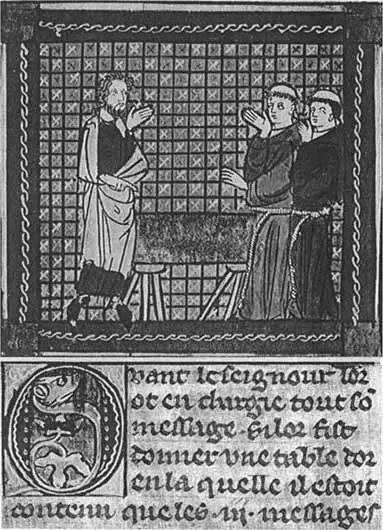
PLATE II
KUBILAI GIVES THE GOLDEN TABLET (PAÏZAH) TO THE BROTHERS POLO
[B.M. Royal Manuscript 19. D. I. fol. 59(b)]
How the Great Kaan gave the two brothers the Golden Tablet of Authority
When the Great Lord had duly instructed the two brothers and his baron as to the message he was sending to the Pope, he caused a golden tablet to be given them, the purport of which was that, wheresoever they went, they were to be furnished with all the necessary quarters, and with horses and men to escort them from one town to another. And when Messer Niccolò and Messer Matteo, together with the other envoy, duly provided themselves with all that was needful to them, they took leave of the Great Lord, and, mounting their horses, set out on their journey. When they had ridden some distance, the Tartar baron who was going with them fell sick, and, being unable to continue the journey, remained behind in a certain city. When Messer Niccolò and Messer Matteo saw that he was ill, they left him, and proceeded on their way. And I assure you that, wherever they went, they were honoured and furnished with all they wished to command. What more shall I tell you? They rode so long, day after day, that they reached Laias. And I tell you that they toiled three years on the way. And this was due to the fact that they could not always ride on account of foul weather or snow or rivers that were big.
How the two brothers reached the city of Acre
They left Laias and went to Acre, reaching it in the month of April, in the year 1269 after Chris’s Incarnation. And they found that the Lord Pope was dead. And when Messer Niccolò and Messer Matteo found that the Pope (Clement by name) was dead, they went to a wise clerk who was Legate of the Church of Rome for the whole kingdom of Egypt. He was a man of great authority and his name was Tebaldo of Piacenza. They told him of the mission upon which the Great Lord of the Tartars had sent them to the Pope. And when the Legate had heard what the two brothers told him, he marvelled greatly, and thought that it was very much to the honour and advantage of Christendom. He said to the two brothers: “Gentlemen, ye see that the Pope is dead; ye must therefore needs wait until there be another. And when there is a Pope, ye shall then be able to execute your mission.” The two brothers, seeing that what the Legate said was right, declared that, while waiting for the election of the Pope, they would proceed to Venice to see their family. So they left Acre and went to Negropont. From Negropont they departed in a ship, and sailed until they reached Venice. Messer Niccolò found that his wife was dead, and had left a son of fifteen years of age, whose name was Marco; and this is the Marco of whom the present book relates. Messer Niccolò and Messer Matteo remained at Venice about two years, waiting until there should be a Pope.
How the two brothers left Venice to return to the Great Kaan, and took with them Marco, the son of Messer Niccolò.
When the two brothers had waited as long as you have heard, seeing that no Pope was being made, they thought they should delay no longer in returning to the Great Kaan. So they departed from Venice, taking with them the boy Marco, and went straight to Acre, where they found the Legate of whom I have told you above. They spoke at length of these matters with him, and asked him leave to go to Jerusalem to fetch some of the oil from the lamp of Christ’s Sepulchre, that the Great Kaan had asked them for, being desirous of having it because his mother was a Christian. The Legate gave them leave to go. So the brothers left Acre and proceeded to Jerusalem, and took of the oil of the lamp of Christ’s Sepulchre. They returned to the Legate at Acre, and said to him: “Sir, as we see that no Pope is being elected, we wish to return to the Great Lord, for we have tarried too long.” And the Lord Legate, who was one of the greatest lords of the Church of Rome, said to them: “Since you wish to return to the Great Lord, I am content.” So he prepared his letters and his message to send to the Great Kaan, witnessing that Messer Niccolò and Messer Matteo had come to perform their commission, but that, as there was no Pope, they had been unable to do so.
How the two brothers and Marco left Acre
When the two brothers had received the Legate’s letters, they departed from Acre and set out on their journey to return to the Great Lord; and they journeyed until they reached Laias. They had hardly arrived there, when that same Legate was elected Pope, assuming the name of Gregory. The two brothers were greatly pleased. And a short time after, a messenger reached Laias, sent by the Legate who had been elected Pope, to Messer Niccolò and Messer Matteo, to tell them, should they not have already left, to return to him. The two brothers were still in that city because at that time the roads along which they were to travel were closed and ravaged by a nephew of the Great Kaan, who had been a Christian, and having fought against the Great Kaan had taken flight. They greatly rejoiced at this message and said they would return willingly. What more shall I tell you? The King of Armenia had a galley armed for the two brothers, and sent them with all due honours to the Legate.
How the two brothers went to the Roman Pontiff
When they had come to Acre, they went to the Lord Pope, and most humbly paid him their respects. The Lord Pope received them honourably, and gave them his blessing, welcoming them with joyful hospitality. Then he caused new letters to be prepared for the Great Lord, in which, among other things, he requested that the Great Lord’s nephew Abaga, namely the Lord of the Tartars of the Levant, might vouchsafe his aid and favour to the Christians, so as to make their passage overseas possible. The Pope further appointed many splendid gifts of crystal and of other substances for the Great Kaan. Then he gave Messer Niccolò and Messer Matteo two preaching friars, the wisest that were to be found in the whole province. The one was called Fra Niccolò of Vicenza, and the other Fra Guglielmo of Tripoli. He endowed the two friars with the necessary authority, that they might do everything in those countries with full powers, ordain priests and consecrate bishops, and bind and unbind even as he himself. He gave them their written credentials and letters, and entrusted them with the message he wished to send to the Great Kaan. And when Messer Niccolò and Messer Matteo and the two preaching friars had received the credentials and letters and the message of the Lord Pope, they asked him to give them his blessing; then all four set out, and with them went Marco, the son of Messer Niccolò. They went straight to Laias. When they had arrived there, Bondocdaire, who was the Soldan of Babylon, came to Armenia with a large host, doing great damage throughout the country. And the messengers ran the risk of being killed. When the two preaching friars saw this, they were greatly afraid to proceed further. So they said that they would not go. They consigned to Messer Niccolò and Messer Matteo all the credentials and letters that they had, and left them, going away with the Master of the Temple.
How the two brothers and Marco reached the city of Kemenfu, where the Great Kaan was
And Messer Niccolò and Messer Matteo, with Marco, the son of Niccolò, set out on their journey, riding so long, winter and summer, that they reached the Court of the Great Kaan, who at that moment was in a large and wealthy city, called Kemenfu. Of what they found on their journey we will make no mention at presen...
Table of contents
- Cover
- Half Title
- Title Page
- Copyright Page
- Original Title Page
- Original Copyright Page
- Illustrations
- Introduction
- The Travels of Marco Polo
- Annotated Index
- Index
Trusted by 375,005 students
Access to over 1.5 million titles for a fair monthly price.
Study more efficiently using our study tools.
Frequently asked questions
Yes, you can cancel anytime from the Subscription tab in your account settings on the Perlego website. Your subscription will stay active until the end of your current billing period. Learn how to cancel your subscription
No, books cannot be downloaded as external files, such as PDFs, for use outside of Perlego. However, you can download books within the Perlego app for offline reading on mobile or tablet. Learn how to download books offline
Perlego offers two plans: Essential and Complete
- Essential is ideal for learners and professionals who enjoy exploring a wide range of subjects. Access the Essential Library with 800,000+ trusted titles and best-sellers across business, personal growth, and the humanities. Includes unlimited reading time and Standard Read Aloud voice.
- Complete: Perfect for advanced learners and researchers needing full, unrestricted access. Unlock 1.5M+ books across hundreds of subjects, including academic and specialized titles. The Complete Plan also includes advanced features like Premium Read Aloud and Research Assistant.
We are an online textbook subscription service, where you can get access to an entire online library for less than the price of a single book per month. With over 1.5 million books across 990+ topics, we’ve got you covered! Learn about our mission
Look out for the read-aloud symbol on your next book to see if you can listen to it. The read-aloud tool reads text aloud for you, highlighting the text as it is being read. You can pause it, speed it up and slow it down. Learn more about Read Aloud
Yes! You can use the Perlego app on both iOS and Android devices to read anytime, anywhere — even offline. Perfect for commutes or when you’re on the go.
Please note we cannot support devices running on iOS 13 and Android 7 or earlier. Learn more about using the app
Please note we cannot support devices running on iOS 13 and Android 7 or earlier. Learn more about using the app
Yes, you can access The Travels of Marco Polo by L. F. Benedetto, Aldo Ricci in PDF and/or ePUB format, as well as other popular books in History & Chinese History. We have over 1.5 million books available in our catalogue for you to explore.