This book is the first to comprehensively analyse the political and societal impacts of new Information and Communication Technologies (ICT) in a region of the Global South. It evaluates under what conditions some Latin American governments and people have succeeded in taking up the opportunities related to the spread of ICTs, while others are confronted with the pessimist scenario of increased, digitally induced social and democratic cleavages.
Specifically, the book examines if and how far the spread and use of new ICT affected central aims of democratic governance such as reducing socio-economic and gender inequality; strengthening citizen participation in political decision making; increasing the transparency of legislative processes; improving administrative processes; providing free access to government data and information; and expanding independent spaces of citizen communication. The country case and cross-country explore a range of bottom-up driven initiatives to reinforce democracy in the region.
The book offers researchers and students an interdisciplinary approach to these issues by linking it to established theories of media and politics, political communication, political participation, and governance. Giving voice to researchers native to the region and with direct experience of the region, it uniquely brings together contributions from political scientists, researchers in communication studies and area studies specialists who have a solid record in political activism and international development co-operation.
1 Digital trends in Latin American politics (1990–2012)
Anita Breuer
Yanina Welp
DOI: 10.4324/9780203361986-1
Since the Internet became available to the general public in the 1990s, scholars have discussed how it would work to transform human society. Within the social sciences, the most vividly debated questions concerned how the new information and communication technologies (ICTs) would affect political processes and outcomes, as well as social stratification. While the so-called ‘cyber-optimists’ enthusiastically point to the potentials of ICTs to act as enablers of human development and democratic governance, most scholars remain skeptical regarding deterministic assumptions about the positive relationship between digital technologies and inclusive social and democratic growth. At the other end of the opinion spectrum, ‘cyber-pessimists’ envisage the risk of deepening social and democratic cleavages – both within nations as well as between nations – entailed by the ongoing diffusion of the Internet and its services.
In 1999, the OECD expressed concern that while developed industrialized countries at the cutting edge of technology had reinforced their lead in the new information age, the benefits of the Internet had not yet trickled down to the poorer developing nations, thus clearly placing the Global South on the losers’ side of the global digital divide (OECD 1999). This volume aims to reassess this judgment by focusing on recent developments in the field of ICT and democratic governance in Latin America.
ICTs, democracy, and social inclusion: theory, evidence, and the Latin American experience
The effects of ICT diffusion on national-level democratic growth
Beginning with the creation, public availability, and ensuing expansion of the Internet, scholars have taken great interest in the question of whether or not it would act as a driving force in the worldwide diffusion and consolidation of democracy. Yet, to date, only a few studies have approached this question with cross-national, quantitative data-based analysis and the results are not overwhelmingly encouraging.
By means of statistical studies of a data set containing records from 188 nations between 1992 and 2002, Best and Wade (2009) find that although Internet penetration accounts for more variation in levels of democratic development within countries than literacy rates, overall the Internet is not able to explain significant variation in democracy scores during that period. They suggest that while Internet-enabled increases in government transparency and NGO efficacy were responsible for much of the Internet’s statistical success in countries that were at least partially developed and democratic, in less developed and non-democratic countries such positive effects may be hampered by governments which purposefully limit public access to the Internet, state and self-censorship, and poor ICT infrastructure. Using panel data from 152 countries between 1994 and 2003, Groshek (2009) arrives at a similar conclusion. According to his findings, any effects Internet diffusion may have on democracy are likely to eventually plateau. Furthermore, he too finds Internet diffusion to be associated with those countries becoming more democratic that had already reached a minimum level of democracy, while the democratizing effect of the Internet was severely limited among non-democratic countries. A criticism leveled against both these studies is that they operate with data sets that predate important ICT innovations such as Web 2.0 features and social media platforms. This critique is especially germane given that social media platforms, such as YouTube, Facebook, and Twitter, were only launched in the mid-2000s but are nowadays frequently used for political and civic activism.
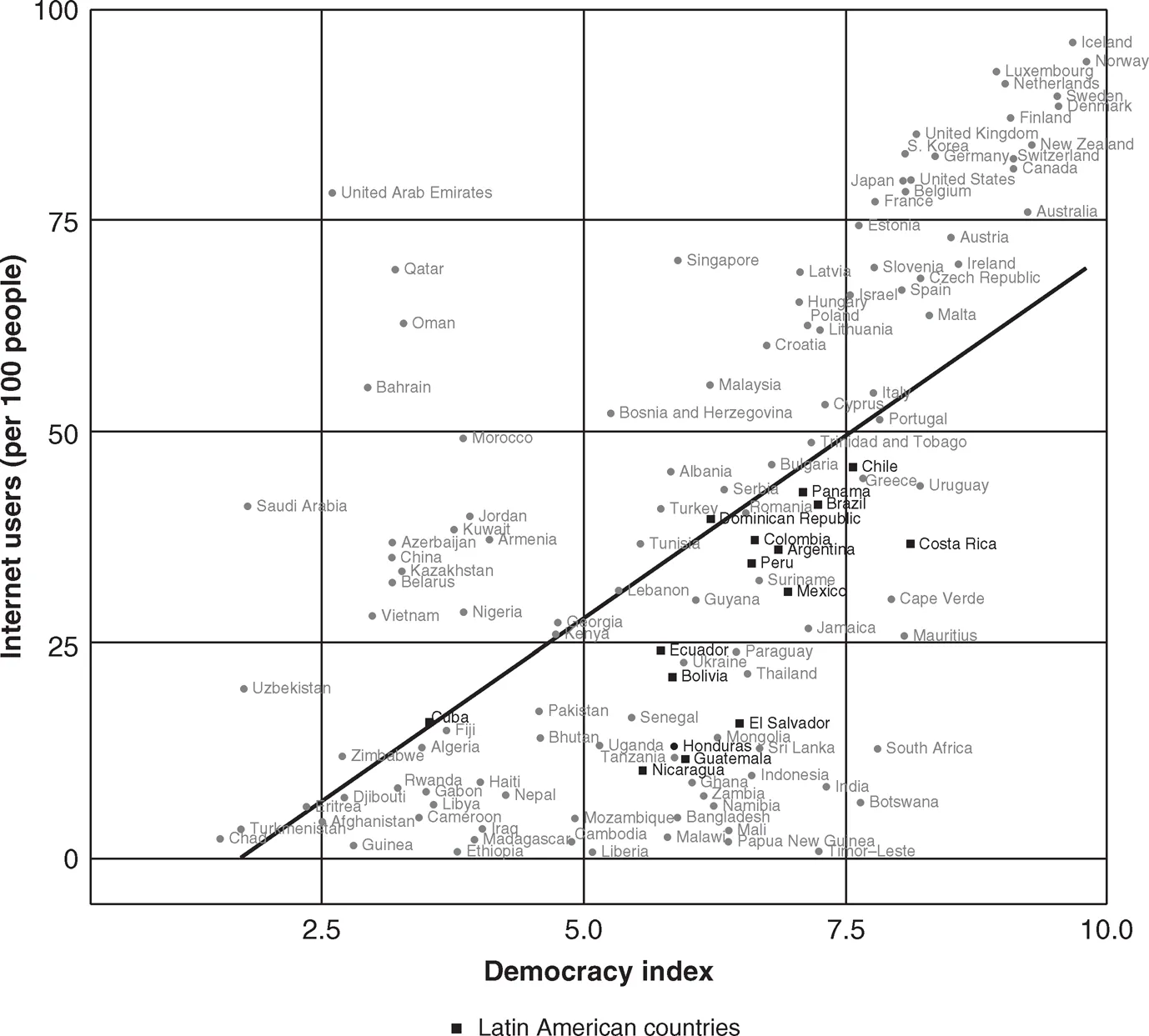
While the ability of the Internet to act as a catalyst of national level democratic growth remains to be proven, empirical evidence suggests an inverse dynamic of democracy as a determinant of Internet access. Based on 2010 World Bank data, Rhodes (2012) demonstrates that 41 percent of a country’s Internet penetration rate can be explained by its level of democracy.
The suggested interpretation of this relationship is straightforward: authoritarian governments typically resort to a mix of censorship, intimidation, and persecution to suppress negative information about the government or conditions within the country. Since the Internet provides a space for increased free speech and hence poses an existential threat to the ability of authoritarian governments to control the national narrative, authoritarian governments have an interest to keep technologies like the Internet repressed and/or filtered. Democratic governments, in turn, should be willing to invest in the creation of the infrastructural conditions which are necessary for the successful implementation of free access to information for a country’s citizenries.
However, as can be seen from Figure 1.1, this logic apparently does not apply to Latin America, as most of the region’s countries fall below the general trend line – their Internet penetration rate is lower than should be expected from their score on the democracy index.
Figure1.1 Global Internet penetration of countries in the world by democracy index, 2010
Source: Based on http://rhodestales.com
In fact, rates for Internet penetration and broadband subscription in Latin America and the Caribbean are significantly below the developed world’s figures. While the number of Internet and broadband subscribers in the developed countries are respectively 24 and 19 per 100 individuals, in Latin America and the Caribbean both these indicators are below 12 per 100 individuals (Balboni et al. 2011). Rhodes (2012) offers late adoption in Internet technology and a related delay in harvesting technology gains as one possible explanation. Another conceivable factor to explain the mismatch between democratic consolidation and Internet penetration at the macro level of nation states is the continued high concentration of some of the Latin American telecommunications markets (e.g. Mexico and Argentina) where lack of competition has resulted in delayed infrastructure development and high access prices (see, for example, Chapter 3 in this volume by Barry).
The effects of ICT use on individual democratic participation
At the micro level of individual behavior, studies on the impact of ICT use on political participation have produced somewhat sobering results. A meta-analysis of 38 studies spanning the period from 1995 to 2005 by Boulianne (2009) confirms a positive but very modest impact of ICT use on civic engagement. Furthermore, these small positive effects appear to be positively moderated by factors that have long been established as standard predictors of political participation such as social capital and political interest.
According to Bimber et al. (2008), digital media use in general does not necessarily result in higher levels of participation but supplements the strategic action repertoire of those who already are interested in politics. As for the politically apathetic, there is little evidence that the use of digital media will make them more likely to participate in politics. At best, it appears, they will become more engaged in political activities that are exclusively Internet based. As a general trend, micro-level studies so far appear to confirm the concern that rather than producing an overall increase in democratic participation rates, ICT diffusion will contribute to deepening the democratic divide between those who dispose of the skills and resources necessary for political engagement and those who do not.
However, recent research conducted by Chadwick (2012) suggests that a simplistic bipolar concept that contrasts the Internet as a tool to mobilize the participation of political apathetic individuals on the one hand, and a tool to reinforce the participation of already politically engaged and knowledgeable individuals on the other hand, is no longer adequate. According to this author, in the light of the diversity of digital architectures and the different uses to which they are put, whether or not mobilization or reinforcement of political participation are occurring can no longer be exclusively explained by socio-demographic characteristics of Internet users. It will also depend on the specific types of participation.
Anduiza et al. (2012) discuss the implications of digital medi...
Table of contents
Cover Page
Half Title Page
Series Page
Title Page
Copyright Page
Table of Contents
List of figures
List of tables
Notes on contributors
Acknowledgements
1 Digital trends in Latin American politics (1990–2012)—ANITA BREUER AND YANINA WELP
2 A Latin Spring? Examining digital diffusion and youth bulges in modeling political change in Latin America—JACOB GROSHEK AND INGRID BACHMANN
3 A digital sublime or divide? The impact of information communication technology on the poor in Latin America—JACK BARRY
4 Designing open data policies in Latin America—SILVANA FUMEGA AND FABRIZIO SCROLLINI
5 Some notes on the experiences of using technology and electronic voting in Latin America—JOSÉ THOMPSON
6 South American politics in the information age: a study of political parties and MPs on the net in Argentina, Paraguay and Uruguay—YANINA WELP AND ALEJANDRA MARZUCA
7 Crafting a new parliamentary dialogue sphere? The Web and political communication in the current Venezuelan National Assembly—XAVIER RODRÍGUEZ FRANCO
8 Social movements, democratic participation and ICTs—SALLY BURCH AND OSVALDO LEÓN
9 Social change and social media: incorporating social networking sites into activism in Latin America—SUMMER HARLOW
10 Slacktivism or efficiency-increased activism? Online political participation and the Brazilian Ficha Limpa anti-corruption campaign—ANITA BREUER AND JACOB GROSHEK
11 Social media and diaspora activism: participating in the Argentine elections 2011 from abroad—DENISE SENMARTIN
12 Claiming citizenship: Web-based voice and digital media in socialist Cuba—BERT HOFFMANN
13 Re-assessing ICTs for democratic governance in Latin America—YANINA WELP AND ANITA BREUER
Index
Trusted by 375,005 students
Access to over 1.5 million titles for a fair monthly price.
Study more efficiently using our study tools.
Frequently asked questions
Yes, you can cancel anytime from the Subscription tab in your account settings on the Perlego website. Your subscription will stay active until the end of your current billing period. Learn how to cancel your subscription
No, books cannot be downloaded as external files, such as PDFs, for use outside of Perlego. However, you can download books within the Perlego app for offline reading on mobile or tablet. Learn how to download books offline
We are an online textbook subscription service, where you can get access to an entire online library for less than the price of a single book per month. With over 1.5 million books across 990+ topics, we’ve got you covered! Learn about our mission
Look out for the read-aloud symbol on your next book to see if you can listen to it. The read-aloud tool reads text aloud for you, highlighting the text as it is being read. You can pause it, speed it up and slow it down. Learn more about Read Aloud
Yes! You can use the Perlego app on both iOS and Android devices to read anytime, anywhere — even offline. Perfect for commutes or when you’re on the go. Please note we cannot support devices running on iOS 13 and Android 7 or earlier. Learn more about using the app
Yes, you can access Digital Technologies for Democratic Governance in Latin America by Anita Breuer, Yanina Welp, Anita Breuer,Yanina Welp in PDF and/or ePUB format, as well as other popular books in Economics & Development Economics. We have over 1.5 million books available in our catalogue for you to explore.