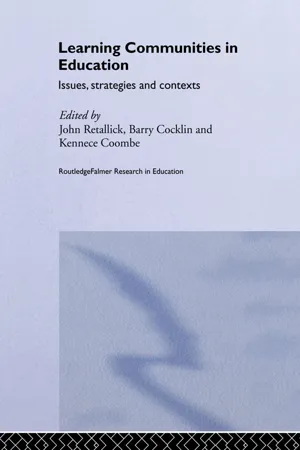
Learning Communities in Education explores the theory and practice of learning communities from an international perspective. Covering primary/elementary, secondary and tertiary levels in a variety of educational contexts, leading researchers discuss:
* theoretical issues and debate
* processes and strategies for creating learning communities
* learning communities in action
The current experience of the learning community is examined with reference to case studies from England, Ireland, Canada, the USA and Australia. With comprehensive coverage of this much-debated topic and a careful balance between theoretical analysis and case-study material, Learning Communities in Education will be a valuable addition to the literature in this field.
- 312 pages
- English
- ePUB (mobile friendly)
- Available on iOS & Android
eBook - ePub
Learning Communities in Education
About this book
Information
Part I
LEARNING COMMUNITIES
LEARNING COMMUNITIES
Issues and debate
1
THE STORY OF COMMUNITY
THE STORY OF COMMUNITY
Thomas Sergiovanni
Stories tell us about events, what these events mean and how these events affect our lives. Different stories lead to different values, beliefs and decisions about what is real and what is possible. What is the story of community? How does this story differ from other stories about schools? What narratives does the story of community encompass? What stories compete with community for the attention of policy makers and administrators in education?
The story of community includes unique ways of thinking about connections, human nature and societal institutions. In schools that are traditionally organised, for example, connections are understood using the narrative of social contracts; human nature is understood using the constrained narrative; and schools themselves are understood using the narrative of formal organisations. In schools that are striving to become learning communities connections are understood using the narrative of social covenants; human nature is understood using the unconstrained narrative; and schools themselves are understood using the narrative of social organisations.
SOCIAL CONTRACTS
The major story line in the narrative of social contracts involves a deal within which each of the parties to the contract gives up something to the other party in order to get something else back that is valued. In this narrative, teachers, like workers in other sectors of our economy, hand over to their employers time, muscle and brain in order to obtain money, health benefits, psychological fulfilment and security. Similarly, children endure the rituals of schooling in order to get the gold stars and praise they covet from teachers; the attention they want from parents; and the grades they need to be admitted to college. A social contract is maintained as long as each of the parties gets what it wants. When teachers, for example, no longer receive the contracted amount of money, health benefits, fulfilment and security, they are less willing to hand over to the school time, muscle and brains. And when students no longer get the gold stars, attention and grades they want, they are less willing to endure the rituals of schooling. This narrative is about calculations involving trades that offer incentives in exchange for compliance. Self-interest is presumed to be paramount and let’s make a deal is the order of the day.
The narrative of social contracts guides the practice of the principal of the Locke Elementary School. He promised the student body that if 2,000 books were read during the month of October, on Halloween night he would dress up like a witch and kiss a pig on the roof of the school building. This goal was achieved and, to the apparent delight of the students, the deed was done. The Locke principal believes that contracts are important motivational devices and that unless students get something tangible for their efforts they will not be motivated. You can’t expect a manager to manage well, a worker to be diligent or a football player to play hard unless there is something in it for them. So, he asks, how can we expect teachers to teach well, students to learn well and schools to reform themselves without incentives? How can we expect them to display proper behaviours without providing exhaustive lists of rules and regulations or outcome requirements that are linked to clear consequences for non-compliance?
SOCIAL COVENANTS
The major story line in the narrative of social covenants is much less conditional. In this narrative, connections are covenantal and thus are more moral than calculated. Marriages, extended families, civic associations, faith communities, caring groups and friendship networks are examples of affiliations characterised by covenantal relationships. Connections among people are created when they are together connected to shared ideas and values. Once achieved, this bonding together of people and this binding of people to ideas forms a fabric of reciprocal roles, duties and obligations that are internalised by members of the group. This is a fabric that cannot be torn apart when one or another party no longer likes the deal. This is a fabric that perseveres even when the fun is gone, when needs are not being met or when self-interests must be sacrificed.
The narrative of social covenants guides the practice of the principal of the Rousseau Elementary School. She encourages teachers and students together to develop a description of how everyone in the school should lead their lives together. Connected to a larger vision of school purposes, critical values and pedagogical beliefs, this ‘covenant’ provides the basis for an ongoing discussion about how teachers, administrators, parents and students can meet their commitments to each other and to the school. Students at Rousseau, for example, expect teachers to work hard, to be caring, and to teach well. Since relationships are reciprocal, teachers expect students to respond similarly. Students are given considerable latitude in deciding important things at Rousseau. They help decide how learning goals will be achieved and help make decisions about how they will spend their time. But decisions must be responsible ones that embody and advance the school’s covenant. Both teachers and students work hard to make reading fun and useful while also increasing mastery. Rousseau’s students are avid readers as a result.
The Rousseau principal believes that when given the opportunity to make important decisions about school goals, purposes, values and other important school matters, teachers and students will respond by being morally obliged to embody these decisions in their actions. Further, the bonding of school members together and their binding to shared ideas and ideals provides a normative environment that encourages moral responsiveness. Social contracts, she reasons, have important roles to play in the real world. But so do social covenants. The school is the place, she argues, to learn about social covenants, to practise developing them, and to use them in a practical way to govern affairs.
In comparing the two narratives, Sacks (1997) argues that a social contract is maintained by the promise of gain or the threat of external force. A social covenant is maintained by loyalty, fidelity, kinship, sense of identity, obligation, duty, responsibility, and reciprocity. A social contract, he points out, ‘gives rise to the instrumentalities of the state’ both corporate and political. ‘A covenant gives rise to quite different institutions — families, communities, traditional and voluntary associations. It is the basis of civil society’ (Sacks 1997: 16). Social contracts are at the core of what connects people in Gesellschaft enterprises and social covenants are at the core of what connects people in Gemeinschaft enterprises (Tonnies 1957). The former are rules-based and the latter are norms-based (Sergiovanni 1994a).
THE NATURE OF HUMAN NATURE
Related to the social contract and social covenant narratives are two narratives about the nature of human capacity and will — constrained and unconstrained (Herzberg 1966; Sowell 1987; Etzioni 1988). The constrained narrative is aligned with the selfish side of human nature rooted in the satisfaction of physical needs and psychological egoism. The unconstrained narrative is aligned to the altruistic side of human nature rooted in moral conceptions of goodness. The altruistic side includes our capacity to practise such virtues as moral bearing, self-sacrifice and cooperation aimed at the enhancement of the common good. The selfish side includes our propensity to put self-interest first, to compete to win, and to strive to accumulate advantages such as wealth and power aimed at enhancing our individual pleasure and position.
The major story line in the constrained narrative emphasises controlling the impulses of self-interest thought by Hobbes (1950) and others to dominate human nature. According to this narrative, people are inclined to be self-centred, competitive, devious, addicted to gratification and even unscrupulous as they seek to maximise their own gains with little regard for the common good. Thus, the constrained story avers, principals, teachers and students must be ‘constrained’ if they are to overcome these brutish impulses and instincts. Without constraints they will not be inclined to do the right thing. Society therefore must use rewards and punishments to provide the necessary constraints that will channel human behaviour in the right direction — be it paying taxes, communing with God, providing leadership, preparing lessons, being collegial, or studying and behaving at school.
The major story line in the unconstrained narrative emphasises the capacity of people to embody such virtues as altruism, moral bearing, and cooperation aimed at enhancing the common good, even if doing so occasionally requires sacrificing one’s self-interest. Instead of viewing people as being cost-benefit machines who make individual choices rationally in an effort to win, the unconstrained narrative includes the emotive, normative and altruistic side of people. Motivation, in this story, is a result of the complex interaction not only between our emotions, values and beliefs, but between these and our ties to others (Etzioni 1988). Connections, in the unconstrained narrative, are normatively derived and have moral overtones (Sergiovanni 1992).
Policy-makers who subscribe to the unconstrained narrative believe that principals and teachers can be trusted to act morally, and therefore should be provided with the freedom to optimise their moral propensity to do what is right. Principals and teachers, for example, have both the capacity and the need to sacrifice their self-interest for causes they believe in and for conceptions of the common good that they value. As professionals, they willingly accept responsibility for their own practice and they commit themselves to the learning needs of their students above other concerns. A similar tale is told for students.
Within the constrained narrative, by contrast, it is believed that principals and teachers will act selfishly if given the chance. Their primary concern is to maximise their self-interest. Thus constraints in the form of incentives and penalties must be provided to force them to do the right thing. Principals and teachers may have the capacity to do the right thing, this narrative concedes, but this capacity will only be motivated if constraints are provided. A similar tale is told for students.
Though some may view the two narratives as being mutually exclusive, in most people they coexist in reasonable balance. The selfish side of human nature described by Hobbes (1950) provides the constrained narrative with its plot — a plot that can help us when navigating through many aspects of our lives. Similarly, the altruistic side of human nature provides the unconstrained narrative with its plot — a plot that can help us when navigating other aspects of our lives. The selfish side, for example, dominates when we are buying a used car, negotiating a pay rise, shopping for jeans, or playing the stock market. The altruistic side dominates in our family relationships, in our spiritual lives and in our interactions with friends and neighbours.
The principal of the Rousseau school recognises this duality. Further, she believes that the school is a setting for evoking the altruistic side of human nature. Thus, she is strongly influenced by the unconstrained narrative. The principal of the Locke school, by contrast, either does not recognise this duality or feels that the school is not a compatible setting for evoking the altruistic side of human nature. Thus, he is strongly influenced by the constrained narrative.
FORMAL AND SOCIAL ORGANISATIONS
Cutting across the narratives about connections and human nature are two narratives about societies’ institutions — formal organisation and social organisation (Sergiovanni 1994b). Formal organisations are the institutions of political and economic society. Most of us were born in formal organisations and now work in them. We use formal organisations to obtain health care, to invest in and protect our economic future, to provide protection from fire, war and other calamities, to obtain needed government services, and otherwise to enhance our material well-being. Formal organisations include IBM, the Xerox Corporation, Qantas Airlines, Harrods Department store, McDonald’s Restaurant, the New York Yankees, the Royal Marines, Bell Research Laboratory, and hundreds of other valued enterprises. Social organisations, on the other hand, are the institutions of civil society. They include the families we love, friendship networks we enjoy, volunteer associations we value, faith communities we belong to, and other family, neighbourhood and community groups where moral connections characterised by intimacy, caring, shared commitments and reciprocal responsibilities are the norm.
Differentiating among organisational types has a long history. Peter Blau and W. Richard Scott made an important distinction between social organisations and formal organisations in their seminal work Formal Organisations: A Comparative Approach (19...
Table of contents
- Cover Page
- Half Title page
- Series page
- Title Page
- Copyright Page
- Contents
- Contributors
- Introduction
- Part 1 Learning Communities Issues and debate
- Part 2 Learning Communities Strategies and processes
- Part 3 Case Studies of Learning Communities
- Name Index
- Subject Index
Trusted by 375,005 students
Access to over 1.5 million titles for a fair monthly price.
Study more efficiently using our study tools.
Frequently asked questions
Yes, you can cancel anytime from the Subscription tab in your account settings on the Perlego website. Your subscription will stay active until the end of your current billing period. Learn how to cancel your subscription
No, books cannot be downloaded as external files, such as PDFs, for use outside of Perlego. However, you can download books within the Perlego app for offline reading on mobile or tablet. Learn how to download books offline
We are an online textbook subscription service, where you can get access to an entire online library for less than the price of a single book per month. With over 1.5 million books across 990+ topics, we’ve got you covered! Learn about our mission
Look out for the read-aloud symbol on your next book to see if you can listen to it. The read-aloud tool reads text aloud for you, highlighting the text as it is being read. You can pause it, speed it up and slow it down. Learn more about Read Aloud
Yes! You can use the Perlego app on both iOS and Android devices to read anytime, anywhere — even offline. Perfect for commutes or when you’re on the go.
Please note we cannot support devices running on iOS 13 and Android 7 or earlier. Learn more about using the app
Please note we cannot support devices running on iOS 13 and Android 7 or earlier. Learn more about using the app
Yes, you can access Learning Communities in Education by Barry Cocklin,Kennece Coombe,John Retallick in PDF and/or ePUB format, as well as other popular books in Education & Education General. We have over 1.5 million books available in our catalogue for you to explore.