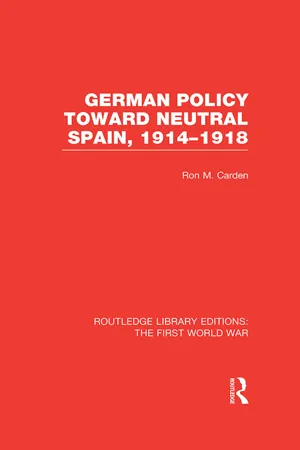
This volume describes and analyses the methods Germany used to reinforce Spain's independence thereby preventing Madrid's entry into the war on the Allied side. While there have been many studies dealing with the wartime economic histories of Holland, Switzerland, Denmark and Iceland, Spain, physically large and strategically situated has been largely ignored, with little American study of Spanish relations with the European belligerents having been done. Particular attention is paid to the forceful personality of Spanish King Alfonso XIII, who shrewdly used his special friendship with Kaiser Wilhelm II for Spanish profit: he remained a Francophile who shrewdly manipulated the Germans into thinking he favoured their side. At the same time Alfonso fended off the embrace of the Entente.
- 312 pages
- English
- ePUB (mobile friendly)
- Available on iOS & Android
eBook - ePub
German Policy Toward Neutral Spain, 1914-1918 (RLE The First World War)
Chapter I
Spain and the International Scene to 1902 and Leading Personalities
Initially, Germany was not in a position geographically or diplomatically to draw Spain into the maelstrom, though a number of diverse factors accounted for continued Spanish neutrality, a policy that would be of enormous value to Berlin. First, Spaniards had long memories and harbored hatreds and resentments toward the leading powers of the Entente, France and Great Britain. Second, Spain had evolved a domestic political structure which, by 1914, had become quite tenuous, and participation in the war could destroy the monarchy and conservative ruling classes. Divisions among those who supported the contending sides in the war reflected internal political cleavages, consequently interconnecting domestic and foreign relations. Third, the Germans were able to counter Allied economic and political influence by means of a very active diplomatic and business community which exploited all factors contributing to Spanish neutrality.
Spanish differences with England stemmed from sixteenth century quarrels over religion and economics. Spain and England became mortal enemies due to violent confrontations arising from religious differences during the Reformation, attacks upon Spanish treasure ships from America, and the defeat of the Spanish Armada in 1588. English attempts to breach Spanish colonial trade regulations had resulted in a series of wars during which Spain lost Gibraltar in 1702. Throughout the remainder of the eighteenth century the two were enemies, though they cooperated after 1808 to drive the French from the Iberian peninsula. But after the Napoleonic Wars, England encouraged the colonies of Spain to separate from the mother country, and by the late nineteenth century, Great Britain, occupied by troubles in South Africa, sat by and watched as the United States defeated Spain. The U.S. took the remnants of the worldwide Spanish Empire at the Peace of Paris in 1898. By the early twentieth century, the British cooperated with France in restricting Spanish possessions in North Africa, thereby intensifying popular hatred for the policies of Whitehall.1
Spanish popular dislike of France was possibly keener than that for Great Britain. Memories of the French invasion of 1808 yet lingered, and the brutal slaughter of Spaniards continued to color Madrid’s view of Paris. Among the religious, French rationalism and anticlericalism were anathema, particularly after 1905, when France expelled Catholic religious orders. Furthermore, the republican structure of the French government seemed to be a threat to the monarchy of Spain. Finally, French attempts to expand into North Africa, an area that Spain had long thought to be her own domain, further exacerbated relations.2
For Spanish public opinion the Entente, therefore, represented hateful images of the past and stirred up fears for the future. Great Britain and France together and separately had stripped Spain of her power and influence, attacked her and threatened to strangle future colonial development. Despite this enmity, Spain had to recognize her unique geographical position and had to deal diplomatically and economically with England and France. When, however, the opportunity arose, Madrid balanced the influence of her powerful neighbors by cooperation with Germany.3 The Germans, of course, encouraged these inroads into British and French control over western Europe.
Spanish domestic developments up to the eve of the war also created a situation that Germany could exploit. Since the Restoration of the monarchy in 1875, Spain had developed only the forms of parliamentary democracy, not the substance. By 1885, Conservatives and Liberals agreed to alternate control of the country. The architect of the system, Antonio Cánovas del Castillo, a conservative and admirer of Germany, convinced that Spain had not sufficiently developed its economy or class structure to avoid chaos in a true democratic system, manipulated elections to create support for a Liberal or Conservative ministry. Through the device of local chieftains or caciques who were dependent upon the central government for financial support, Cánovas and his Liberal Party counterpart, Mateo Práxedes Sagasta, dictated election results in advance.4 Spain was also a constitutional monarchy, and the ministers of the government governed in cooperation with the King. The system worked well under Habsburg Queen and Regent María Cristina, who scrupulously observed all constitutional requirements. Domestic troubles were, therefore, at a minimum in the late nineteenth century.
In foreign affairs from 1880 through 1891, Spain followed a pro-German policy. The Restoration monarch Alfonso XII on a visit to Berlin in October 1883 offered Spanish support for Germany should a Franco-German war occur. Kaiser William I told the Spanish King, however, that the latter was a bit young and brash and that he ought to think over his offer. The Emperor told the Spanish monarch that Germany would be quite satisfied with benevolent neutrality.5 In later years, nevertheless, Spain went further; in May 1887 Spain, under the leadership of a pro-German foreign minister, Vega de Armijo, entered the Triple Alliance indirectly through an agreement with Italy. In the event of a Franco-German conflict, Spain promised to assist the Central Powers by placing five thousand men on the Pyrenees border with France, thereby immobilizing three corps of the French army.6 In return for her service, Spain was to receive assistance in North Africa, particularly coaling stations for commerce with her far eastern possessions.7 But the Italians never supplied the required stations, and when the proposal came up for renewal in 1891, the Spanish turned it down.8 In the meantime, Alfonso XII died, and Spain became friendlier with France when Paris demonstrated support and sympathy for Madrid during the Spanish-American War of 1898.
Meanwhile, in domestic affairs from 1885 through 1902, Cánovas and Sagasta were successful in keeping disturbances to a minimum, but the system of alternating Liberal with Conservative governments began to fragment when María Cristina’s son, Alfonso XIII, came of age in 1902.9 It was this fragmentation that eventually created a political vacuum from which emerged government by personalities. Certain of the personalities involved were susceptible to German influence, thereby aiding Germany in preventing Spain from joining the Entente during the war.
The personality of Alfonso XIII and his determination to rule Spain independently of party leaders partly accounted for Spanish domestic instability from 1902 through 1918. From his early childhood the monarch revealed his love for things military. He regularly played with eight boys dressed in uniforms, and he and his playmates conducted mock battles and drills. In later life Alfonso preferred military uniforms for his daily attire.10 In a council meeting held just after his installation ceremony, the young King demanded the reopening of military colleges recently closed for economic reasons.11 Infatuation with the military and supreme self-confidence were the major characteristics of Alfonso XIII, and in the process of asserting his own authority, the King uncovered for all to see the insubstantial nature of the Spanish political structure which was parliamentary in name only.
More effective leadership from the King would have eased Spain into the twentieth century without the extensive domestic turmoil that arose from incipient industrialization. The monarch apparently had no specific ideology other than the preservation of his crown through an alliance with the army. Contemporaries described him as gay and quite convivial but devoid of serious political thought.12 This unflattering portrait is modified, however, by the German documents. As a diplomat, Alfonso was fully aware of the dangers to Spain were she to be drawn into the European conflict. The Spanish monarch’s determination to play a major role in the diplomatic sphere is revealed in an entry in his diary dated immediately after his installation as King:
I can be a King who will be filled with the glory of having regenerated his country, whose name will pass on in history as an imperishable memento of his reign, but likewise I can be a King who does not govern but is governed by his ministers.…I hope to rule Spain as a just King. I hope at the same time to revive my country and make her, if not powerful, at least sought for as an ally.13
The desires to rule Spain personally and to make the Spanish voice heard in the international constellation of powers remained the young monarch’s goals throughout the war.
Both domestic and foreign observers commented upon the extraordinary interest Alfonso exhibited in foreign affairs. The Prime Minister for the greatest length of time during the war, Liberal leader Alvaro de Figueroa, the Count of Romanones, emphasized the breadth and depth of knowledge about foreign affairs possessed by Alfonso.14 Albert Pingaud, a French historian who had access to the French Foreign Ministry Archives, constantly referred to Alfonso as the preponderant Spanish voice in foreign affairs from 1902 through the war.15 Clearly, in Spanish relations with other countries, King Alfonso XIII determined the major lines of Madrid’s policies.
Meanwhile, in domestic affairs, Cánovas died at the hands of an assassin in 1897, and Sagasta succumbed to natural causes in 1903. Succeeding ministries attempted to introduce genuine parliamentary democracy but failed to go far enough to suit all segments of Spanish political opinion. Particularly, Antonio Maura, a leader of the Conservative Party, sought to purify the corrupt practices of the Cánovas system, but the Liberal opposition regarded his reforms with deep distrust. The awakening industrial masses joined with certain segments of the Liberal Party to oppose Maura. Neither Cánovas nor Maura took significant notice of the emergence of the class of industrial workers in Spain’s cities. The result of such neglect was violence. In July 1909 Maura’s policies provoked a general uprising in Barcelona during the “tragic week.” Antonio Maura resigned his post and the King appointed a member of the Liberal Party as the Prime Minister. Subsequently, a rift developed between the King and the kind of leadership that Maura offered. After 1909 there was no clear leader for the Conservative Party. Maura thereafter rejected participation in the political system.16
During the war, Maura appeared ambivalent toward the Germans. He seemed pro-German and then would waver and speak out in a pro-Entente sense. After new elections and severe domestic disturbances, he reentered the political field in March 1918, when he accepted the post of Prime Minister again in a national government. Maura became, then, a major political personality for Germany to support, despite his occassional ambiguity in international affairs. His conservative outlook seemed to be in accord with German monarchial conservatism, but while there was some superficial similarity between his philosophy and that of the German Foreign Office, Maura merely wanted to keep Spain out of the war; he had no desire to advance any of the goals of the Wilhelmstrasse, a lesson that Berlin learned in the summ...
Table of contents
- Cover
- Half Title
- Title Page
- Copyright Page
- Original Title Page
- Original Copyright Page
- Table of Contents
- Introduction
- Chapter I. Spain and the International Scene to 1902 and Leading Personalities
- Chapter II. Spain and International Politics 1902-1914
- Chapter III. The Press and Politics 1912-1916
- Chapter IV. A German Alliance and German Sabotage 1914-1915
- Chapter V. German Concessions to Spain December 1915-September 1916
- Chapter VI. German-Spanish Tension September 1916-April 1917
- Chapter VII. Domestic Disturbance and the Submarine Problem May 1917-March 1918
- Chapter VIII. Ship Transfer Negotiations April-November 1916
- Conclusion
- Selected Bibliography
Trusted by 375,005 students
Access to over 1.5 million titles for a fair monthly price.
Study more efficiently using our study tools.
Frequently asked questions
Yes, you can cancel anytime from the Subscription tab in your account settings on the Perlego website. Your subscription will stay active until the end of your current billing period. Learn how to cancel your subscription
No, books cannot be downloaded as external files, such as PDFs, for use outside of Perlego. However, you can download books within the Perlego app for offline reading on mobile or tablet. Learn how to download books offline
We are an online textbook subscription service, where you can get access to an entire online library for less than the price of a single book per month. With over 1.5 million books across 990+ topics, we’ve got you covered! Learn about our mission
Look out for the read-aloud symbol on your next book to see if you can listen to it. The read-aloud tool reads text aloud for you, highlighting the text as it is being read. You can pause it, speed it up and slow it down. Learn more about Read Aloud
Yes! You can use the Perlego app on both iOS and Android devices to read anytime, anywhere — even offline. Perfect for commutes or when you’re on the go.
Please note we cannot support devices running on iOS 13 and Android 7 or earlier. Learn more about using the app
Please note we cannot support devices running on iOS 13 and Android 7 or earlier. Learn more about using the app
Yes, you can access German Policy Toward Neutral Spain, 1914-1918 (RLE The First World War) by Ron Carden in PDF and/or ePUB format, as well as other popular books in History & 20th Century History. We have over 1.5 million books available in our catalogue for you to explore.