![]()
Introduction
M. Paz Galupo
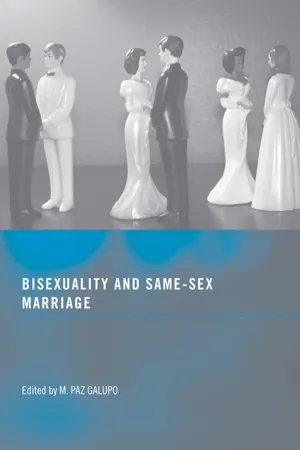
In all of the public and academic debate about same-sex marriage and marriage equality, bisexuality has been invisible or marginalized at best, and demonized at worst. This volume was conceptualized as a way to allow for thoughtful and deliberate discourse on bisexuality and bisexual experience as it informs, and is informed by, the same-sex marriage debate. The resulting interdisciplinary volume includes scholars from diverse fields representing American Studies, Communication, Criminology, Human and Organizational Systems, Law and Social Policy, LGBT Studies, Organizational Behavior, Psychology, Sociology, Women’s Studies, and Queer Studies. Contributing authors approach the topic of bisexuality and same-sex marriage from three distinct perspectives (theoretical perspectives, research perspectives, and personal perspectives). This volume, then, is organized into three corresponding sections that frame the debate from a macro to micro level of analysis.
THEORETICAL PERSPECTIVES: FRAMING BISEXUALITY IN THE SAME-SEX DEBATE
Although different in scope, the three articles that comprise this section frame bisexuality in the same-sex marriage debate within a given theoretical context. Taken together these works reveal the ways in which existing frameworks are constrained by dichotomized notions of sex, gender, and sexual orientation and how the discourse and language shift within the same-sex marriage debate when bisexual existence and experience is acknowledged.
In “Supremacy by Law: The One Man One Woman Marriage Requirement and Antimiscengenation Law,” Jacqueline Batterlora analyzes the legal arguments against same-sex marriage (Defense of Marriage Act and Federal Marriage Amendment) in the context of antimiscengenation law. Interestingly, Battalora considers the ways in which the conceptualization of bisexuality parallels multiracial (part-White) identities in legal definitions and restrictions of marriage.
Danielle Antoinette Hidalgo, Kristen Barber, and Erica Hunter in “The Dyadic Imaginary: Troubling the Perception of Love as Dyadic,” deconstruct the dyadic assumptions used in social science research regarding definitions of love, intimacy, sexuality and kinship. Their analysis reveals the ways in the same-sex marriage debate fails these dyadic assumptions and continues to reinforce dichotomized notions of sex, gender, and sexual orientation.
Ajnesh Prasad in “On the Potential and Perils of Same-Sex Marriage: A Perspective from Queer Theory,” considers arguments for and against same-sex marriage. Central to Prasad’s consideration of same-sex marriage is the analysis of sexuality as it is understood from a queer theory perspective. Prasad offers a discussion of the ways in which queer marriage and same-sex marriage intersect and how bisexuality is situated within these frameworks.
RESEARCH PERSPECTIVES: ATTITUDES TOWARD BISEXUALITY AND SAME-SEX MARRIAGE
Four research articles are included in this section. Representing both qualitative and quantitative research approaches, these articles further investigate attitudes regarding bisexuality and same-sex marriage. These contributions offer (1) insight into the unique experiences of bisexual women and men in the context of same-sex marriage; (2) an understanding of the ways in which bisexual individuals are connected, or not connected, to the marriage equality movement; (3) an understanding of the implications for broadening the same-sex marriage debate to include bisexual experiences; and (4) suggestions for directions of future research on the topic.
Often attitudes about bisexuality are explicitly measured or displayed. In our article “Bias Toward Bisexual Women and Men in a Marriage-Matching Task,” Angela L. Breno and I present a study that allows for a more subtle measure of attitudes toward bisexual women and men with regard to same-sex marriage. In a marriage-matching task, participants were presented with a profile of a fictitious individual (formatted similarly to a personal advertisement) and were asked to create an ideal marriage match for the profile. When making marriage matches there was a clear perception that bisexual partners were best suited to other bisexual individuals. These findings represent a bias in perception towards bisexual individuals in that they are not seen as viable matches for cross-orientation marriages (with either lesbians and gay men or with heterosexual women and men).
Pamela J. Lannutti in “‘This is Not a Lesbian Wedding’: Examining Same-Sex Marriage and Bisexual-Lesbian Couples,” describes a study in which she interviewed bisexual-lesbian couples in Massachusetts who were either married or engaged to be married. Her participants discuss the ways in which bisexual identity is negotiated in the context of same-sex marriage and highlight the unique experiences of cross-orientation couples in same-sex marriage.
When bisexuality has been visible in the same-sex marriage debate, it has been in ways that often lead to questions of “what next?” That is, same-sex marriage for (presumably) lesbians and gay men establishes a “slippery slope” from which bisexuals might want to seek public recognition for polyamorous relationships and family. Hadar Aviram in “Make Love, Not Law: Perceptions of the Marriage Equality Struggle Among Polyamorous Activists,” describes the findings of her work with the Bay Area polyamorous community. Based on in-depth interviews, Aviram’s research allows an understanding of the ways in which these polyamorous activists view the relation between the marriage equality movement, their personal relationships, and their political strategies.
Marcia L. Pearl and I, in the final contribution to this section, “Bisexual Attitudes Toward Same-Sex Marriage” extend the usage of the Attitudes Toward Same-Sex Marriage Scale (ATSM) to a sexual minority population. Data suggest that ATSM scores for bisexual individuals do not differ from those of lesbians and gay men. However, demographic and relationship factors did impact attitudes toward same-sex marriage for bisexual women and men. Among bisexual participants ATSM scores were higher for women, non-parents, and individuals who were partnered or divorced (versus married). These findings emphasize that there is not a homogenous bisexual viewpoint regarding same-sex marriage.
BISEXUAL PERSPECTIVES ON SAME-SEX MARRIAGE
Three contributions included in this section offer personal perspectives on same-sex marriage and the marriage equality movement. Although informed by the academic literature, these works are compelling because they are rooted in personal experience and elucidate the complex reality for individuals in the context of a very public debate. Each work offers a unique perspective on same-sex marriage reflected through the way in which the issue is resolved at a personal level. Collectively these personal perspectives serve as a reminder that the experiences of bisexual women and men are diverse.
Mia Ocean, in her essay “Bisexuals are Bad for the Same-Sex Marriage Business,” provides a personal and political analysis that nicely reflects the tension that bisexual individuals face in advocating for an institution in which bisexuality is invisible. Despite the tension and the knowledge she is not welcome on either side of the debate, Ocean ultimately weighs in on the side for same-sex marriage advocacy.
Hameed (Herukhuti) S. Williams in “A Bisex-Queer Critique of Same-Sex Marriage Advocacy,” reaches a different conclusion. Williams uses both personal examples and queer theory analysis to suggest that a more radical argument for marriage equality is necessary in order to support queer forms of relationship structure.
Laurie J. Kendall, in her work entitled “Dancing with My Grandma: Talking with Robyn Ochs About Complex Identities and Simple Messages in the Marriage Equality Movement” provides an excellent interview with Robyn Ochs, a long time bi-activist. Ochs describes the ways in which her bisexuality informs her personal and political experiences within the marriage equality movement.
DEFINING SEXUALITY, DEFINING MARRIAGE
While this volume is organized into three sections, two themes consistently emerge across the contributions: (1) The ways in which bisexuality challenges or fails to challenge dichotomous notions of sex, gender, and sexual orientation and how that shifts the same-sex marriage debate; and (2) the way in which marriage has traditionally reinforced and relied upon sexist, heterosexist, and coupled notions of relationships, and how same-sex marriage simultaneously challenges and fails to challenge these notions.
Both of these themes ultimately center on current definitions of sexuality and marriage. As is evident in the contributions, these definitions differ across personal, legal, cultural, and religious arenas. It is also important to note that within the academic literature definitions differ across theoretical and research contexts and that future academic writing needs to address the disconnect between the two. Collectively these contributions provide a sense of how definitions of sexuality and marriage impact social organization and individual experience. By centering the discourse on bisexual experience, this volume provides unique perspectives from which to consider issues of sexuality and marriage and ultimately allows for a distinct sense of bisexual visibility and vision within the context of same-sex marriage.
![]()
THEORETICAL PERSPECTIVES: FRAMING BISEXUALITY IN THE SAME-SEX DEBATE
Supremacy by Law: The One Man One Woman Marriage Requirement and Antimiscegenation Law
Jacqueline Battalora
During a panel discussion on queer social movements at an academic conference, participants inquired as to why transgender, transsexual and bisexual persons were turning to established gay and lesbian organizations for advocacy when it seems clear that social experience, political agendas, and concerns can be quite different. Is there something that unites gay, lesbian, transgender, transsexual, and bisexual persons (GLBTs) even when there might exist conflicting conceptions of gender and sexuality and competing political agendas? It was my sense that, at a minimum, these groups confront a common challenge, that of the dominant cultural assertion of heterosexuality as a singular norm in the realm of sexuality and, it’s counterpart, the enforcement of traditional gender roles linked with one’s sex classification at birth. In this article, I turn to the current federal ban on same-sex marriage and to race-based restrictions on marriage in the past with an eye toward how, if at all, they might shed light on same-sex marriage bans and unite sexual outsiders.
I begin by discussing the analytical tools that inform the analysis herein. I then discuss concerns over the use of the analogy between same-sex and race-based restrictions on marriage and work to locate them within the larger historical context within which they emerged and were fiercely asserted. Support for same-sex marriage bans is examined. Focus is placed on the voices of support for the Defense of Marriage Act in Congress and the broader culture. The distinctions made between race-based and sex-based marriage bans by supporters of the latter are then considered with attention drawn to the fact claims upon which they rely. These are considered in relation to fact claims deployed in the legal decisions of appellate court judges addressing race-based marriage bans and the history of the law’s demise. Because articulations of support for same-sex and race-based racial bans share striking similarities, they are quoted when possible rather than summarized in order to let the words highlight parallels and expose underlying assumptions. Finally, the assumptions that structure the fact claims are excavated for evidence of a thread that might link GLBTs in the context of same-sex marriage bans and challenges thereto.
SEEING FACTS, MAKING DIFFERENCE
This article most generally is directed to an examination of the ways in which law works to define and regulate bodies through facts and the construction of difference. I do not propose a legal framework to challenge same-sex marriage bans but rather, focus upon epistemological concerns. The relationship between marriage restrictions in the United States and ideas or fact claims about nature, God, family, and certain bodies take center stage. Ultimately, I am interested in considering such fact claims in light of the larger context within which they were organized and derive from them their underlying structure. By structure, I mean an organizing principal upon which a set of social relations are systematically patterned.
I examine the legal and cultural resources used by supporters of the Defense of Marriage Act (DOMA) and juxtapose them with those utilized in appellate court cases that justified racial restrictions on marriage. There is not data available to tell us why each legislator who supported DOMA voted for the law nor why each appellate judge who upheld a conviction under laws restricting who a person could marry on the basis of race did so. However, those legal actors who directly express their concerns about marriage in the context of the bans and who explain their support for the laws help to shed light on rationale for the laws. In addition, I locate support for the laws within the larger social context. There are common themes in the articulation of support for DOMA just as there are in appellate court decisions upholding and enforcing race-based marriage restrictions.
The deployment of certain ideas about God and nature take center stage as “fact” in the legal battle over marriage. Descriptions of fact have been a well established site of contestation necessitating analysis (Matsuda, 1993; Williams, 1988, 1991). Furthermore, it has been shown that fact description is patterned (Scheppele, 1988). “Pattern” is helpful in that it captures the idea that something, in this case fact claims, are not simply arbitrary but are organized such that a definite design emerges upon examination. One of my objectives is to show that descriptions of fact, in the case of the marriage restrictions examined, are informed by a common structure. In other words, I focus upon fact descriptions with an eye toward the patterns they shape and the structural support without which they would collapse. Another objective is to show how dualistic constructions of difference work to erase, by necessity, those excluded by it.
It is noteworthy that the role of “difference” in these laws functions in distinct ways. Race difference functioned to exclude certain couples from marriage because Whites were understood to be different, in fact “pure” compared to racial “others” whereas sex difference in the case of DOMA justifies only opposite sex couples inclusion in marriage. Where difference worked to exclude in the case of racial marriage bans, it works to restrict inclusion in the case of same-sex marriage bans. Where difference was prohibited in the prior it is required in the latter. Because gender difference functions as the critical component for inclusion within the institution of marriage for the purpose of current federal law, I refer to such male and female marital couplings as “different-sex” marriage.
A number of scholars have challenged the appropriateness of a legal analogy between the history of race-based marriage restrictions and current sex-based marriage restrictions primarily because the prior was part and parcel of a much larger system of legal segregation (Gerstmann, 2004; Sunstein, 1994). There is no perfect analogy because historical contexts change and any attempt to equate the pervasive limitations and degradations imposed upon Black people in particular, first under slavery and then under a Jim Crow regime, with the harms experienced as a result of gender discrimination today, is without compelling historical support. This does not mean, however, that women are not harmed because of gender inequalities and that these harms are not significant. Race-based marriage bans were a pillar of systemic racial segregation while sex-based marriage bans are not. This does not mean however, that same-sex marriage bans are not part of the systemic exclusion and suppression of GLBTs. What it does mean is that any attempt to draw from the history of racial exclusions in marriage must be contextualized in order to fairly evaluate its relevance to a very different context.
There are many differences between racial restrictions on marriage, called “antimiscegenation”1 law and DOMA. While the prior restricted access to marriage on the basis of race, the latter restricts access to marriage on the basis of sex. Antimiscegnation law made illegal the marriage of a White person to an opposite-sex partner who was not White. Antimiscegenation law will be expounded upon later in this article. DOMA has two facets: (1) it defines “marriage” and “spouse” as involving one man and one woman; and (2) it provides that no state is required to honor a same-sex marriage contracted in another state (1 U.S.C.A. §7 and 28 U.S.C.A. §1738C).2 While antimiscegenation laws were exclusively a matter of stat...