![]()
Introduction: A 10 Year Perspective on the Role of Marketing in Politics
BRUCE I. NEWMAN and CHRISTINE B. WILLIAMS
DePaul University; Bentley University
Ten years ago, Vol. 1(1) of the Journal of Political Marketing was published. In this 10 year anniversary collection, Christine Williams, Managing Editor, North America and I have edited a volume that reflects on the ten years since the inaugural issue of the journal was published in 2002. The journal continues to be the only academic and professional publication devoted to the advancement and recognition of the role of marketing in politics. This volume brings together a selection of articles that represent a continuation of the mission of the journal, which is to serve as an outlet for a wide spectrum of scholars and practitioners who carry out research activities in the field of political marketing. Whereas the technology continues to change, the strategic significance of the marketing tools implemented by political operatives remains constant. Politicians and political parties cannot win office without an understanding of marketing. This volume will shed a light on the merging of new technological tools into the marketing arsenal of campaigns.
THE DEFINITION AND STUDY OF POLITICAL MARKETING
To fully appreciate the evolution and development of the field over the past 10 years, it is instructive to define exactly what political marketing is. for the purpose of establishing a conceptual foundation to move the field forward, a definition was put forward in the preface of the Handbook of Political Marketing (Newman, 1999), the first formal collection of works in the field. Political marketing was defined as “the applications of marketing principles and procedures in political campaigns by various individuals and organizations. The procedures involved include the analysis, development, execution and management of strategic campaigns by candidates, political parties, governments, lobbyists and interest groups that seek to drive public opinion, advance their own ideologies, win elections and pass legislation and referenda in response to the needs and wants of selected people and groups in society” (Newman, 1999, p. xiii).
As one considers the broad range of activities encompassed by political marketing, the focus still centers on the strategic management of political campaigns. Within this domain, the past 10 years has seen large increases in the amount of money necessary to pay for the execution of these campaigns. Changes in technology have also played a big role in the successful implementation of strategies at all levels of political campaigns. The application of political marketing methods continue to expand in North America, Europe, Asia and Latin America, and are now part of most campaigns in emerging democracies around the world, whether it is a door- to-door grassroots effort, or a national campaign driven by the Internet. Needless to say, the field of political marketing has grown along with and through the establishment of more advanced technological tools that are essentially used to accomplish the goal of driving public opinion in a desired direction.
Originally an outgrowth of the work carried out by political communication specialists in several different social science disciplines, political marketing has grown to include a broad spectrum of scholars in many different fields, and is truly a discipline that stands on its own legs, with theories and models that can be used to explain and predict the outcomes of campaigns and elections at all levels of office (Cwalina, Falkowski and Newman, 2011).
The field has an international collection of scholars and practitioners who have met around the world on a regular basis over the past 10 years to discuss the latest thinking in the field, as well as Special Issues devoted to the subject in highly respected academic journals. It is clear that the field is in a growth cycle, and will continue to attract researchers in many different social science disciplines who understand the increasingly important role that political marketing plays in all types of campaigns.
The Inaugural issue of the journal predicted “There will be a particular interest in the consequences for political marketing as the spread of democracy continues to grow around the world” (Newman, 2002). Recently, the world has witnessed a series of political revolutions in the Middle East that have resulted in leaders who had been in power for decades being overthrown by a coalition of citizens. These revolutions stemmed from political movements and grassroots efforts that relied on the use of social networks and social media tools to organize and plan demonstrations as well as public responses to government initiatives to stop those actions.
These tools are one part of the arsenal of hi-tech political campaigns carried out in democracies around the world that are studied by political marketers. These same tools are being used by young people in countries around Europe to build coalitions of citizens who are not in agreement with the policies of their government leaders. These same tools were also used by the Obama campaign in the 2008 U.S. Presidential Election to support the political movement that put him into office. Now, as young people and increasing numbers of older people around the world communicate with one another, and share their experiences through various Internet outlets, the United States is witnessing the “Occupy Movement” in cities all over the country. It is clear that there has been a paradigm shift in political systems around the world, and we are in the midst of witnessing a series of changes in politics that has been facilitated by the use of social media and social networks as cost effective communications vehicles.
OVERVIEW AND PLAN OF THE BOOK
This 10 year anniversary volume includes a collection of manuscripts that report on conceptual, theory building research, qualitative and quantitative studies and ethical perspectives. Their coverage is both multi-national and comparative as well as geographically situated. The authors are representative of the mix of disciplines and approaches as well as the duality of research and practice perspectives that comprise political marketing.
The collection of articles in this volume was selected to represent “state of the art” reflections on where the field is at today, and provide the basis for an understanding of how the field has matured over the past decade. They should be considered a sampling of the intellectual capital and knowledge amassed in the field over ten years of scholarly research and discourse. Each chapter points readers to larger bodies of literature which comprise the theoretical perspectives and research findings within specific areas of specialization and application. Collectively, they illustrate the diversity in analytical framework, subject matter and method that connects scholars to practitioners and co-mingles research with practice. Moving beyond these retrospectives on what has been learned to date, these chapters point readers to important new challenges and unanswered questions that will set the research agenda for the next decade of political marketing.
We introduce the volume with an overview that documents changes in, and maturation of, the discipline of political marketing through an analysis of articles published in the Journal of Political Marketing over the past ten years. This chapter provides a framework and backdrop for those that follow, which are individually and collectively representative of different research streams within the field. Content analyses of journal titles, keywords, abstracts and institutional affiliations attest to the continuing subject matter dominance of campaigns and elections and to a geographic focus concentrated around the United States and (Western) Europe that is evident in both article content and authorship. There is an ebb and flow in the particular topics that attract scholarly interest that evolves in response to events, technological invention and scholarly trends in general marketing literature and related disciplines. Maturation is evident in an increasing amount of attention accorded to theory as well as to the methodology and analytical tools of empirical research.
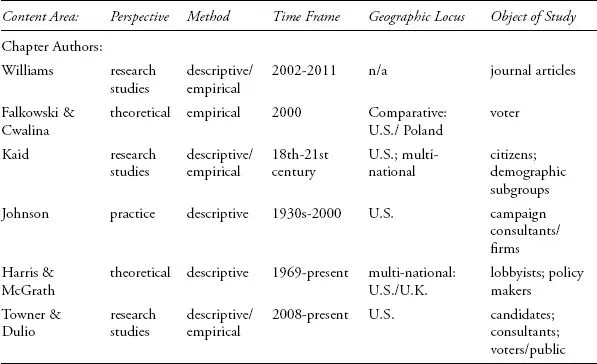
The subsequent chapters are organized both topically and temporally. The next three fall within what has been the dominant focus of political marketing, campaigns and elections. We begin with Falkowski and Cwalina’s theoretically grounded inquiry into the impact of political marketing strategy on a chief object of interest in the field, individual vote choice and its aggregation into countrywide electoral outcomes. The Kaid chapter on political advertising broadens the kinds of impacts investigated, parsing their effects on various demographic groups and differentiated by communications medium. The chapter by Johnson completes this tripartite grouping by shifting the focus from the recipients of campaign communications to the professionals who produce them: the political consultants, their firms and activities. In the next selection, Harris and McGrath apply political marketing theories to understanding an emerging object of study, lobbying, and its use by a wide array on non-party/non-candidate actors ranging from interest groups to social movements in pursuit of their larger policy objectives and agenda. Finally, in the most temporally proximate chapter, Towner and Dulio consider the latest and rapidly evolving campaign technologies as they affect all three producer/consumer categories: voters, candidates, and their advisors. Table 1 delineates the major content areas encompassed by each of the five chapters.
CHAPTER SYNOPSIS
In their chapter, Falkowski and Cwalina conduct empirical tests of the realist and constructivist approaches to explain voting behavior in Poland and the United States. They find that while the realist approach is a better fit for Poland, both approaches are applicable in the U.S. Their work has important implications for scholars and campaign professionals. First, factors specific to an individual country’s political development and environment may favor one marketing strategy over another. Second, three domains-media, cognitive and emotional-are all relevant when analyzing voter behavior. Finally, the relevant cognitive domains differ for candidates and require an individualized, not universal, marketing approach.
The study of political advertising has been a major focus within political marketing. In her chapter, Kaid reviews the key research findings and open questions by medium (print, radio, television and internet) and format (negative advertising, issue advocacy, and political advertising by and for women and minorities) in both a U.S. and international context. She outlines a set of research priorities that urges greater attention to variations by channel and particularly their visual components. Rapidly evolving new technologies are themselves important to study, but also the new interactivity they create-between news media and political advertising and between citizens and politicians. The environmental context of political advertising is itself changing in response to new laws and regulations, a heightened importance of gender and racial/ethnic differences, and need for much greater international awareness.
TABLE 1 Contents Area by Chapter
The chapter by Johnson juxtaposes two trends in the evolution of political consulting in the United States. On the one hand, the industry has become increasingly specialized, shifting from commercial advertising firms to polling and media specialists and niche marketers. On the other hand and in parallel, the repertoire and reach of consulting activities have expanded from the early national campaigns to state and local races, corporate and issue advocacy and ballot questions to international clients. Although the underlying elements of a marketing strategy remain essentially the same, political consultants today confront two important new challenges. First is adapting to new technologies and online communication tools, particularly social media, which afford voters a much larger participatory role in campaigns. Second is the infusion of vast quantities of campaign money unleashed as a result of the Supreme Court’s 2010 decision in the Citizens United case.
Harris and McGrath offer a marketing perspective on lobbying arguing in their chapter that the field needs to move beyond political parties and campaigns to a broader focus. That direction is warranted by the expansion in the number, activities, and influence of interest groups and social movements and by similarities in their theoretical underpinning (exchange theory, network theory and relationship marketing), objectives and practice (the use of persuasive communication to achieve a desired political outcome). Lobbying is an area ripe for empirical investigation and rich in potential sources of information. Harris and McGrath see the central questions for scholars and practitioners as being what lobbyists and politicians exchange and how they use product positioning, branding and communication strategies to frame the public policy issues they seek to advance. They ask, to what extent do exchange theory, network theory and relationship marketing theory inform our understanding of the linkages between lobbying and policy makers and the effectiveness of these interactions?
Towner and Dulio track the role of new media in political marketing in 2008 and project its developmental path into 2012 and beyond. Their chapter highlights where candidates, consultants, voters and the general public find themselves on familiar ground and where that ground is shifting. The underlying goals and questions for those who create, manage, consume and or study media remain largely the same. It is the rapid escalation in number, variety and sophistication that pose challenges for political actors who are struggling to keep up with and integrate these new communications technologies into their behaviors, activities and relationships. Towner and Dulio argue that new media require researchers to better understand and even rethink who and how many are using which media, for what purposes, and with what consequences. Their proposed research agenda urges more study of differences among media and their uses, different and especially lower levels of office, other age groups besides the youth cohort, and a geographic focus that moves beyond the United States and includes comparative and cross national studies.
Table 2 compiles the major recommendations of the chapter authors in their retrospective and prospective analyses of political marketing. It is hoped they will help scholars and practitioners chart a new agenda for research and best practice in the next decade.
Similar to the evolution that has taken place in the field of marketing over the past several decades, the discipline of political marketing is evolving in ways that one could not have predicted one decade ago. The field continues to borrow from several different social science disciplines, and at the same time, is contributing to the growth of related disciplines. As the field evolves, it will continue to bridge the political systems in democracies around the globe, and at the same time, bridge the thinking of theorists and practitioners. By definition, political marketing is an applied, contemporary discipline that will continue to be shaped by a wide spectrum of actors, including: Governments, political parties, politicians, candidates, consultants, journalists, lobbyists, and the voters and citizens themselves. This volume reflects on how each of these actors has played a role in various campaigns around the world, and how the discipli...