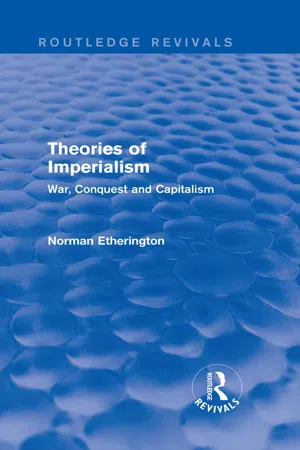
First published in 1984, this study examines closely the shifting attitudes towards, and theories concerning, imperialism, from the colonial wars of the late nineteenth century to America's involvement in Vietnam. This lucid investigation encompasses the World Wars, the disintegration of the Colonies and the Cold War. It also gives fascinating insight into the theories of imperialism advocated by such diverse writers as Hobson, Wilshire, Angell, Brailsford, Luxemberg and Lenin. Throughout, the author objectively evaluates the theory that capitalism is a cause of aggression – a fundamental tenet of anti-imperialist writers. It is Norman Etherington's contention that further investigations into the sources, causes and effects of imperialism can only take place if the various theories concerning it are analysed. A fascinating and detailed study, this reissue will be of particular value to students interested in the theories and history of imperialism.
eBook - ePub
Theories of Imperialism (Routledge Revivals)
War, Conquest and Capital
- 296 pages
- English
- ePUB (mobile friendly)
- Available on iOS & Android
eBook - ePub
CHAPTER 1 America’S First Capitalist Theory of Capitalist Imperialism
DOI: 10.4324/9781315758077-3
In his study of what imperialism meant to Englishmen in different historical periods, Richard Koebner got as far as showing that two words, empire and imperialism had different pedigrees. The British Empire had once meant simply the united territories of England, Wales, Scotland and Ireland. As overseas colonies were added to the British isles, the meaning of empire expanded to include them. Imperialism, on the other hand, had a sinister past bound up with strutting dictatorships, contempt for liberty and a lust for military glory. It did not have anything to do with colonies. In the middle years of Queen Victoria’s reign, it was perfectly possible for patriotic, freedom-loving Englishmen to love the British Empire while simultaneously hating imperialism and praying that it might never cross the English Channel to threaten their homeland.
By the eighteen nineties, however, the words were beginning to get mixed up. People who opposed any further additions to Britain’s colonies were calling the advocates of expansion imperialists. Some expansionists were beginning to accept the name of imperialist and to wear it as a badge of pride instead of shame. Koebner believed that the South African War (1899–1902) swung the balance of meaning sharply back towards the unfavourable connotations of imperialism. He particularly blamed the English economist John A. Hobson for spreading the idea that the South African War with all its horrors — burning civilian farms and putting women and children in stinking concentration camps — came about because of the self-interested manipulations of a little clique of capitalist investors.1 Koebner also believed that Hobson’s idea was taken up by foreign socialists and communists who made it part of their worldwide propaganda against capitalism.
Koebner was partly right and partly wrong. Hobson’s study of imperialism has had an enormous impact on later socialists. But Hobson did not invent the idea that capitalists would benefit from imperialism. Capitalists invented that idea. Koebner missed discovering the capitalist inventors of the idea because he did not look into the financial journals which capitalists read and because he failed to look closely enough at the United States.2 Taking up the trail where Koebner missed it requires leaving England and moving to Boston, Massachusetts in 1898, the year of the Spanish-American War.
In May of that year the Bostonian editor of the weekly newspaper United States Investor announced his sudden conversion to the cause of ‘imperialism’. The editor makes an ideal source for contemporary American notions about imperialism not only because he suddenly changed his opinions but also because he particularly emphasised that ‘imperialism’ was a ‘word new to our political vocabulary, a word which had lately been on everyone’s tongue’.3 His use of the word was therefore likely to conform to the very latest American usage.
The editor of the Investor changed his mind about imperialism when he realised that contrary to almost everyone’s expectations the war was good for business. Before the declaration of war the Investor along with virtually the whole of the American financial press had hoped for peace.4 Saving oppressed Cubans from the atrocious rule of the senile Spanish empire did not seem to be a principle worth fighting for. In April, 1898, the editor wrote that the situation was ‘humiliating to an extraordinary degree’ : fighting ‘a nation incapable of coping with us, we fight in the name of humanity, and are the occasion of added wretchedness to suffering humanity, and in the end we find ourselves confronted with the problem of what to do with Cuba’.5 From the commercial point of view the editor expected war to result in ‘a paralysis of all kinds of business, in’ cancellations of orders, in the shortening of time in the mills, in the reduction of earning capacity on the part of the masses’. If, the Investor concluded with proper Bostonian prudence, ‘we impoverish ourselves, we cannot be of great assistance to downtrodden humanity elsewhere’.
Two weeks later, after Commodore Dewey had captured Spain’s Pacific fleet at Manila Bay, the editor confessed to a surge of patriotic pride. Dewey had ‘effectively disproved the theory that we are not as efficient in war as in peace’.6 He added that once ‘the mind has habituated itself to the thought that we have at last entered the arena of international politics, the effect is perhaps not altogether unpleasing’. After a further two weeks the Investor took up the profit-making aspects of war under the headline : ‘The Benefit of the War to Commercial and Financial Interest — How the Thing Will Work’.7 The most beneficial effect of war would be ‘in stimulating financial and commercial confidence among ourselves, and in killing the distrust of venturing in many enterprises, which has been far too prevalent during the last decade’. For most of the eighteen nineties the American economy had been under a cloud. First there had been a panic on the stock exchange followed by a major recession. Then had come worries in 1896 that the radical Populist Party and Free Silver Democrats would succeed in electing William Jennings Bryan as President and bring about a deliberate inflation of the currency which would, in turn, severely reduce the profits made by investors, bankers, and other lenders of money. The editor believed that worried investors had sat on their money or sent it to other parts of the world, and that this withdrawal of investment capital had delayed America’s economic recovery.
War had come along just at the right time to stimulate the economy by giving large amounts of the taxpayers’ money to important industries. The Investor could ‘safely say that the greater proportion of the money expended by the government comes back to the people’: people such as ‘the shipyard at Newport News, Va.’, which was helping to build the new American navy, ‘the great Carnegie and other steel works in Pennsylvania’ which made the steel to build the ships, ‘ammunition works, ordnance works, cloth factories, clothing makers and other concerns supplying uniforms’ to the army, along with food contractors and coal mines. ‘Thus we see’, the editor concluded, ‘that the government in appropriating money for war is really spending most of it in benefiting American industries, and in causing an extraordinary stimulus to business in many branches. The fact is, many imagine a war to be far worse than it really is’. From a commercial point of view that is. Leaving aside the killed, the wounded and the homeless, the Investor believed that ‘so far as the avowed purpose of the war — the relief of the reconcentrados — is concerned, it has been, and must continue to be, a dismal failure’.
No matter. Whatever the original causes and aims of the war, it had undeniably ‘accomplished great things for the country, in removing that depression of spirits which has hung like a pall over the entire American people for the last five years’. In the weeks and months that followed, the United States Investor discussed the policy which might help to make prosperity permanent : the policy of ‘imperialism’. When, on May 28th the editor weighed up the ‘Pros and Cons of “Imperialism”’, he identified the pro-imperialists as ‘those who favor a broader international policy on the part of the United States’. The Investor was vague about the precise details of ‘a broader international policy’ except to say that ‘we should have to maintain a powerful navy and army’, and that ‘we should have to nominally abandon the Monroe Doctrine’. The reason stated for giving up President Monroe’s seventy-six year old warning to Europe that the United States would not tolerate the influence of Old World Powers in New World affairs was that ‘we could not trench on what other people consider their preserves, and with decency insist that they should keep out of our “sphere of influence’”. The purpose of building up a big military establishment was partly to counter the hostilities the United States would arouse by its ‘participation in the affairs of the other hemisphere’ and partly to curb the rambunctious individualism of the average American citizen.
The fact that we should have to maintain a powerful navy and army is not without its compensation. The thought of a big navy and a big army constantly employed in warlike measures would be abhorrent. But such institutions on a peace footing — that is the footing they would practically be on all the time — might be made of immense every-day service to the country. The chief danger to a democracy is a too great freedom from restraint, both of action and of thought. European experience demonstrates that the army and navy are admirably adopted to inculcate orderly habits of thought and action.
In June 1898 the Investor amplified and clarified the purposes of this new policy of national discipline and armed swagger in an article on ‘The Struggle For Existence’. The editor explained that the reason ‘so many of the staid commercial papers of the United States are now advocating “imperialism”’ was ‘not because the people who conduct these have suddenly become crazyheaded sentimentalists’. It was because ‘they have subordinated sentiment to the stern facts of the great world struggle for existence’.8 The sternest of stern facts was that ‘the one great need of the world today is new markets’.
Alexander sighed for new worlds to conquer, but his eagerness was far less intense, because it sprang far less from necessity, than that which now characterises the commercial nations of the globe. If the capital at present in employment throughout the civilised world is to be kept at work, an enlarged field for its product must be discovered.
This was the first time that the Investor had mentioned ‘necessity’. Previous discussions of war, armaments and ‘a broader international policy on the part of the United States’ had presented ‘imperialism’ as an option with attractive possibilities. Now it was presented as something more compelling than Alexander’s hunger for world-wide domination. This key note of ‘necessity’ with its ‘stern facts’ and ‘musts’ grew more pronounced as the paper developed its position on imperialism.
So too did the emphasis on the ‘employment of capital’. The Investor perceived an intimate connection between investment and markets. The exchange of goods produced profits or capital, part of which was used to produce more goods which in turn had to be sold. In June 1898 the Investor believed that a new field needed to be found for both (1) the growing flood of goods produced by ‘the great commercial nations of the globe’, and (2) the investment of profits made in the course of previous production and trade. The Investor stated further that the new ‘field lies ready for occupancy. It is to be found among the semi-civilised and barbarian races’. In particular the editor singled out China as the outstanding available field for the realisation of profits from future trade and investment. At the moment ‘the great powers of Europe’ were ‘getting ready to dominate that vast empire under one form or another, and their motive is in each case the extension of trade’. The first task of American ‘imperialism’ was to see that ‘no nation should be allowed to acquire commercial privileges in China which are withheld from us’. One way of going about that business was to build up a big army and navy which ‘the great powers’ would have to take seriously, and to station part of it in the Philippine Islands.9
The editor had come a long way since April when he had worried about ‘the problem of what to do with Cuba’. Now he took it for granted that America would keep her recent conquests. ‘It may’, he wrote, ‘be repugnant to us to hold the Philippines and Porto Rico, but we should have thought of that before we went to war’. The main purpose of holding colonies was to provide strategic points of support for America’s new policy of throwing her weight around in the councils of the great. But the Investor saw other advantages as well. The colonies themselves could be developed into worthwhile fields of trade. In July 1898 another Massachusetts paper, the Springfield Republican, challenged this proposition and forced the Investor to clarify its position on colonies. According to the Republican, it was not necessary to own a country in order to trade with it. Ownership merely burdened American taxpayers with the administrative expenses of colonial government and increased expenditures for defense. The Investor replied that whatever economic theorists might say about ownership and trade, ‘the experience of the race for, perhaps ninety centuries, has been in the direction of foreign acquisitions as a means of national prosperity’.10 Canada, which the Springfield paper had cited as a prime example of the pointlessness of ownership, was turned into a counter-example by the Investor. ‘Canada’, wrote the editor, ‘while nominally a British dependency, is practically part of the great American commonwealth’. But even so, her original owners had done very well out of their Canadian connection.
In considering the trade relations of Great Britain with the Dominion, we must not confine them merely to the exports and imports of merchandise commodities. Where England derives her greatest commercial benefit from her Canadian-colony is in her ownership of British North American banks, railroads, steamship companies, trading establishments, etc. Canada contains many men of great wealth and influence, but after all the mechanism of Canadian finance and commerce is largely regulated in back parlors in London, and a very large percentage of the profits accruing therefrom is deposited to the account of English capitalists and investors.
These future returns on investments the Investor considered to be as important, or even more important than the strategic and trading benefits of colonies.
No doubt the idea of regulating distant affairs from back parlors and depositing the profits accruing therefrom appealed irresistibly to readers of the Investor. In weeks to come they heard a great deal more about the ways in which investors could directly profit from ‘a broader international policy on the part of the United States’. Some of the anticipa...
Table of contents
- Cover Page
- Half Title Page
- Title Page
- Copyright Page
- Title Page 01
- Copyright Page 01
- Table of Contents
- Preface and Acknowledgments
- Introduction
- 1 America’s First Capitalist Theory of Capitalist Imperialism
- 2 H. Gay lord Wilshire and the First Socialist Theory of Capitalist Imperialism
- 3 J.A. Hobson and the Economic Taproot of Imperialism
- 4 Hobson’s Study of Imperialism
- 5 British Discussion of Imperialism and War on the Eve of World War I – Norman Angel and H.N. Brailsford
- 6 Central European Socialists and Imperialism before the First World War
- 7 Explaining the German ‘Betrayal’; Luxemburg, Bukharin and Lenin
- 8 Assessing the Prospects for Peaceful Capitalism, Thorstein Veblen and Joseph Schumpeter
- 9 Concise Exposition of Classic Theories of Imperialism
- 10 Theories of Imperialism become ‘Theories of Empire’
- 11 The Patriots Fight Back; the Round Table Tradition in Imperial Historiography
- 12 Hot War, Cold War and Decolonisation
- 13 Sorting out Historical Problems of Imperialism
- Index
Trusted by 375,005 students
Access to over 1.5 million titles for a fair monthly price.
Study more efficiently using our study tools.
Frequently asked questions
Yes, you can cancel anytime from the Subscription tab in your account settings on the Perlego website. Your subscription will stay active until the end of your current billing period. Learn how to cancel your subscription
No, books cannot be downloaded as external files, such as PDFs, for use outside of Perlego. However, you can download books within the Perlego app for offline reading on mobile or tablet. Learn how to download books offline
Perlego offers two plans: Essential and Complete
- Essential is ideal for learners and professionals who enjoy exploring a wide range of subjects. Access the Essential Library with 800,000+ trusted titles and best-sellers across business, personal growth, and the humanities. Includes unlimited reading time and Standard Read Aloud voice.
- Complete: Perfect for advanced learners and researchers needing full, unrestricted access. Unlock 1.5M+ books across hundreds of subjects, including academic and specialized titles. The Complete Plan also includes advanced features like Premium Read Aloud and Research Assistant.
We are an online textbook subscription service, where you can get access to an entire online library for less than the price of a single book per month. With over 1.5 million books across 990+ topics, we’ve got you covered! Learn about our mission
Look out for the read-aloud symbol on your next book to see if you can listen to it. The read-aloud tool reads text aloud for you, highlighting the text as it is being read. You can pause it, speed it up and slow it down. Learn more about Read Aloud
Yes! You can use the Perlego app on both iOS and Android devices to read anytime, anywhere — even offline. Perfect for commutes or when you’re on the go.
Please note we cannot support devices running on iOS 13 and Android 7 or earlier. Learn more about using the app
Please note we cannot support devices running on iOS 13 and Android 7 or earlier. Learn more about using the app
Yes, you can access Theories of Imperialism (Routledge Revivals) by Norman Etherington in PDF and/or ePUB format, as well as other popular books in History & 20th Century History. We have over 1.5 million books available in our catalogue for you to explore.