![]()
The unpublished letters of Melanie Klein
In Marcelle Spira’s library
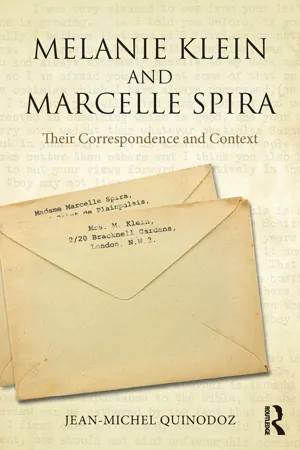
Only a few of the letters that Melanie Klein wrote to her colleagues have been preserved. According to Elizabeth Spillius, who at my request examined the Klein Archives in London, there are letters that she sent to various members of her family, but no trace of those that she wrote to her colleagues. Only nine letters addressed to her by other psychoanalysts have been preserved. That is why I felt that it could be of some interest to publish the 45 letters that Klein sent to Marcelle Spira, the Swiss psychoanalyst, even though they do not discuss any very major psychoanalytical topics.
These letters were discovered in Marcelle Spira’s library after her death on 1 April 2006, when she was 96 years old. She had bequeathed the contents of her library to the Raymond de Saussure Psychoanalysis Centre in Geneva (Quinodoz 2009).
Klein wrote these letters—all of them in English—between 1955 and 1960. Most of them were dictated by Klein and typed out by her private secretary; some, however, were handwritten from start to finish. Marcelle Spira trained with Kleinian psychoanalysts in Argentina and settled in Geneva in 1955; she held on to those letters and took great care of them. I have never seen them mentioned elsewhere, and Spira’s name is not to be found in any biography of Klein (Grosskurth 1986; Segal 1979). The original versions of the letters that Spira wrote to Klein no longer exist. However, six rough drafts written by Spira, some of which are difficult to read, are still extant and are included in her collection of Klein’s letters.
Everyday concerns
All through their exchange of letters, Klein discusses several topics simultaneously, or successively. The common theme has to do with the French translation of The Psycho-Analysis of Children by Boulanger in collaboration with Spira. The translation of that book, which was first undertaken by Lacan before he abandoned his attempt in 1949, went through many ups and downs; Klein’s letters contain a lot of new information about what was going on between 1955 and 1959, the year in which the book was published by the Presses Universitaires de France. In her letters, Klein writes also of what she was, at that time, working upon, in particular Envy and Gratitude, which was published in 1957. These letters have often to do with practical questions, such as how she was going about organizing her summer holidays, which she frequently spent in a hotel situated in the mountains in the French-speaking part of Switzerland. A very discreet person, Klein rarely spoke of her family or of how she herself was keeping. As regards what interested Spira, this can to some extent be surmised from the replies that Klein sent to her and from the six draft copies of the letters that Spira wrote. On several occasions, Klein—at some length—encourages her younger colleague (Spira was 45 years old in 1955) to be patient in the face of the resistance shown by some of her colleagues in the Swiss Psychoanalytical Society towards Kleinian thinking. That enabled Klein to go into some very moving autobiographical detail about the difficulties that she herself had encountered and about how she overcame them.
Why publish these letters?
As to their psychoanalytical content, Klein does little more than comment on some papers that Spira was writing and wanted Klein to have a look at. Since Klein was too busy with her own work, she suggested that Spira come to London, where they could discuss these topics orally rather than send letters to each other. As far as Klein’s personal life is concerned, the letters do not give us much more information than we already possess; there is indeed a kind of reserve on her part as regards her friendship with Spira. With that in mind, I would still argue that these letters bear witness to the final five years of Klein’s life and to a decisive period in Spira’s life.
As these letters are being published, it may be of some interest to think again, with Spillius, about why Klein did not hold on to Spira’s letters or to those sent to her by other psychoanalyst colleagues.
“She [Klein] must have been assiduous about chucking things out.” (Spillius 2006)1
There is probably the beginning of an explanation in what Klein herself wrote: as early as the third letter that she sent to Spira, Klein said that she would not communicate to anyone else the content of Spira’s letters to her, if Spira so wished:
I am always pleased to receive letters from you and I know that you will not expect me to answer them promptly. (…) I shall be very pleased to hear your opinions which you can express quite firmly to me and which, if you so wish, will not be communicated to anybody else.
(Kl 3, 6 January 1956)
It would seem, therefore, that the fact that Klein did not keep any of her colleagues’ letters had to do with confidentiality. One of my own colleagues, Dr Rolf Schäppi from Geneva, has confirmed that impression. His mother2 told him that, as a young woman in the early 1930s, she had worked as a private secretary for a certain Mrs Klein in London and that Mrs Klein had instructed her to throw away all the rough drafts of her letters and other written work once they had been typed out, and not to hold on to them. Dr Schäppi was surprised to learn that his mother’s employer was none other than Melanie Klein! And it was only then that his mother realized that she had been working for a distinguished psychoanalyst!
In some parts of her letters, Klein could be very critical of her colleagues or of psychoanalytical societies, and in particular of the Swiss Society. Uncompromising with respect to her own work, she sometimes made disparaging comments on what those who did not share her views—and perhaps even opposed them—were doing. That attitude is often found in pioneers who, in their desire to pass on their discoveries, are very careful to maintain their originality; this was the case with Freud, for example. Feeling herself to be protected by the confidentiality of a private correspondence, Klein no doubt felt that she could share some intimate thoughts which, during the lifetime of the people concerned, might have seemed defamatory. Now that more than 50 years have passed, what can we say about that situation? If we were still to maintain that confidentiality, would we not be depriving ourselves of an admittedly biased but nonetheless invaluable account of that exchange of letters, which the library of the Raymond de Saussure Psychoanalysis Centre in Geneva has made available for public consultation? In my view, now that a considerable number of years have passed, Klein’s letters are no longer strictly private documents; their historical value is at present a significant element. I think that publishing them now may cast a new light not only on the way that Klein dealt with the reactions—often publicly quite disrespectful—to her work, but also on a turbulent period in the history of the psychoanalytical movement during which conflicts were certainly not few and far between.
Two witnesses of those days: Hanna Segal and Betty Joseph
I asked Hanna Segal and Betty Joseph to tell me what they thought of Klein’s letters to Spira, because they had both been invited to Geneva by Spira towards the end of the 1950s.
I met Hanna Segal in London on 30 May 2011, just a month before she died. She told me that, for her, those letters were of historical importance.
But I think it is a marvellous piece of research, extremely interesting. (…) For me, the most touching one was the last one, because I was there nearly every day visiting Klein in the hospital. She was talking about her work and making sure that The Psycho-Analysis of Children was well edited.
(Segal 2011, interview 03:59)
Klein, however, never said anything to her about her exchange of correspondence with Spira: “It was not secrecy, it was privacy.” The same was true of Spira: “She [Spira] must have been quite reserved… She was very careful of her privacy. I think she was right, it is [also] not secrecy, it is privacy. And she didn’t speak much…” (Segal 2011, interview 32:50).
Segal did not remember a great deal about her few meetings with Spira, except for the time that Spira invited her to stay with her in her house on the Isola del Giglio, in Italy. She did recall, however, the importance of the Lausanne Symposium, which took place in 1956.
Klein was pleased that I was sent to it because I was “not aggressive”! [Laugh] And it was my first sort of public performance (ibid. 07:50). (…) This meeting was most important because it was the first common action; we all agreed about the importance of baby and child observation and the importance of child analysis. And we all agreed it was honesty, it was not compromise.
(ibid. 18:20)
I met Betty Joseph in London on 24 September 2011. She told me that reading Klein’s letters reminded her of the first time that she stayed in Geneva, having been invited there by Spira. “Geneva was one of the first places I went to to give seminars and lectures: therefore I was very anxious and I must have been quite young.” (Joseph 2011, interview 05:31) Did she remember Marcelle Spira?
She was a pleasant, easy person. She didn’t talk much, and I was very junior. My impression is that she was an enterprising and brave woman, but hardly a personality to me. She [Spira] was quite reserved and I was very inexperienced and clearly anxious as to whether I could do good enough work. So I hardly got to know her as a personality. (ibid. 27:00)
In Betty Joseph’s opinion, Klein was quite reserved in her letters to Spira, she was somewhat down-to-earth and revealed less of herself as a private person than one might have expected. I asked her if the reserve that Klein showed towards Spira might have been linked to the somewhat deferential attitude that Spira seems to have adopted towards Klein, as evidenced in the draft copies of her letters. Spira was probably overawed by Klein’s renown—and that might have meant that she could not have a more relaxed and intimate relationship with Klein, whom she admired so much.
I think that is so… And also I feel that it was very brave of Spira to undertake the task of trying to help people to understand about Klein’s work. But Klein was not a person expected to be idealized. People were in awe of her, but she herself had a great simplicity.
(ibid. 37:00)
Betty Joseph also recalled how demanding Klein could be with her close colleagues. However, in her view, in these letters Klein appears to be less demanding, although she does keep putting pressure on Boulanger and Spira to go on with their translation of The Psycho-Analysis of Children.
She was demanding, but I think we felt that it was clear her work came first, nothing would interfere with that, but that if one had such quality, really genius, one was justified in being demanding and apparently self-centred. We could put up with being a bit “bullied”, or having to alter our papers, or being phoned and reminded that we must go to such and such a scientific meeting. She was so outstanding and this was part of what made it possible for her to carry on her work.
(ibid. 25:38)
Betty Joseph spoke also about the very particular situation in which Spira found herself in Geneva, where she was the only “Kleinian” psychoanalyst. Furthermore, it was very much the case at that time that someone who had not been analysed by one of Klein’s analysands or by Klein herself was not seen by the London Kleinians to be truly “Kleinian”. “Spira must have felt that she was the only Kleinian in Geneva, and so to speak the representative of Klein there, even though she had not had an analysis with any London Kleinian analyst” (ibid. 37:00).
1 Personal communication by e-mail, 28 August 2006.
2 Anna Schäppi-Wysling. Personal communication from Dr. Rolf Schäppi in Geneva.
![]()
Melanie Klein, Marcelle Spira, Raymond de Saussure and the Swiss Psychoanalytical Society
Klein’s life at the time she was writing to Spira has been well documented by her biographers (Grosskurth 1986; Segal 1979). I shall simply mention here what was on Klein’s mind during the years when she and Spira were writing letters to each other; readers who would like more details about her life in the period between 1955 and 1960 will find them in those biographies. In this chapter, I shall present some brief biographical elements concerning Marcelle Spira and Raymond de Saussure in the context of the Swiss Psychoanalytical Society as it was at that time.
Melanie Klein (1882–1960)
In 1955, Klein was 73 years old. She was just recovering after a lengthy convalescence following on from an ear infection that caused her to have dizzy spells. She had to cut back her activities and had just moved into her new flat at 20 Bracknell Gardens in London—most of the letters that she wrote to Spira carry this address. In 1955, she was well enough to attend the 19th International Psychoanalytical Association (IPA) Congress in Geneva; that was where she met Spira for the first time. The paper she read, with the title “A study on envy and gratitude”, would be published in 1957 as part of her book Envy and Gratitude.
In 1956, during the celebrations in London to mark the centenary of Freud’s birth, Klein met Raymond de Saussure; he invited her to participate in a Symposium in Lausanne on the psychoanalysis of children. Klein said to him that it would be better to invite Hanna Segal rather than Paula Heimann to attend the meeting. The conflict bet...