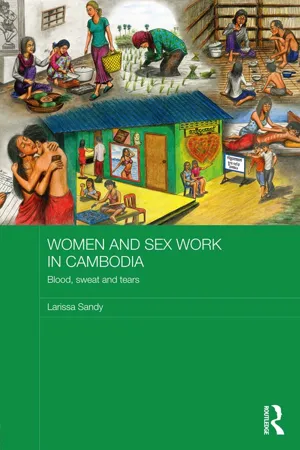
Prostitution is strongly embedded in local cultural practices in Cambodia. Based on extensive original research, this book explores the nature of prostitution in Cambodia, providing explanations of why the phenomenon is so widely tolerated. It outlines the background of the French colonial period, with its filles malades, considers the contemporary legal framework, and analyses the motivations for sex work, examining in particular how women become locked into debt bondage. Overall the book provides significant contributions to wider debates about sex work, sex trafficking and the constrained nature of women's choices.
- 140 pages
- English
- ePUB (mobile friendly)
- Available on iOS & Android
eBook - ePub
About this book
Information
1 Introduction
Two long rows of wooden shacks stand divided by an impossibly potholed dirt road. Out the front, young girls hover in doorways illuminated by dim red lights. Hidden behind the flimsy plywood walls lurk armed gunmen – vicious pimps with powerful connections – who are ready to protect their precious bounty at the slightest provocation. This is Tuol Kork, one of the most notorious districts in Phnom Penh, where many of the prostitutes are underaged, most of them are HIV positive and virtually all of them are slaves.
(Basil 2001: 13)
Srey Neth, a petite teenager, squeals when she sees my interpreter and me … Westerners are an unusual sight in the brothels of the Cambodian town of Poipet – most customers are Cambodian or Thai … her awkwardness turns to curiosity as she realises we are not going to make her perform the sexual favours she is forced to bestow on customers up to three times a day. As one of least a dozen teenage girls in this brothel, her situation is dire, but it is not as bad as in the seedy street bordellos where girls have sex 10 times a day for little more than a dollar a time. Within minutes Srey Neth admits that she is imprisoned by her pimp. Even if she wanted to escape, there is really no way she could.
(Kristof 2004: 37)
These depictions of Cambodian sex workers evoke images of helpless, ignorant and dependent women and girls: ‘most of them are HIV positive and virtually all of them are slaves’. Characteristic of the investigative journalism genre, Basil and Kristof’s exposés of ‘sexual slavery’ in Cambodia mix moral outrage and sexual sensationalism as they outline how young girls are deceived into a life of horror from which escape is virtually impossible: ‘even if she wanted to escape, there is really no way she could’. Two interwoven discourses are active here – trafficking and HIV – each playing a key role in perpetuating the idea that sex workers are inherently diseased. For Basil and others, the ‘Cambodian prostitute’, much like her counterpart the ‘Asian prostitute’, is both an exotic commodity and the alleged focus of the global HIV epidemic (Law 1997: 233; Murray and Robinson 1996: 43). The emphasis that is placed on the inevitability of disease, degradation and death, and totality of the slave experience depicted in accounts of sex work, leads to the inescapable conclusion that women are helpless victims (Grittner 1990: 68).
This book challenges the cultural myths and misconceptions that surround sex work in Cambodia. It confronts and disrupts two predominant images of the ‘Cambodian prostitute’. In one image she is a ruined, destroyed and victimized woman; in the other a destroying body that threatens society (cf. Law 1997: 233; Bell 1994: 44). While men and women work in Cambodia’s sex industry, in the public’s mind, sex workers are all women. Also, there are no gender-neutral terms of reference for sex workers in the Khmer language. The common term used to refer to women working in the industry is srey kouc (prostitute, lit: spoilt, rotten or bad woman). It is a gender specific term not applied to men. The term for sex worker, srey roksii phlauvphet, is literally a woman (srey) making a living (roksii) from her vagina (phlauvphet), which is also gender-specific. Male sex workers, referred to as proh luk khleun (a man who sells his body), are largely absent in the local trafficking and sex work discourses with the issue confined to HIV and male-to-male sexual practice and as a subcategory of ‘MSM’ (men-who-have-sex-with-men). These images rely on the ongoing construction of sex workers as an abject ‘other’. This construction has the effect of rendering sex workers as non-persons and noncitizens and this has had, and continues to have, a palpable effect on female and male sex workers.
Chan Dina of the Cambodian Prostitutes Union (CPU) has described how these discourses intersect on the bodies, and in the lives, of Cambodian sex workers:
I want you to listen, to me the real person … we are not ‘problems’ we are not animals, we are not viruses, we are not garbage. We are flesh, skin and bones, we have a heart, and we have feelings, we are a sister to someone, a daughter, a granddaughter. We are people, we are women and we want to be treated with respect, dignity and we want rights like the rest of you enjoy.
(Chan 1999: 176)
Chan makes it clear that sex work is treated as a deviant activity and/or sexual slavery, which promotes the view that sex work is the defining activity around which a sex worker’s sense of self or identity is shaped. Chan highlights how sex workers take issue with such understandings of sex work because they do not stress the social location of sex workers as working people. In this book, I move away from frameworks that reduce sex work to a deviant activity or form of sexual slavery. I do so in an effort to develop an historically and culturally situated analysis of sex work, which pays attention to the contradictions and resistances that sex workers articulate and thus captures the complexity of their lives. There is an urgent need to develop these kinds of grounded frameworks for understanding sex work in order to better inform policy and practice (Sanders, O’Neill and Pitcher 2009; see also Kempadoo 2005). In this book, I explore the daily lives and struggles of sex working women in order to develop a richer understanding of sex work in Cambodia. It is my hope that this book contributes to the development of more nuanced thinking about sex work in Cambodia and can help in better understanding women’s embodied experiences:
I do not want to go to your shelter and learn to sew so you can get me to work in a factory. This is not what I want. If I tell you that you will call me a srei coit [srey kouc whore/prostitute]. But those words are easy for you because you have easy solutions to difficult problems you do not understand, and you do not understand because you do not listen.
(Chan 1999: 179)
According to Chan, listening to Cambodian sex workers is a habit rarely cultivated in approaches to sex work. She claims that most approaches to sex work ignore sex workers’ rights and voices. As a result, they mostly fail to understand the lived experiences of sex workers and lead to interventions that do not take their needs or wishes into account. Chan’s words imply that regardless of the amount of attention paid to sex work, the lack of attention paid to sex workers by researchers, government and non-government organizations (NGOs), and their seeming refusal to take them seriously as persons has prevented us from reaching a fuller understanding of the complexities of sex workers’ lived experiences, their needs, wants and desires.
By listening to and documenting the life stories of sex working women, this book contributes to the project of redefining sex work in Cambodia. It is not a guide to Cambodia’s seedy underbelly. It does not contain explicit stories that offer sexual titillation or erotic fantasies built on stereotypes of submissive Asian women and dominant (Western) men. The book is based on the lived experiences and everyday concrete social realities of sex working women and it is my hope that it puts forward an alternative model for understanding and responding to sex work in Cambodia. It takes up Chan’s challenge of learning to listen to and engage with sex workers. As an exercise in active listening, the book explores how Cambodian sex workers themselves understand sex work. I believe this is important because the current orthodoxy treats sex work and sex workers in a reductionist way, and this has led to the development of laws, regulations and interventions that are really doing harm to sex workers.
While many studies have been conducted on sex work in Southeast Asia (cf. Montgomery 2001; Murray 2001; Law 2000; Bishop and Robinson 1998; Lim 1998; Odzer 1994; Sturdevant and Stoltzfus 1992; Troung 1990), in-depth analyses of sex work in Cambodia are almost non-existent. There is a rich NGO literature on the topic, which has led some to claim that sex work in Cambodia is ‘relatively well-researched’ (Derks, Henke and Ly 2006: 15). But, these reports mostly focus on trafficking for sexual exploitation (cf. Derks, Henke and Ly 2006; Preece 2005; Douglas 2003; Steinfatt 2003; Derks 1998, 1997; RGC 1997; CWDA 1995, 1994; UNICEF 1995). The remaining reports have a restricted focus and concentrate on sex work in relation to HIV, sexual health and condom use, and rural-urban migration (cf. Catalla and Catalla 2004; NAA, MoH and UNAIDS 2003; Lowe 2003; Nelson 2002; Ramage 2002; CARAM 2001; Ohshige et al. 2000a, 2000b; Prybylski and Alto 1999). A small number of these reports focus on the lived experiences of sex working women and go beyond the subject of sexual health and condom use to tackle issues inextricably connected to this such as violence and vulnerability (cf. Jenkins et al. 2006; WAC 2005; Wilkinson and Fletcher 2002).
My own experience working with Cambodian sex workers helped me to realize the need for this book. The totality of the slave experience depicted by journalists (such as those by Basil and Kristof used in the opening of this chapter) and radical feminist academics (cf. Jeffreys 2004; Brown 2000; Hughes 2000) did not gel with my own earlier experiences when volunteering on a sex worker project with an NGO. As a result, I set out to critically examine sex work in Cambodia. The book’s central objective is to foreground sex workers’ own experiences and perspectives and explore sex working women’s concrete social realities. I believe that this approach offers insight and knowledge in a way in which the current orthodoxy can be critiqued, and an alternate way of knowing sex work can be developed in order to direct future theory and policy (Parreñas 2011; Kempadoo 2005; Smith 1999).
Vectors, victims, agents – discourses on sex work
My body is tortured
I am full of pain
I am not a citizen
I am not a person
You see me as a virus
I am invisible
Your eyes do not see me
You hate me
You blame me
Some of you pity me
I do not want your pity
I do not want your charity
I want my rights
Not your lies and abuse
(Chan 1999: 176)
This example of Cambodian sex worker poetry clearly depicts how modernday discourses on sex work have produced two dominant images of sex workers: ruined, destroyed, victimized women, and destroying bodies that threaten society (Bell 1994). These are discourses of alterity in which women’s agency is either denied or accorded a negative value and amplified to the extent that sex workers are seen as largely responsible for the alarming rise in the spread of HIV to the general (heterosexual) population. These modernday discourses on sex work in Cambodia have a history traceable to French colonization (1863–1953). They are intimately tied to the regulation and control of sex work in the country and they have shaped the landscape of sex work and ultimately, sex workers’ lived experiences. In order to better understand and contextualize sex work and the lived experiences of women documented in this book, in this section I provide a brief overview of the ways that the three main global discourses on sex work have intersected with local discourses over time. I consider the origins of these discourses, how they have shaped ways of knowing and responding to sex work and highlight the effects for sex workers. I then begin to sketch out an alternate way of knowing sex work based on current feminist thinking on the issue.
Vectors
The dominant cultural image of sex workers as purveyors of disease or ‘vectors’ was made popular in the nineteenth century public health discourse that originated in France (Quétel 1990). This public health discourse attempts to naturalize sex work within an idiom of natural desire and inevitability. In a number of nineteenth century landmark ‘scientific’ studies sex workers became iconic signs of ‘the pox’ (venereal disease) and signified disease, pollution and moral corruption (Laqueur 1990).1 In the association made between desire, disease and sexual danger, sex workers were held responsible for spreading disease by conveying deadly pathogens to their male clients. Public health theoreticians argued that sex work needed to be contained and controlled, thereby facilitating state regulation through medical controls and police supervision.2
When the HIV epidemic emerged in the mid-1980s, sex workers were quickly identified as a ‘high-risk group’ or ‘vectors of HIV’ (Lyttleton 2000; Treichler 1999). Public health frameworks had long privileged the notion of sex workers as purveyors of disease. Prior to the ‘time of AIDS’ (Herdt and Lindenbaum 1992), the dominant cultural image was of sex workers as diseased, evil and a source of biological and moral contagion. These ideas heavily informed the re-inscription of sex workers as ‘pools of infection’ in HIV discourse, and this was a label that originated in nineteenth century public health debates about the syphilis epidemic (Law 1997). In Cambodian HIV discourse, sex workers were constructed as ‘core transmitters’ and blamed for infecting the rest of the Cambodian population with HIV:
first detected in Cambodia in 1991, HIV continues to spread and the country now faces potentially the worst epidemic in Asia. Heterosexual intercourse is the predominant mode of HIV transmission in the country and commercial sex workers are believed to be a major vector for the spread of the disease.
(NCHADS and Oppenheimer 1998: 1)
The cultural legacy and historical genealogy of sex work in public health discourse meant that it was unsurprising that sex workers were labelled as a ‘high-risk group’ in HIV discourse. The concept of HIV ‘risk groups’ was developed by epidemiologists working in the field of public health and centred on the idea that reported HIV infections could be separated into groups of people based on risk factors. Entire populations were designated as ‘risk groups’ that featured the usual suspects (sex workers, drug users, gay men). This concept not only obscured differences among people but also implied that people not included in those boundaries of stigma were not at risk of HIV (Schoepf 2001: 338). Although the concept of a ‘risk group’ has been critiqued (Parker 2001; Schoepf 2001; Treichler 1999; Porter 1997; Bolton 1992; Patton 1990), the framework remains influential in shaping responses to HIV and is still a dominant paradigm in the HIV discourse.
In Cambodia, the ‘core transmitters’ ideology has constructed men as being endangered by contact with female sex workers and women working in the sex industry as responsible for the alarming rise in the spread of HIV to the general (heterosexual) population: ‘Cambodia has the fastest HIV transmission rate in Asia, with some 20,000 sex workers serving as the prime transmitters’ (Cambodia Daily 1998a: 1). This local construction helped in conveying the ‘sense that the HIV epidemic was attributable to small, physically and socially discernable epicenters … populated by “core transmitters”’ (Porter 1997: 216).
The re-entrenchment of sex workers as purveyors of disease has fed into a powerful conflation in which women’s deviant sexuality is condensed with the corporeal threat of illness and death from HIV and AIDS. Figure 1.2 shows a cartoon of a young Cambodian man and woman standing with their arms wrapped around each other. The woman is dressed in the ubiquitous miniskirt of a sex worker. The artist’s caption reads ‘Darling! … AIDS! … Ouch!’, and together with the cartoon image it shows how in the signification of the HIV sex workers as ‘core transmitters’ are symbolic of both HIV and death.3 The image shows how HIV has been linked to sex work and ‘freighted with extraordinary symbolic and emotional power’ that includes ideas about social and moral pollution (Schoepf 2001: 336).
In this book, I aim to show how the ‘core transmitter’ ideology and imagery supporting it has given legitimacy to the idea that sex workers should be the subject of and subject to intensive ‘targeting’ th...
Table of contents
- Cover
- Half Title
- Title Page
- Copyright Page
- Dedication
- Table of Contents
- List of figures
- Series editor's foreword
- Acknowledgements
- List of abbreviations
- 1 Introduction
- 2 Filles malades: sex work in French Cambodia, 1863-1953
- 3 Sihanouk's 'Thesis A and B': sex work in post-independence Cambodia
- 4 The social and cultural context of sex work
- 5 Just choices: the moral and political economies of sex work
- 6 Core transmitter/sex slave: ten years of regulating sex work (1998-2008)
- 7 Conclusion: blood, sweat and tears
- Glossary
- Bibliography
- Index
Trusted by 375,005 students
Access to over 1.5 million titles for a fair monthly price.
Study more efficiently using our study tools.
Frequently asked questions
Yes, you can cancel anytime from the Subscription tab in your account settings on the Perlego website. Your subscription will stay active until the end of your current billing period. Learn how to cancel your subscription
No, books cannot be downloaded as external files, such as PDFs, for use outside of Perlego. However, you can download books within the Perlego app for offline reading on mobile or tablet. Learn how to download books offline
Perlego offers two plans: Essential and Complete
- Essential is ideal for learners and professionals who enjoy exploring a wide range of subjects. Access the Essential Library with 800,000+ trusted titles and best-sellers across business, personal growth, and the humanities. Includes unlimited reading time and Standard Read Aloud voice.
- Complete: Perfect for advanced learners and researchers needing full, unrestricted access. Unlock 1.5M+ books across hundreds of subjects, including academic and specialized titles. The Complete Plan also includes advanced features like Premium Read Aloud and Research Assistant.
We are an online textbook subscription service, where you can get access to an entire online library for less than the price of a single book per month. With over 1.5 million books across 990+ topics, we’ve got you covered! Learn about our mission
Look out for the read-aloud symbol on your next book to see if you can listen to it. The read-aloud tool reads text aloud for you, highlighting the text as it is being read. You can pause it, speed it up and slow it down. Learn more about Read Aloud
Yes! You can use the Perlego app on both iOS and Android devices to read anytime, anywhere — even offline. Perfect for commutes or when you’re on the go.
Please note we cannot support devices running on iOS 13 and Android 7 or earlier. Learn more about using the app
Please note we cannot support devices running on iOS 13 and Android 7 or earlier. Learn more about using the app
Yes, you can access Women and Sex Work in Cambodia by Larissa Sandy in PDF and/or ePUB format, as well as other popular books in Social Sciences & Ethnic Studies. We have over 1.5 million books available in our catalogue for you to explore.