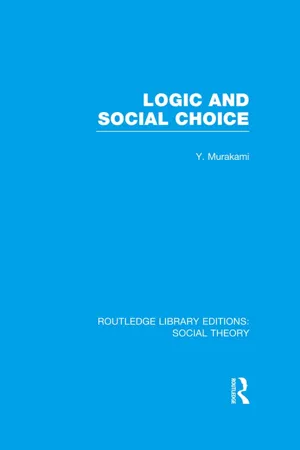
How is a social decision made out of individual members' decisions? This is one of the primary questions in the social sciences. Logic and Social Choice provides an answer to the topic by the application of mathematical logic. Yasusuke Murakami formulates social decision-making in logical terms, and shows that an analysis of social decision is equivalent to a logical calculus in many-valued logic. The logical conditions are then derived for various types of societies, especially for democracy. This foundation enables the author to discuss such topics as the relation between direct democracy and the representative system, a comparison of various rules of election, and the stability of social decision. The main conclusion is that inconsistency or paradox is inherent not only in voting and in democracy itself, but also in any piecemeal social decision-making.
- 140 pages
- English
- ePUB (mobile friendly)
- Available on iOS & Android
eBook - ePub
Logic and Social Choice (RLE Social Theory)
About this book
Information
Chapter One
INTRODUCTION
1. Society and Individuals. A society consists of individual members and a society’s decision is composed of its members’ decisions. Each society has its own rule for making decisions. When a combination of individual decisions is given, a society’s decision is reached according to that rule. Probably the most familiar example of a social decision-making rule is voting. By casting a ballot, each individual expresses his decision on the issue in question, say, an election where a Conservative candidate and a Labour candidate are contesting a seat in Parliament. Society adopts the decision supported by the majority of voters; thus, if the Conservative candidate obtains more votes, he is the ‘social choice’. Once a pattern of individual decisions is formed, the rule of majority voting yields a social decision. As the pattern changes, the social decision also varies. The mathematician, as well as the logician, would say that a social decision is a function of individual decisions, in the sense that a combination of individual decisions determines a social decision. More formally, we may express this as
R = F (R1, R2, …, Rn)
where R and Rj are variables for the decisions of the society and of the jth individual respectively, n being the number of individuals. The function F represents society’s rule for decision-making, so we may call this function the social decision function.
Any change in a social decision can occur only through changes in individual decisions. Thus, by the formulation presented above we can express any social decision-making rule. Sometimes, as in the case of religious taboos, a social decision may be traditionally fixed, regardless of changes in individual decisions. However, a traditionally fixed social decision is still a function of individual decisions, in the sense that the function takes on a constant value. In some societies, a particular individual may be so powerful that his decision is always adopted by the society. In other words, the individual is a dictator. But this dictatorial rule of social decision-making constitutes simply a special class of social decision function; individuals other than the dictator can be deleted from the function. Whether a society is traditional, dictatorial or democratic, which we shall investigate later, the social decision function as defined above is sufficiently general to express any form of social decision.
2. Individual Decisions. From a psychological point of view, an individual decision is a complex phenomenon. Hedonist psychology assumes that an individual decision is a revelation of the person’s desire, satisfaction, pleasure, taste or whatever the philosopher or social scientist wishes to call it. Many economic analyses, as well as the utilitarian philosophy behind them, are known to be based on a similar view. On the other hand, many people argue that the exercise of individual desire is restrained by some idealistic principle, or perhaps by some subconscious motivation. The question of how and why individual decisions are made belongs to the field of psychology.
Throughout this book we shall be concerned with the ‘behaviouristic’ rather than the motivational aspect of decision making. By an individual decision we mean simply that the individual behaves as if he had a definite order of preference concerning the alternatives open to him. Whatever his motivations, the individual behaves as if he had arranged, in his mind, all the conceivable alternatives, in order of preference, when he makes a decision. This is our definition of individual decision.
Mr. Smith, a citizen in a Midwest town, prefers a Republican candidate to a Democratic candidate for some reason of his own. This is his decision. Mr. Jones, a gentleman in North Devon, prefers a Liberal candidate to a Conservative candidate, and a Conservative candidate to a Labour candidate. Various motivations prompt Mr. Jones to make this decision. One of the most fundamental assumptions of economics is that a consumer orders all possible expenditure plans according to his preference. The well-known ‘indifference map’ is a device to describe visually a consumer’s ordering. Each individual’s indifference map reveals his decision.
Throughout this book, we shall generally regard an individual’s decision as equivalent to his preference, represented as an ordering, or, in short, to his preference ordering. It must be noted, however, that a distinction between preference and decision is sometimes meaningful. For an individual may sometimes purposely misrepresent his preference ordering. Once a social decision-making rule is given, an individual might find it profitable to misrepresent his preference in action. That is, he might act insincerely. We shall assume in this book, however, that every individual is sincere or, in other words, that every individual’s decision is identical with his preference. This is one of the limitations of this book.
However, we shall later present (Section 10, Chapter Four) a condition under which no misrepresentation of individual preference is profitable. We shall see that this condition is satisfied by many social decision functions familiar to us; so we may sometimes be justified in assuming individual sincerity. Only in that section, are decision and preference to be carefully distinguished. Otherwise, both terms will be employed interchangeably.
Indeed, the concept of decision can be formulated in many other ways with greater sophistication. For example, we may include not only preference orders but also preference intensities as elements of an individual decision. In fact, we shall examine this idea in Chapter Six. Or we may assume that preference itself is subject to uncertainty; the reader interested in this ‘probability’ approach may refer to R. D. Luce’s work (a). However, in this introductory book we shall start with the most elementary assumption that decision is preference ordering.
3. Axioms of Ordering. An individual decision has now been defined as an individual preference ordering of all conceivable alternatives. In this section we shall formulate a preference ordering in exact logical terms. We shall start by denoting alternatives, or possible states of the society, by lower-case letters...
Table of contents
- Cover
- Half Title
- Title Page
- Copyright Page
- Original Title Page
- Original Copyright Page
- Table of Contents
- 1 Introduction
- 2 Social Decision Function
- 3 Democracy in a World of Two Alternatives
- 4 Democracy in a World of More than Two Alternatives
- 5 Voting Paradox
- 6 Voting Paradox Reconsidered
Trusted by 375,005 students
Access to over 1.5 million titles for a fair monthly price.
Study more efficiently using our study tools.
Frequently asked questions
Yes, you can cancel anytime from the Subscription tab in your account settings on the Perlego website. Your subscription will stay active until the end of your current billing period. Learn how to cancel your subscription
No, books cannot be downloaded as external files, such as PDFs, for use outside of Perlego. However, you can download books within the Perlego app for offline reading on mobile or tablet. Learn how to download books offline
Perlego offers two plans: Essential and Complete
- Essential is ideal for learners and professionals who enjoy exploring a wide range of subjects. Access the Essential Library with 800,000+ trusted titles and best-sellers across business, personal growth, and the humanities. Includes unlimited reading time and Standard Read Aloud voice.
- Complete: Perfect for advanced learners and researchers needing full, unrestricted access. Unlock 1.5M+ books across hundreds of subjects, including academic and specialized titles. The Complete Plan also includes advanced features like Premium Read Aloud and Research Assistant.
We are an online textbook subscription service, where you can get access to an entire online library for less than the price of a single book per month. With over 1.5 million books across 990+ topics, we’ve got you covered! Learn about our mission
Look out for the read-aloud symbol on your next book to see if you can listen to it. The read-aloud tool reads text aloud for you, highlighting the text as it is being read. You can pause it, speed it up and slow it down. Learn more about Read Aloud
Yes! You can use the Perlego app on both iOS and Android devices to read anytime, anywhere — even offline. Perfect for commutes or when you’re on the go.
Please note we cannot support devices running on iOS 13 and Android 7 or earlier. Learn more about using the app
Please note we cannot support devices running on iOS 13 and Android 7 or earlier. Learn more about using the app
Yes, you can access Logic and Social Choice (RLE Social Theory) by Yasusuke Murakami in PDF and/or ePUB format, as well as other popular books in Social Sciences & Sociology. We have over 1.5 million books available in our catalogue for you to explore.