In recent decades, scientific theories have postulated the existence of many universes beyond our own. The details and implications of these theories are hotly contested. Some philosophers argue that these scientific models count against the existence of God. Others, however, argue that if God exists, a multiverse is precisely what we should expect to find. Moreover, these philosophers claim that the idea of a divinely created multiverse can help believers in God respond to certain arguments for atheism. These proposals are, of course, also extremely controversial. This volume collects together twelve newly published essays – two by physicists, and ten by philosophers – that discuss various aspects of this issue. Some of the essays support the idea of a divinely created multiverse; others oppose it. Scientific, philosophical, and theological issues are considered.
eBook - ePub
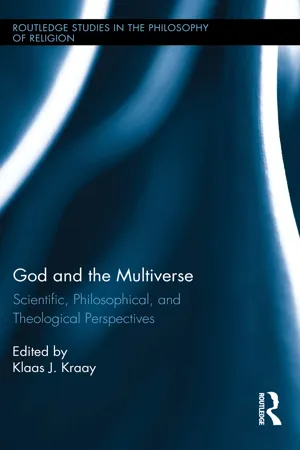
God and the Multiverse
Scientific, Philosophical, and Theological Perspectives
- 248 pages
- English
- ePUB (mobile friendly)
- Available on iOS & Android
eBook - ePub
About this book
Information
Theistic Multiverses
Details and Applications
3 The Multiverse
Separate Worlds, Branching, or Hyperspace? And What Implications Are There for Theism?
Peter Forrest
My purpose is to compare three basic versions of multiverse, that is, the many ‘worlds’, theory: Separate Worlds, Branching, and Hyperspace. There is, in addition, a variant on Branching, the Lattice Universe, as well as mixed theories. I shall reject Separate Worlds even though I assimilate merely possible worlds to those of Multiverse. The choice between Branching and Hyperspace is not so straightforward, although I judge that Hyperspace is to be preferred by theists. I then examine the consequences for theism, arguing that Hyperspace coheres better with theism than its rivals. In addition, Hyperspace supports the existence of something physical prior to God’s act of creation, which I identify with the divine body. This ‘something’ could be described pretheoretically as without structure and indeterminate (the ‘apeiron’).
Background
This essay is audience-specific in that I take for granted an approach to metaphysics that I shall expound but do not here have the space to defend. First I think that, de facto, metaphysics is speculative and that it should be a speculative scientific discipline. To say it should be a discipline is to submit that it should be conducted in as rigorous and clear fashion as is feasible, not with the mix of sensationalism and obscurity characteristic of much Continental philosophy. To describe it as scientific would be misleading without the ‘speculative’ qualification. For there is core science and speculative science, I say. And core science deserves to be called collective knowledge, with the authority this implies. Scientific progress, however, requires speculative research programs, whose Lakatosian ‘hard cores’ are not themselves core science (Lakatos 1970). By metaphysics I mean the science of the most fundamental truths, including the interpretation of core science itself.1 (When I say that de facto it is speculative I am denying that it must always remain so, but at present we lack the consilience of different lines of argument required for it to achieve core science status.)
More specifically, I am operating within some assumptions that I devoutly hope will become collective knowledge, with the same status as core science. Currently I have to take these as speculative because many of my intellectual peers reject them. These assumptions, which make up Properly Anthropocentric Metaphysics (PAM), include the truth of core science, interpreted realistically. But they also include the denial that agency and consciousness occur in virtue of a more fundamental physical order. Hence PAM is compatible with physicalism only in some weak sense, and is incompatible with naturalism. One such compatible physicalism states that the nonphysical is correlated in a metaphysically noncontingent fashion with the physical. Another compatible physicalism is the denial that we have souls. In both these weak senses I consider physicalism a fairly probable piece of speculative metaphysics. PAM takes seriously the phenomenology of human freedom, while granting the relevance of brain science. Of importance to this essay is my assumption that the gravity of our choices is no illusion: a difficult choice is not like the toss of a coin.
Many World Theories
Universe-Fibers
The Universe, with an upper case ‘U’, is the sum of all that is physical. Multiverse (many worlds) asserts that the Universe is composed of many universe-fibers, as I call them, or u-fibers, for short. Informally, a u-fiber is roughly what eternalists (block theorists) used to think of as the whole universe, past present and future. I say ‘roughly’ because there is a version in which some u-fibers—maybe eventually all but one—terminate: that is, there is a space-like boundary beyond which the u-fiber does not extend. It is useful to think of an analogy in which the Universe is thought of as a book with an infinite number of pages—the u-fibers. I take the space dimension to be down to up and temporal dimension to be left to right.
It is not easy, however, to give a precise geometric definition of a u-fiber. We should not even assume that a u-fiber is of one temporal and three spatial dimensions. For String theorists typically consider 10 dimensions. Nor should we require u-fibers to be maximally connected parts of the Universe, for that would exclude Hyperspace. For the purposes of this essay I could operate with a disjunction: either String theory is correct and a u-fiber has 10 spatial dimensions, or it is false and every u-fiber has 3 spatial dimensions. In either case I take a u-fiber to have a (topological) manifold structure.2 This stipulation stops us calling any branching structure a single u-fiber.3 So, when I say a u-fiber branches (or splits or undergoes fission) I am saying that two or more u-fibers overlap (cf. Lewis 1983 on surviving fission4). In terms of the book analogy, consider a sheet that (like a sheet of paper) has a right hand edge, and suppose someone has glued onto that edge two sheets (each of which therefore has a left hand edge where it was glued). I stipulate that this page that splits in two is not to be considered a single u-fiber but two u-fibers, which overlap to the left of the glue but are disjoint to the right. We may now imagine a most peculiar way of binding the pages in a book: start with a single sheet of paper, glue onto it two or more, and keep on repeating the process. This corresponds to one of the multiverse hypotheses, namely Branching. I am not, however, assuming that a u-fiber is nothing but a manifold. For the commonsense position, which might or might not be correct, would include its furniture, which we might think of as the print on the pages.
The preceding characterization requires that we stipulate the number of dimensions of a u-fiber. To avoid this stipulation we could use a definition that is not purely geometric but uses the concept of naturalness. It requires an assumption that I shall not rely on elsewhere, namely that there are no spatially extended atoms. In that case I characterize a u-fiber as having at least two dimensions (one of which is temporal) and being the result of a maximal natural (i.e., nonarbitrary), observer-independent, division of the sum of all ordinary particulars (such as events or material objects) into disjoint parts of at least one temporal and one spatial dimension. So the idea is that the multiverse is ‘carved at the joints’ into u-fibers, but that any finer division is arbitrary slicing—except perhaps the carving into successive temporal slices.5 The restriction to ordinary particulars is intended to exclude not only universals but such things as laws of nature, which might not get divided up as required. It also excludes any nontemporal particulars there might be.
This way of characterizing the u-fibers permits Cross Fiber Extension, the thesis, for which I argue later, that all familiar particulars are extended across many u-fibers. On each page of the ‘book’ we might have a pattern of lines looking like a photograph of an interaction in a cloud chamber, or, if you prefer, a Feynman diagram. Ordinarily we would think of each of these lines as the history of a particle. On the thesis here being considered, however, the history of a particle extends some way through the book, and consists of different lines on the different pages. It is as if a diagram begins on page 30 and varies somewhat on each consecutive page until we get to page 70. Then Cross Fiber Extension tells us that an electron, say, belongs to many u-fibers and so is represented not just by one diagram but by many diagrams.
If there are extended atoms, then familiar particulars might be crossworld extended without having parts in distinct u-fibers, analogous to the way something with a temporal span might be said to endure rather than perdure. (Here I use the Mark Johnston / David Lewis Princeton terminology of endurance versus perdurance. 6) If there are no extended atoms, then familiar particles are sums of, perhaps atomic, parts each of which is restricted to a single fiber.
Because Cross Fiber Extension asserts that familiar particulars extend across the u-fibers, we may introduce the idea of the lower case ‘u’ universes, consisting of many but not all u-fibers. My universe as of now is the join of the u-fibers to which the particles that make me up now belong.7 This is either identical to or largely overlaps your universe as of now.8 Generalizing, a universe is a bundle of u-fibers that share all or most of their familiar particulars. An important property of universes is that they can split even if the u-fibers do not branch, that is, even if no u-fibers overlap. That kind of fission occurs if the postfission universes containing just some of the u-fibers of the prefission universe. If such fission occurs, then your universe as of now is a proper part of your universe as of a second ago. Popular expositions of multiverse theories often talk of the universe splitting in this way, usually with the implication that we split with the universe. This is compatible with, but does not entail, Branching (see Forrest 2007).
Multiverse Hypotheses
All the hypotheses under consideration are of the multiverse genus. They, along with the genus itself, belong to speculative science-cum-metaphysics. And they all posit vastly more than a single u-fiber. On the hypothesis of Separate Worlds, there are many u-fibers with no direct spatial relations between them. The sheets of paper that we thought of as pages are not bound together, they are ‘scattered’. Indeed they are not even spatially related. Consequently, the occupants of distinct u-fibers cannot share the same (spatial) location.9 Branching, by contrast, is the hypothesis that the Universe is the sum of many overlapping u-fibers, subject to the rule that if location x belongs to both u-fiber v and u-fiber w, then so does location y if y is earlier than x. The ‘earlier than’ relation might be taken as the frame-invariant relation of being earlier in all frames, or on a dynamic theory of time, the relation that holds if y came to be present before x did. This constraint results in a tree-like structure in which we may think of a u-fiber splitting, but no two u-fibers fuse together.
Clearly there is a variant on Branching in which u-fibers can fuse together. I call this Lattice. On the book analogy, it is as if a single sheet is sometimes glued to two or more, at their right hand edge. When I compare hypotheses about the multiverse I include Lattice under Branching.
Hyperspace posits many u-fibers that occupy subspaces each of 4 (or for String theorists 10) dimensions in a Universe of N + 1 = M + 4 (or M + 10) dimensions, where M is the number of extra dimensions, and N the total number of spatial dimensions. This gives it the mathematical structure of a fiber bundle—the fibers are the u-fibers. If we considered the u-fibers to vary in n respects, then, we might expect M to equal n.10
On the book analogy, the u-fibers of hyperspace are distinct sheets that undergo neither fission nor fusion but are tightly bound together. Hyperspace itself can have a geometric structure. So if we are thinking of infinite sheets of paper we may think of Hyperspace as a three-dimensional space with the sheets being layers. Or to vary the image, consider cylindrical two-dimensional u-fibers with the infinite axis being temporal but space being circular. If we thought of these cylinders as differing only in radius, then they could all fit in as concentric layers in a three-dimensional Euclidean space with a missing central axis.11 I note in passing the variant in which the division into u-fibers is relative to a relativistic frame of reference. Interested readers can work out the details, the rest may safely ignore it.
In addition to these three hypotheses, we might consider various mixed hypotheses. Thus there could be a tree in which some branches are ‘fastigate’, being themselves hyperspaces that branch, and there could be separated parts of the Universe not all of which are u-fibers but some are trees or hyperspaces. That would be like a book in several volumes.
Further Preliminaries
My comparison of the various multiverse hypotheses will be based on how well they provide the explanations that Multiverse is capable of. So before I make the comparison, I shall consider how Multiverse gives us a theory of agency, a theory of time, and a theory of physical probability. This will also provide a case for Multiverse itself. But first I shall make some preliminary points.
The Case for Cross Fiber Extension
The preceding definitions depend on a stipulated use of the term ‘u-fiber’ to mea...
Table of contents
- Cover
- Title
- Copyright
- Contents
- Introduction
- Physicists on God and the Multiverse
- Theistic Multiverses: Details and Applications
- Criticisms of Theistic Multiverses
- Pantheistic Multiverses
- Multiverses and the Incarnation
- Contributors
- Index
Trusted by 375,005 students
Access to over 1.5 million titles for a fair monthly price.
Study more efficiently using our study tools.
Frequently asked questions
Yes, you can cancel anytime from the Subscription tab in your account settings on the Perlego website. Your subscription will stay active until the end of your current billing period. Learn how to cancel your subscription
No, books cannot be downloaded as external files, such as PDFs, for use outside of Perlego. However, you can download books within the Perlego app for offline reading on mobile or tablet. Learn how to download books offline
Perlego offers two plans: Essential and Complete
- Essential is ideal for learners and professionals who enjoy exploring a wide range of subjects. Access the Essential Library with 800,000+ trusted titles and best-sellers across business, personal growth, and the humanities. Includes unlimited reading time and Standard Read Aloud voice.
- Complete: Perfect for advanced learners and researchers needing full, unrestricted access. Unlock 1.5M+ books across hundreds of subjects, including academic and specialized titles. The Complete Plan also includes advanced features like Premium Read Aloud and Research Assistant.
We are an online textbook subscription service, where you can get access to an entire online library for less than the price of a single book per month. With over 1.5 million books across 990+ topics, we’ve got you covered! Learn about our mission
Look out for the read-aloud symbol on your next book to see if you can listen to it. The read-aloud tool reads text aloud for you, highlighting the text as it is being read. You can pause it, speed it up and slow it down. Learn more about Read Aloud
Yes! You can use the Perlego app on both iOS and Android devices to read anytime, anywhere — even offline. Perfect for commutes or when you’re on the go.
Please note we cannot support devices running on iOS 13 and Android 7 or earlier. Learn more about using the app
Please note we cannot support devices running on iOS 13 and Android 7 or earlier. Learn more about using the app
Yes, you can access God and the Multiverse by Klaas Kraay in PDF and/or ePUB format, as well as other popular books in Philosophy & Philosophy History & Theory. We have over 1.5 million books available in our catalogue for you to explore.