eBook - ePub
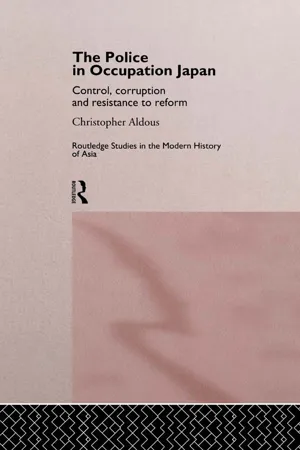
The Police In Occupation Japan
Control, Corruption and Resistance to Reform
- 328 pages
- English
- ePUB (mobile friendly)
- Available on iOS & Android
eBook - ePub
About this book
Many Western commentators have expressed their admiration for the Japanese police system, tracing its origins to the American Occupation of Japan (1945-52).
This study challenges the assumptions that underlie these accounts, focusing on the problems that attended the reform of the Japanese police during the Occupation. Drawing on a wide range of primary sources, Christopher Aldous explores the extent to which America failed in it's goal of 'democratizing' the Japanese police force, arguing that deeply-rooted tradition, the pivotal importance of the black market, and the US's decision to opt for an indirect Occupation produced resistance to reform. His study concludes with a consideration of the postwar legacy of the Occupation's police reform, and touches on a number of recent controversies, most notably the case of Aum Shinrikyo.
Trusted by 375,005 students
Access to over 1.5 million titles for a fair monthly price.
Study more efficiently using our study tools.
Information
Subtopic
Ethnic StudiesIndex
Social Sciences1 Introduction
Any assessment of the health of a country’s political system, its democratic impulses or authoritarian tendencies, finds itself drawn inexorably to the role of the police in that society. The nature of the police system, its raison d’être, has great bearing on any judgement as to whether or not the subject qualifies as a democracy. As Anthony Sampson puts it, ‘[t]he police are inevitably the most visible arm of government …. Relations with the police are everywhere a touchstone of true democracy’.1 Operating at the interface between state and society, the police serve as an instrument of state power, exercising a monopoly of legitimate force; as a mechanism for social control, regulating public behaviour and deterring criminal activity; and, less obviously, as a symbol of stability and continuity, buttressing the status quo against sudden, unpredictable change – so much so that the police institution itself seems peculiarly resistant to change or reform. Indeed, David Bayley, author of numerous works on policing, maintains that ‘police systems exhibit an enormous inertial strength over time; their forms endure even across the divides of war, violent revolution and shattering economic and social change’.2
This tendency is exemplified by the Japanese police in the aftermath of the Pacific War, when, under the aegis of the Allied Occupation of Japan (1945–52), American reformers set about redefining its role, transforming its ethos, even restructuring the system itself. Those involved in the business of Occupation fully understood the significance of the police – they would have recognized the import of Bayley’s assertion that ‘police penetrate society more completely than any other governmental agency’.3 Thus, it is no exaggeration to say that the ‘democratization’ of Japan depended to a large extent on the transformation of this institution. The extraordinary potential of the moment was keenly felt by those involved in carrying out the reform. But what did they achieve? To what extent was the role of the Japanese police altered in line with American views of democratic government? These questions are fundamental to any assessment of the Allied Occupation, given that it was committed to freeing Japanese people from ‘restrictions on freedom of thought, of religion, of assembly and of speech’.4
Thus, it is surprising that there is never more than passing reference to the Japanese police in Western accounts of this period. This can be explained in large part by general attitudes towards both the study of the Occupation itself and the police as an institution. In the case of the former there has been too much concentration on the various factors that informed US policy-making, and too little interest in the impact of reform. A tendency to dwell on the bigger picture, to emphasize the contribution of particular individuals, has led to neglect of more mundane, but ultimately more important, issues, such as the implications of a pervasive black market. For the great majority of the Japanese people their experience of Occupation was coloured more by economic scarcity than anything else – this much is captured by the 1946 election slogan ‘Food Before a New Constitution’.5 Study of the Japanese police, who acted as agents of economic regulation throughout the country, draws attention to the black market, highlighting its significance as a constant force for disruption and subversion of Occupation policies.
The police are examined in this thesis from several angles – from the very different perspectives of the Occupation, the Japanese government and the Japanese people. A comprehensive approach is necessitated by the absence of any rigorous, detailed studies of the police during the Occupation period. This deficiency is explicable in terms of a wider pattern of neglect – for a variety of reasons historians seem reluctant to focus their attention on the police, regardless of the country or period under examination. D. H. Bayley, an authority on police systems, seeks to explain ‘the discrepancy between the importance of the police in social life and the amount of attention given them by scholars’. Disregard for policing, he argues, may derive from its association with ‘forces of control, of conservatism, of the status quo’. More interestingly, he suggests that ‘police are rarely important actors in great historical events …. Their activities are too routine, their presence too pervasive, and their clientele too ordinary to be the stuff of high political drama’.6
It is precisely for these reasons that they are so important during the Occupation. ‘High political drama’ – the machinations of a Yoshida or a Willoughby – must not be allowed to dominate the historical landscape. Just as important were the petty struggles that represented the real stuff of life for most people. By focusing on the police – the interface between government and governed – this book draws attention to developments at all levels of the Occupation. It supplements existing literature on the Japanese police and, indirectly, general studies of the institution itself. More importantly, however, it contributes to an understanding of the Occupation of Japan, adopting a different kind of vantage point in the hope that features hitherto obscured will stand out in sharp relief.
STUDIES OF THE POLICE IN JAPAN AND ELSEWHERE
Recent analyses of the prewar police have not generated sequels. Thanks to the efforts of Richard Mitchell7 and Elise Tipton,8 much is now known about the imperial police and the legal framework within which they operated. The notion of a ‘police state’ – and its applicability to prewar Japan – has been examined by both authors, Tipton accepting the term only after redefinition,9 Mitchell opting for elaboration (‘paternalistic police state’).10 Whilst these studies concentrate on the interwar period, James Leavell and Eleanor Westney have focused on the origins of the modern police system, the former exploring the ‘transition from Tokugawa to Meiji’ (c. 1853–76),11 the latter assessing the relative importance of Western models and indigenous influences.12 Westney examines the postal system and newspapers as well as the police, investigating each institution with reference to ‘cross-societal emulation’. Her seventy-page chapter represents the only substantial analysis of the Meiji police written in English. In marked contrast to the interwar period, the years before the First World War and immediately after the Second World War have been largely disregarded as far as the police are concerned. The Occupation period does not even merit a chapter in a book.
English-language studies of the postwar police first appeared in the 1970s.13 Written by American social scientists, they generally reflected admiration for Japan’s success in reducing crime in the face of increasing urbanization.14 D. H. Bayley places Japan’s police system within a comparative framework, analysing the cultural, social and political determinants of police work and its effectiveness. Detailed studies of the police systems of India, the USA and Japan,15 together with periods of research in Britain, France and Norway, culminated in a comparative work that examines ‘relations between police and society – the ways in which each affects the other’.16 Although Bayley provides a useful theoretical/conceptual framework, his analysis of the historical development of Japan’s police system is sketchy. The same can be said of the works of Walter Ames and Craig Parker.17 In fairness to them all, their subject is police studies rather than Japanese history. Nevertheless, their conclusions are still important for the student of Occupation Japan. As Bayley explains, ‘the police are not self-created; they are tied to the social units from which they derive authority’.18 These social units survived the shocks of defeat and Occupation – the way they functioned during the Occupation would not have been very different from the way they function today.
Comparison with other countries that were occupied after the Second World War may reveal some general truths about the impact of defeat and Occupation on an indigenous police force. Were other police systems as durable as that of Japan? Are there features peculiar to police organization that make it impervious to change? In Germany and Korea, both subject to direct rule by the Allied powers, indigenous police forces were neither supplanted nor transformed.19 With regard to the British zone in West Germany the Foreign Office regarded a reliable police force as an essential ‘instrument of Military Government’. As a result, ‘the German police force was [only] half denazified’.20 In the case of South Korea, the American chief of the Police Division saw no reason why policemen trained by the Japanese should not be retained: ‘We felt that if they did a good job for the Japanese, they would do a good job for us. It would be unfair to drive men trained by the Japanese out of the force’.21 Given that the Occupation of Japan was ‘indirect’ – the Japanese Government was responsible for implementing American directives – it can be supposed that the Japanese police force was even less susceptible to reform than its Korean and German counterparts.
THE JAPANESE POLICE AND THE AMERICAN OCCUPATION
English-language studies of the Japanese police during the American Occupation are confined to a few articles in periodicals22 and one short piece in a collection of essays.23 These sketch in the outlines of the pre-surrender police, discuss the impact of the Occupation and then highlight the retreat from decentralization. There is a sense in which the Occupation is nothing more than a temporary irritation for the Japanese police, an interlude between defeat and reconsolidation. The strict division between local and national jurisdictions, formalized in 1948, lasted barely three years: ‘A succession of legislative revisions beginning in 1951 and culminating in 1954, … succeeded in recentralizing the police system …‘.24 Developments affecting the police are generally examined in the light of the Police Law of December 1947. This is in keeping with most studies of the Occupation, Japanese and American scholars preferring to examine the process of policy formation – the influences that informed it – rather than the more mundane business of administration.25
The most recent study of the Occupation period by Richard Finn26 typifies the tendency among Western historians to focus on individuals – in this case MacArthur and Yoshida – with a view to assessing their relative importance. At the same time they seem concerned to highlight and explain the changing balance of power between Washington and Tokyo and its effects on policy-making. Finn’s book is atypical in the sense that it surveys the Occupation as a whole rather than examining a specific aspect,27 but its principal conclusions can be located in a well-established historiographical framework. Finn describes ‘waves of reform’ and then moves on to the evolution of ‘new policies and new directions’, indicating acceptance of the conventional outline of the Occupation – a progressive phase followed by a period of reassessment. The latter is described as a ‘second phase’ or, less charitably, as a ‘reverse course’, depending on the politics of the writer. Regardless of the designation chosen, this change of direction cannot be ignored. The police were affected by it as were other important actors in the Occupation drama (for example, the labour unions, the zaibatsu, and conservative politicians).
Justin Williams dismisses the concept of a reverse course as ‘that idée fixe of sympathizers with radical socialism in Japan … ‘,28 whereas John Dower incisively defines it as ‘the shift of Occupation priorities from democratization of a former enemy to reconstruction of a future cold-war ally …’.29 Divergent views, representing ‘orthodox’ and ‘revisionist’ schools of interpretation, tend to obscure a common focal point, namely policy – the principal participants in its creation together with its various determinants. The orthodox line tends to concentrate on early social and political reforms, equating the passage of progressive legislation with benign motives on the part of the Americans.30 Concluding his book on a positive note, Finn encapsulates the orthodox interpretation:
Whatever historians say about ‘feudal survivals’ or ‘reverse course’, few people would disagree that Japan today is democratic, peaceful and prosperous. Th...
Table of contents
- Cover
- Half Title
- Title Page
- Copyright Page
- Dedication
- Table of Contents
- List of Figures and Tables
- Acknowledgements
- Conventions
- List of Abbreviations
- 1 Introduction
- 2 Foundations
- 3 The Consequences of Defeat
- 4 Guardians of the People
- 5 Serving the Old Guard
- 6 Allies of Military Government
- 7 ‘Immediate and Final Decentralization’
- 8 Towards Recentralization
- 9 Conclusion
- Epilogue
- Notes
- Bibliography
- Index
Frequently asked questions
Yes, you can cancel anytime from the Subscription tab in your account settings on the Perlego website. Your subscription will stay active until the end of your current billing period. Learn how to cancel your subscription
No, books cannot be downloaded as external files, such as PDFs, for use outside of Perlego. However, you can download books within the Perlego app for offline reading on mobile or tablet. Learn how to download books offline
Perlego offers two plans: Essential and Complete
- Essential is ideal for learners and professionals who enjoy exploring a wide range of subjects. Access the Essential Library with 800,000+ trusted titles and best-sellers across business, personal growth, and the humanities. Includes unlimited reading time and Standard Read Aloud voice.
- Complete: Perfect for advanced learners and researchers needing full, unrestricted access. Unlock 1.5M+ books across hundreds of subjects, including academic and specialized titles. The Complete Plan also includes advanced features like Premium Read Aloud and Research Assistant.
We are an online textbook subscription service, where you can get access to an entire online library for less than the price of a single book per month. With over 1.5 million books across 990+ topics, we’ve got you covered! Learn about our mission
Look out for the read-aloud symbol on your next book to see if you can listen to it. The read-aloud tool reads text aloud for you, highlighting the text as it is being read. You can pause it, speed it up and slow it down. Learn more about Read Aloud
Yes! You can use the Perlego app on both iOS and Android devices to read anytime, anywhere — even offline. Perfect for commutes or when you’re on the go.
Please note we cannot support devices running on iOS 13 and Android 7 or earlier. Learn more about using the app
Please note we cannot support devices running on iOS 13 and Android 7 or earlier. Learn more about using the app
Yes, you can access The Police In Occupation Japan by Christopher Aldous in PDF and/or ePUB format, as well as other popular books in Social Sciences & Ethnic Studies. We have over 1.5 million books available in our catalogue for you to explore.