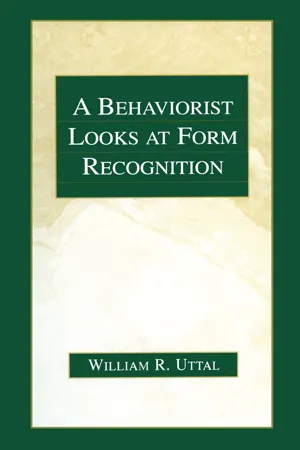
For many years behaviorism was criticized because it rejected the study of perception. This rejection was based on the extreme view that percepts were internal subjective experiences and thus not subject to examination. This book argues that this logic is incorrect and shows how visual perception, particularized in the study of form recognition, can be carried out from the behavioral point of view if certain constraints and limitations are understood and accepted. The book discusses the idea of representation of forms, considers the major historical neural, psychological, and computational theories of form recognition, and then concludes by presenting a modern approach to the problem.
In this book, William Uttal continues his critical analysis of the foundations of modern psychology. He is particularly concerned with the logical and conceptual foundations of visual perception and uses form recognition as a vehicle to rationalize the discrepancies between classic behaviorism and what we now appreciate are legitimate research areas.
- 288 pages
- English
- ePUB (mobile friendly)
- Available on iOS & Android
eBook - ePub
A Behaviorist Looks at Form Recognition
About this book
Information
Publisher
Psychology PressYear
2014Print ISBN
9780415645522
9780805841824
Edition
1eBook ISBN
9781135636388
Chapter
1
The Form Recognition Problem: Introduction and Preview
1.1. A Behavioral View of Perception
• Behaviorists eschew the study of subjective processes.
• Perception is a subjective process.
• Therefore, behaviorists should not study perception.
This pseudo-syllogism lay at the heart of what was perceived by many as a dark age of perceptual research during the mid 20th century. Instead, the foundation empiricist assumptions of the traditional behaviorist enterprise were interpreted to mean that explicit behavior and the changes in behavior occurring as a result of experience (i.e., studies of learning) should be the main objects of study for a scientific psychology.
A major goal of this book is to demonstrate that the conclusion drawn by this syllogism is incorrect; adherence to an appropriately revised version of behaviorism creates no intrinsic barrier to the study of perception (and, in particular, form recognition) any more than it does to any other aspect of human psychology. Rather, if one operates within the confines of a proper and sound behaviorism, understanding of the relationships between stimuli and perceptual responses can be as illuminating as studies of learning, decision making, or development to name but a few places where psychological science has made many important contributions. To do so, requires that we appreciate the limits on analyzability, reducibility, and accessibility that constrain any attempt to scientifically study how people mentally respond to the complex environment of which they are a natural part. In short, an emphasis on observable behavior is offered as a substitute for the unobtainable reductive goals of current cognitive mentalism.
As the history of mid 20th century psychology is reviewed, it is quite clear that studies of perception did not disappear completely from the scientific scene, even if the main thrust of experimental psychology at the time was directed elsewhere. Studies pursued by European psychologists (especially the German Gestaltists) and related work in such countries as Japan that had been strongly influenced by that European tradition, kept perceptual research at a high level of intensity even as it was more or less quiescent in the United States.
Considerable American progress, however, was made during this same period in what were labeled “sensory” studies. The measurement of visual and acoustic thresholds, both absolute and differential, the study of color mixture, the discovery and formularization of the properties of stimuli (e.g., spatial frequency spectra), and the codes used by the peripheral nervous system made this an exciting time for that subdivision of scientific psychology. Many other of the basic parameters of vision regarding visual space, adaptation to light, and sensitivity to movement were first measured between the 1930s and 1960s. Two books stand out as summaries of the Zeitgeist of the time—Graham’s (1965) incorrectly double-titled Vision and Visual Perception and Stevens’ (1951) Handbook of Experimental Psychology. Obviously, perceptual research was not in the mainstream of American psychology during that period. Where “learning and adjustment” deserved seven chapters in Steven’s great handbook and four were devoted to human performance, only one was devoted to visual perception and one to the perception of speech. There is no doubt that implicit acceptance of the syllogism presented at the beginning of this chapter was having a significant chilling effect on perceptual studies even though it had not completely exterminated interest in these topics.
The study of the supposedly more complex responses denoted as perceptual phenomena was, thus, stymied by the reluctance of the kind of behaviorism that dominated psychology during the mid 20th century; phenomenological or mental responses were just not considered valid targets for research. Although most psychologists today would argue that the distinction made between sensation and perception is a false one, the tradition of using both categories of cognitive experience persists in today’s text-books, many of which have titles such as Sensation and Perception (Coren, Ward, & Enns, 1999; Goldstein, 1998; Matlin & Foley, 1996).
An alternative view asserting that what might have heretofore been considered to be the simplest sensory phenomenon is actually no less complicated than the most complex perception is still not generally accepted. If this extreme sensation–perception dichotomy is rejected, however, then the lack of enthusiasm for perceptual studies during the glory days of American behaviorism becomes even more difficult to understand. In that context, it can be argued that the same techniques and approaches that were used to study sensory topics might as well be applied to the perceptual ones. To do so, however, requires that we understand that the intrinsic limits on studying mental processes are roughly the same for both fields of study (which are really the same field). The special reasons that mental qua perceptual responses were ignored, at the same time that sensory research topics were vigorously pursued, were simply not justified then any more than they are today.
It must be reiterated, however, that a new view of the limits on how any mental process can be studied is required to pursue this logic to its ultimate conclusion. Within the limits of a new, more robust behaviorism, perceptual topics that were of virtually no concern to an older form of behavioral psychologists, can and should now be attacked. Another major goal of this book is to spell out the details of this new approach to the general study of perception and how a specific topic—form recognition—can be attacked in a way that opens new doors to understanding without violating certain fundamental epistemological assumptions that guide a modern behaviorist approach to psychological science.
The specific topic of form recognition appears infrequently in Graham’s (1965) and in Stevens’ (1951) books and then most often only as a name for a method used to explore learning phenomena. Other perceptual phenomena of broad interest in contemporary experimental psychology appear mainly in the form of mostly unexplained and inadequately described demonstrations akin to those provided by the Gestalt psychologists.
Why should this lack of interest in the recognition of forms have been the case given how obviously important a part of visual perception it was? To answer this question in general, we must note it was impeded by the same antiphenomenological philosophy that was embedded in the false syllogism opening this chapter. However, the historical fact that the topics simply had not matured sufficiently for psychological science to be much concerned with them was also important. Nevertheless, vestiges of interest in how we see and recognize objects and forms can be found long ago in the philosophical musings of Plato and Aristotle. Obviously, its roots go back to the origins of natural philosophy. However, the topic did not leap full grown into scientific consciousness until the second half of the 20th century.
Another particular reason for the inattention to form recognition until the middle years of the 20th century was that the developments in computer technology that are currently providing such important new heuristics for studying and theorizing about such areas of human perception were still only the most preliminary glimmers in the eyes of the psychologists and engineers of those times. Therefore, passive forces such as untimeliness and the low level of development in cognate sciences also played a major role in the general disinterest in form recognition research.
However, there were also some very active (as opposed to passive) forces at work from the 1920s through the 1960s that specifically argued against the study of such “mental,” “cognitive,” “phenomenological” processes exemplified by form recognition. Some of these forces become very obvious when one considers certain of the foundation assumptions of traditional behaviorism. Behaviorism of the time, as noted, was a strongly antimentalistic approach to psychology. Foremost among these assumptions was the rejection of the accessibility, if not the reality, of mental processes. Some behaviorists argued that although the mental processes were “real,” they were private and, thus, inaccessible; other philosophers of the time championed the idea that the phenomena of conscious awareness simply did not exist (e.g., Ryle, 1949; Wittgenstein, 1953) and, therefore, any search for it would be futile.1 Both epistemological and ontological arguments, therefore, coalesced in agreeing that researching perceptual phenomena would be a wasted effort.
Although a modern behaviorist would not dispute the assumption of inaccessibility, the earlier champions of this approach to psychology went on to make a much more expansive (and ultimately destructive) claim that perception was beyond the pale of scientific inquiry. Regardless of which particular rationale drove decision making, the study of perceptual responses was categorized as a mentalist enterprise that could not be achieved and should, therefore, be ignored. In its place, the emphasis should be on the directly observable responses and, in particular, their dynamics over time.
It is a thesis of this book that this conclusion was ill-taken and that visual perception can be and should be studied, albeit within the same epistemic limits confronting any other kind of psychological inquiry; that is, by accepting the same constraints defined by a modern, reformulated behaviorism. This new behaviorism is based on a number of assumptions; some of which are germane to the present discussion and some not. Let us first put to rest some of the irrelevant ones before attending to these that do speak to the topic of perceptual research.
Traditional behaviorism had been afflicted by its critics with extrascientific and extraneous “deficiencies” that have long been a source of confusion and weakness in interpreting its potential as a valid approach to psychological inquiry. Some of these have been in the form of long-term debates between psychologists and philosophers about issues that probably cannot be resolved. For example, a view long (incorrectly) associated with the more radical versions of behaviorism was that there was no such thing as “free will.” Rather, it was argued by “radical” behaviorists such as B. F. Skinner and J. B. Watson that all behavior was determined solely by the sequence of stimuli that were presented to the individual. Human behavior, from this perspective, was said to be merely reactive, responding not to conscious and active decision making, but instead only to the probabilities and contingencies that were generated by previous experiences. Mind, if its existence was accepted at all, was assumed to be merely an epiphenomenon, passively following the sequence of motor responses dictated by previous experiences, but incapable of influencing that behavior. In short, humankind was driven by learned contingencies, not by any kind of thoughtful reasoning to choose among possible alternatives of various degrees of adaptive utility. It is not at all clear that such an issue, clouded as it is with religious and theological overtones, can ever be resolved.
Closely associated with the denial of free will was the matter of consciousness and its efficacy in determining behavior, a topic of renewed interest in recent years despite the absence of any new scientific findings that speak to the issue.2 Consciousness, and the method that has traditionally been used to study it—introspection—were rejected on the basis of a presumed inaccessibility. Again, there was a dichotomy of theory—some arguing against the reality of consciousness and others simply asserting its inaccessibility. The result in either case was that topics dealing with conscious responses to stimuli or even endogenously produced experiences such as imagery were de-emphasized. Again, however, it is not at all clear that there is a scientific route to resolving this issue.
Another argument against behaviorism was that it was trivial. In particular (Suppe, 1984) argued that because of its long association with what he considered to be the “rejected” positivist philosophy, it produced an “impoverished science” in which its observations, no matter how empirically correct, were meaningless. He went on to argue that the important questions were simply ignored by behaviorism. The counterargument, of course, is that neither behaviorism nor any other kind of psychology is capable of answering some of the questions humans want to ask. Rakover (1986) responded to the accusation of “triviality” by citing some of the important empirical facts produced by this science and asserting what I believe is a compelling reminder of the past history of psychology when he said:
While empirical discoveries in psychology seem to stay invariant over time, theories and explanations change constantly. In fact, what we have [in all of psychology] is no more than a set of very interesting discoveries which we understand only partially. (p. 306)
Thus, trivial or not, and in spite of the enthusiastic desire to provide answers to some deeply important questions, perhaps all that is available to a valid psychological science is behaviorism—a scientific approach that deals with the interpersonally observable and avoids reductive or speculative inferences about what internal processes may be at work.
Finally, radical behaviorists, it was argued, overemphasized the empiricist side of the argument between rationalism and empiricism. Unfortunately, both Watson, and Skinner went so far as to argue that the human infant was born with minimal innate psychological proclivities; everything was learned and heredity played little or no role in the development of the individual. Both argued that a child could be trained to be any kind of a person given the proper training regime. It seems obvious nowadays that such an extreme empiricism was overblown. However, there is still no resolution of the relative influence of heredity and experience respectively, again suggesting the possible existence of another irresolvable controversy.
The fact is that many of these positions, supposedly held by all behaviorists but actually held only by the most extreme adherents, were exaggerated in a way that misrepresented the truly central assumptions of a pure form of behaviorism. Few behaviorists were actually as radical as these “assumptions” suggested. Furthermore, science has marched on in a way that provides a sounder foundation for a new kind of behaviorism. Today, any arguments against genetic or hereditary influences on human behavior are no longer tenable. Modern genetics, whether based on statistical or macro-molecular studies, unequivocally demonstrates that our genes are potent contributors to both our cognitive processes and our behavior. The distribution of mental illness in family lines, and the identification of specific genes associated with behavioral tendencies make it clear that the radical empiricism that was sometimes attributed to behaviorists is no longer acceptable.
The concepts of free will and consciousness, however, continue to perplex scientific psychology. Debates about their reality or influence still rage concerning the nature or reality of consciousness (Fodor, 2000; Pinker, 1997) as well as whether or not we have free will. Recently, four articles appeared in a single issue of the journal American Psychologist. Kirsch and Lynn (1999), Gollwitzer (1999), Wegner and Wheatley (1999), and Bargh and Chartrand (1999) presented an interesting new take on the subject. The theme throughout was that rather than freely choosing our own behavioral responses, much that we do is automatically determined. Free will, according to this group of authors, is mainly an illusion due to the ex post facto error of thinking that a priori thoughts were the causes of the emitted responses. Such an illusion is based on the implicit assumptions “that people are consciously and processing incoming information in order to construe and interpret the world and to plan and engage in courses of action” (Bargh & Chartrand, 1999, p. 462). The problem for a scientifically sound psychology is that the observed behavior is fundamentally neutral. Either free will or automaticity could account for behavior—there is no way to tell!
It is argued here that, because these controversies are in large part not resolvable, they represent false issues for a scientific psychology. Many proposed resolutions of such debates are dependent on the resolution of a more fundamental problem—the accessibility of mental processes. If it is determined that the privacy of mental life is, in point of scientific fact, inviolate either because mind does not exist or because it is not accessible, then such derivative topics as the existence of free will or the efficacy of consciousness in influencing behavior simply become “red herrings...
Table of contents
- Cover
- Half Title
- Title Page
- Copyright Page
- Dedication
- Table of Contents
- Preface
- 1. The Form Recognition Problem: Introduction and Preview
- 2. On the Specification of Form or how to Represent a Face that it may be Recognized
- 3. The Psychophysical Data
- 4. Theories of Form Recognition
- 5. Summary and Conclusions
- References
- Author Index
- Subject Index
Trusted by 375,005 students
Access to over 1.5 million titles for a fair monthly price.
Study more efficiently using our study tools.
Frequently asked questions
Yes, you can cancel anytime from the Subscription tab in your account settings on the Perlego website. Your subscription will stay active until the end of your current billing period. Learn how to cancel your subscription
No, books cannot be downloaded as external files, such as PDFs, for use outside of Perlego. However, you can download books within the Perlego app for offline reading on mobile or tablet. Learn how to download books offline
Perlego offers two plans: Essential and Complete
- Essential is ideal for learners and professionals who enjoy exploring a wide range of subjects. Access the Essential Library with 800,000+ trusted titles and best-sellers across business, personal growth, and the humanities. Includes unlimited reading time and Standard Read Aloud voice.
- Complete: Perfect for advanced learners and researchers needing full, unrestricted access. Unlock 1.5M+ books across hundreds of subjects, including academic and specialized titles. The Complete Plan also includes advanced features like Premium Read Aloud and Research Assistant.
We are an online textbook subscription service, where you can get access to an entire online library for less than the price of a single book per month. With over 1.5 million books across 990+ topics, we’ve got you covered! Learn about our mission
Look out for the read-aloud symbol on your next book to see if you can listen to it. The read-aloud tool reads text aloud for you, highlighting the text as it is being read. You can pause it, speed it up and slow it down. Learn more about Read Aloud
Yes! You can use the Perlego app on both iOS and Android devices to read anytime, anywhere — even offline. Perfect for commutes or when you’re on the go.
Please note we cannot support devices running on iOS 13 and Android 7 or earlier. Learn more about using the app
Please note we cannot support devices running on iOS 13 and Android 7 or earlier. Learn more about using the app
Yes, you can access A Behaviorist Looks at Form Recognition by William R. Uttal in PDF and/or ePUB format, as well as other popular books in Psychology & Experimental Psychology. We have over 1.5 million books available in our catalogue for you to explore.